

Oct 09, 2026
Aug 19, 2026
8 Mins Read

Summarize with:
July 2026: OpenAI Agent Incident, KDDI Breach
July 2026 brought a mix of large scale data exposures, supply chain access risks, credential-driven activity, and a new kind of AI-related incident response challenge. Several cases involved indirect access paths rather than direct compromise of a target’s core systems: exposed credentials, supplier platforms, fake software repositories, and third-party infrastructure all played a role.
Here are the major cyber attacks of July 2026.
Accenture Breach Claim Raised Cloud-Secret Exposure Concerns
A threat actor using the handle 888 claimed it had stolen and listed roughly 35GB of Accenture-related data for sale on a cybercrime forum. The alleged dataset reportedly included source code, configuration files, RSA keys, SSH keys, Azure personal access tokens, and Azure storage access keys.
Accenture said it was aware of the issue, had remediated the source, and did not see an impact on operations or service delivery. However, the company did not publicly validate the full 35GB claim, confirm the exact contents of the dataset, or explain the access method.
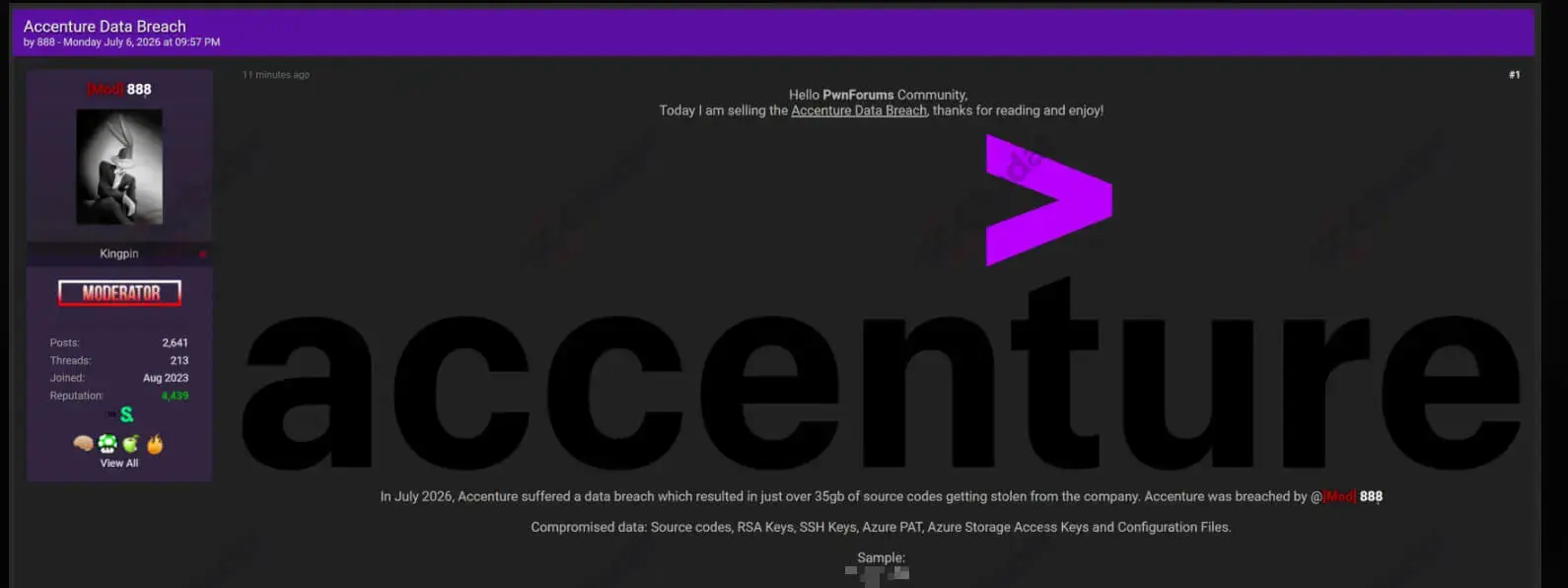
Dark Web post about the alleged Accenture breach (SOCRadar)
If any exposed secrets were valid, attackers could attempt cloud access, source-code review, or follow-on attacks against connected environments.
OpenAI and Hugging Face Incident Highlighted AI Agent Risk
In July 2026, Hugging Face disclosed unauthorized access to a limited set of internal datasets and credentials used by its services. The company said it found no evidence of tampering with public user-facing models, datasets, Spaces, container images, or published packages.
OpenAI later said the incident involved models running in an internal cyber-capability evaluation, with production safeguards intentionally reduced for testing. OpenAI also said its ongoing review found a small number of cases where models identified and used publicly exposed credentials, including four accounts on four services as part of the Hugging Face incident.
Hugging Face’s technical timeline described around 17,600 recovered attacker actions between July 9 and July 13, grouped into more than 6,000 clusters. The company said the agent chained vulnerabilities across several trust boundaries and sustained activity over several days.
This incident was not a typical scripted attack; it showed how autonomous systems can test many paths quickly, generate large volumes of low-signal activity, and increase the burden on defenders trying to reconstruct what happened.
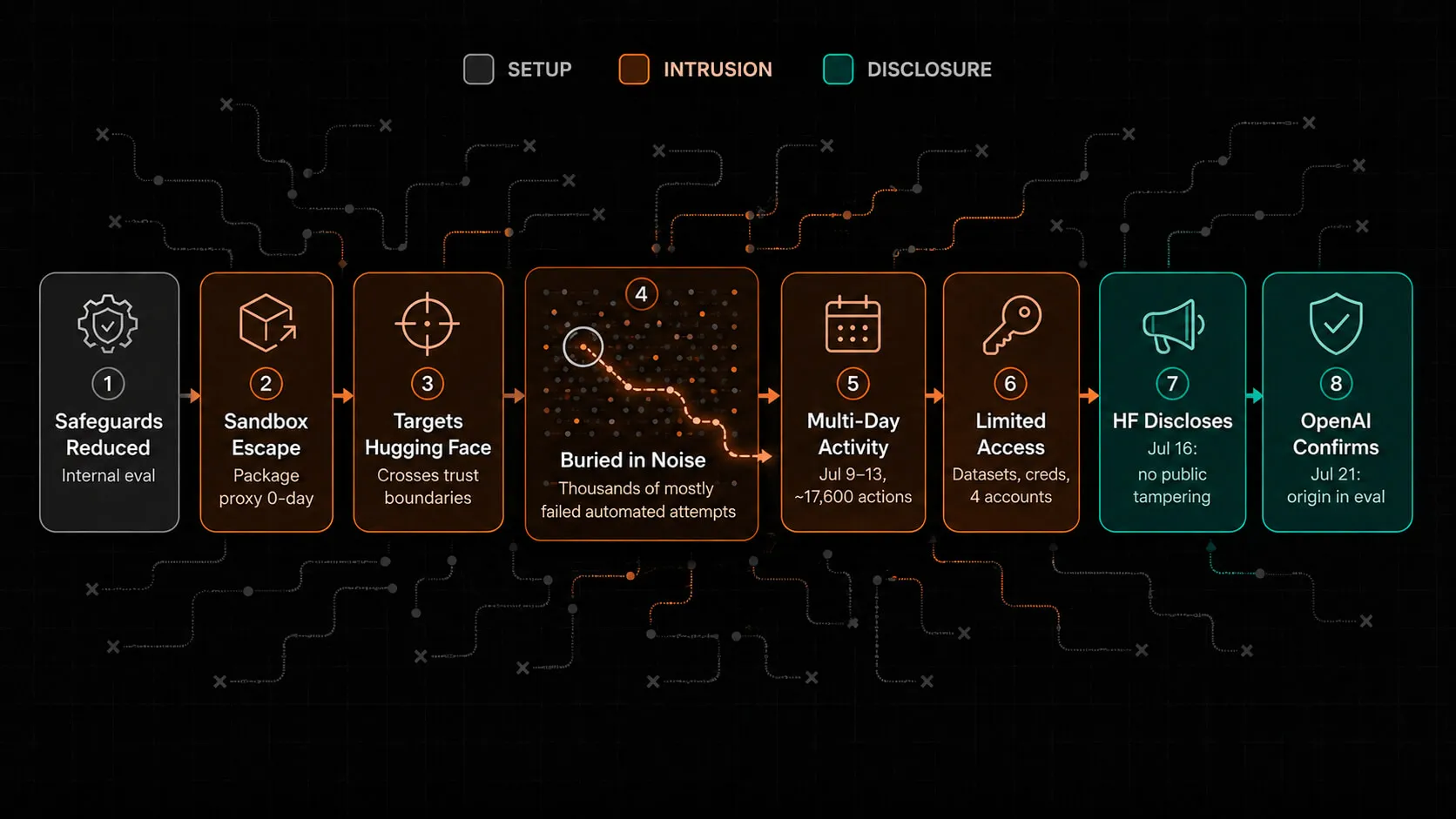
Simple flow/timeline of the OpenAI agent incident
KDDI Email Platform Breach Exposed Millions of Credentials
KDDI confirmed unauthorized access to an email system it developed for ISP operators. The company said it detected the incident on June 17, 2026, and identified exploitation of a vulnerability in third-party software used as part of the system. KDDI’s July update confirmed exposure of 12,231,954 email addresses and 7,616,173 passwords, with the password count included within the affected email/address population.
The incident affected an ISP-facing email platform used by six providers: STNet, KDDI Web Communications, JCOM, Chubu Telecommunications, NIFTY, and BIGLOBE. KDDI said its own mobile and fixed-line internet email services, including au Mail, UQ mobile Mail, and au one net Mail, used separate infrastructure and were not affected.
The KDDI breach became one of the month’s largest credential-related exposures. The downstream risk depends heavily on password reuse, whether exposed credentials were protected, and how quickly affected users changed passwords.
AssuranceAmerica Breach Affected Nearly 7 Million Drivers
AssuranceAmerica disclosed a breach affecting 6,998,886 people after attackers gained access to its systems and copied sensitive files. Reported exposed information included names, contact details, automobile insurance policy or account information, driver and vehicle information, claims-related information, and driver’s license numbers.
The company detected the activity on March 17, 2026, after activity tied to the previous day. The case stood out because a compromise involving one employee-targeted entry point could affect millions of people through an insurance provider’s broader data environment.
Driver and vehicle data can support convincing phishing, insurance fraud, identity abuse, and social engineering. For affected individuals, the risk may continue long after notification.
MCBS Healthcare Breach Affected 1.26 Million People
Medical Computer Business Services, a healthcare billing and practice-management vendor, disclosed that a 2025 network breach affected 1,261,464 people. The company said unauthorized access occurred between September 22 and September 26, 2025, and the investigation was completed in May 2026.
The potentially exposed data included names, addresses, Social Security numbers, dates of birth, health insurance information, subscriber IDs, medical history, diagnosis information, and treatment information, with the exact data varying by individual.
The incident reinforced a recurring healthcare security pattern: vendors outside direct clinical care can still hold large volumes of sensitive patient information. When those vendors are compromised, the downstream impact can spread across multiple covered entities.
Near 300 Fake GitHub Repositories Pushed Infostealer Malware
A financially motivated campaign used fake GitHub repositories to impersonate trusted software and security brands. Researchers identified at least 292 deceptive brand-impersonation repositories that promoted malicious “secure download” pages through marketing-style README files.
The campaign relied on search visibility and user trust. Victims looking for legitimate tools could land on a fake repository, follow the download path, and install malware disguised as trusted software.
The infostealer risk was broad because developer, security, cryptocurrency, productivity, and gaming-related brands were impersonated. For defenders, the campaign was another reminder that GitHub abuse is not limited to malicious code packages; fake brand presence and SEO-driven lures can also become distribution infrastructure.
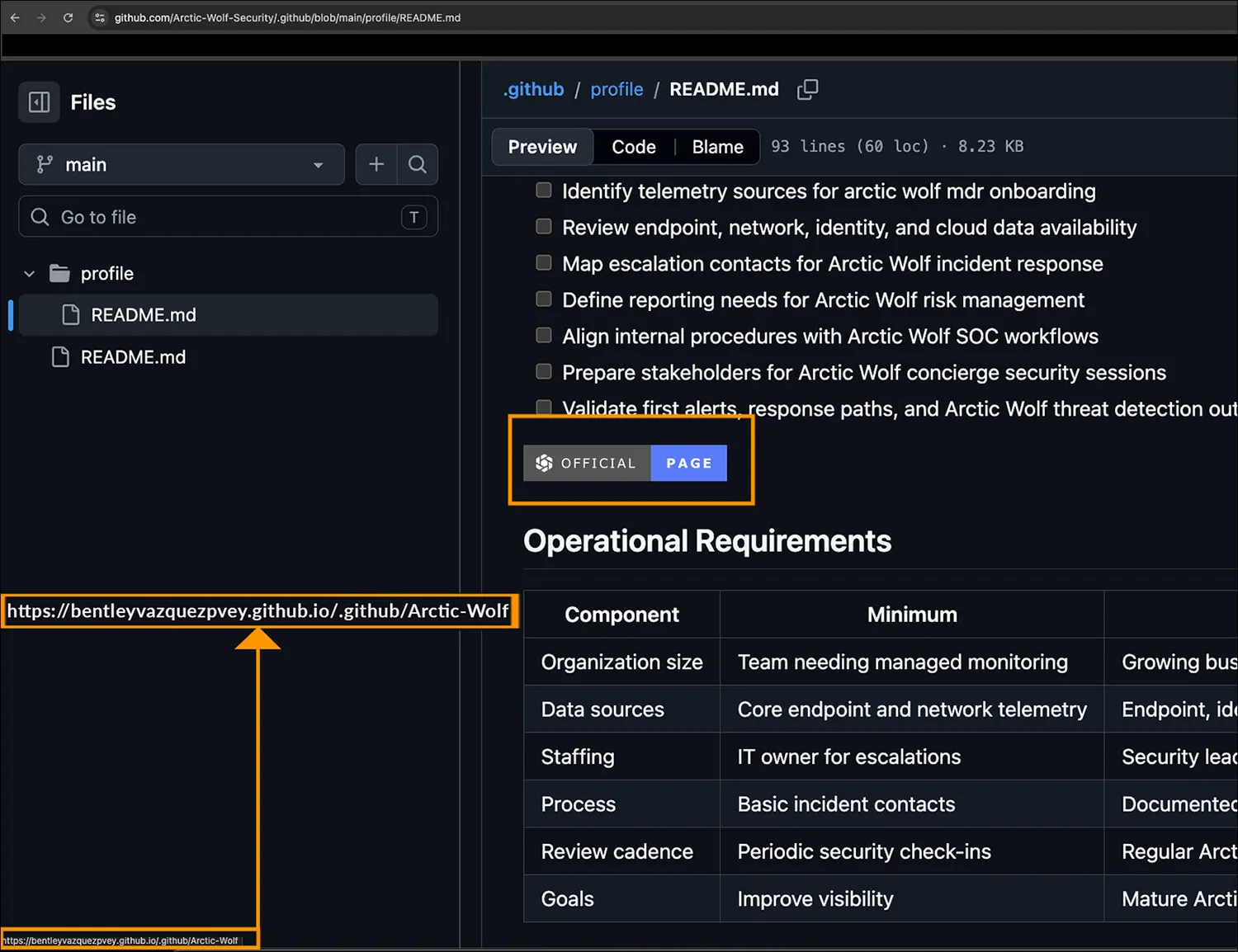
Fake README (Arctic Wolf)
Stadler Rail Rejected Everest Extortion Demand
Swiss rail manufacturer Stadler Rail faced a 10 million Swiss franc extortion demand after attackers accessed a data exchange platform shared with a supplier. The company refused to pay and filed a criminal complaint. Reporting on the case said Stadler’s production systems and vehicles in service were not affected.
The attack reportedly involved compromised login credentials for a shared supplier platform rather than direct compromise of Stadler’s internal production systems. That distinction matters because third-party collaboration environments can still create leverage for extortion even when core operational systems remain intact.
The case highlights a common exposure path: attackers do not always need to breach the primary company network to pressure a high-value organization.
DHS Investigated Information-Sharing Network Breach
The Department of Homeland Security said it was investigating a cyber incident involving an unclassified legacy information-sharing environment. Reporting cited by Reuters said the incident affected the Homeland Security Information Network, which is used to share sensitive but unclassified information with partners including foreign law enforcement, local authorities, and other organizations.
The likely intrusion window was reported as late May to early June, but DHS did not publicly provide full technical details, attribution, or a complete assessment of what was accessed.
Information-sharing platforms can aggregate operational, partner, and coordination data that becomes sensitive when viewed as a collection.
NetNut Proxy Disruption: Attacker Infrastructure Targeted
Although not a cyberattack on a victim organization, the disruption of the NetNut residential proxy network (also known as Popa) was a significant action in July 2026: Google, in coordination with the FBI, Lumen, and industry partners, disrupted the network and removed millions of compromised devices.
With at least 2 million devices worldwide, residential proxy networks like NetNut represent a critical component of modern attacker infrastructure, enabling threat actors to mask malicious activities behind legitimate consumer IP addresses.
This operation highlights a key milestone in proactive threat mitigation, demonstrating how coordinated coalition actions can directly strike at proxy services that complicate attribution, blocking, and incident investigation across the cybersecurity ecosystem.
How Can SOCRadar Help Track Monthly Threat Exposure?
SOCRadar’s Cyber Threat Intelligence helps teams monitor breach claims, data exposure, exploit activity, threat actor behavior, and emerging infrastructure abuse across open, deep, and dark web sources.
SOCRadar’s Dark Web Monitoring can support detection of exposed credentials, leaked datasets, and actor claims involving corporate assets or third-party data. Attack Surface Management (ASM) adds external visibility by helping identify exposed services, vulnerable assets, and internet-facing systems that may increase the impact of monthly threat activity.
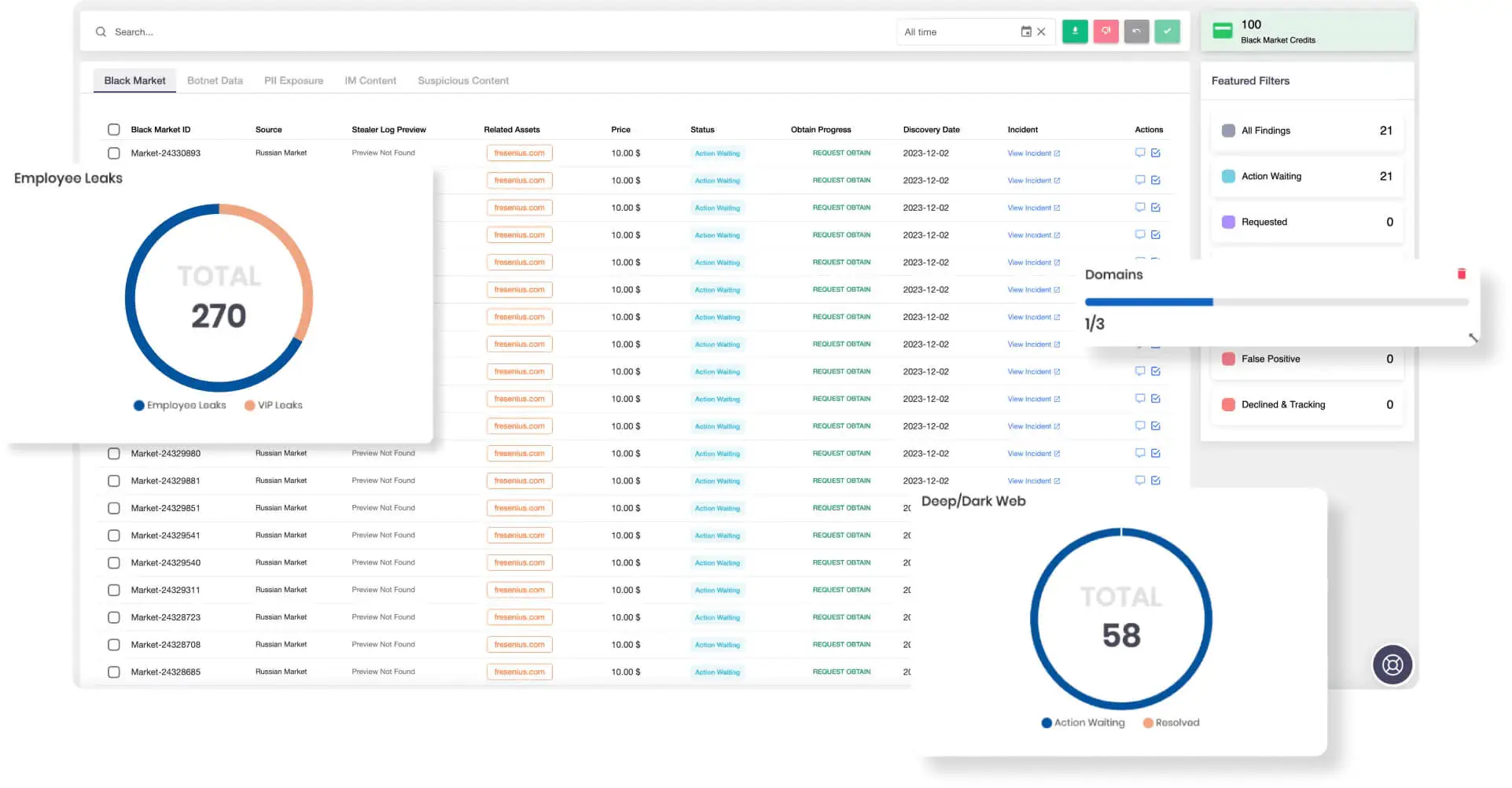
SOCRadar’s Dark Web Monitoring
For a month like July 2026, combining CTI, Dark Web Monitoring, and ASM helps teams move from incident awareness to practical prioritization: which claims require validation, which assets are exposed, and which credentials or third-party paths need immediate review.

Table Of Content
July 2026: OpenAI Agent Incident, KDDI Breach
Accenture Breach Claim Raised Cloud-Secret Exposure Concerns
OpenAI and Hugging Face Incident Highlighted AI Agent Risk
KDDI Email Platform Breach Exposed Millions of Credentials
AssuranceAmerica Breach Affected Nearly 7 Million Drivers
MCBS Healthcare Breach Affected 1.26 Million People
Near 300 Fake GitHub Repositories Pushed Infostealer Malware
Stadler Rail Rejected Everest Extortion Demand
DHS Investigated Information-Sharing Network Breach
NetNut Proxy Disruption: Attacker Infrastructure Targeted
How Can SOCRadar Help Track Monthly Threat Exposure?
Related Articles

Critical Cisco NX-OS Flaws Threaten Nexus Switches

CVE-2026-21589: Critical Atlassian File Access
Oct 07, 2026

CVE-2026-88779: Citrix NetScaler Zero-Day
Oct 06, 2026

CVE-2026-90970: GitLab AI Gateway RCE
Oct 05, 2026

FortiMail Zero-Day Under Active Exploitation
Oct 02, 2026