

Oct 07, 2026
Dec 05, 2025
19 Mins Read
Jul 08, 2026

Summarize with:
Microsoft Digital Defense Report 2025: 10 Key Lessons for Security Leaders
If you work in security or technology leadership, 2025 probably feels like the year everything went “always on, always under attack.” Intrusion attempts are now a constant background condition, not an exceptional event – and the Microsoft Digital Defense Report 2025 makes that painfully clear.
What makes this report worth paying attention to is its vantage point. Microsoft sits on top of billions of sign-ins, endpoint signals, cloud alerts, and threat intel across virtually every region and sector. That gives this report less of a “theory of the threat landscape” feel and more of a flight recorder from the global security ecosystem.
A few themes stand out:
- Cyber risk is business risk. Ransomware on a single shipping company can threaten global trade. Credential theft in one hospital can ripple across an entire health system. These are board-level concerns, not IT housekeeping issues.
- Identity is the new perimeter. The majority of attacks now start not by “breaking in” but by logging in with stolen or abused identities.
- AI is now on both sides of the table. Attackers are using it to scale phishing, fraud, and social engineering. Defenders are using it to spot anomalies, close detection gaps, and automate response.
- Resilience is the new differentiator. The question has shifted from “Can we prevent every breach?” to “Can we detect, contain, and recover fast enough to keep doing business?”
In the rest of this article, we will unpack 10 key lessons from the Microsoft Digital Defense Report 2025 and translate them into practical moves for security leaders.
The 2025 Cyber Threat Landscape: Who’s Being Hit and How
Before we talk defense, it’s worth asking a blunt question: who is actually getting hit the most right now?

The Geography of Risk
Microsoft saw attacks cluster heavily in a relatively small group of countries. The United States alone accounts for nearly a quarter of observed attacks (24.8%), with the United Kingdom (5.6%), Israel (3.5%), and Germany (3.3%) following behind. A second tier of targets – including Ukraine, Canada, Japan, India, the UAE, and Australia/Taiwan – each sits in roughly the 2–3% range.
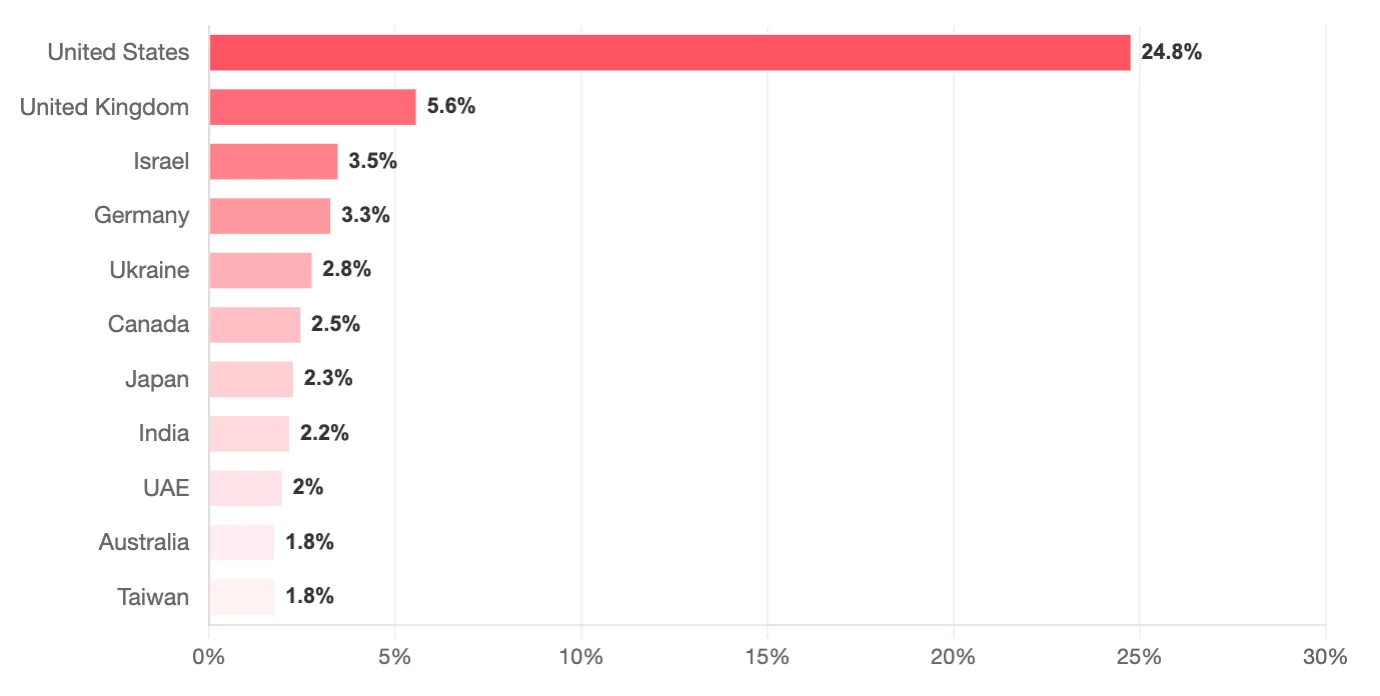
Countries most impacted by cyber threats (January – June 2025)
This doesn’t mean other regions are “safe” – it means highly digitized, globally connected economies are taking the brunt of the activity. If your organization is based in one of these countries, or depends on suppliers there, your exposure is higher whether you like it or not.
The Sectors Attackers Favor
Across all that activity, a clear pattern emerges in who gets targeted:
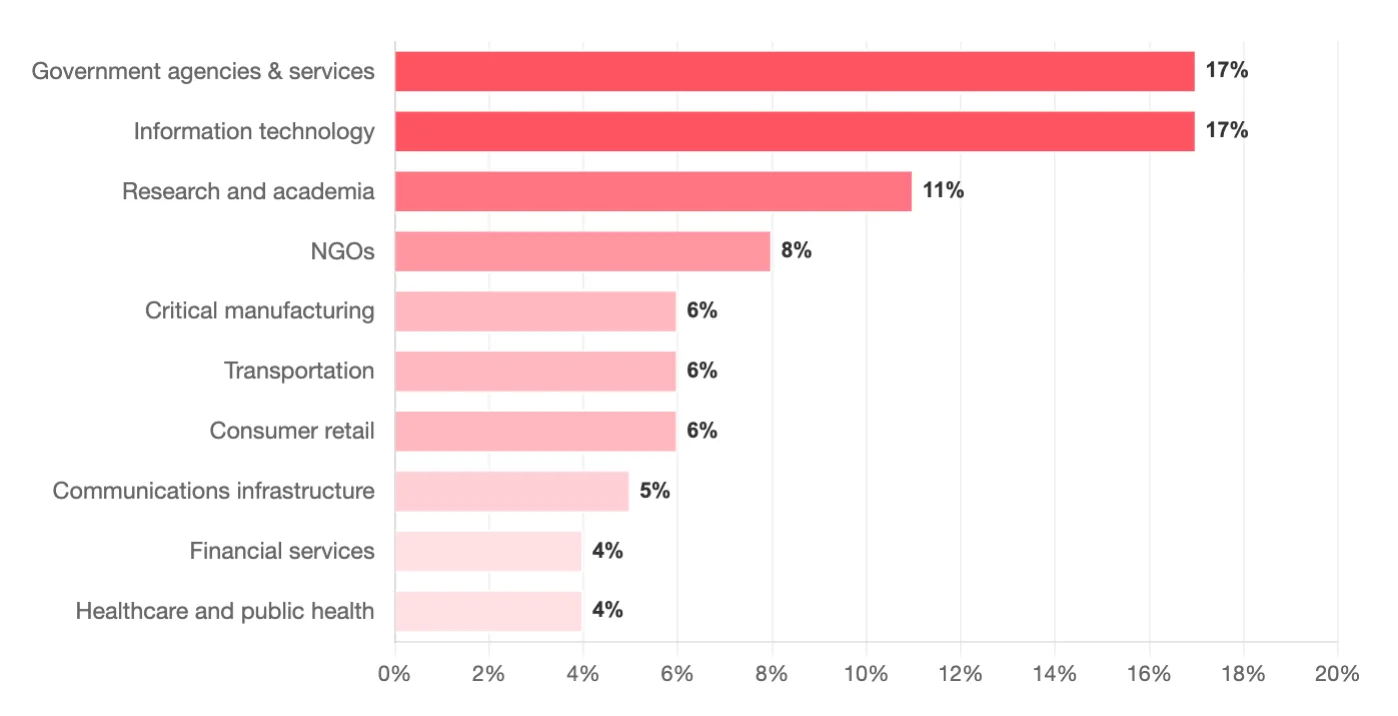
Sectors most impacted by cyber threats
Government (17%) and IT (17%) sit at the top for obvious reasons: they are gateways to everything else. They run critical public services and hold the “good stuff”: PII, tax and voting records, sensitive research, IP.
Research and academia deserve special mention. Microsoft describes them as a strategic incubator: attackers test advanced techniques in universities and labs, then port them to “hardened” targets like governments, defense, and critical infrastructure. In identity-based attacks alone, research and academia account for a disproportionate share of compromises in 2025.
What Are Attackers’ Objectives
When Microsoft’s incident response teams could determine attacker objectives, the breakdown looked like this:
When Microsoft could determine attacker intent, most activity was about money: data theft (37%) and extortion (33%) dominate, with destruction / human-operated ransomware (19%) not far behind.
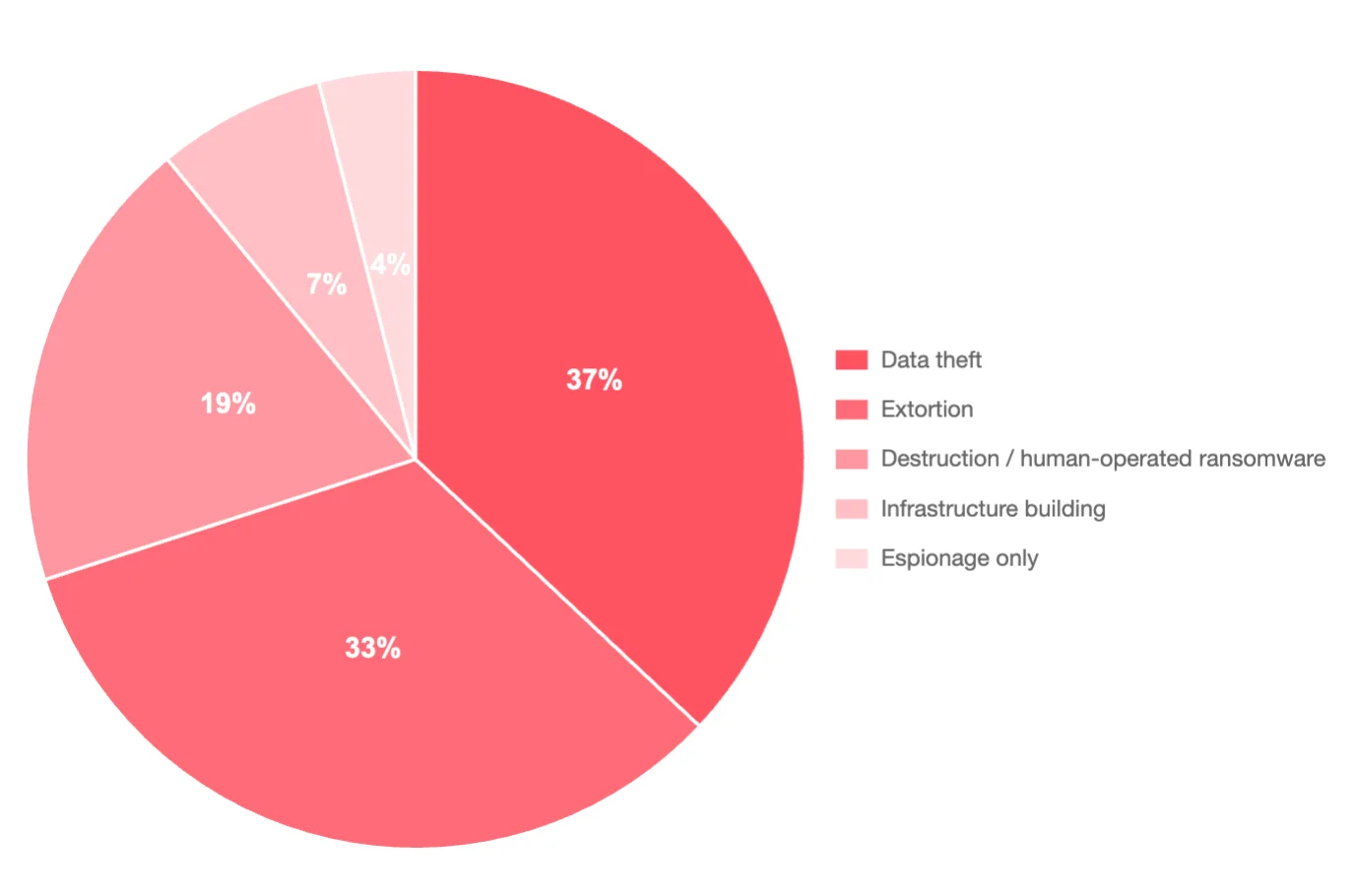
So roughly 70% of activity is about money (data theft + extortion). Pure espionage is real but comparatively rare in the telemetry.
The sleeper risk is “infrastructure building”. In 7% of cases, attackers weren’t primarily interested in the victim at all – they were co-opting that organization’s infrastructure to attack others. You can end up both a victim and an unwitting accomplice.
Taken together, the picture is pretty clear:
- If you run critical services,
- operate in a highly connected economy, or
- sit in research/IT roles that bridge into other sectors,
you’re not just on the list; you are the list.
Lesson 1: Make phishing-resistant MFA non-negotiable.
Microsoft’s data from early 2025 shows:
- >97% of identity attacks are password spray or brute force.
- “Fancy” techniques (token theft malware, adversary-in-the-middle, consent phishing, attacks on MFA infrastructure) together are <3% of attacks.
- Modern MFA reduces identity compromise risk by more than 99%.
Identity-based attacks rose 32% in the first half of 2025, likely helped by AI-crafted lures. In investigations where outcomes were clear, Business Email Compromise (BEC) showed up more often than ransomware (21% vs. 16%), which underlines that identity is now the primary path to financial fraud as well as disruption.
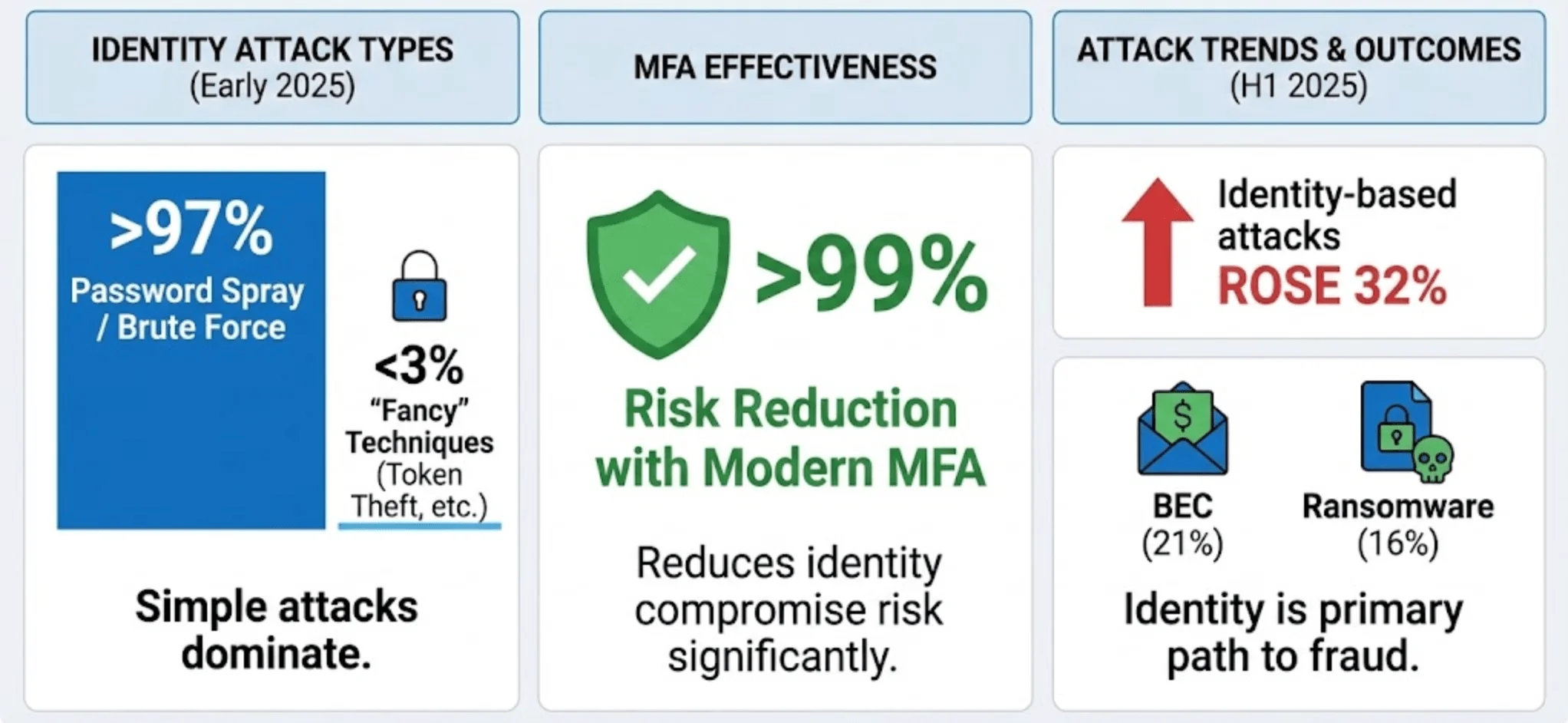
2025 identity attack trends
What security leaders should do:
- Enforce MFA for every account – staff, admins, vendors, executives.
- Prioritize phishing-resistant methods (FIDO2, passkeys, platform authenticators) for high-value accounts.
- Treat “users without MFA” as a risk register item, not a backlog oddity.
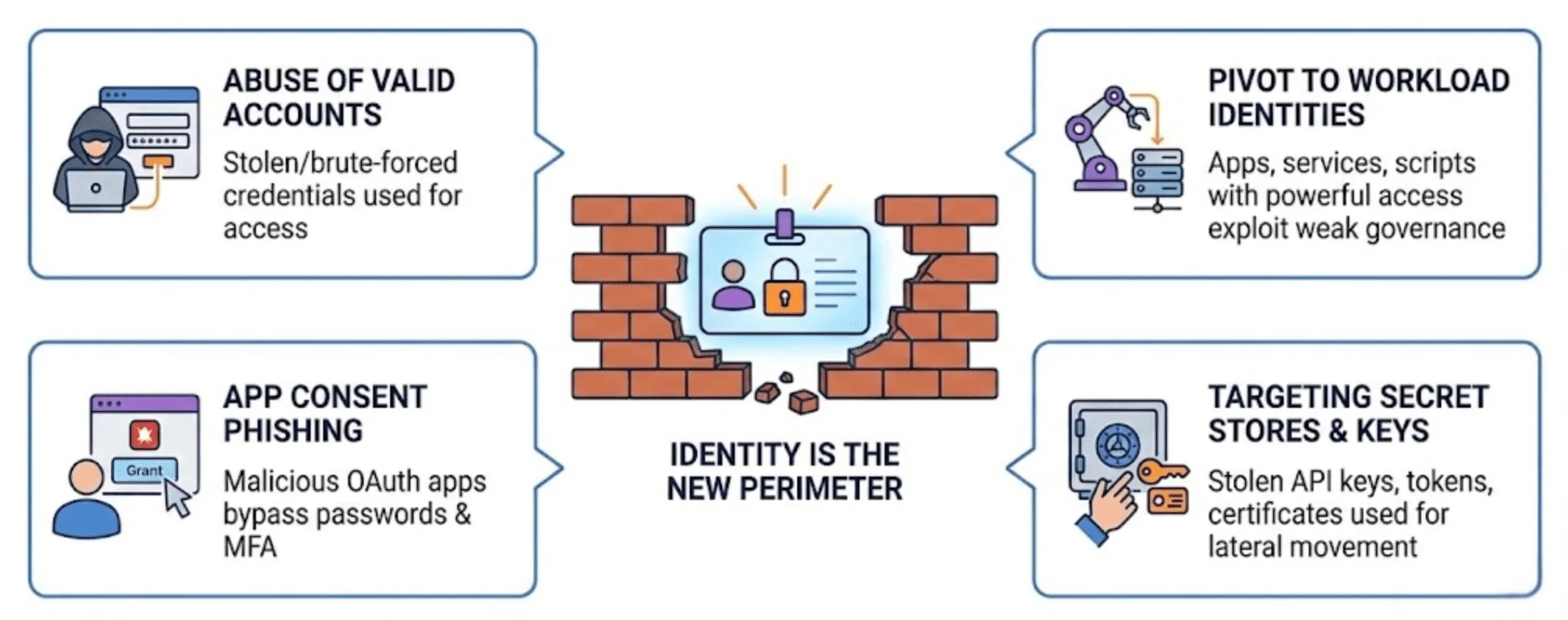
Lesson 2: Treat identity as your new perimeter.
The report shows it clearly: hackers don’t hack, they log in. Common tactics now include:
- Abuse of valid accounts via stolen or brute-forced credentials.
- Pivoting to workload identities – apps, services, and scripts with powerful access and weak governance.
- App consent phishing: users are lured into authorizing malicious OAuth apps whose permissions survive password resets and bypass MFA.
- Targeting secret stores and key vaults, then using stolen API keys, tokens, and certificates for lateral movement and privilege escalation.
What security leaders should do:
- Build an identity inventory: users, service principals, apps, automations, and third-party access.
- Enforce least privilege and review elevated roles regularly.
- Monitor app consents, secrets, and key vault access with the same rigor you apply to domain admins.
Lesson 3: Assume your credentials are already leaked.
Password spray remains cheap and effective at scale:
- Just 20 autonomous systems (about 0.04% of all ASNs) account for 80%+ of malicious spray activity.
- In one campaign across 12.2 million accounts:
- Only 1.5% of login attempts used correct credentials – and were blocked by MFA.
- About 45% were “valid username, wrong password,” showing how widely usernames are exposed.
- A May 2025 comparison with Have I Been Pwned found 85% of usernames targeted in spray attacks already appeared in leaks, each on average in three separate breach logs.
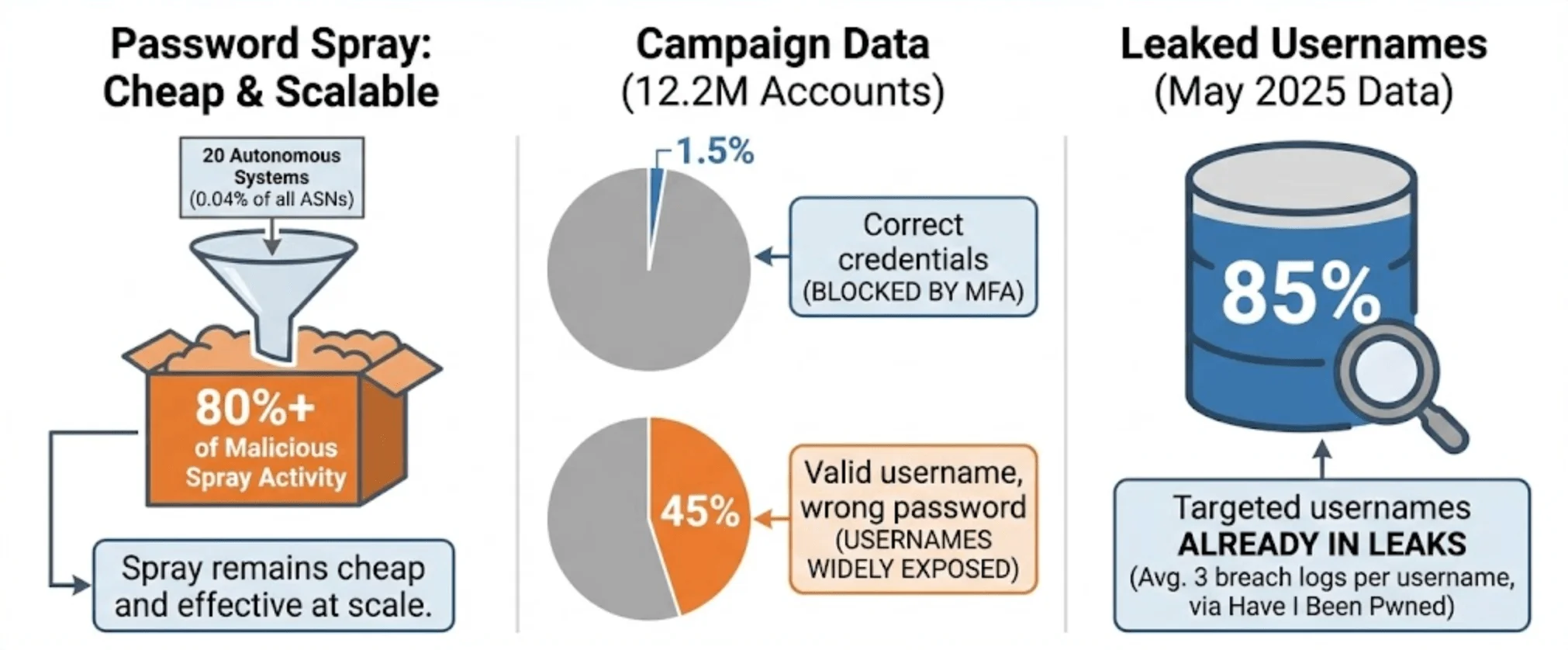
2025 credential attacks & leaks trends
What security leaders should do:
- Enforce strong, unique passwords and deploy banned-password/password-filter policies.
- Use breach data and detection tools to spot reused or leaked credentials.
- Regularly audit and disable stale accounts, which are soft targets in spray and replay attacks.
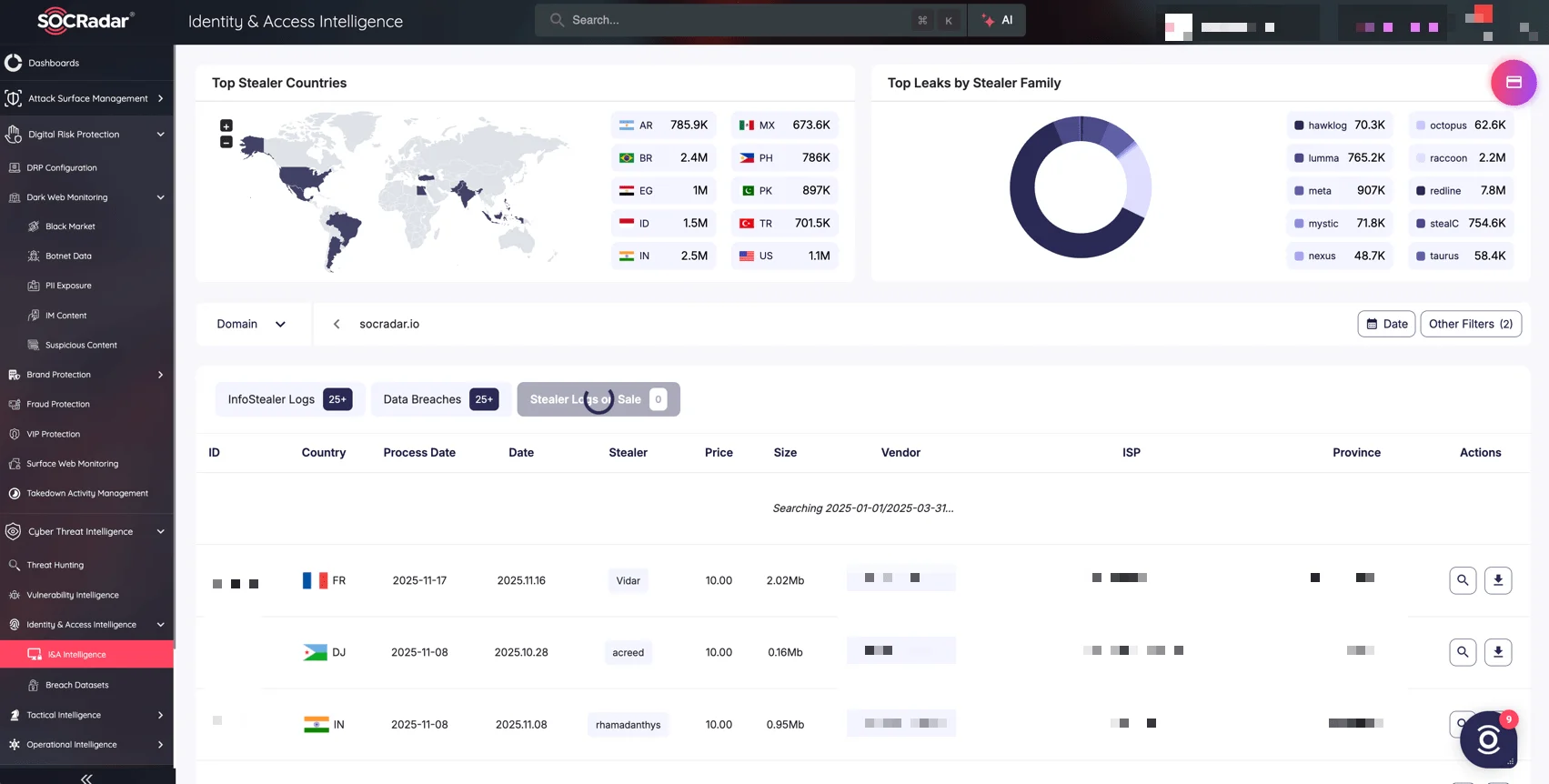
SOCRadar Identity & Access Intelligence
If you want to operationalize that “assume leak” mindset, solutions like SOCRadar’s Dark Web Monitoring and Identity & Access Intelligence can help by continuously tracking infostealer logs, credential dumps, and access-broker listings for your domains and VIP users. Instead of guessing whether your accounts are in the wild, you get concrete, timely alerts you can feed straight into your identity protection workflows.
Lesson 4: Patch fast – especially at the edge.
Exposed edges are still the easiest way in. Microsoft’s incident response data shows a big slice of attacks still begin with:
- Perimeter web-facing assets (public apps, portals, APIs).
- External remote services (VPN, RDP, remote support tools).
- Supply chain paths (vulnerable third-party software and MSPs).
Attackers rapidly weaponize known CVEs, chain exploits in tools like SimpleHelp, BeyondTrust, Fortinet, Cleo, and Apache Tomcat, and go “straight for the code” instead of relying on users to click. Ransomware crews and botnets simply scan for whatever is unpatched and exposed.
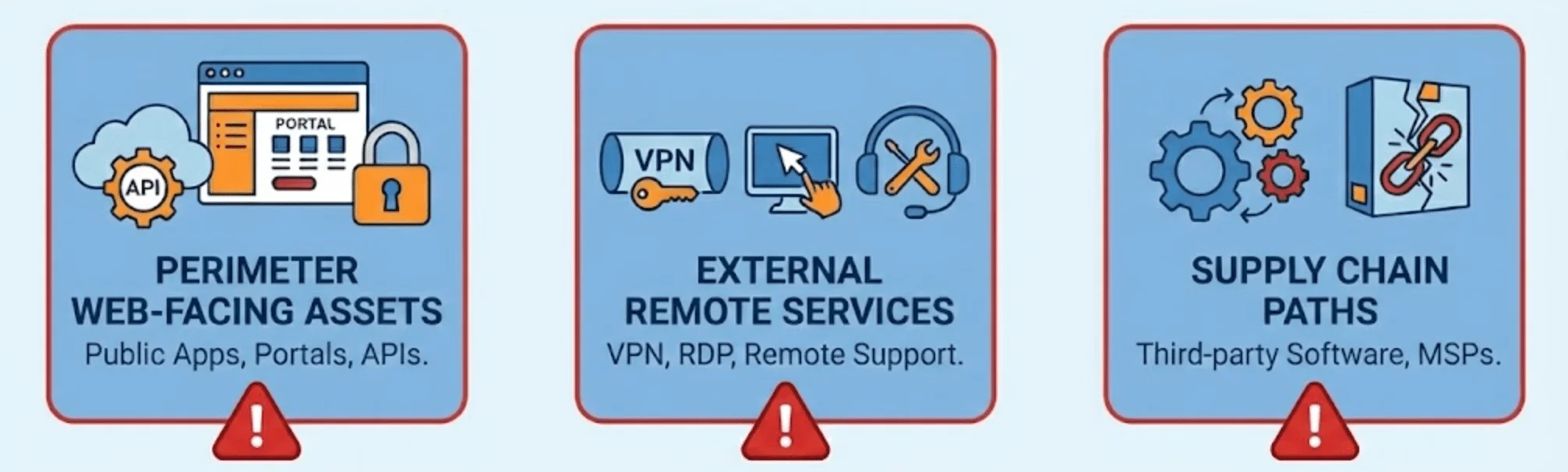
Where do most cyberattacks begin?
What security leaders should do:
- Maintain a living map of internet-facing assets and remote access tools.
- Set aggressive SLAs for patching and configuration hardening on those assets.
- Isolate management interfaces and RMM tools to VPN-only or dedicated admin networks.

Lesson 5: Upgrade your fraud and social engineering defenses.
AI is rewiring the fraud economy. The report puts hard numbers behind the AI shift:
- AI-automated phishing emails hit 54% click-through, vs 12% for standard phishing (4.5× more effective).
- AI can make some phishing operations up to 50× more profitable by scaling targeted attacks.
- Between April 2024–April 2025, Microsoft blocked USD 4 billion worth of fraud and scams, many AI-assisted.
- Anti-fraud systems now block about 1.6 million bot or fake account sign-ups per hour, and in the first half of 2025, >90% of 15.9 billion account creation requests came from bad bots.
- Use of AI-generated IDs grew 195% globally, and deepfakes are increasingly used for identity proofing and tech-support scams.
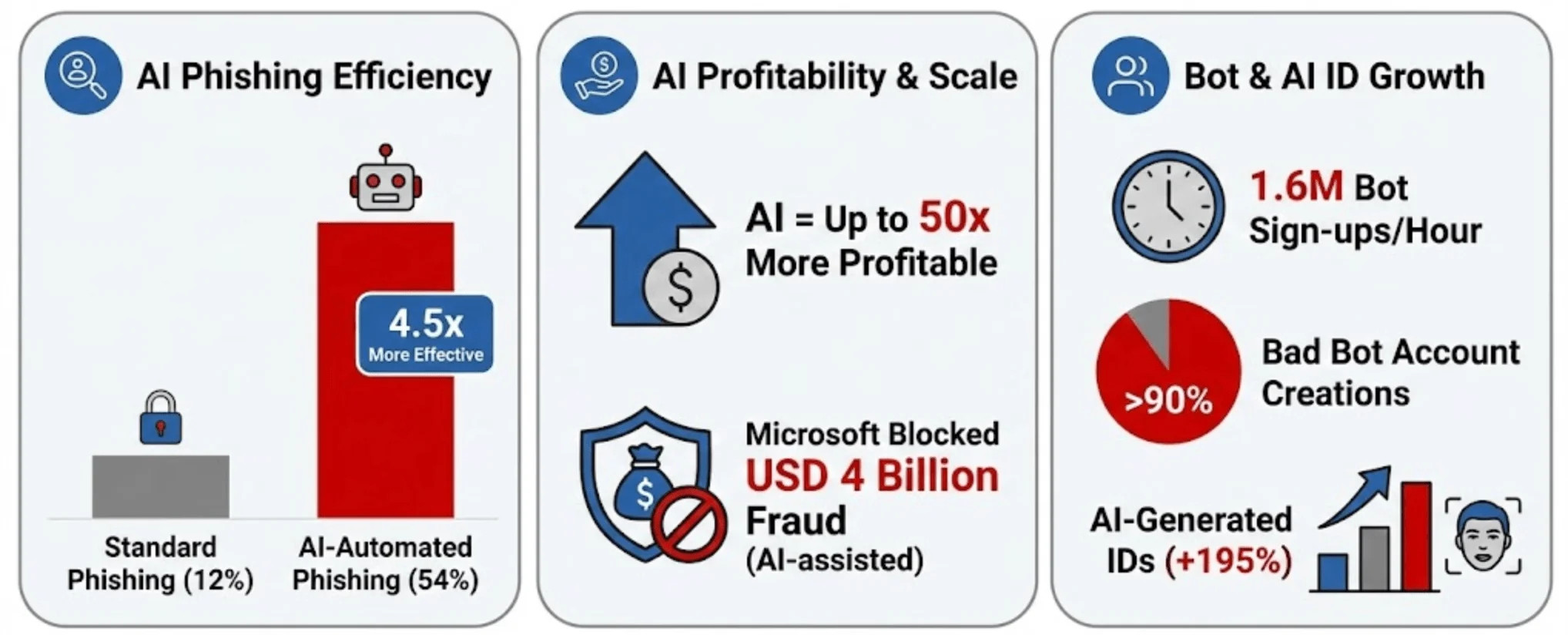
2025 AI-assisted phishing & fraud trends
New Social Engineering Chains You Must Assume
Attackers are moving beyond “bad link in bad email” to multi-step plays:
- ClickFix – Users are tricked into copying a command from a fake pop-up or message into Win+R or a terminal. In late 2024–2025 it became the most common initial access technique in Defender Expert notifications, accounting for 47% of cases.
- Email bombing + fake IT support – Attackers flood inboxes with subscriptions to hide real alerts, then call or message via Teams pretending to be support and walk users through installing remote tools or Quick Assist.
- Device code phishing – Users are persuaded to enter a device code into what looks like a legitimate portal, handing attackers access and refresh tokens without any password theft. 93% of observed events happened in the last half-year, showing explosive growth.
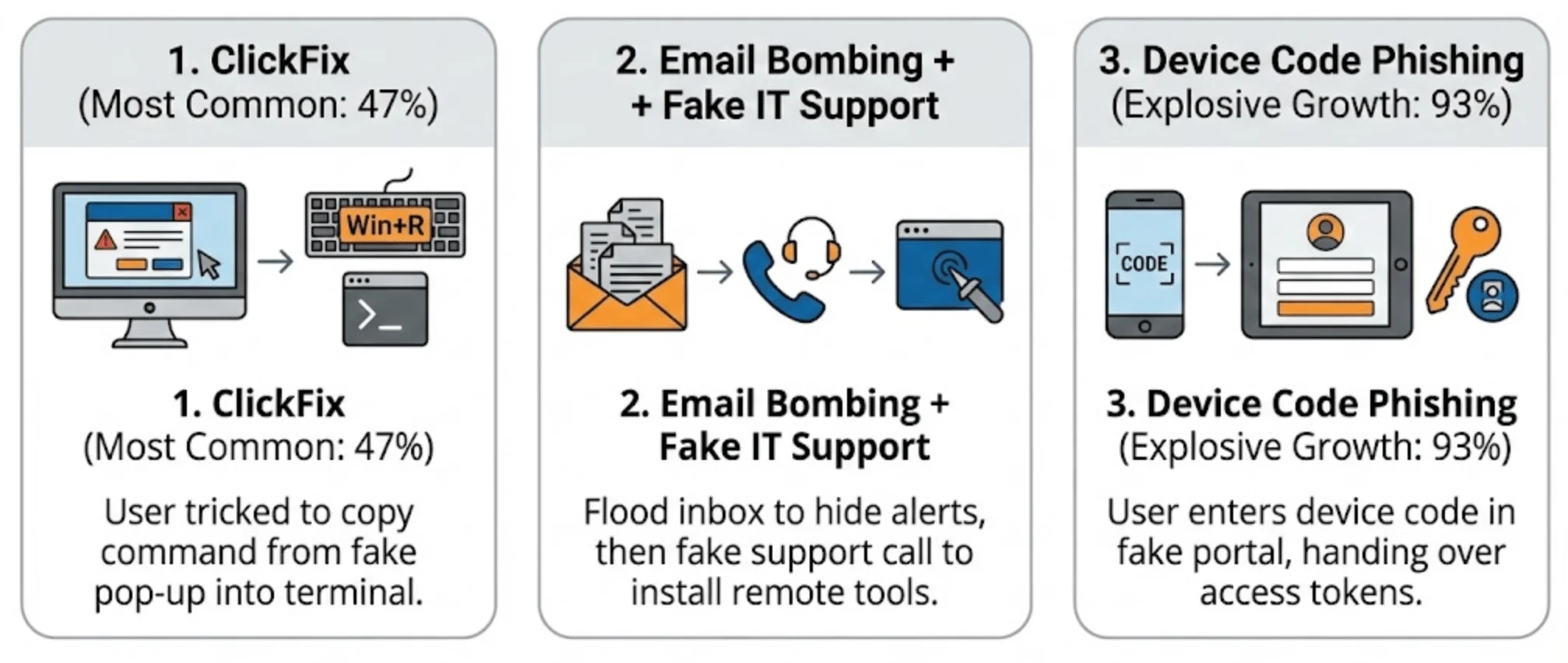
Beware of these social engineering tactics that dominated 2025: ClickFix/FileFix, Email Bombing & Fake Support, Device Code Phishing
What security leaders should do:
- Deploy bot and proxy detection, and tighter checks on account sign-ups and high-risk flows.
- Build specific playbooks for ClickFix, email bombing + fake IT, and device code phishing, not just generic “phishing.”
- Train users that pasting commands or launching remote tools on request is as risky as clicking suspicious links.
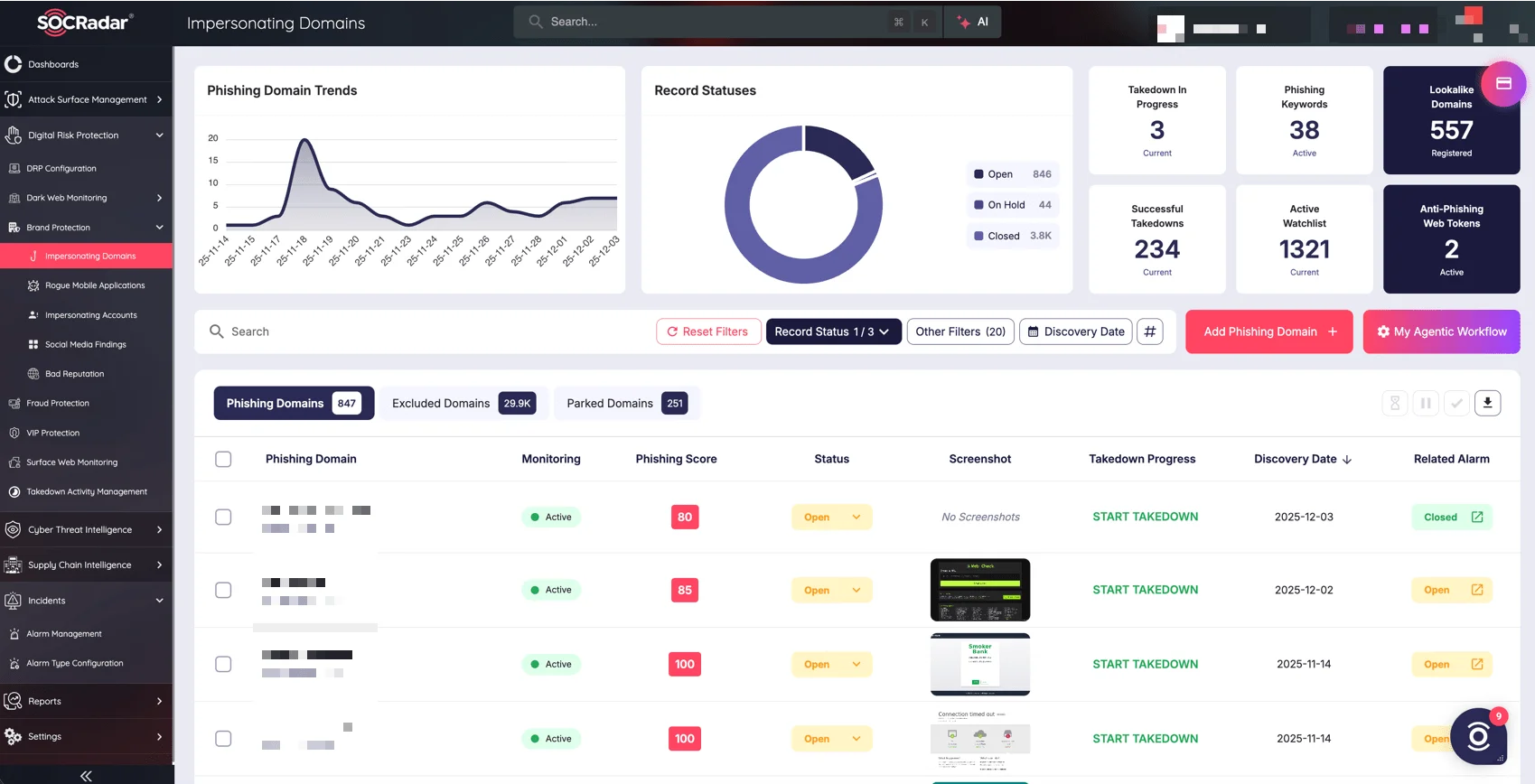
SOCRadar’s Brand Protection, Impersonating Domains
This is also where dedicated brand protection pays off. SOCRadar’s Brand Protection module can monitor for lookalike domains, fake login pages, rogue mobile apps, and abusive social profiles that sit at the very front of fraud and phishing chains. Getting proactive alerts on those assets gives you a chance to block, take down, or warn users about scams before your customers or employees ever see them.
Lesson 6: Put AI to work for detection and response.
Here’s how defenders are already using AI:
- LLMs digest threat intel and internal telemetry, extracting kill chains and common TTPs far faster than humans.
- Models map top threats to MITRE ATT&CK, and map existing detections to the same framework to highlight coverage gaps.
- AI can help author detections, from simple rules to correlation logic and behavioral models, and translate them into SIEM/XDR query languages.
- Agentic red teaming uses autonomous AI agents to simulate multi-stage attacks, stress-testing the entire detection portfolio instead of a single rule.
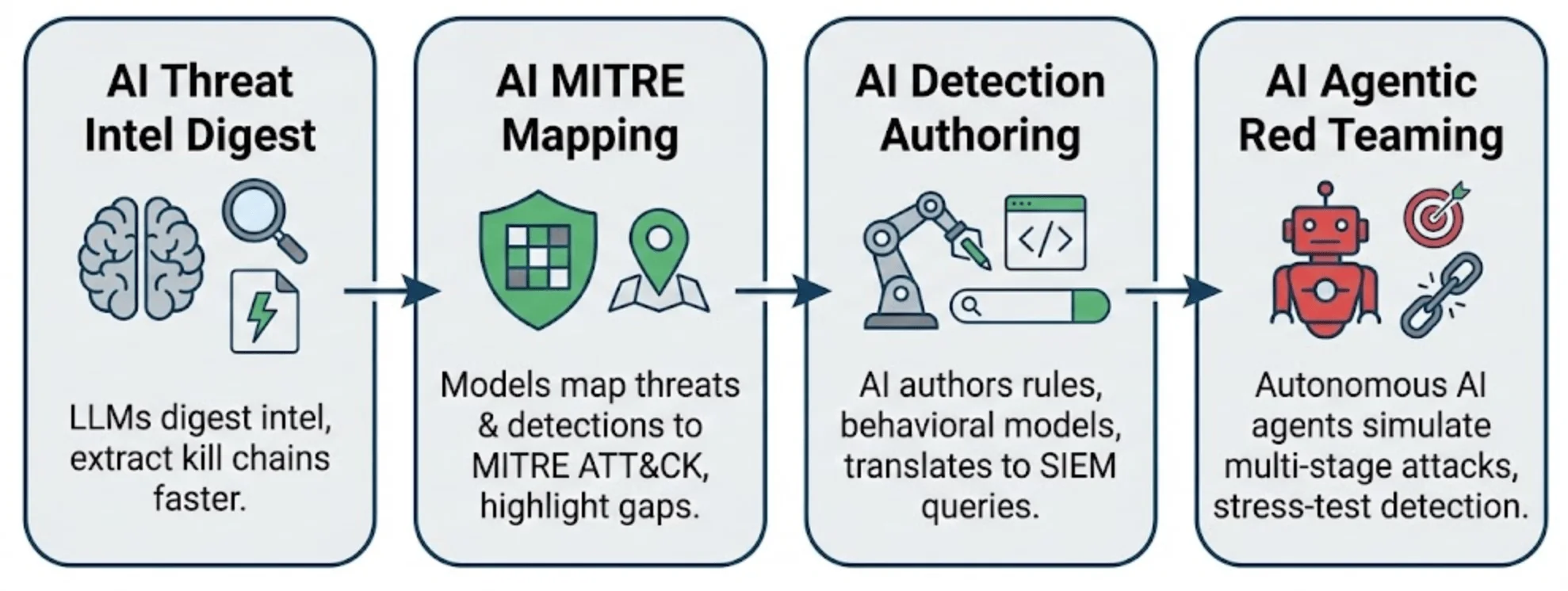
There are numerous ways to use AI in detection and response
From Alerts to Automated Action
AI is also moving from “helping us see” to “helping us act”:
- Identity-focused agents can suspend accounts, revoke tokens, and trigger password resets when risk signals cross a threshold.
- Policy enforcement agents continuously scan for missing MFA, overly broad Conditional Access gaps, and over-privileged accounts.
- App and secret hygiene agents flag unused secrets and risky OAuth consents, proposing or executing cleanup.
- Dedicated “guardian agents” sit in front of AI systems themselves, using layered models to detect prompt injection, tool abuse, and suspicious data access in real time.
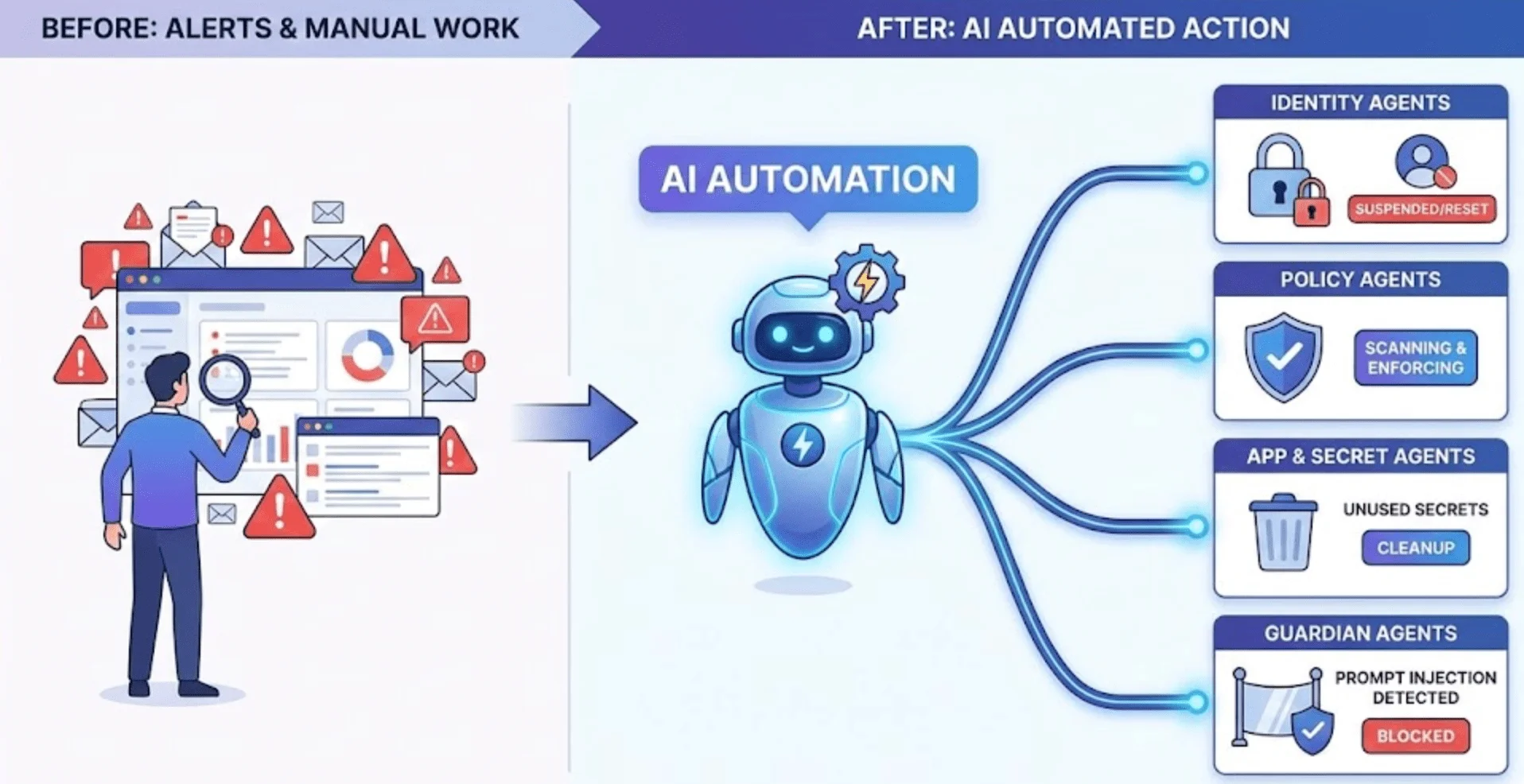
How does AI transform the alert handling process?
What security leaders should do:
- Turn on and tune AI-powered detections in identity, endpoint, and cloud platforms you already own.
- Start with narrow, high-value automations (e.g., auto-locking obviously compromised accounts) and keep humans in the loop for high-impact actions.
- Treat “defending AI with AI” as part of your security architecture, not an R&D side project.
Lesson 7: Harden your cloud and containers from day zero.
Cloud incidents are getting louder and meaner. Comparing the first and second 100 days of 2025 in Azure environments, Microsoft Defender for Cloud saw:
- 26% increase in observed incidents.
- 87% increase in disruptive “impact” campaigns (ransomware, mass deletion, destructive actions).
- 58% increase in data collection/exfiltration alerts.
- 23% increase in credential access attempts.
Attackers increasingly rely on cloud-native mechanisms like Azure Run Command for remote code execution once inside. And many attacks now start with a compromised Entra ID identity and then escalate into cloud activity.
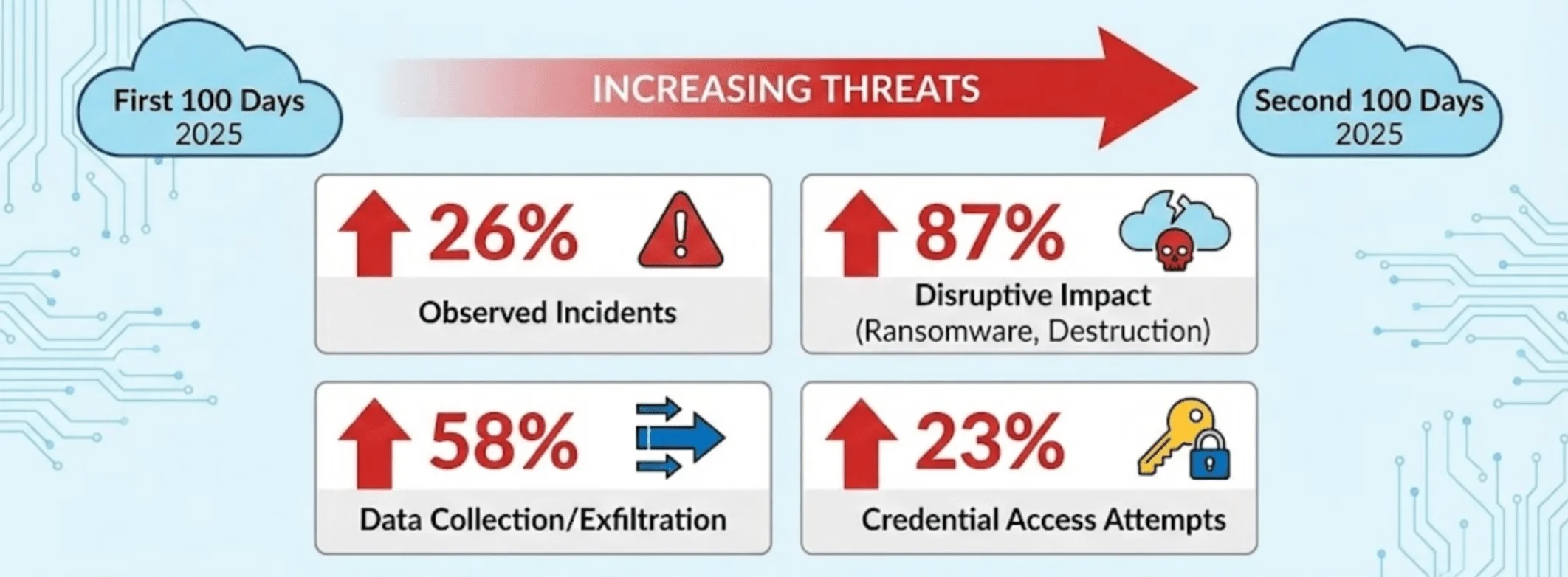
2025 cloud threat trends
Containers Are Compromised Within Days
In Kubernetes and container environments (January – April 2025):
- Most compromised containers were attacked within 48 hours of deployment.
- Infections were dominated by crypto miners (58%), followed by credential theft (21%), as well as known attack tools and web shells.
- Cryptomining has the fastest median time to compromise (under two days), while credential theft takes longer but is often more damaging.
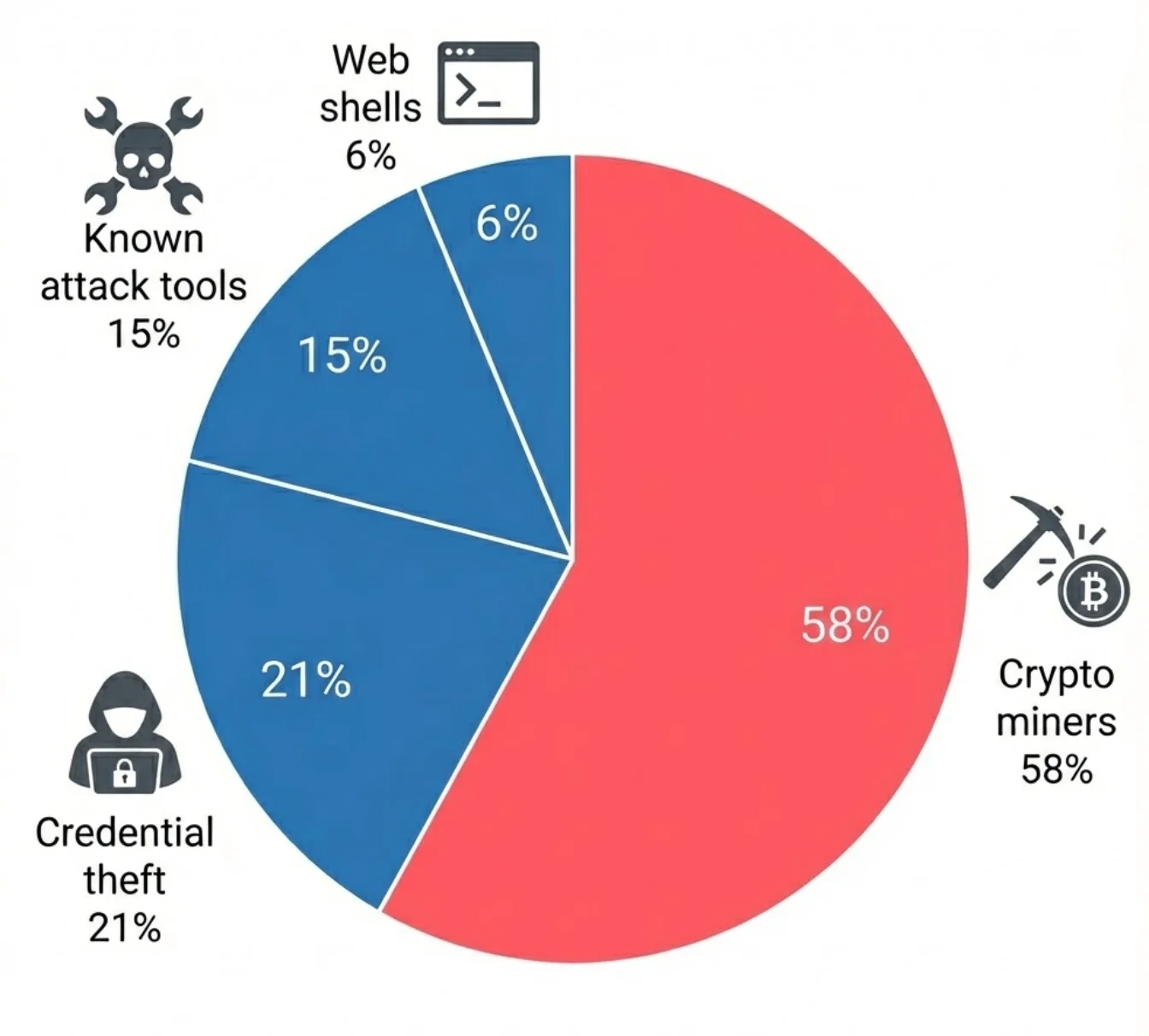
Container compromise vectors
What security leaders should do:
- Turn on cloud threat protection and baseline policies by default; don’t leave them in “we’ll configure later” status.
- Bake runtime security for containers into your CI/CD pipeline instead of trying to bolt it on after deployment.
- Watch for early signals like cryptomining, mass deletion attempts, and unusual data collection across cloud resources.
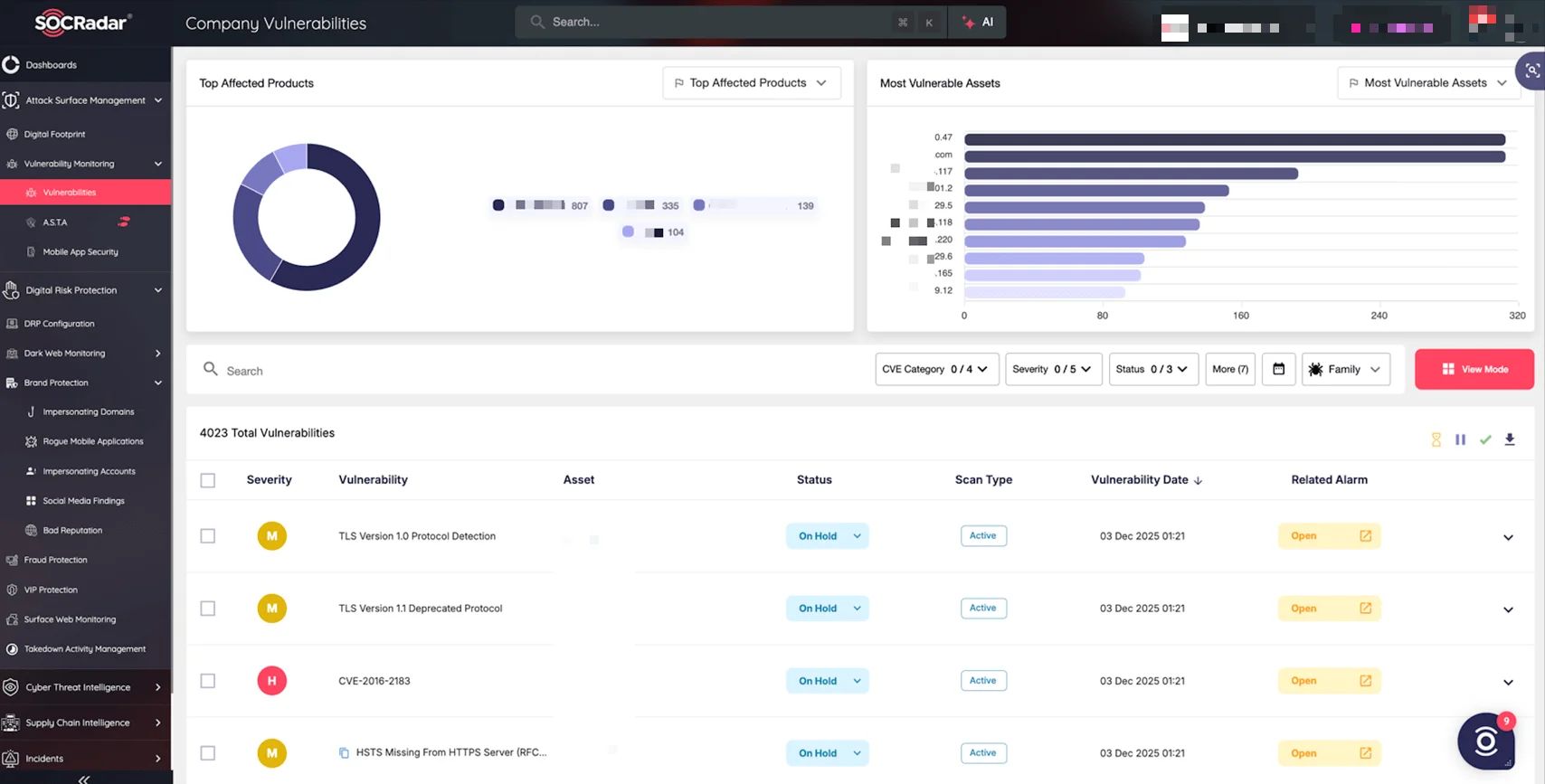
SOCRadar’s Attack Surface Management, Company Vulnerabilities
To stay ahead, you need a live view of what you actually have exposed. A solution like SOCRadar’s Attack Surface Management can continuously map your internet-facing and cloud assets – domains, IPs, APIs, containers, misconfigured services – and tie them to known vulnerabilities. Instead of discovering gaps only after an incident, you get a prioritized list of cloud and edge risks you can fix before attackers script against them.
Lesson 8: Build and rehearse an incident response plan.
Attackers move in days, not months. Microsoft’s Detection and Response Team (DART) data shows:
- About 39% of attacks lasted 0–7 days from first to last detected activity, and another 17% lasted 7–14 days.
- Average dwell time is 12 days, but average “threat actor activity length” is 58 days, meaning some actors come and go over time.
- In 46% of reactive engagements, customers detected the threat actor within 48 hours – but the gap between detection and decisive response is often where damage happens.
Data Exfiltration is Now the Default Assumption
In the past year, DART observed:
- Data exfiltration in 51% of reactive engagements.
- Data collection/access/staging activities in 80% of cases, even when exfiltration wasn’t fully confirmed.
The absence of clear evidence of exfiltration does not mean there was no impact.
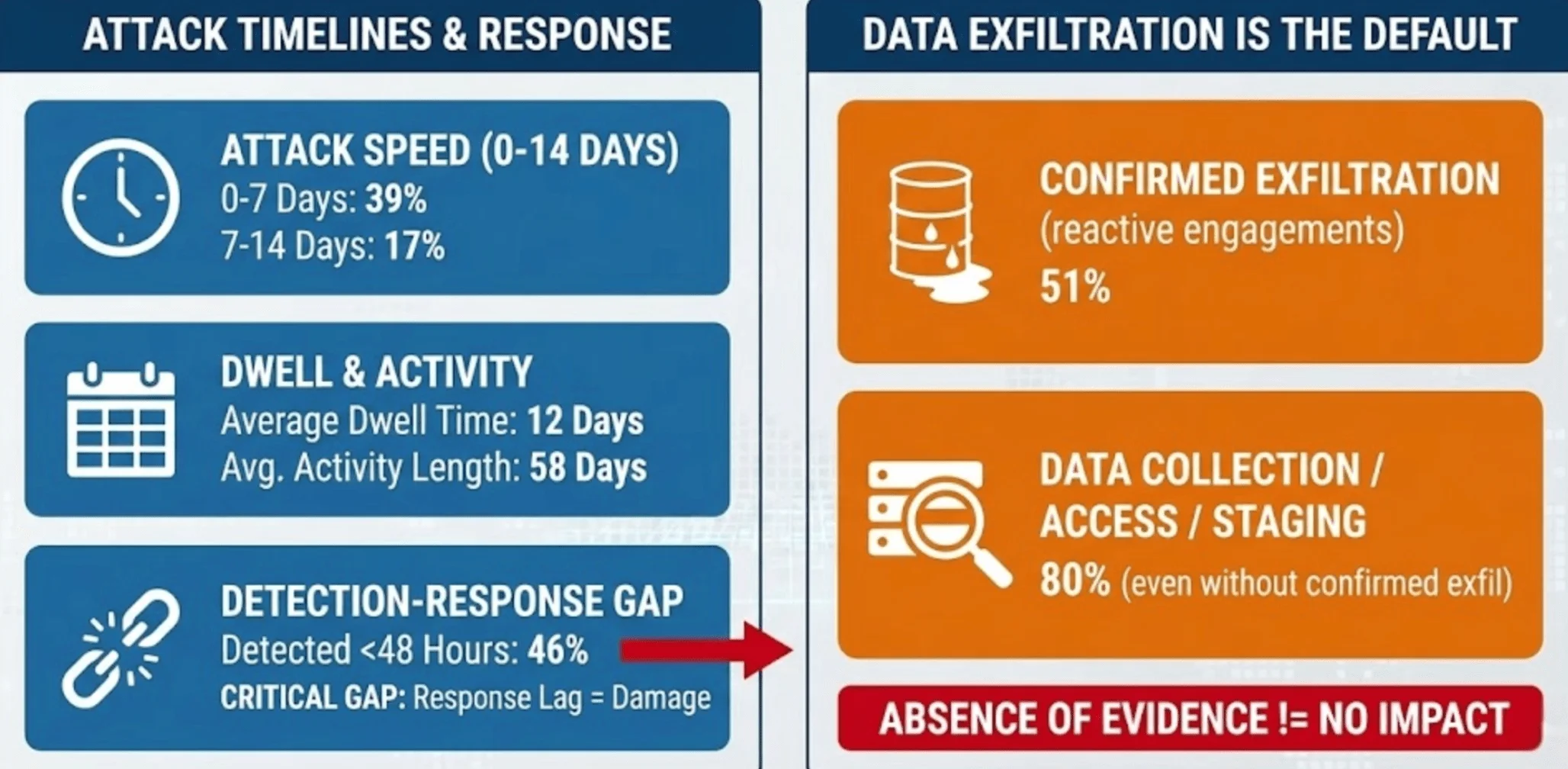
2025 trends on cyberattack timelines & data theft
What security leaders should do:
- Define IR roles, decision-makers, and escalation paths now – not during an incident.
- Run tabletop exercises and, where possible, red-team simulations at least annually.
- Pre-negotiate and budget for when you will bring in external IR help instead of improvising under pressure.

Lesson 9: Design for resilience, not perfection.
The report highlights a February 2025 ransomware attack on a global shipping company that was stopped in under two minutes. If systems had gone offline for just a few hours, global trade could have been disrupted.
Ransomware and data theft are increasingly cyber-physical problems: attacks on IT, manufacturing, transportation, and healthcare can cascade into real-world disruption. Nation-state operations and ransomware “safe havens” add political pressure on top of technical risk.
Resilience is framed as a lifecycle:
- Anticipate – understand your attack surface and model realistic disruptions.
- Withstand – design for redundancy, segmentation, and graceful degradation instead of single points of failure.
- Recover – have tested backup and restoration plans, plus clear communication playbooks.
- Adapt – treat every incident and near miss as design input, not just a cleanup job.
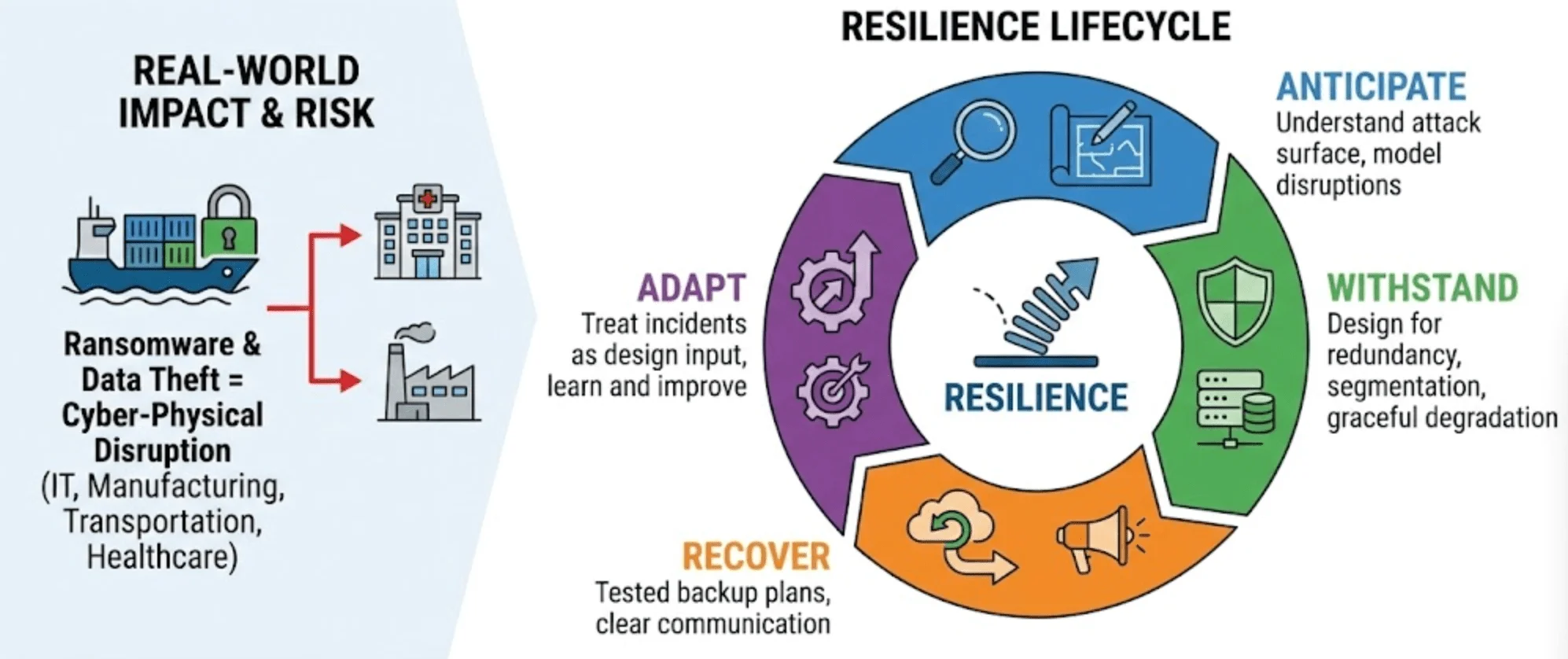
The resilience lifecycle
Boards and Regulators Are Raising the Bar
Microsoft stresses that cyber risk is now a core business risk:
- They tie employee performance objectives to security (every Microsoft employee has a security core priority).
- Governments are moving from voluntary guidance to enforceable requirements, like the EU’s Cyber Resilience Act.
- Fragmented regulations can slow response; there’s an explicit call for harmonized, risk-based approaches across borders.
What security leaders should do:
- Identify your most critical assets – data, systems, and services that would cause serious impact if lost – and design your environment so they can continue operating even under stress.
- Make resilience metrics (recovery times, data loss windows, dwell times) part of leadership reporting.
- Position security investments as business continuity and regulatory readiness, not just “IT spend.”
Lesson 10: Start your quantum-safe journey now.
Quantum risk is long-term, but not theoretical. Modern cryptography depends on problems that are hard for classical computers to solve. A future cryptographically relevant quantum computer (CRQC) could break many of today’s public-key algorithms.
That’s why “Harvest Now, Decrypt Later” is already a concern: attackers can steal encrypted data today, store it, and decrypt it once quantum capabilities mature.
Governments are responding with roadmaps and deadlines: many call for quantum-safe transitions between 2030-2035, with earlier timelines for the most sensitive systems.
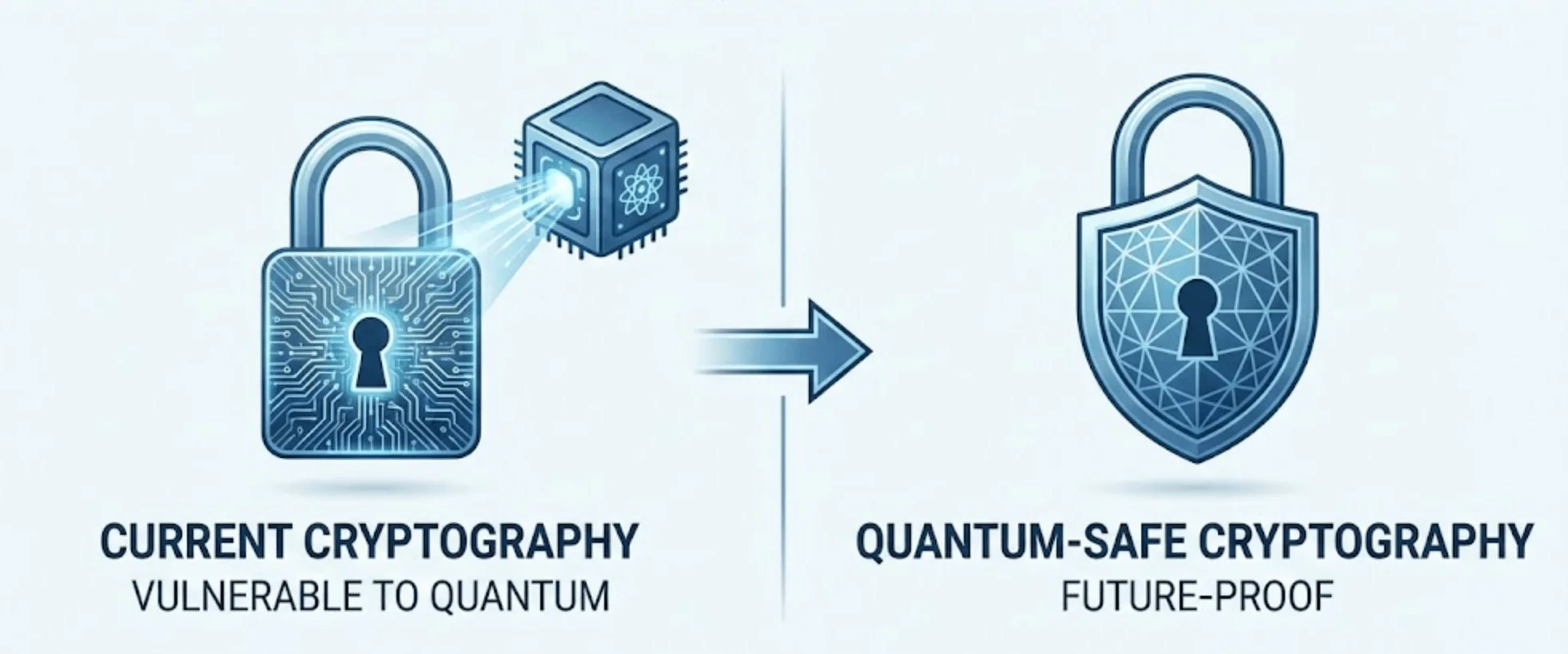
Quantum-safe cryptography
What Microsoft is Doing
Microsoft’s Quantum Safe Program coordinates a company-wide move to post-quantum cryptography (PQC):
- Updating SymCrypt, the core crypto library used under the hood in Windows, Azure, and other products, to support new PQC algorithms.
- Enabling PQC in Windows and Azure Linux and contributing research and standards work to the wider ecosystem.
What security leaders should do:
- Start a cryptography inventory: keys, certificates, protocols, and where they live.
- Prioritize high-value and long-lived data (e.g., health records, legal archives, critical IP) for early PQC migration.
- Align your plan with emerging PQC standards and national guidance, and use cloud platforms’ PQC capabilities as a modernization lever instead of building everything alone.
Conclusion
The 2025 Microsoft Digital Defense Report doesn’t really introduce a new problem; it shows how all our old problems have scaled up and converged. Identity, cloud, AI, fraud, nation-state pressure, ransomware, insider risk: they are no longer separate topics you can tackle in isolation. They form one interconnected risk surface that now directly maps to business continuity, regulation, and even geopolitics.
For security leaders, the message is blunt but empowering: you don’t need a perfect defense, but you do need a deliberate one. That means treating identity as the new perimeter, patching and hardening anything exposed to the internet, using AI to augment detection and response, and designing systems that can take a hit and keep going. It also means looking up from the console: engaging boards, understanding regulatory shifts, starting the quantum-safe journey, and leaning into public–private collaboration instead of fighting alone.
If there’s a single takeaway to carry into your next leadership meeting, it’s this: cyber risk is just business risk in a digital economy. The organizations that will thrive are the ones that assume compromise, invest in resilience, and use automation and AI thoughtfully – not as buzzwords, but as core capabilities in how they detect, respond, and recover every single day.

Table Of Content
Microsoft Digital Defense Report 2025: 10 Key Lessons for Security Leaders
The 2025 Cyber Threat Landscape: Who’s Being Hit and How
Lesson 1: Make phishing-resistant MFA non-negotiable.
Lesson 2: Treat identity as your new perimeter.
Lesson 3: Assume your credentials are already leaked.
Lesson 4: Patch fast – especially at the edge.
Lesson 5: Upgrade your fraud and social engineering defenses.
Lesson 6: Put AI to work for detection and response.
Lesson 7: Harden your cloud and containers from day zero.
Lesson 8: Build and rehearse an incident response plan.
Lesson 9: Design for resilience, not perfection.
Lesson 10: Start your quantum-safe journey now.
Conclusion
Related Articles