MongoBleed (CVE-2025-14847): What MongoDB Users Need to Know About This Memory Leak
A recently disclosed security vulnerability named MongoBleed has drawn attention across the cybersecurity community due to its scale and ease of exploitation. Tracked as CVE-2025-14847, the flaw affects a wide range of MongoDB Server versions and allows attackers to extract sensitive data directly from memory without authentication.
With tens of thousands of internet-exposed databases potentially affected and active exploitation already reported, organizations running self-hosted MongoDB instances need to understand what is happening and how to respond.
What Is the MongoBleed Vulnerability (CVE-2025-14847)?
CVE-2025-14847 (CVSS 7.5) is an unauthenticated memory disclosure vulnerability in MongoDB Server. It allows a remote attacker to retrieve fragments of uninitialized heap memory by sending malformed, compressed network messages. Because this flaw is triggered before authentication, any MongoDB instance exposed to the internet can be targeted, even if strong credentials are configured.
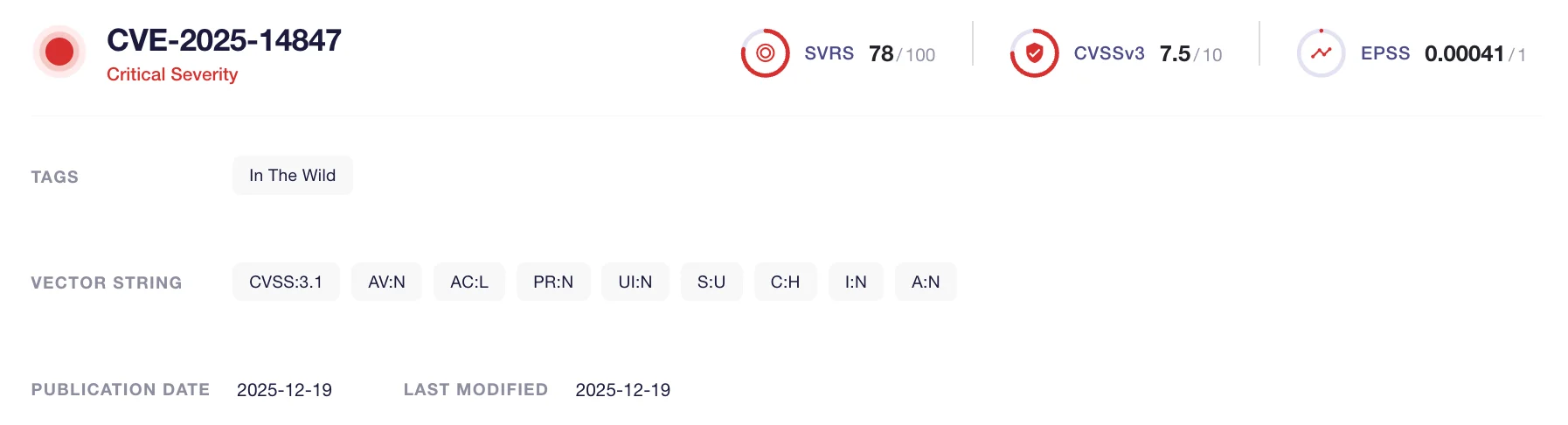
CVE-2025-14847 (SOCRadar Vulnerability Intelligence)
For security teams tracking issues like CVE-2025-14847, SOCRadar’s Cyber Threat Intelligence module provides visibility into newly disclosed vulnerabilities, public Proof-of-Concept (PoC) exploits, and early signs of active exploitation, helping faster prioritization and response.

How Does MongoBleed Work?
The issue originates in MongoDB’s handling of zlib-compressed network messages. When a client sends a compressed request, it also declares the expected uncompressed size. MongoDB incorrectly trusts this value when allocating memory.
If an attacker lies about the uncompressed size and sends malformed BSON data, the server may treat unused portions of allocated memory as valid input. When parsing fails, MongoDB can return error messages that include parts of this memory, unintentionally leaking sensitive data that happened to reside there.
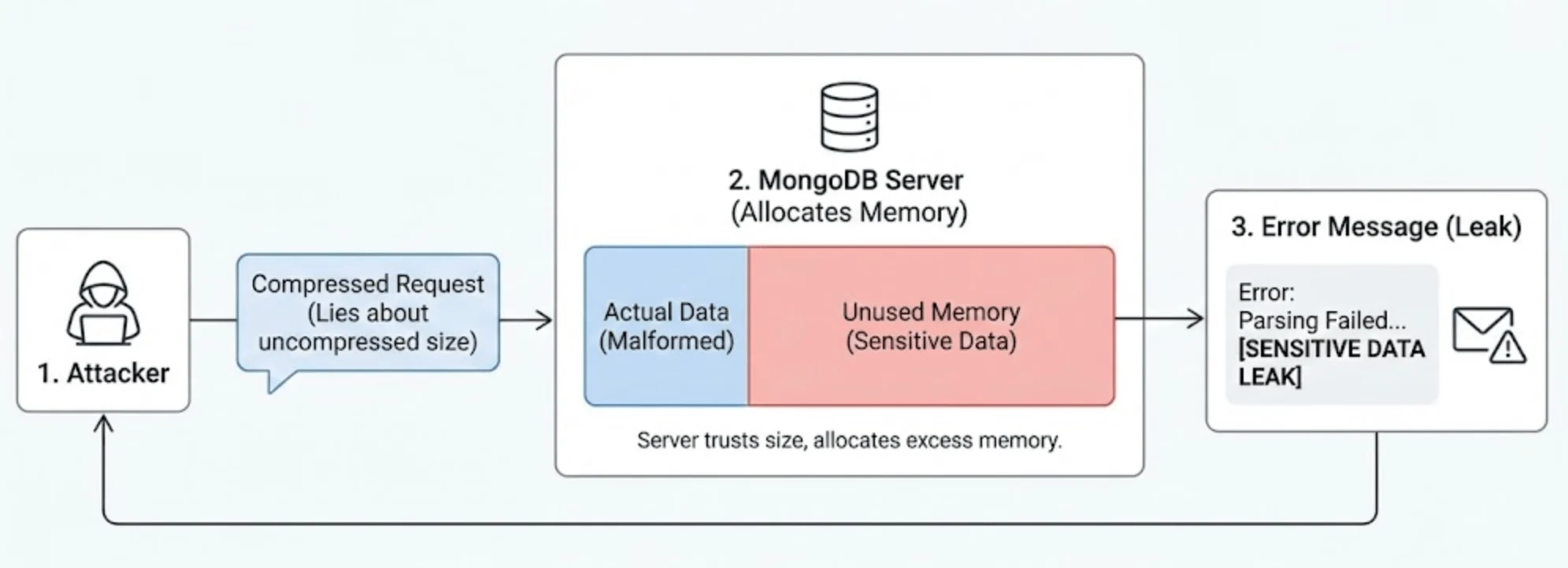
How the CVE-2025-14847 vulnerability works
Which MongoDB Versions Are Affected by CVE-2025-14847?
MongoBleed impacts a broad range of supported and legacy releases, including versions from 3.6 through early 8.2.x builds.
MongoDB has released patched versions that correct the flawed length handling logic. Organizations are advised to upgrade to following versions, depending on their major version branch.:
- 8.2.3,
- 8.0.17,
- 7.0.28,
- 6.0.27,
- 5.0.32,
- or 4.4.30
What Kind of Data Can Attackers Access?
Although MongoBleed does not allow data modification or remote code execution, the confidentiality impact is severe. Leaked memory may contain:
- Database credentials and authentication tokens
- Session identifiers and API keys
- Personally Identifiable Information (PII) processed in memory
Even partial leaks can be dangerous, as exposed secrets may enable attackers to escalate access or move laterally within an environment.
How Widespread Is the Exposure?
Internet scanning data highlights the scale of the problem. Research from Censys estimates around 87,000 publicly accessible MongoDB instances that could be vulnerable, while other scans suggest the number may exceed 100,000. Not all of these systems are necessarily exploitable, but the figures illustrate how common exposed database deployments remain.
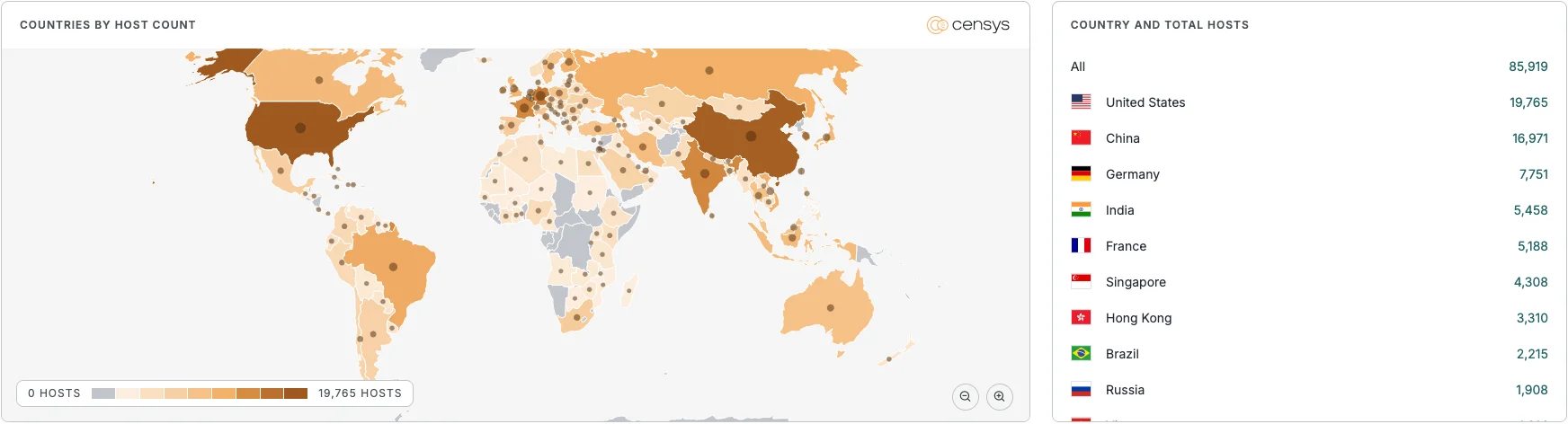
Country distribution of potentially affected hosts (Censys)
Is MongoBleed Being Exploited in the Wild?
Yes. A public Proof-of-Concept (PoC) exploit was released in late December 2025, around the Christmas period. Published on GitHub by a researcher from Elastic Security, the PoC shows how unauthenticated attackers can trigger CVE-2025-14847 to leak MongoDB server memory.
While the vulnerability is read-only, attackers can automate repeated requests to reconstruct leaked memory contents over time, increasing the risk of meaningful data exposure.
CISA KEV Update: MongoDB Vulnerability Added
CISA has added CVE-2025-14847 to its Known Exploited Vulnerabilities (KEV) Catalog on December 29, 2025, based on evidence of active exploitation. Federal agencies are required to remediate the issue by January 19, 2026.
Organizations using affected MongoDB deployments should prioritize patching to reduce exposure to known exploitation.
What Should Organizations Do Right Now?
The most effective response is immediate patching. If upgrades cannot be applied right away, teams should:
- Disable zlib compression in MongoDB network settings
- Restrict access to MongoDB ports using firewall rules or private networking
- Monitor logs for unusual pre-authentication connection patterns
- Use the MongoBleed detection tool to identify vulnerable instances and signs of exploitation
- Review the MongoDB security advisory for official details and patch guidance
Addressing MongoBleed quickly reduces the risk of silent data leakage and helps limit further compromise in environments where MongoDB plays a critical operational role.
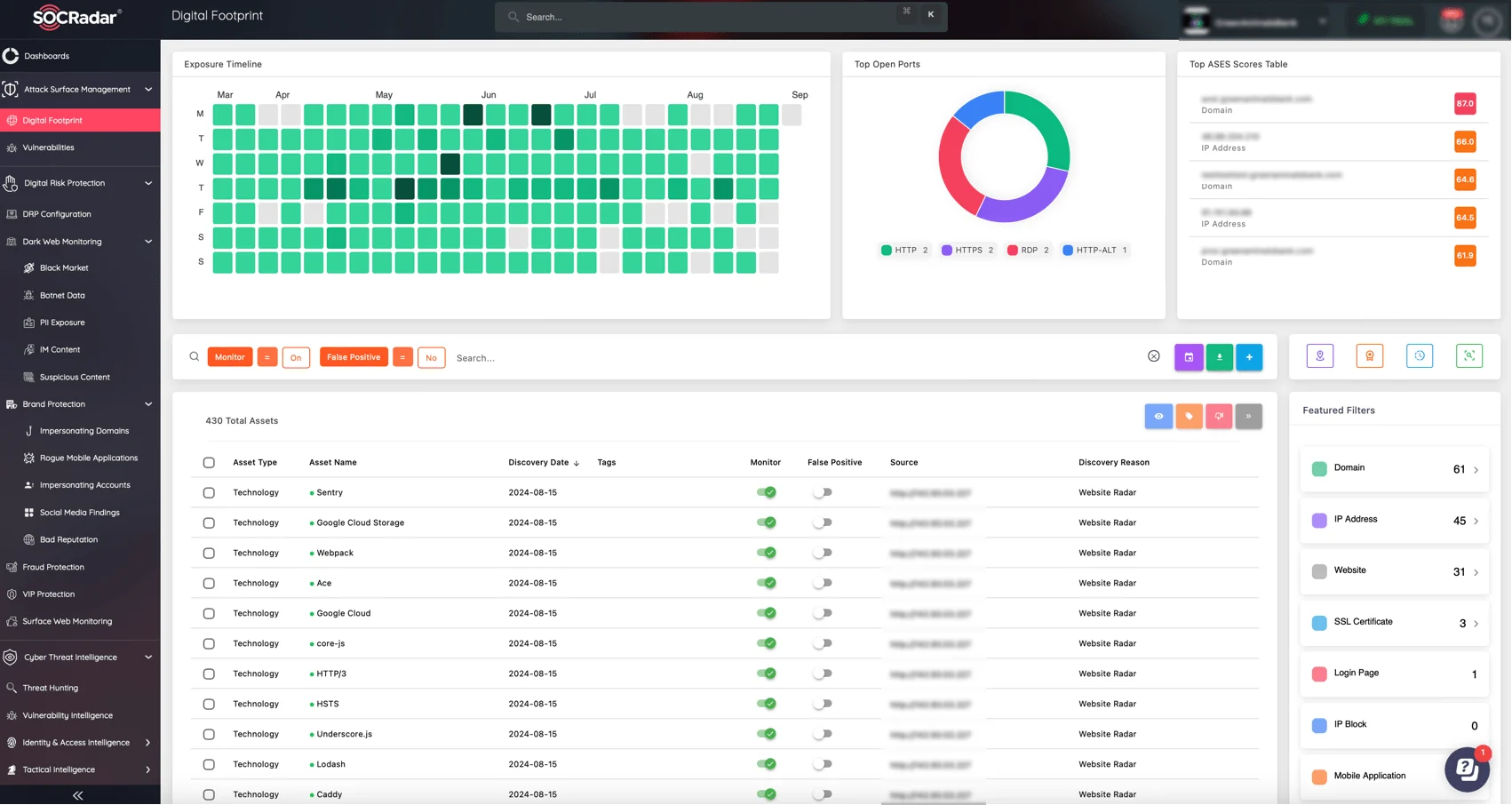
SOCRadar ASM module, Digital Footprint
For organizations managing large or complex environments, combining SOCRadar’s Cyber Threat Intelligenceand Attack Surface Management (ASM) modules can provide broader visibility. While the CTI module helps track emerging vulnerabilities, exploits, and real-world threat activity, the ASM module enables teams to continuously identify exposed assets, such as internet-facing databases, and understand where vulnerabilities like MongoBleed may pose the greatest risk.