

| Tool | Best For | Key Feature | Deployment Type | Pricing Tier |
| SOCRadar | Full-spectrum threat intelligence | AI-powered coverage across Deep, Dark, and Surface Web | Cloud SaaS | Free tier + Paid |
| Have I Been Pwned | Credential baseline checks | Domain-wide breach search and Pwned Passwords API | Web / API | Free / API paid |
| SOCRadar Free Tools | Zero-budget starting point | Instant breach and stealer log exposure checks | Web | Free |
| SentinelOne Singularity | Endpoint + Dark Web correlation | AI behavioral analytics linking external and internal signals | Cloud SaaS | Enterprise |
| Dark Web ID by Kaseya | MSP credential monitoring | Forensic origin tracing for compromised credentials | Cloud SaaS | Mid-market |
| Breachsense | Account takeover prevention | Real-time stealer log and credential stuffing detection | Cloud SaaS / API | Mid-market |
| Flare | Identity exposure management | Entra ID integration for automated credential remediation | Cloud SaaS | Mid-market |
| DarkOwl Vision | Forensic investigation depth | One of the largest Dark Web search indexes available | Cloud SaaS | Enterprise |
| OpenCTI | Centralized threat intel hub | STIX 2.1 standard for cross-platform interoperability | Self-hosted / Cloud | Free |
| MISP | Community threat sharing | Global IOC distribution across trusted organizations | Self-hosted | Free |
| OWASP TorBot | Direct Tor network crawling | Scriptable access to .onion domains and hidden services | Self-hosted | Free |
Apr 03, 2025
18 Mins Read
Jun 24, 2026

Summarize with:
Best Dark Web Monitoring Tools 2026 | Expert Guide
Last updated: June 2026 | In our analysis of platforms for this guide, we evaluated source coverage, alert quality, integration fit, and operational overhead across team sizes and budgets.
Stolen credentials from a single breach surface on Dark Web forums within hours. The Verizon 2025 Data Breach Investigations Report found that compromised credentials were a factor in 22% of all breaches. IBM’s Cost of a Data Breach Report 2025 puts the average breach cost at $4.88 million. The gap between data appearing underground and an attacker exploiting it is shrinking fast, and the right Dark Web monitoring tools close that gap.
Dark Web monitoring tools are platforms that continuously scan underground forums, ransomware leak sites, paste sites, and encrypted Telegram channels to detect stolen credentials, session cookies, stealer logs, and early signs of targeted attacks against an organization.
This guide compares the top Dark Web monitoring tools in 2026 across three categories: free, commercial, and open source, with features, best use cases, and honest limitations for each. We cover options across free, mid-market, and enterprise tiers to match your team’s budget and threat profile.
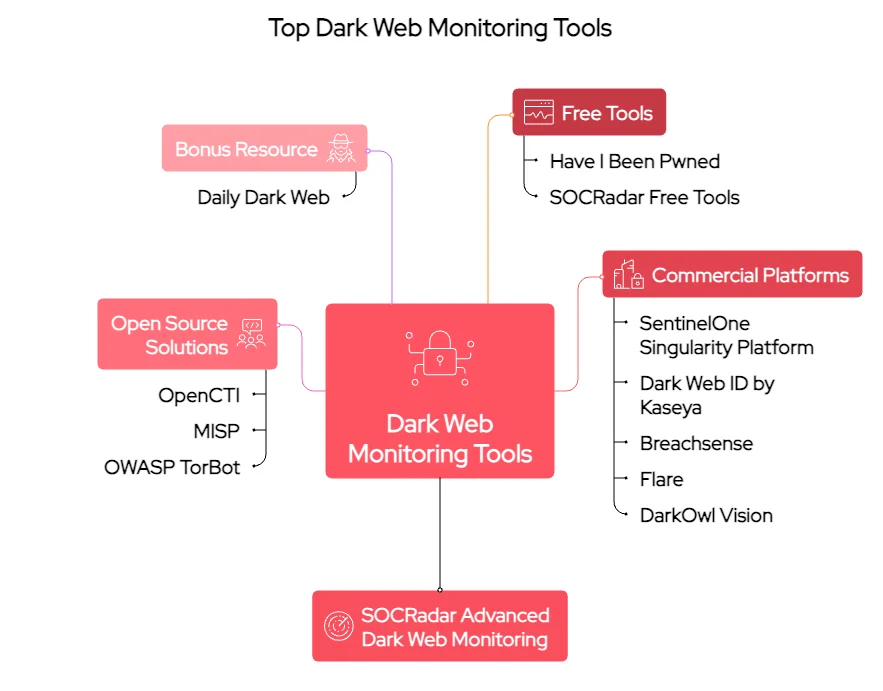
Top 10 Dark Web monitoring tools overview
What Is Dark Web Monitoring?
Dark Web monitoring is the continuous process of scanning hidden online spaces, including Tor-based forums, encrypted Telegram channels, Dark Web marketplaces, ransomware leak sites, and paste sites, for signs that your organization’s data has been compromised or is actively being targeted.

Understanding the three layers of the internet helps frame the scope:
- Surface Web: Publicly indexed pages most people use daily
- Deep Web: Non-indexed content including private databases, academic repositories, and internal portals
- Dark Web: Deliberately hidden networks requiring Tor or I2P, heavily used by threat actors to trade stolen data, sell initial access, and coordinate attacks
Modern Dark Web monitoring tools go beyond basic keyword searches. They use AI-driven analytics, natural language processing, and threat intelligence correlation to surface actionable alerts, flagging leaked credentials, session cookies, stealer log entries, initial access broker listings, and internal documents before attackers can exploit them. For security teams, the value is time: early detection enables credential resets, account lockouts, and incident response before a breach escalates. The best platforms include analyst-validated alerts and false positive reduction workflows, critical for teams that cannot afford alert fatigue disrupting operations.
Quick Comparison: Best Dark Web Monitoring Tools (2026)
SOCRadar Advanced Dark Web Monitoring
Before the full list, one platform stands in a category of its own. SOCRadar is a full-spectrum cyber threat intelligence platform that goes well beyond credential monitoring, providing real-time insights into ransomware groups, APT activity, initial access broker listings, hacker forums, and underground marketplaces, all from a single interface.
SOCRadar’s Advanced Dark Web Monitoring scans the Deep, Dark, and Surface Web simultaneously. When an alert fires, it delivers context alongside the raw finding: the threat actor, the source, the likely attack vector, and recommended remediation steps. This is what separates monitoring from intelligence.
Key capabilities:
- Real-time monitoring across Dark Web forums, marketplaces, ransomware leak sites, Telegram channels, and paste sites
- Detection of leaked credentials, session cookies, stealer log entries, API keys, and internal documents
- AI-powered Dark Web search engine enabling proactive threat hunting by IP, domain, email, hash, or URL
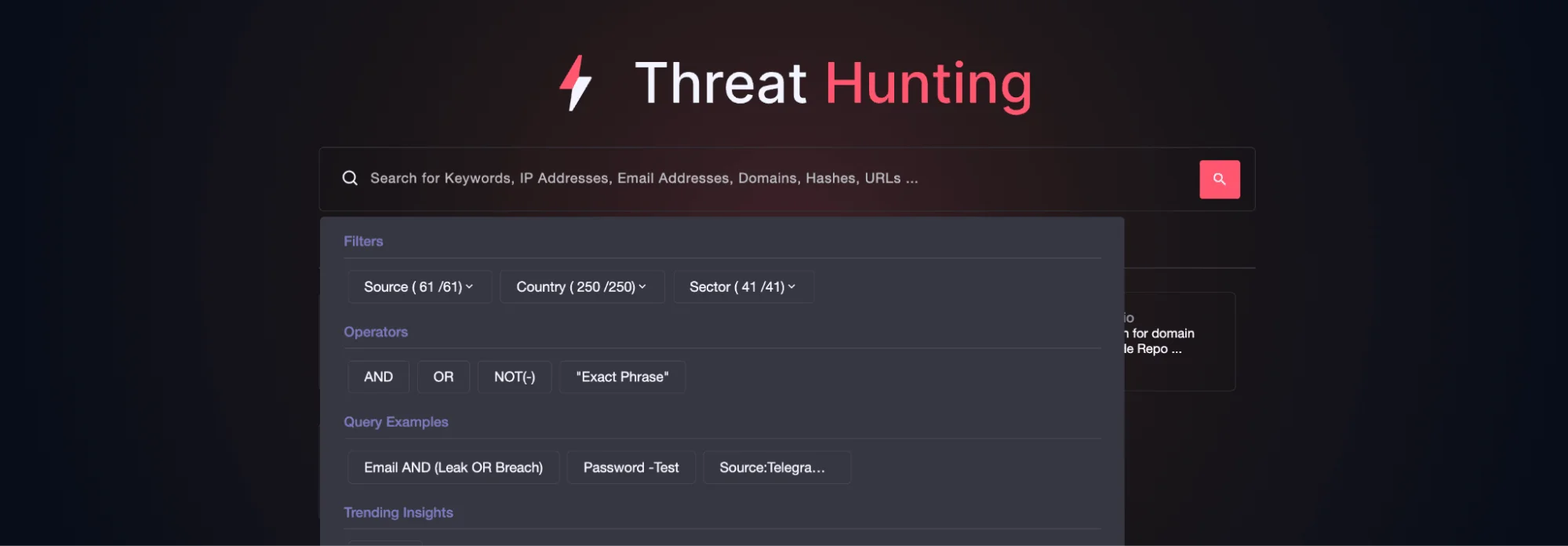
Threat Hunting search page on the SOCRadar platform
- Underground forum monitoring for real-time discussions referencing your organization
- VIP and executive protection tracking personal exposure of high-profile individuals
- Fraud protection covering stolen credit cards, financial credentials, and banking scams
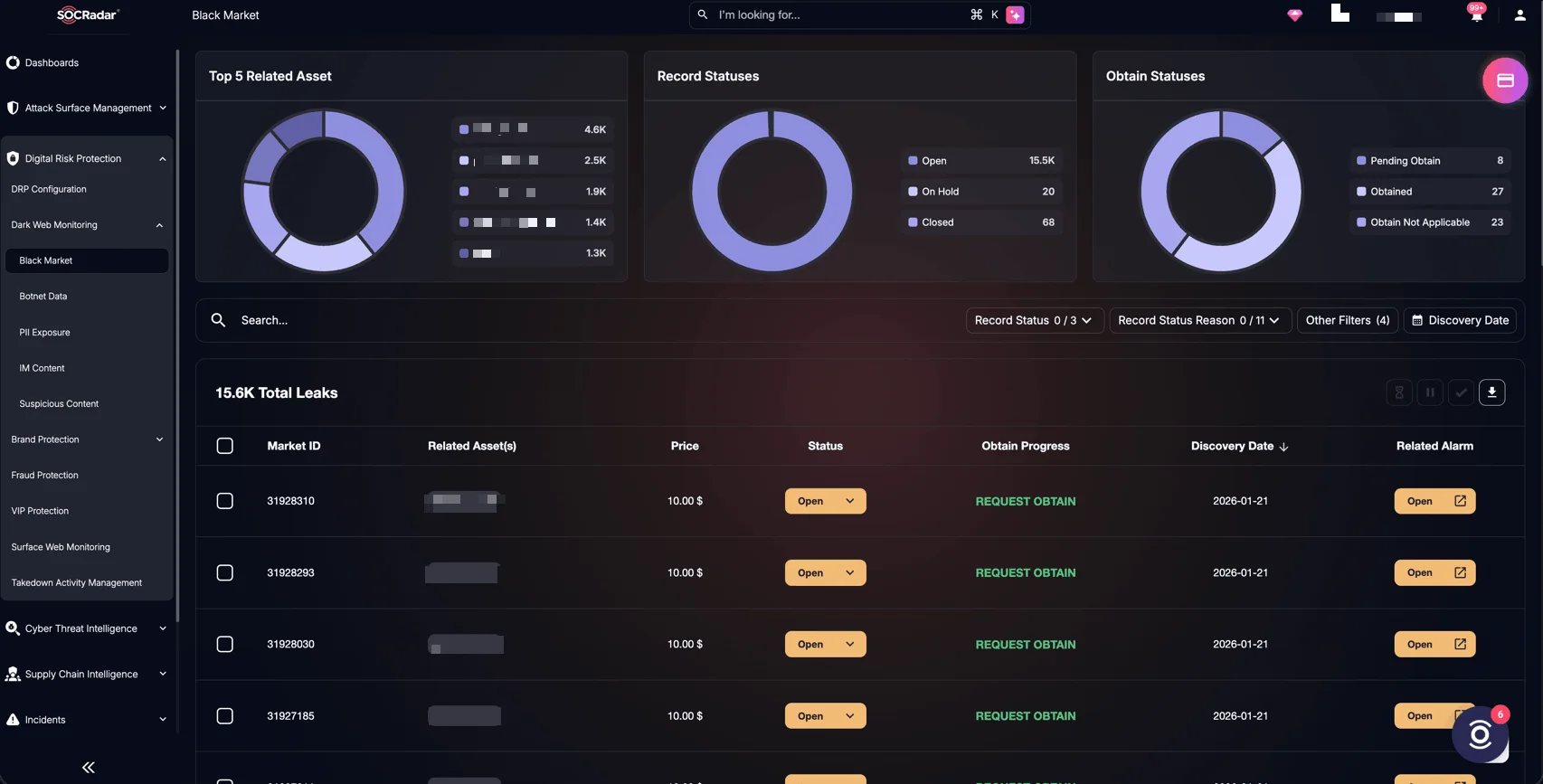
SOCRadar’s Dark Web Monitoring, Black Markets
- SOCRadar Copilot (platform feature), an AI assistant that accelerates investigation workflows and reduces analyst overhead from alert fatigue
- SIEM and SOAR integration for automated response and false positive reduction
- Country-specific threat intelligence for regional risk profiling
What sets SOCRadar apart is how accessible it makes complex threat data. Its interface is built for security teams of all sizes, not just enterprise SOCs with dedicated full-time analysts. SIEM integration, automated alerting, and analyst-ready dashboards mean teams act on intelligence without alert fatigue slowing them down.
Best for: Organizations that need a single platform combining Dark Web monitoring, threat intelligence, digital risk protection, and AI-driven investigation support.
Top 10 Dark Web Monitoring Tools in 2026
In our analysis, we organized these tools into three categories to help match them to your team’s budget, technical capacity, and threat profile: free tools, commercial platforms, and open source solutions.
Free Dark Web Monitoring Tools
Starting Dark Web monitoring does not require a budget. These free Dark Web monitoring tools provide genuine value for credential exposure checks, breach baseline assessments, and initial visibility into your organization’s underground footprint. They are not replacements for a full monitoring platform, but they are legitimate and effective starting points.
1. Have I Been Pwned
Have I Been Pwned (HIBP) is the most recognized free Dark Web monitoring tool available. Created and maintained by security researcher Troy Hunt, the platform holds a vast database of credentials and personal data sourced from thousands of known breaches and data dumps.
Key features:
- Email and phone number breach lookup against billions of exposed records from known breaches
- Domain search for organization-wide credential exposure monitoring via the HIBP API
- Pwned Passwords API for real-time password hygiene enforcement at scale
- Public breach notification alerts for registered users
- Free developer API for embedding breach detection into authentication flows
Best for: Individuals, IT teams, and developers needing a fast, reliable credential exposure baseline at no cost.
Not ideal for: Teams needing real-time Dark Web crawling, stealer log monitoring, or threat actor intelligence beyond known public breaches.
2. SOCRadar Free Tools
SOCRadar offers a set of free Dark Web monitoring utilities that give security teams immediate visibility into their organization’s exposure without requiring a full platform subscription. These tools serve as a practical entry point into SOCRadar’s broader threat intelligence ecosystem.
Key features:
- Free Dark Web Report: instant check of whether your domain, email, or credentials appear in breach data and stealer logs
- Free exposure search covering underground forums and data dumps
- Access to limited threat intelligence feeds for breach detection
- No commitment required to run initial checks
Best for: Security teams evaluating their exposure before committing to a full platform, and organizations with limited budgets needing a structured starting point for Dark Web monitoring.
Not ideal for: Continuous automated monitoring at scale; the free tier is designed for spot checks and initial assessments rather than ongoing organizational surveillance.
Commercial Dark Web Monitoring Tools
These platforms deliver automated alerting, SIEM and SOAR integration, analyst-validated intelligence, and broader source coverage. They are built for security teams with ongoing monitoring requirements and organizational assets to protect at scale.
3. SentinelOne Singularity Platform
SentinelOne integrates Dark Web monitoring into its AI-powered cybersecurity ecosystem, correlating external underground threat signals with internal endpoint telemetry. When stolen credentials or stealer log entries surface on a Dark Web forum, SentinelOne links that finding to endpoint-level context, giving teams a clearer picture of what the exposure means for their actual environment.
Key features:
- Dark Web credential and stealer log monitoring with AI-driven behavioral correlation
- Endpoint telemetry integration connecting external threat signals to internal security events
- Automated alert triage with risk scoring to reduce analyst overhead and alert fatigue
- SIEM and SOAR integration for response workflow automation
- Continuous monitoring for initial access broker listings targeting your industry
Best for: Enterprise SOCs that want Dark Web intelligence integrated with endpoint detection and response in a unified platform.
Not ideal for: Smaller teams seeking a standalone Dark Web monitoring tool without the broader endpoint security stack.
4. Dark Web ID by Kaseya
Developed by Kaseya, Dark Web ID is a purpose-built credential monitoring platform designed with managed service providers in mind. It continuously scans Dark Web forums, illicit marketplaces, paste sites, and data dumps, alerting businesses when employee credentials, financial data, or intellectual property surface in underground sources.
Key features:
- Continuous credential monitoring across Dark Web forums, paste sites, and data dumps
- Forensic origin tracing identifying how and where credentials were compromised
- Automated alerts with detailed context for each credential stuffing and exposure event
- MSP-friendly multi-tenant architecture for managing multiple client organizations
- SIEM integration for streamlined incident response workflows
Best for: MSPs and mid-size enterprises seeking dedicated credential monitoring with a partner-friendly deployment model.
Not ideal for: Teams that need broader threat actor intelligence, APT tracking, or strategic intelligence beyond credential and data exposure.
5. Breachsense
Breachsense specializes in real-time data breach detection, continuously scanning underground forums, illicit marketplaces, stealer logs, and data dumps for compromised credentials linked to your organization. Its intelligence is particularly valuable for preventing account takeover attacks and credential stuffing campaigns, two of the most common exploitation paths following a Dark Web credential exposure.
Key features:
- Real-time stealer log monitoring for freshly harvested infostealer credentials
- Credential stuffing attack prevention through early exposure detection and alert workflows
- Automated alerting with SIEM integration for immediate incident response
- API access for embedding breach detection directly into authentication and identity workflows
- Coverage of underground marketplaces, paste sites, and closed data dumps
Best for: Financial institutions and enterprises where account takeover prevention and credential stuffing defense are the primary monitoring objectives.
Not ideal for: Teams requiring strategic threat actor intelligence, APT tracking, or broader digital risk monitoring beyond credential exposure.
6. Flare
Flare is a Threat Exposure Management platform built on the premise that most organizations have far more external exposure than they realize. It runs continuous surveillance across Telegram cybercrime communities, Dark Web forums, infostealer log markets, and illicit paste sites, surfacing credential exposures and leaked assets before they get exploited.
Its Identity Exposure Management feature goes beyond simple credential alerting by building a profile around each compromised identity and mapping the potential damage an attacker could cause with those credentials. Organizations running Microsoft environments benefit from a direct Entra ID integration for automated remediation, and a full REST API makes it straightforward to push intelligence into existing SIEM, SOAR, and ticketing workflows.
Key features:
- Continuous monitoring across tens of thousands of Telegram cybercrime channels and hundreds of Dark Web forums
- Identity Exposure Management with per-user compromised identity profiling
- Blast Radius analysis showing attack potential of each exposed credential set
- Microsoft Entra ID integration for automated account remediation and false positive reduction
- REST API for SIEM, SOAR, and ticketing system integration
Best for: Mid-size to enterprise security teams wanting strong stealer log coverage, fast deployment, and automated credential remediation in Microsoft environments.
Not ideal for: Teams needing deep strategic threat actor intelligence or APT-level tracking beyond credential and identity exposure.
7. DarkOwl Vision
DarkOwl Vision operates one of the largest commercial Dark Web search indexes available, built on a continuously expanding dataset spanning underground forums, illicit marketplaces, ransomware leak sites, Telegram channels, and other hidden networks. This depth of coverage makes it particularly valuable for organizations needing comprehensive historical and real-time Dark Web data.
Key features:
- One of the largest commercial Dark Web search indexes, continuously updated in real time
- Searchable historical and live data across forums, markets, and ransomware leak sites
- Automated intelligence feeds for integration with existing security tooling and SIEM platforms
- Deep ransomware leak site and paste site coverage with victim and data tracking
- Forensic-depth search across closed forums and Telegram channels
Best for: Threat intelligence teams, forensic investigators, and organizations needing extensive Dark Web data depth and long-term historical coverage.
Not ideal for: Teams without experienced analysts; raw data volume requires expertise to interpret and operationalize effectively.
Open Source Dark Web Monitoring Tools
For organizations with technical teams that want Dark Web visibility without vendor dependency, these open source Dark Web monitoring tools offer powerful, customizable options. They require more setup and maintenance than commercial platforms but provide full control over data, integrations, and deployment.
8. OpenCTI
OpenCTI (Open Cyber Threat Intelligence) is an open source threat intelligence platform developed by Filigran that enables organizations to ingest, structure, store, and share threat intelligence from multiple sources, including Dark Web feeds, MISP instances, ISAC data, commercial providers, and custom integrations.
Key features:
- Ingests Dark Web feeds alongside Surface Web and Deep Web intelligence sources in a single hub
- STIX 2.1 standard ensuring broad interoperability with security tools and threat feeds
- Threat actor profiling and campaign correlation for contextual analysis beyond raw alerts
- Connectors for MISP, VirusTotal, AlienVault OTX, and many commercial intelligence feeds
- Analyst-validated alert workflows to reduce false positives and support risk scoring
Best for: Security teams building a centralized threat intelligence program with Dark Web data as one of several inputs, particularly those invested in the STIX/TAXII ecosystem.
Not ideal for: Teams without dedicated technical resources for setup, maintenance, and connector management.
9. MISP (Malware Information Sharing Platform)
MISP is one of the most widely deployed open source threat intelligence sharing platforms in the world, used by national CERTs, financial sector organizations, law enforcement agencies, and enterprises. It enables organizations to share indicators of compromise, including Dark Web-sourced credentials, domains, IP addresses, and stealer log artifacts, across trusted communities in near real time.
Key features:
- IOC sharing covering credentials, domains, and artifacts sourced from Dark Web monitoring
- Trusted community feeds enriching each deployment with collective global intelligence
- REST API and STIX/TAXII support for integration with existing security stacks and SIEM platforms
- Flexible taxonomy and tagging for organizing threat data and reducing alert fatigue
- Used by national CERTs and government agencies for cross-border threat sharing programs
Best for: Organizations participating in threat intelligence sharing communities, national CERTs, and enterprises with established security operations.
Not ideal for: Teams without community connections or analyst capacity to configure, maintain, and actively contribute to MISP deployments.
10. OWASP TorBot
OWASP TorBot is an open source OSINT tool designed to crawl and index content on the Tor network. As part of the OWASP ecosystem, it gives security researchers and threat hunters direct, scriptable access to Dark Web content without relying on a third-party platform.
Key features:
- Tor network crawler for discovering and indexing .onion hidden services
- Domain enumeration across the Tor network with link and content extraction
- Scriptable architecture for building custom Dark Web monitoring and research workflows
- Open source codebase with active OWASP community maintenance and contribution
- Integration capability with broader OSINT investigation and threat intelligence pipelines
Best for: Security researchers, threat hunters, and penetration testers needing direct, customizable Tor network access for custom use cases and research.
Not ideal for: Automated enterprise monitoring; requires significant development investment and does not include alerting, intelligence correlation, or analyst-validated outputs out of the box.
Bonus: Daily Dark Web
Daily Dark Web complements any Dark Web monitoring stack with something no automated tool can provide: human intelligence and investigative reporting.
Unlike traditional Dark Web monitoring tools focused on automated scanning, Daily Dark Web actively tracks discussions from hacker forums, Telegram channels associated with cybercriminal groups, and updates from ransomware collectives. It publishes comprehensive statistical reports on Dark Web activity, available weekly, monthly, and yearly, covering trends in data breaches, stealer logs, initial access broker sales, and ransomware campaigns.
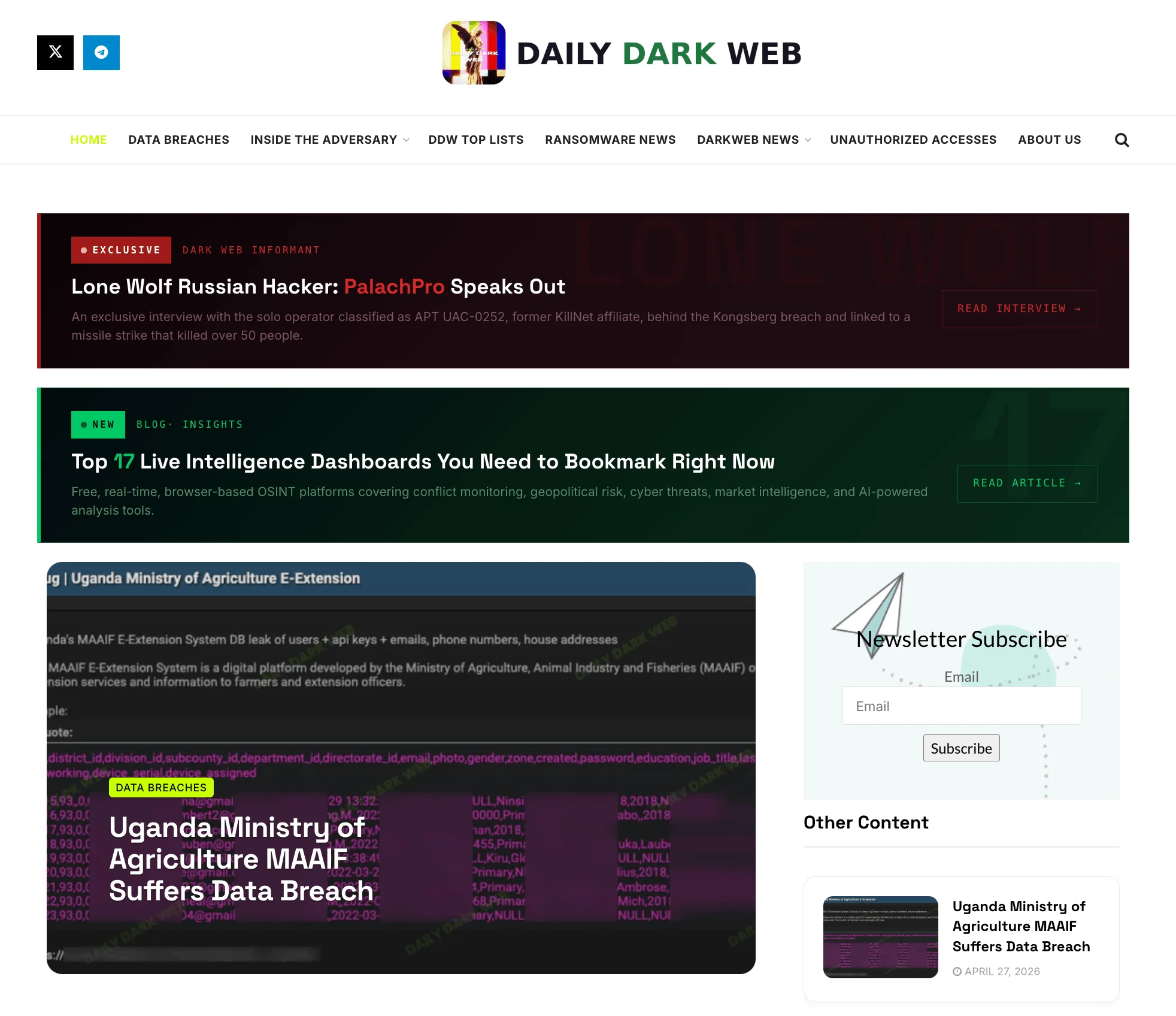
Daily Dark Web news site
One of its most distinctive features is a series of exclusive interviews with notable threat actors, including figures such as USDoD and RansomedVC, providing direct insight into the motivations, tactics, and strategies of cybercriminals operating in the underground economy.
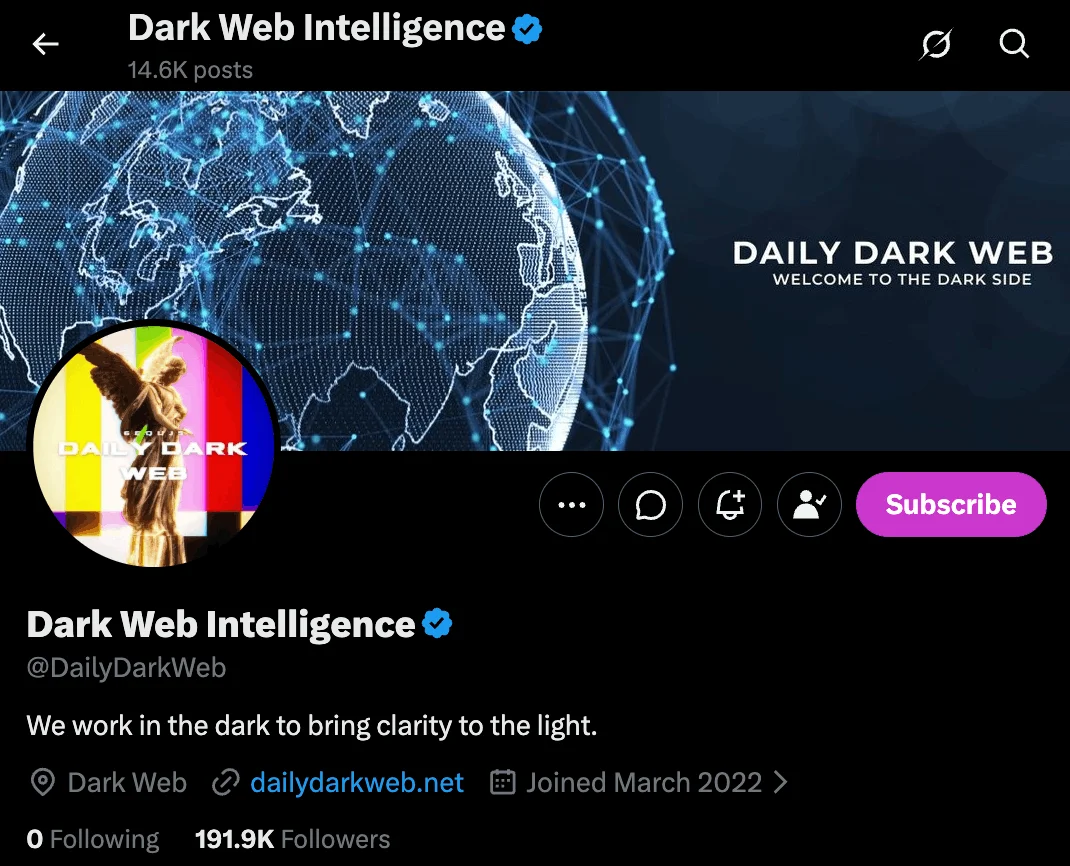
Dark Daily Web X account
For security professionals, Daily Dark Web serves as an essential intelligence layer alongside automated monitoring platforms, providing narrative context and trend analysis that raw data feeds cannot replicate.
What Can Dark Web Monitoring Tools Detect?
The best Dark Web monitoring tools cover a wide range of threat signals, such as:
- Leaked credentials: usernames, passwords, and email addresses from data breaches
- Stealer logs: passwords, session cookies, and autofill data harvested by infostealer malware
- Session cookies: active authentication tokens enabling account takeover without a password
- Initial access broker listings: threat actors selling direct access to corporate networks
- Internal documents: confidential files, source code, and financial records on leak sites
- API keys and tokens: developer credentials enabling unauthorized access to systems
- Ransomware early warning: underground forum chatter about your organization before an attack
- Paste site exposure: credentials and data fragments on public and private paste services
- Brand abuse: phishing domains, impersonation accounts, and fraudulent sites
- Executive and VIP exposure: personal data of high-profile individuals being traded or discussed
How to Choose the Right Dark Web Monitoring Tool
Not every platform suits every team. Here is a short framework to narrow the decision quickly.
- Define your primary risk driver. Credential leaks? Ransomware early warning? Brand abuse? Match the tool to your actual exposure, not a generic feature list.
- Evaluate source coverage. Ask vendors exactly which Dark Web forums, ransomware leak sites, paste sites, and Telegram channels they monitor, and how frequently. Breadth and recency both matter.
- Prioritize alert quality over volume. Alert fatigue is a common failure mode. Analyst-validated alerts with clear context are worth far more than high-volume automated notifications that require heavy triage.
- Check integration fit. Tools that connect directly to your SIEM, SOAR, or ticketing system cut response time significantly. Integration fit is often the deciding factor between two comparable platforms.
- Be realistic about overhead. Some platforms need dedicated analysts to deliver full value. Others are built for lean teams. Match the tool to your actual capacity.
- Consider operational maturity. Platforms like DarkOwl Vision and OpenCTI are built for teams with established threat intelligence programs and the analyst capacity to work with raw data. If your team is earlier in its security journey, a more guided commercial platform will deliver faster value.
Frequently Asked Questions (FAQ): Dark Web Monitoring Tools
What is the best Dark Web monitoring tool for enterprises?
SOCRadar is a strong all-in-one option, combining Dark Web monitoring, threat intelligence, and AI-assisted investigation in a single platform. SentinelOne Singularity and DarkOwl Vision are also good enterprise choices, offering deep source coverage and SIEM and SOAR integration.
How do Dark Web monitoring tools detect stolen credentials?
They use automated crawlers and AI analytics to continuously scan underground forums, ransomware leak sites, paste sites, and Telegram channels. When a credential matching your monitored assets appears in a stealer log or data dump, an alert is generated, typically within hours.
Are there free Dark Web monitoring tools?
Yes. Have I Been Pwned is the most widely used free Dark Web monitoring tool for credential exposure checks. SOCRadar also offers free utilities including breach checks and stealer log searches, making it a practical starting point before evaluating the full platform. For teams building a full program, commercial platforms provide the automation and coverage depth required at scale.
How quickly can security teams act on Dark Web monitoring alerts?
With predefined response workflows, most credential alerts can be acted on within hours. Teams integrating Dark Web monitoring with SIEM or SOAR platforms respond faster and with less manual effort, resetting passwords and locking accounts before exploitation occurs.
What is the difference between Dark Web monitoring and threat intelligence?
Dark Web monitoring is a focused component of threat intelligence covering underground sources specifically. Full threat intelligence platforms like SOCRadar add Surface Web monitoring, vulnerability intelligence, and adversary tracking for a complete picture of external risk.
Do Dark Web monitoring tools support compliance requirements?
Yes. Continuous Dark Web monitoring supports GDPR, CCPA, and PCI-DSS compliance, strengthens audit readiness, and factors positively into cyber insurance assessments as evidence of proactive risk management.
What is credential stuffing and how does Dark Web monitoring help?
Credential stuffing is an automated attack where stolen credentials from Dark Web data dumps are tested against login portals at scale. Dark Web monitoring detects when your users’ credentials appear in stealer logs, enabling password resets before an attack occurs.
Final Thoughts
Dark Web monitoring has moved well past the point of being a specialist concern for large enterprise security teams. Credentials get stolen, they surface underground fast, and the window to act before they are weaponized is getting shorter.
What this guide shows is that there is no single right tool for every organization. A small IT team checking credential exposure for the first time has genuinely useful free options. A mid-market company trying to stop account takeovers needs something more automated. An enterprise SOC managing complex threat actor activity needs depth, context, and integration across its entire security stack.
The category you land in matters less than being honest about where you actually are today and choosing a tool that matches that reality, not an aspirational one.
One thing holds true across all of them: finding out your data is on the Dark Web from a news headline is always worse than finding out from an alert. The Dark Web monitoring tools in this list exist to make sure you are in the second group.

Table Of Content
Best Dark Web Monitoring Tools 2026 | Expert Guide
What Is Dark Web Monitoring?
Quick Comparison: Best Dark Web Monitoring Tools (2026)
SOCRadar Advanced Dark Web Monitoring
Top 10 Dark Web Monitoring Tools in 2026
What Can Dark Web Monitoring Tools Detect?
How to Choose the Right Dark Web Monitoring Tool
Frequently Asked Questions (FAQ): Dark Web Monitoring Tools
Final Thoughts
Related Articles
Dark Web Profile: Blue Locker Ransomware
Sep 25, 2026
ShinyHunters Claims Access to FBI Systems
Sep 24, 2026