


Jun 05, 2026
Mar 13, 2026
13 Mins Read

U.S. Tax Season: How Threat Actors Exploit IRS Phishing, W-2 Fraud, and Dark Web Activity
Every year, the U.S. tax filing period brings a surge of financial activity, sensitive data exchanges, and increased online communication between taxpayers, employers, and tax authorities. Unfortunately, this same period also attracts cybercriminals who attempt to exploit the urgency and complexity surrounding tax filings.
Threat actors frequently design campaigns that mimic legitimate tax communications, trick organizations into sending payroll records, or sell stolen tax data through underground marketplaces. These schemes target both individuals and organizations, often resulting in identity theft, fraudulent tax refunds, and financial losses.
This article examines how attackers exploit the U.S. tax season through phishing campaigns, W-2 fraud schemes, and Dark Web activity, while also highlighting why these threats continue to grow each year.
Why Is The U.S. Tax Season Attractive to Cybercriminals?
The U.S. tax season presents an ideal environment for cybercriminal activity because of the volume of financial transactions and sensitive personal data involved. Millions of Americans share tax documents, Social Security numbers, and employer information during a relatively short time window. This concentration of valuable information creates a lucrative opportunity for attackers.
Cybercriminals rely on social engineering tactics that exploit urgency and authority. Messages that appear to come from the Internal Revenue Service (IRS), payroll departments, or tax preparation services can pressure victims into responding quickly. These messages often claim that taxpayers must verify information, resolve filing issues, or receive a refund.
Security researchers and government agencies consistently warn that attackers take advantage of this predictable seasonal behavior. Fraudulent emails, malicious websites, and impersonation attacks typically increase as tax deadlines approach.

What Types of Tax-Related Scams Target Individuals?
Individuals face a wide range of scams during the tax season. Many of these schemes rely on impersonation, misleading advice, or urgent requests designed to pressure victims into acting quickly. Cybercriminals take advantage of the confusion surrounding tax forms, refunds, and deadlines to convince people that a message or request is legitimate.
The IRS notes that scam communications often share several warning signs. They may arrive unexpectedly, create urgency, promise unusually large refunds or tax credits, or pressure victims to provide personal or financial information. Messages that demand immediate payment or threaten legal action are also common indicators of fraud.
Common tax scams include:
- Fake refund notifications requesting banking or identity details so attackers can claim refunds fraudulently.
- Messages claiming unpaid taxes or legal penalties, often threatening arrest or enforcement action unless payment is made immediately.
- Emails directing victims to fake IRS login portals designed to steal credentials or personal information.
- Phone calls impersonating IRS agents, sometimes targeting seniors and demanding payment through wire transfers, gift cards, or cryptocurrency.
- Fake charity requests, where scammers exploit disasters or crises by asking for donations to fraudulent organizations that are not eligible for tax deductions.
- Social media refund schemes, where misleading posts encourage taxpayers to falsify information on forms like W-2 statements in order to claim large refunds or credits.
- Fraud involving government tax forms, such as fraudulent requests for forms like W-8BEN that attempt to collect passport numbers, PINs, or other identity information.
- Unemployment benefit identity theft, where criminals file fraudulent unemployment claims using stolen personal information, leaving victims with unexpected tax forms reporting income they never received.
Some scams also attempt to exploit tax relief programs. For example, attackers may impersonate IRS representatives offering assistance to disaster victims or claiming they can help taxpayers settle tax debt through special programs. These messages typically attempt to collect personal data or upfront payments under false pretenses.
Attackers often request payment through unusual channels such as gift cards, cryptocurrency, or wire transfers. These payment methods allow criminals to quickly move funds while making recovery extremely difficult once the money has been transferred.
The IRS repeatedly emphasizes that it does not initiate contact with taxpayers through unsolicited email, text messages, or direct messages on social media. Any unexpected communication requesting sensitive financial information should be treated with caution and verified through official IRS channels.
If individuals encounter suspicious tax-related communications or believe they have been targeted by a scam, the IRS encourages reporting the incident through its official fraud reporting channels. Taxpayers can submit reports of phishing, impersonation attempts, or other tax scams through the IRS scam reporting resources, which help authorities investigate fraudulent activity and warn others about emerging threats.
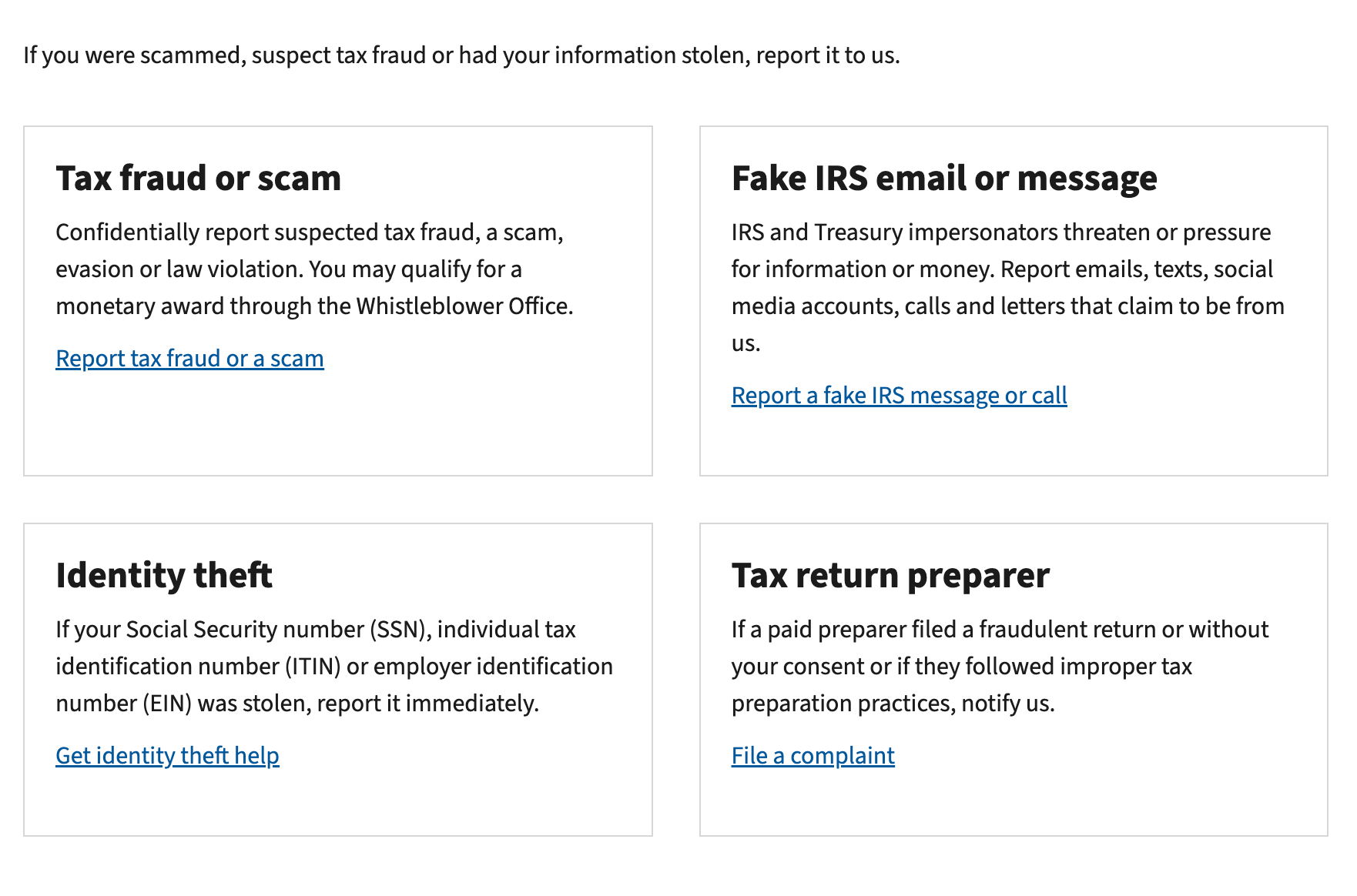
IRS report fraud page
What Is W-2 Fraud and Why Do Organizations Fall for It?
W-2 fraud is a form of Business Email Compromise that specifically targets payroll and human resources departments. In these schemes, attackers impersonate company executives and request copies of employee W-2 tax forms.
The emails often appear urgent and authoritative, typically instructing HR staff to send payroll records quickly for a supposed internal review. Because the requests appear to come from senior leadership, employees sometimes comply without verifying the message.
When successful, attackers gain access to sensitive employee information, including Social Security numbers, addresses, and income details. This data can be used to file fraudulent tax returns, commit identity theft, or sell records in underground markets.
How Do Business Email Compromise and W-2 Theft Enable Tax Fraud?
Business Email Compromise (BEC) schemes are closely linked to W-2 fraud and remain one of the most financially damaging forms of cybercrime affecting organizations during the tax season. In these attacks, cybercriminals compromise legitimate email accounts or spoof trusted addresses to impersonate executives, payroll managers, or senior staff. They then send urgent messages requesting copies of employee tax documents.
Once attackers obtain these records, the data can be used to file fraudulent tax returns, commit identity theft, or be sold through underground marketplaces. Because the request appears to come from a trusted internal authority, employees may respond quickly without verifying the legitimacy of the message, making W-2 phishing highly effective.
BEC attacks frequently involve financial manipulation. According to threat intelligence presented during National Tax Security Awareness Week briefings, wire transfers remain the preferred payment method for attackers, accounting for roughly 88% of BEC proceeds, and the median amount stolen per incident has remained around $50,000.
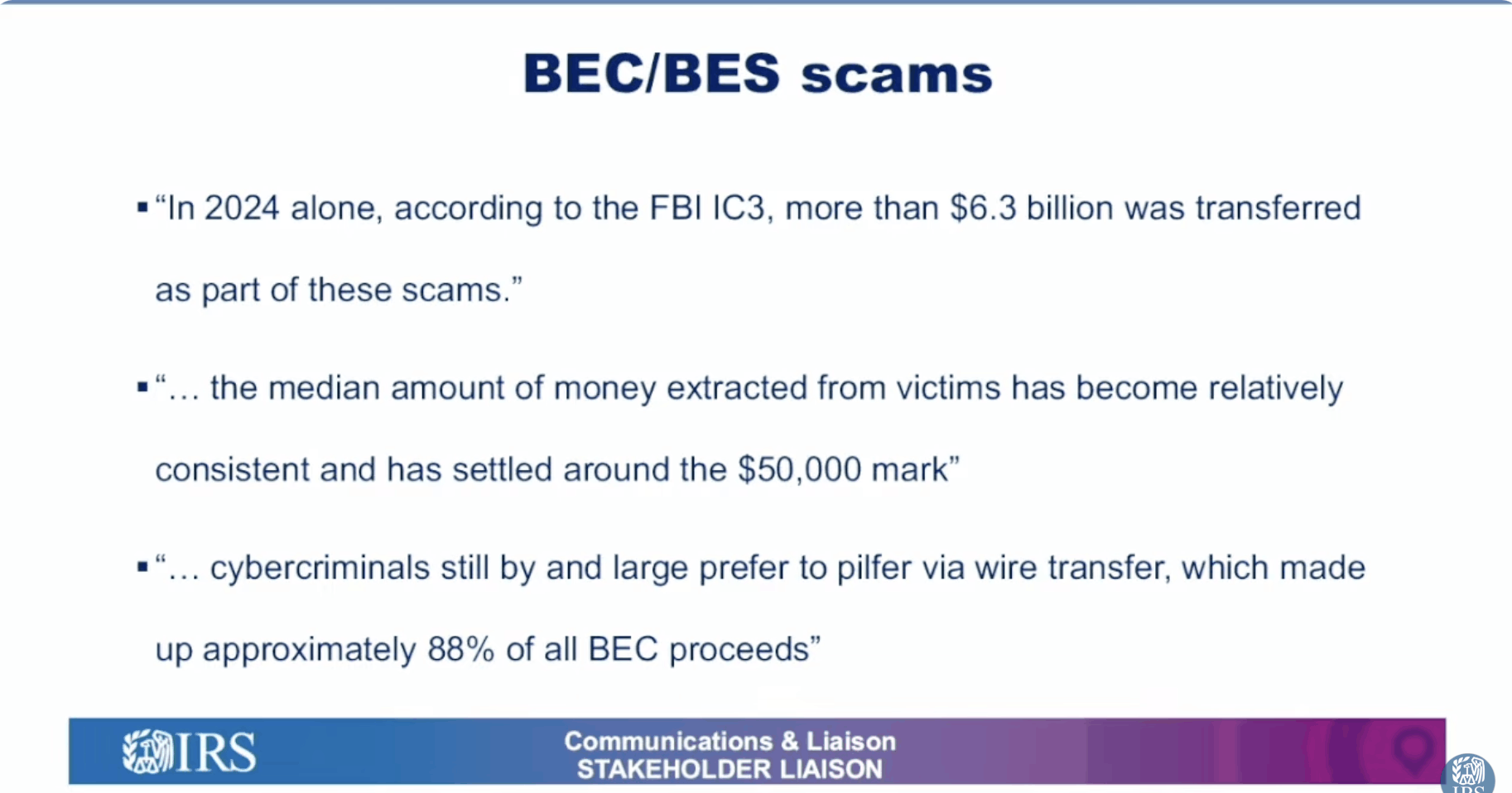
BEC scams statistics (Source: National Tax Security Awareness Week briefing)
These schemes can involve very large transfers, particularly in cases where attackers intercept business transactions such as payroll payments or real estate deals. Data referenced in the same briefings indicates that more than $6.3 billion has been transferred through BEC/BES-related scams in a single year of reported incidents, illustrating the scale of financial movement associated with these attacks. This figure reflects the total value of fraudulent transactions reported in BEC cases rather than confirmed annual victim losses, but it highlights how attackers rely heavily on financial transfers to monetize these schemes.
What Are IRS Phishing Scams and How Do They Work?
IRS-themed phishing attacks are among the most common cyber threats associated with the U.S. tax filing period. Threat actors frequently impersonate the IRS, tax preparation services, payroll providers, or financial institutions in order to trick individuals and organizations into revealing sensitive financial and identity information.
Typical phishing messages claim the recipient must verify tax details, review a refund notification, or respond to an alleged issue with their tax filing. These emails often contain links that redirect victims to fake websites designed to collect credentials, Social Security numbers, or banking information.
Some campaigns also distribute malware through attachments disguised as tax forms or verification documents. If opened, these files can install malicious software that steals stored credentials or allows attackers to gain access to the infected system. Security researchers have observed tax-themed phishing emails delivering malware loaders and remote access tools capable of collecting financial data or installing additional malicious payloads.
Attackers increasingly rely on techniques such as URL shorteners, QR codes, and legitimate file-hosting services to disguise malicious links and bypass security filters. In some cases, phishing emails contain PDF attachments with embedded links or QR codes that lead victims to credential-harvesting pages designed to mimic trusted login portals.
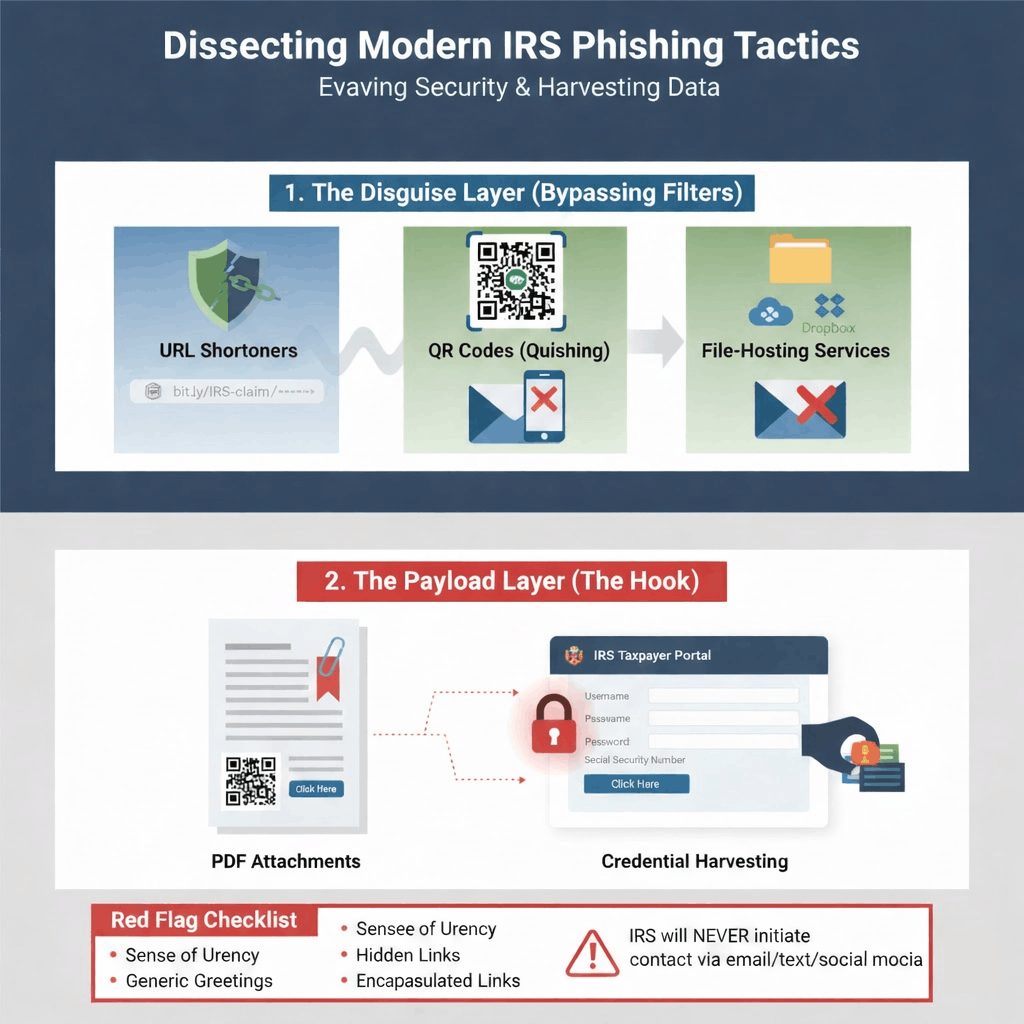
IRS phishing scams
To make these campaigns appear legitimate, threat actors often replicate official IRS branding, language, and formatting. However, the IRS clearly states that it does not initiate contact with taxpayers through unsolicited emails, text messages, or social media requests for personal or financial information. Messages requesting such details through these channels are a strong indicator of phishing activity.
Individuals who receive suspicious IRS-related emails are encouraged to forward them to [email protected] so investigators can track and shut down malicious campaigns. The IRS also advises users not to click links, open attachments, or respond to suspicious messages before reporting them.
How Does Spear-Phishing Enable Tax Season Attacks?
Many tax-season attacks begin with spear-phishing, a targeted form of phishing that impersonates trusted individuals or organizations. Unlike mass phishing campaigns, spear-phishing messages are crafted to target specific recipients, such as payroll employees, tax preparers, or accounting firms.
Security experts warn that spear-phishing plays a major role in data breaches and credential theft. The IRS notes that an estimated 91% of cyberattacks begin with spear-phishing emails, which attempt to trick victims into clicking malicious links or opening infected attachments.
These attacks are particularly dangerous for tax professionals. IRS data indicates that about 60% of spear-phishing reports submitted to [email protected] target tax professionals, often through “new client” scams where attackers pretend to be prospective customers requesting tax services.
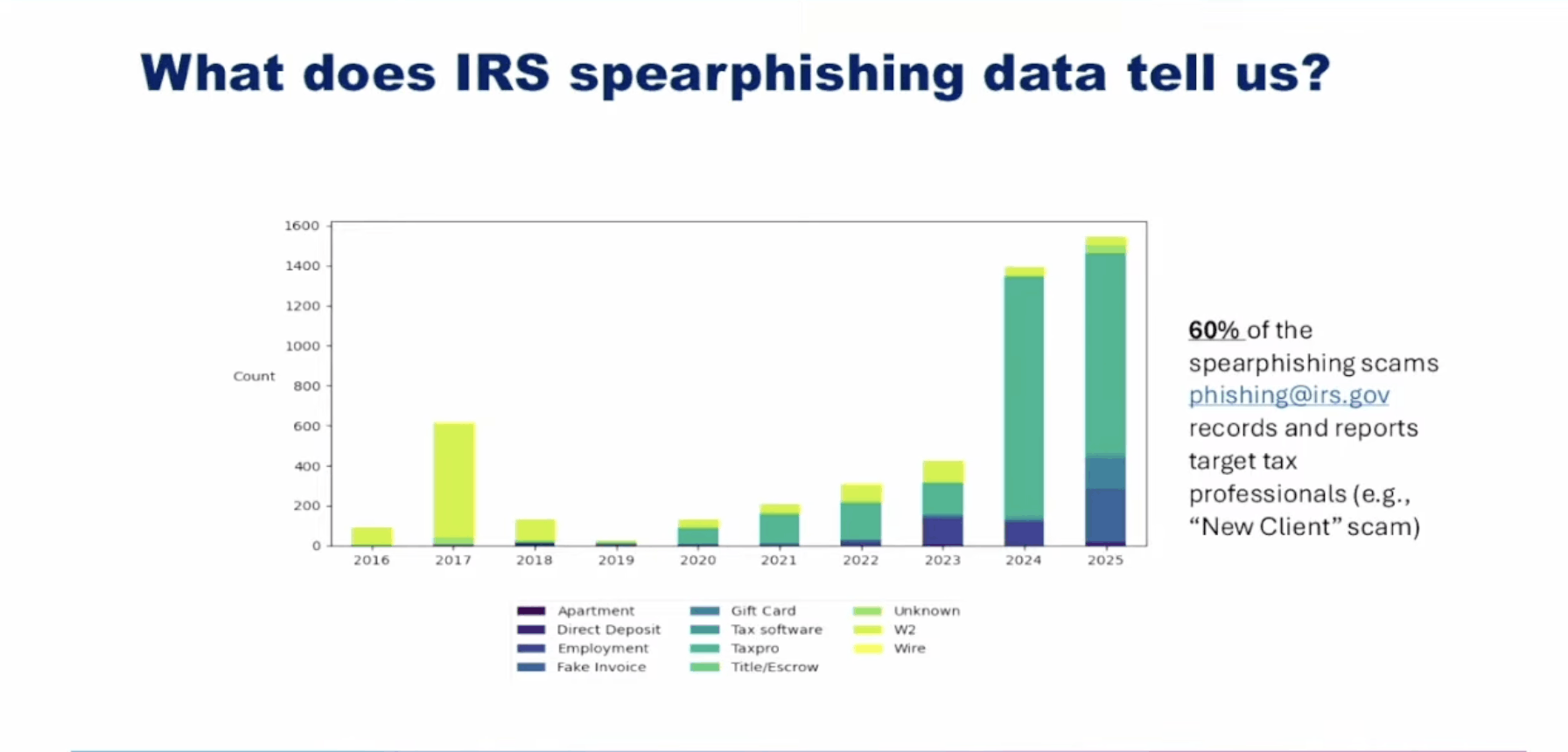
IRS data on spear-phishing scams (Source: National Tax Security Awareness Week briefing)
In these scenarios, attackers initiate an email conversation and later send a malicious attachment that appears to contain tax documents. Instead, the attachment may install malware or steal login credentials, allowing criminals to access tax preparation software and sensitive client data. Once compromised, attackers can file fraudulent returns, steal identities, or launch further phishing attacks using the victim’s trusted email account.
Because tax professionals store large volumes of personal and financial data, even a single successful spear-phishing attack can expose thousands of taxpayer records.
How Do Attackers Use the Dark Web During Tax Season?
The Dark Web plays a significant role in tax-related cybercrime. Stolen personal information, tax credentials, and refund-related data are frequently traded in underground forums and marketplaces where cybercriminals buy and sell access to sensitive datasets.
Threat actors may sell complete identity packages that include Social Security numbers, tax records, email addresses, and other financial information. These datasets allow buyers to file fraudulent tax returns before legitimate taxpayers submit their filings. Because tax refunds are often issued quickly once a return is accepted, criminals attempt to exploit stolen identities early in the filing process to redirect refunds to accounts they control.
Dark Web marketplaces also provide services that support tax fraud operations. Criminal vendors may offer phishing kits, compromised email accounts, malware designed to harvest tax credentials, or automated tools used to submit fraudulent refund claims. These tools lower the technical barrier for criminals, allowing individuals with limited technical skills to participate in tax-related fraud schemes.
Threat intelligence monitoring often shows that stolen taxpayer data continues circulating long after the initial breach. Highly sensitive information such as Social Security numbers can be reused for identity theft, fraudulent tax filings, financial account takeovers, and other forms of fraud.
Example: Alleged Database of American Taxpayers Offered for Sale
Threat intelligence monitoring from SOCRadar Dark Web News has highlighted cases where large datasets of taxpayer information appear for sale on underground forums. In one observed listing, a threat actor advertised a database allegedly containing information belonging to 1.9 million American taxpayers. According to the forum post, the dataset included full names, Social Security numbers (SSNs), email addresses, and phone numbers, all structured in a format suitable for identity fraud.
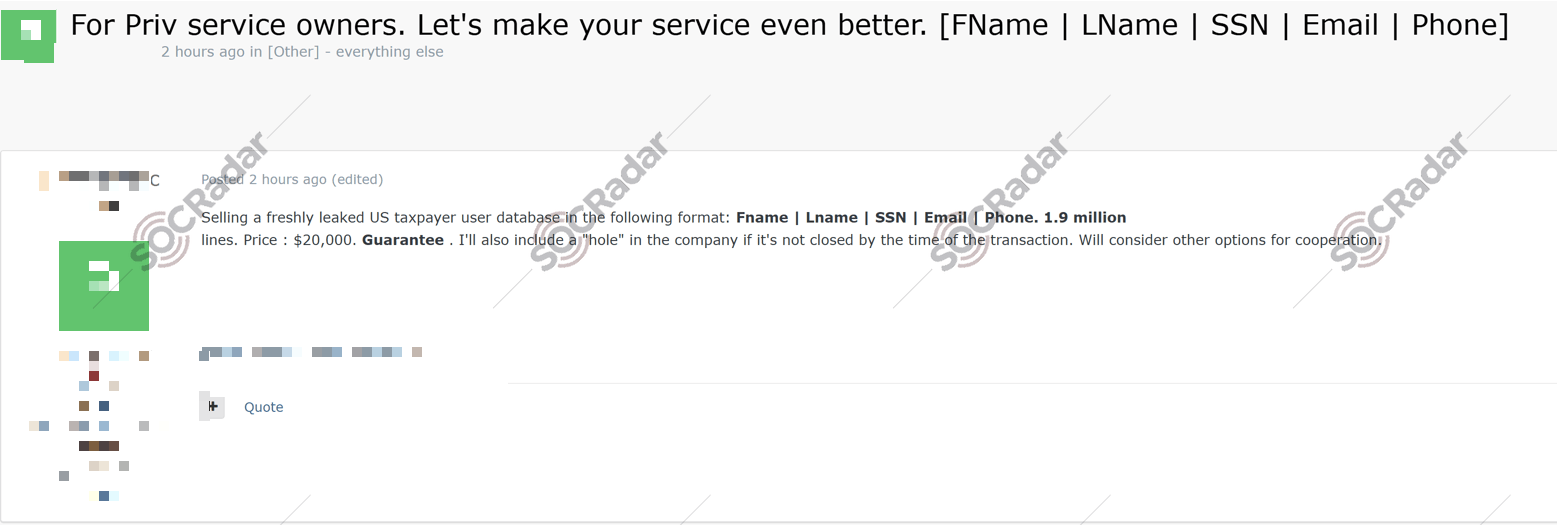
Example Dark Web forum post advertising a database containing 1.9 million U.S. taxpayer records (Source: SOCRadar Dark Web News)
The seller listed the dataset for $20,000 and claimed that the information originated from a breach involving an organization that handled taxpayer data. The threat actor also suggested that a security vulnerability within the affected company’s systems remained open, implying the possibility of further exploitation. If authentic, datasets like this could enable large-scale identity theft and fraudulent tax filings.
Listings such as this demonstrate how stolen taxpayer information becomes a commodity within cybercriminal ecosystems. Once exposed, these datasets can be purchased by other threat actors and reused for various financial crimes, including tax refund fraud, identity theft, and account takeover attacks.
How Do Impersonation Attacks Target Taxpayers and Businesses?
Impersonation attacks have become increasingly sophisticated during tax season. Attackers frequently spoof email domains or create fake websites that closely resemble official tax portals.
These campaigns may impersonate the IRS, accounting firms, payroll providers, or tax preparation services. Victims are often asked to log in to fake portals, verify financial details, or download documents that contain malicious software.
Email authentication failures and domain spoofing remain common factors behind these attacks. Without proper email authentication protocols such as DMARC, attackers can successfully send messages that appear to originate from trusted organizations.
Security analysts note that tax-themed impersonation campaigns frequently combine multiple techniques, including phishing emails, malicious links, and credential harvesting pages. These tactics increase the chances of successfully compromising victims during the busy filing period.
How Can Individuals and Organizations Reduce Tax Season Risks?
Reducing tax-related cyber risks requires both technical defenses and strong awareness practices. Because many tax scams rely on social engineering, education and verification procedures remain critical.
Organizations can reduce exposure by implementing verification policies for sensitive payroll requests, monitoring suspicious email activity, and enabling multi-factor authentication. Threat intelligence sources such as SOCRadar Dark Web News can also help identify emerging fraud trends and potential data exposures linked to tax-related cybercrime.
Individuals should remain cautious when receiving tax-related communications and avoid clicking links in unsolicited emails. Accessing tax portals directly through official websites and verifying suspicious messages with tax professionals can prevent many scams.
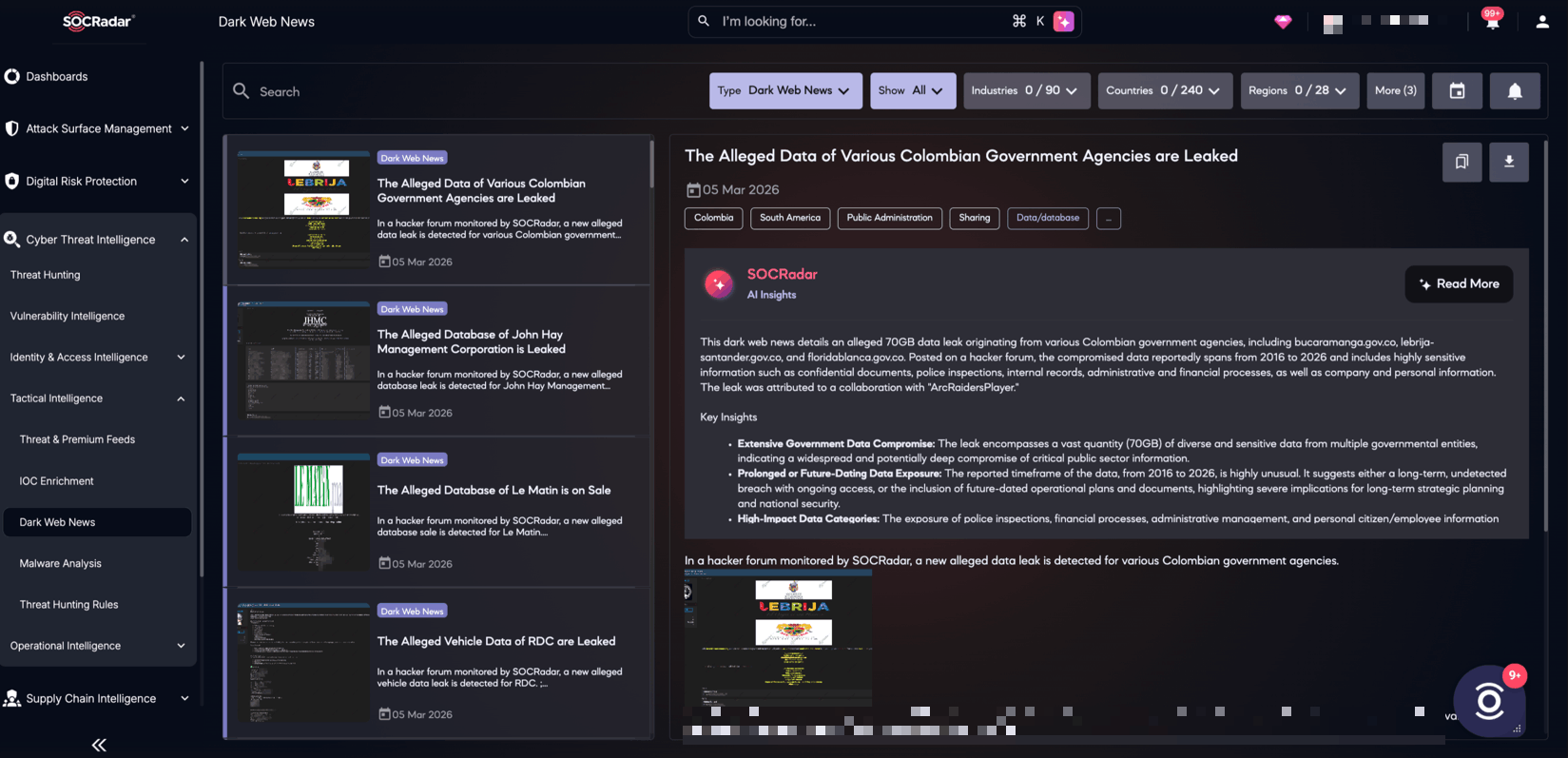
Use SOCRadar’s Dark Web News to always stay ahead of incoming threats.
Organizations may also benefit from Dark Web monitoring capabilities, such as SOCRadar Dark Web Monitoring, which help detect leaked credentials, exposed personal data, or underground discussions involving stolen taxpayer information. Early detection can allow security teams to respond before attackers exploit the data for identity theft or fraudulent tax filings.
Government agencies and cybersecurity experts consistently emphasize that awareness and proactive monitoring remain key defenses against seasonal fraud campaigns.

Table Of Content
U.S. Tax Season: How Threat Actors Exploit IRS Phishing, W-2 Fraud, and Dark Web Activity
Why Is The U.S. Tax Season Attractive to Cybercriminals?
What Types of Tax-Related Scams Target Individuals?
What Are IRS Phishing Scams and How Do They Work?
How Does Spear-Phishing Enable Tax Season Attacks?
How Do Attackers Use the Dark Web During Tax Season?
How Do Impersonation Attacks Target Taxpayers and Businesses?
How Can Individuals and Organizations Reduce Tax Season Risks?
Related Articles