

Oct 07, 2026
Aug 22, 2025
5 Mins Read

Summarize with:
What Are Deep Web Threat Intelligence Solutions?
The deep web is much larger than the surface web and contains private, non-indexed resources that search engines cannot access. From academic databases to banking portals, these examples of the deep web show its everyday importance. With the help of Deep Web Threat Intelligence solutions, organizations can turn this hidden layer into actionable insights and stay ahead of cyber risks.
Examples Of Deep Web
The deep web is the vast portion of the internet that search engines cannot index, far larger than the surface web we use every day. While it is often confused with the dark web, the deep web is not inherently malicious. Instead, it powers many of the secure and legitimate services we rely on daily. Examples of the deep web include academic databases, subscription-only research platforms, medical record systems, online banking dashboards, corporate intranets, private email inboxes, cloud storage services, and financial dashboards.
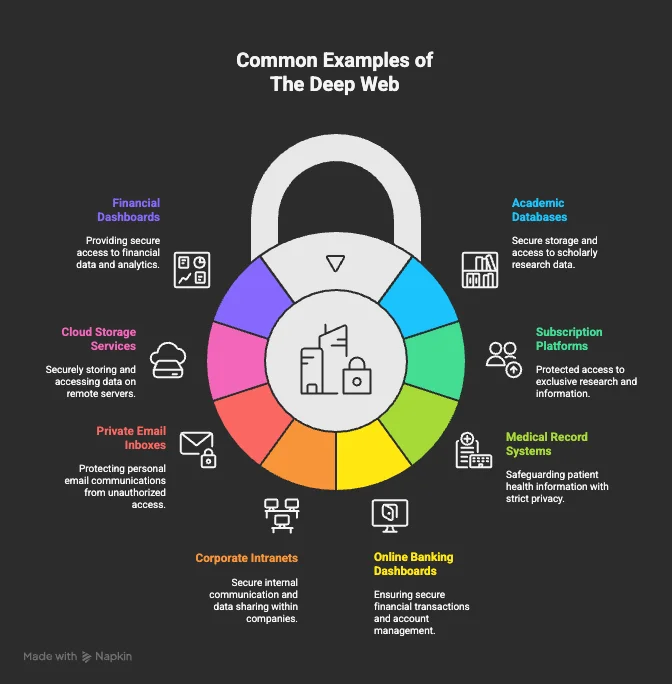
For security professionals, these hidden environments are more than just private portals – they are potential sources of early-warning intelligence. When paired with Deep Web Threat Intelligence solutions, the deep web becomes a powerful tool for detecting credential leaks, uncovering fraud attempts, monitoring compliance-sensitive systems, and identifying risks before they escalate. By monitoring and analyzing non-indexed environments, organizations gain visibility into areas that attackers may exploit, transforming the deep web from an invisible layer into a proactive defense resource.
What Are Deep Web Threat Intelligence Solutions?
Deep Web Threat Intelligence solutions are platforms that collect, analyze, and transform non-indexed data into actionable insights for cybersecurity teams. They extend visibility beyond the surface web, uncovering hidden risks that cannot be found through traditional search engines.
SOCRadar’s solutions integrate seamlessly with SOC operations, providing organizations with real-time monitoring, fraud detection, and contextual intelligence to counter evolving threats.
How Deep Web Data Enhances Threat Intelligence Programs
- Early detection of breaches by monitoring hidden portals.
- Context enrichment for alerts in SOC and SIEM.
- Fraud protection against financial scams and stolen data.
- Industry-specific visibility, from healthcare to finance.
- Compliance monitoring for regulated environments.
Key Features of Effective Deep Web Intelligence Tools
Types of Threats Detected Through Deep Web Monitoring
- Credential leaks from password-protected systems.
- Insider activity within private enterprise portals.
- Exposed medical and financial records.
- Misconfigured cloud environments leaving data open.
- Subscription leaks of sensitive research or IP.
Why Enterprises Need Deep Web Threat Intelligence
Every modern enterprise depends on deep web resources for daily operations — from online banking portals to cloud collaboration platforms. Without intelligence from these environments, organizations risk blind spots in their defense, making them vulnerable to fraud, compliance violations, and credential abuse.
Use Cases: Applying Deep Web Intelligence in Real-World Scenarios
- Healthcare: Detecting patient record exposures and ensuring HIPAA compliance.
- Financial Services: Monitoring banking dashboards and preventing fraud.
- Education: Protecting research paper databases and student records.
- Enterprises: Securing proprietary content in private cloud services.
Integrating Deep Web Threat Feeds with SOC and SIEM Systems
By integrating feeds into SOC and SIEM platforms, organizations can:
- Correlate alerts with deep web activity.
- Automate responses through SOAR workflows.
- Gain executive-level visibility into high-risk environments.
Challenges in Collecting Threat Intelligence from the Deep Web
- Credential restrictions limiting access.
- Encryption and privacy barriers.
- Massive data volumes requiring AI/ML filtering.
- Legal and ethical constraints in monitoring sensitive data.
Compliance and Privacy Considerations in Deep Web Monitoring
Monitoring the deep web must comply with global data privacy laws. SOCRadar applies ethical intelligence practices to ensure:
- Collection without interference.
- Monitoring without engagement.
- Reporting without exposing sensitive data.
This balance enables actionable security insights while protecting user privacy.
Choosing the Right Deep Web Threat Intelligence Provider
The right provider should offer:
- Advanced monitoring across industries.
- Real-time alerts for PII and credential exposures.
- Integration-ready APIs.
- Proven expertise in compliance and ethical monitoring.
- Scalable intelligence tailored to enterprise needs.
FAQ – Deep Web vs Surface Web Examples
Q: What are some real examples of deep web websites?
Examples include academic databases, online banking dashboards, private corporate intranets, medical portals, and cloud storage systems.
Q: Is my email account part of the deep web?
Yes. Email inboxes are private, login-protected resources and considered deep web content.
Q: Are online banking portals considered deep web content?
Yes. Banking portals and dashboards are part of the deep web.
Q: Can academic journal databases be classified as deep web?
Yes. Subscription-only academic resources require login credentials, making them deep web.
Q: Are medical records systems part of the deep web?
Yes. Patient record platforms are non-indexed, secure systems.
Q: Do cloud storage services like Google Drive belong to the deep web?
Yes. Login-protected cloud resources are part of the deep web.
Q: Is the deep web illegal or dangerous to access?
No. It is legal and safe when used for legitimate purposes.
Q: Can search engines index deep web content like login-protected portals?
No. Search engines cannot access password-protected or subscription-based content.
Conclusion
The deep web powers much of modern enterprise activity, from financial portals to healthcare records. Yet this hidden layer also presents risks if left unmonitored.
With Deep Web Threat Intelligence solutions, organizations can illuminate hidden risks, protect sensitive data, and ensure compliance across industries. SOCRadar delivers a comprehensive platform with real-time alerts, fraud detection, and integration-ready intelligence that empowers enterprises to stay ahead of evolving threats.

Table Of Content
What Are Deep Web Threat Intelligence Solutions?
Examples Of Deep Web
What Are Deep Web Threat Intelligence Solutions?
How Deep Web Data Enhances Threat Intelligence Programs
Key Features of Effective Deep Web Intelligence Tools
Types of Threats Detected Through Deep Web Monitoring
Why Enterprises Need Deep Web Threat Intelligence
Use Cases: Applying Deep Web Intelligence in Real-World Scenarios
Integrating Deep Web Threat Feeds with SOC and SIEM Systems
Challenges in Collecting Threat Intelligence from the Deep Web
Compliance and Privacy Considerations in Deep Web Monitoring
Choosing the Right Deep Web Threat Intelligence Provider
FAQ – Deep Web vs Surface Web Examples
Conclusion
Related Articles
NetScaler C2: CVE-2026-88771 Exploitation Operation