What Is Agentic Threat Detection?
Key Takeaways
- Agentic threat detection is detection run by autonomous AI agents that choose their own steps toward a goal instead of firing a predefined rule.
- Every agentic detection cycle runs the same five stages: collect, correlate, decide, act, and learn from the outcome.
- Detection asks whether an incoming signal is a threat. Agentic threat hunting starts from an analyst hypothesis and looks where nothing is watching yet.
- The strongest early use cases are high-volume, repeatable decisions: impersonating domains, credential exposure, newly exposed assets, and Tier 1 alert triage.
- Autonomy needs an approval gate on anything with production impact, validated inputs, and a decision log behind every verdict.
Agentic Threat Detection at a Glance
| Also Called | Agentic AI for threat detection, agent-based threat detection |
|---|---|
| What It Is | Threat detection performed by autonomous AI agents that plan their own steps toward a stated goal |
| What It Replaces | Static rules and signature matching that fire only on patterns someone predicted in advance |
| Core Traits | Autonomy, memory, goal-directed reasoning, awareness of a changing environment |
| Typical Decisions | Is this domain impersonating the brand, does this alert deserve an analyst, is this asset newly exposed |
| Human Role | Sets the goal and escalation criteria, reviews escalations, approves high-impact actions |
| Main Risks | Acting on an incomplete read, reasoning errors, poisoned inputs, weak auditability |
What Makes Threat Detection Agentic?
Four properties separate an agent from a script. Remove any one of them and what remains is automation with a language model attached. Autonomy: the agent starts work without being prompted and completes a decision without a human stepping through it. Memory: it keeps context between tasks, so a domain it cleared last week informs how it reads a related domain today. Goal-directed reasoning: it receives an objective, such as confirming whether a lookalike domain threatens the brand, and picks its own route to the answer. Environmental awareness: it reads the environment it defends, including which assets are exposed and which actors target the sector, and adjusts its weighting as that picture changes. Those same four traits define the wider category of agentic threat intelligence, which covers the full intelligence lifecycle. Detection is the layer where an agent first recognizes that something deserves attention.How Agentic AI for Threat Detection Works?
An agentic detection cycle repeats five stages, and each pass leaves the agent better calibrated than the last.
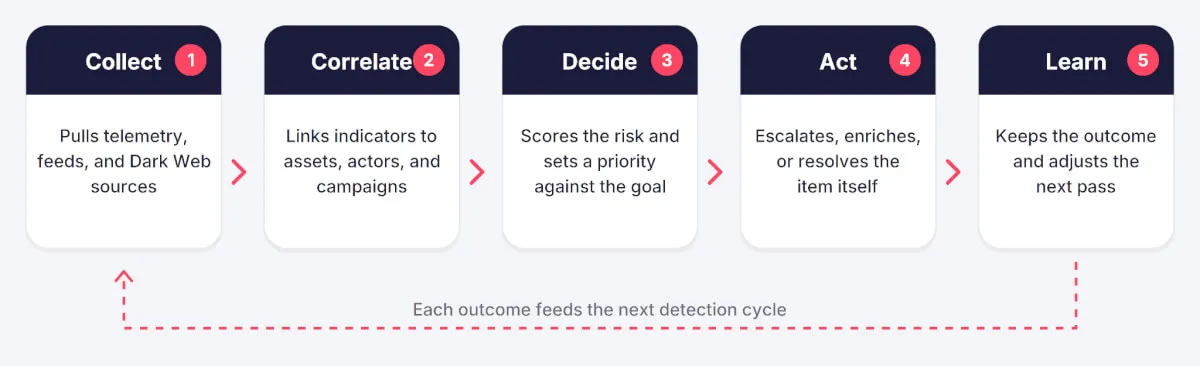
The five stages of an agentic threat detection cycle.
Collect: the agent pulls the signals relevant to its goal, including telemetry, threat feeds, certificate and DNS records, and Dark Web sources, and it decides which of them to query rather than waiting for a scheduled ingest. Correlate: it links each indicator to the assets, actors, and campaigns it already knows about, which is where a bare IP address becomes an actor-attributed staging server. Decide: it scores the finding against the goal and assigns a priority, weighing exposure, asset value, and confidence in the evidence. Act: it escalates the item with the evidence attached, enriches it for the queue, or closes it out when the case for a threat fails. Learn: it records the outcome, including analyst overrides, and carries that into the next cycle so repeated false positives stop consuming attention. Multi-model validation belongs inside the decide stage. Using one model to reach a verdict and a second to check it catches the confident wrong answer that a single model has no way to flag.Agentic Threat Detection vs Agentic Threat Hunting
The two terms get used interchangeably, and they describe different jobs.
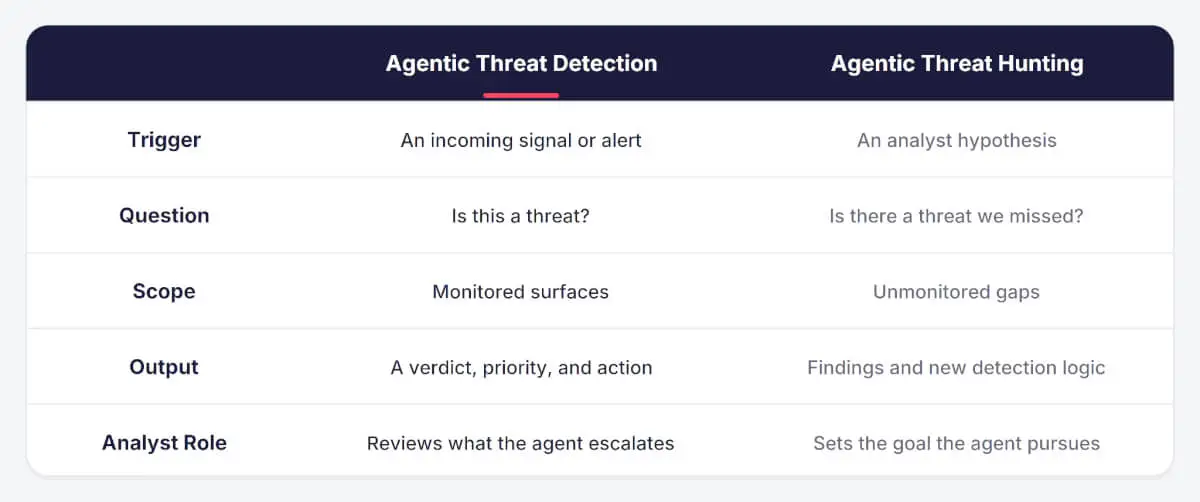
Agentic threat detection compared with agentic threat hunting.
Detection is reactive by design. Something arrives, and the agent judges it. Threat hunting starts from the opposite end, with an analyst assuming a threat is already inside and asking where. Agentic threat hunting hands that hypothesis to an agent, which queries, pivots on what it finds, and reports back. In practice the two feed each other. A hunt that confirms a technique produces detection logic the agents then apply continuously, and detection outcomes reveal which gaps deserve the next hunt. Teams adopting agents usually start with detection, because the decisions are repeatable and the success criteria are clear.What Agentic Detection Catches That Rules Miss
Impersonating domains and phishing infrastructure: a rule can match a registered lookalike string. An agent compares page text, visual layout, and domain metadata together, which is how it separates a hostile clone from a partner microsite that happens to use the brand name. Credential and data exposure: agents monitor Dark Web markets and leak channels continuously, then check each exposed credential against the assets and identities that actually exist in the environment before raising anything. Newly exposed assets: an agent watching the external attack surface notices a service that appeared this morning, judges what it exposes, and prioritizes it before a scheduled scan would have found it. Alert triage at volume: the largest immediate win is Tier 1 triage. Agents resolve low-risk items before analysts log in, and the items that survive arrive enriched with related indicators and a recommended action.Risks and Guardrails of Agentic Threat Detection
Autonomy is the feature and the risk. An agent that can act on its own conclusion can act on a wrong one, which makes guardrails a prerequisite for deployment rather than a later hardening step.
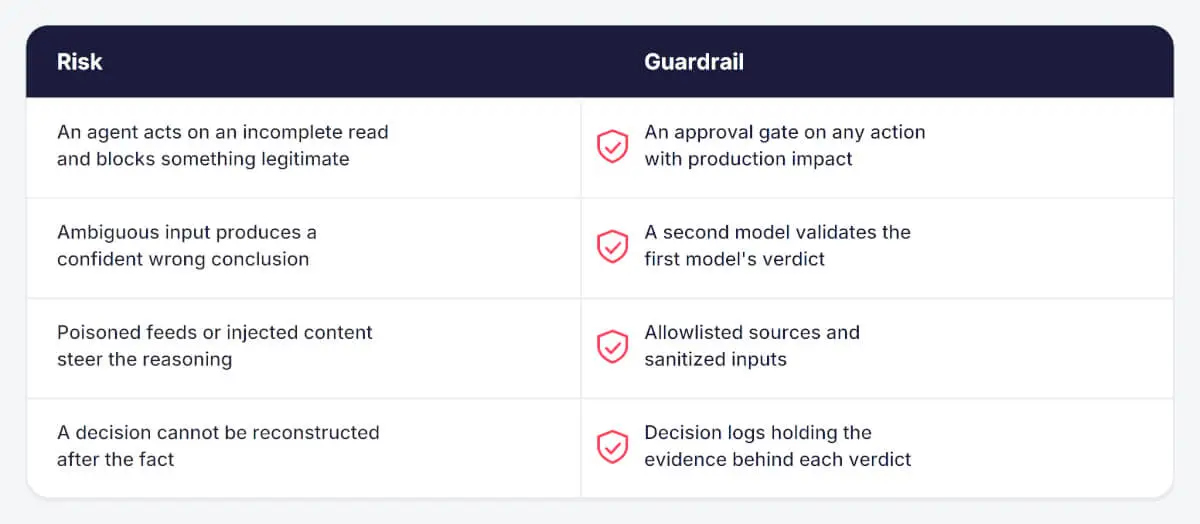
Each risk of agentic threat detection with the guardrail that contains it.
Scope the permissions to the risk: reading, enriching, and prioritizing are safe to hand over early. Blocking, takedown requests, and anything that touches production sit behind an approval gate. Validate the inputs: an agent reasoning over an attacker-controlled page is reading untrusted content. Allowlisted sources and sanitized inputs keep injected instructions out of the reasoning path. Log the reasoning behind each verdict: every decision needs its evidence and its steps recorded in a form an analyst can reconstruct weeks later, which is also what regulators and auditors ask for. Keep a human on the escalation path: analyst overrides are the highest-quality training signal available, and they are the mechanism that keeps a drifting agent visible.How to Apply Agentic Threat Detection
Adoption goes wrong when a team hands agents a broad mandate on day one. A narrower path works better.- Start with one decision: choose a judgment your team already makes the same way every day and give exactly that to an agent. Impersonating domain assessment and Tier 1 alert triage are the usual first choices.
- Write the escalation criteria first: define what the agent resolves alone, what it escalates, and what it never touches, before it processes anything real.
- Give it real intelligence to reason over: an agent is only as good as its context. Detection quality depends on live coverage of the surface web, the Dark Web, and your own external attack surface.
- Run it in parallel before you trust it: compare agent verdicts against analyst verdicts on the same queue for several weeks, then widen scope where the two agree and tune where they diverge.
- Measure against the baseline that mattered before: false positive rate, time to triage, and the share of alerts closed without human touch tell you whether the agent earned its scope.
Frequently Asked Questions
Q: What Is Agentic Threat Detection?
A: Agentic threat detection is threat detection carried out by autonomous AI agents that pursue a goal instead of executing a fixed rule. The agent decides which sources to query, correlates what it finds against the environment it is defending, scores the risk, and then escalates the item with its evidence attached or resolves it on its own.Q: How Is Agentic AI for Threat Detection Different From Traditional Detection?
A: Traditional detection compares an input against a pattern that someone wrote in advance, so it catches what was predicted and misses the rest. Agentic AI for threat detection reasons toward an outcome, gathers additional context when the first answer is thin, and adapts as the attacker changes technique. It also arrives at a priority and a recommended action rather than a raw alert.Q: Is Agentic Threat Detection the Same as SOAR Automation?
A: No. A SOAR playbook runs a path a human defined, in the form of if X, then Y. An agent receives the objective and selects its own path, which is why it holds up against inputs nobody wrote a rule for. Automation remains useful underneath an agent for the deterministic steps.Q: What Is the Difference Between Agentic Threat Detection and Agentic Threat Hunting?
A: Detection is triggered by an incoming signal and asks whether that signal represents a threat. Hunting is triggered by a hypothesis and asks whether a threat is already present somewhere nobody is watching. Agentic threat hunting hands that hypothesis to an agent, which then queries, pivots, and reports back with findings that often become new detection logic.Q: What Are the Risks of Letting an AI Agent Detect Threats?
A: Four risks matter in practice. An agent can act on an incomplete read and block something legitimate. Ambiguous input can produce a confident wrong conclusion. Poisoned feeds or injected content can steer the reasoning. And a decision that cannot be reconstructed afterward is impossible to audit. Approval gates, model-on-model validation, allowlisted sources, and decision logs address all four.Q: How Do I Start With Agentic Threat Detection?
A: Pick one high-volume decision your team already makes the same way every day, such as judging whether a lookalike domain is hostile. Give an agent that single decision, keep an analyst on the escalation path, and compare its verdicts against your own for a few weeks before widening its scope or its permissions.
Oct 27, 2026
Australia’s Annual Cyber Threat Report 2025-26 Shows Cyber Incidents Up 20%
Australia’s cyber security authority responded to 1,524 cyber security incidents in the 2025-26 financial year, a 20% increase from the previous year…

Oct 27, 2026
PHP2Shell Weaponized After Japanese Real Estate Extortion
An exposed server ties an extortion wave on about 20 Japanese property sites to an operator who later weaponized PHP2Shell (CVE-2026-109618, CVE-2026-109619)…
Oct 27, 2026
Wasmtime Sandbox Escape Flaws Patched in Cranelift
Two critical Wasmtime sandbox escape flaws, CVE-2026-115889 and CVE-2026-115893, let a crafted WebAssembly (Wasm) module push the Cranelift compiler into generating unsafe…
Intelligence in your inbox every Thursday.
Join 30,000+ security professionals reading SOCRadar research.
Subscribe