
What Is the Clear Web?
The clear web, also called the surface web, is the publicly accessible part of the internet that standard search engines can index. It includes public websites, news pages, blogs, product pages, social profiles, documentation, and other content available without special software or authentication.
Public visibility does not make clear-web content harmless or complete. Attackers use ordinary hosting, social platforms, code repositories, advertisements, paste sites, and messaging services for impersonation, phishing, leaks, malware delivery, and reconnaissance.
Key Takeaways
- Public websites and indexed pages is a central category or use case.
- Reliable assessment depends on source, timing, ownership, and operational context.
- Detection should connect external findings with identity, device, network, and business signals.
- Response should protect affected people and remove every reusable access path.
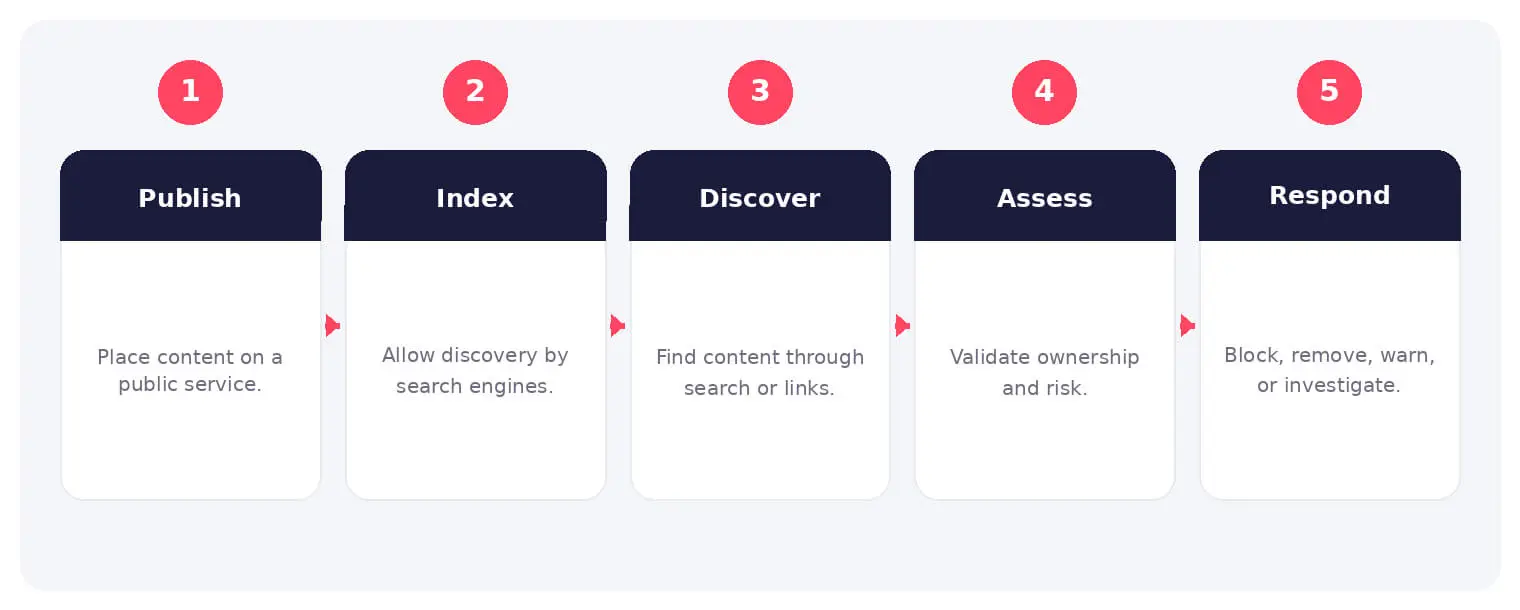
How the Clear Web Works
The sequence shown above provides a practical operating model. Individual steps may overlap, repeat, or involve different services and participants, so analysts should validate each stage against available evidence.
Public visibility does not make clear-web content harmless or complete. Attackers use ordinary hosting, social platforms, code repositories, advertisements, paste sites, and messaging services for impersonation, phishing, leaks, malware delivery, and reconnaissance.
Common Types and Use Cases
- Public websites and indexed pages
- Social media and public communities
- Code repositories and file-sharing pages
- News, paste, advertising, and marketplace content
Security, Privacy, and Business Risks
- Brand impersonation and phishing
- Public leakage of secrets or internal data
- Reconnaissance against people and assets
- Malware distribution and fraudulent advertising
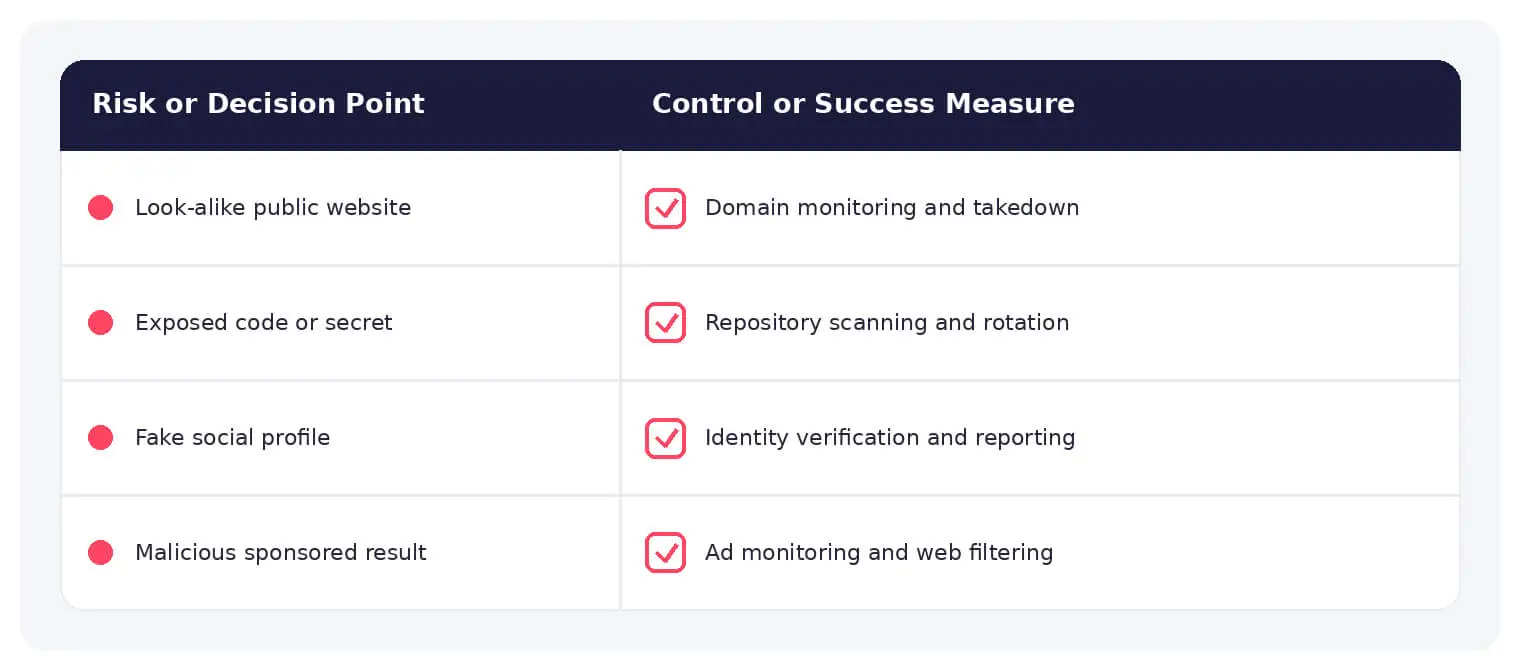
Warning Signs and Validation
Monitor brand names, executives, domains, certificates, source-code exposure, public credentials, cloned pages, advertisements, and newly indexed assets. Validate content because search results can be stale, copied, or misleading.
Prevention and Response
Reduce public data exposure, protect official accounts and domains, scan repositories for secrets, publish trusted channels, monitor look-alike infrastructure, and maintain takedown and incident-response workflows.
How SOCRadar Can Help
SOCRadar combines external intelligence, Dark Web visibility, brand monitoring, attack-surface discovery, and contextual enrichment to help teams identify exposure and investigate activity connected to clear web.
Explore SOCRadar Brand Protection or request a demo to strengthen external threat detection and response.
Frequently Asked Questions
What Counts as Clear Web Content?
The clear web covers every page that standard search engines can crawl and index: public websites, news, blogs, product and documentation pages, social profiles, forum threads, paste sites, and marketplace listings. It is defined by indexability, not by trustworthiness — legitimate businesses and malicious campaigns share the same public space.
Why Do Attackers Use Public Internet Services Instead of Hidden Channels?
Ordinary hosting, social platforms, repositories, ad networks, and paste sites are cheap, quick to set up, and inherit the trust users place in familiar domains and brands. They also reach victims who never use anonymity tools, which makes them practical for phishing, impersonation, malware delivery, and reconnaissance. Because the platforms themselves are legitimate, removal depends on provider abuse processes and can lag behind an active campaign.
How Are Trusted Platforms Turned Into Attack Infrastructure?
Attackers register look-alike domains, clone login pages, push malicious code into public repositories, run fraudulent advertisements, and post leaked data to paste sites — without compromising the platforms themselves. Their advantage is speed and volume: by the time content is reported and removed, copies may already be indexed, shared, or mirrored elsewhere.
Which Clear Web Findings Deserve Fast Investigation?
Treat the following as high-priority leads:
- Look-alike domains or cloned login pages that use your brand
- API keys, passwords, or configuration files exposed in public repositories
- Credentials or internal documents posted to paste sites
- Executive impersonation on social platforms or fraudulent advertisements bidding on your brand terms
Confirm each finding before acting, because search results can be stale, duplicated, or deliberately misleading.
How Should Teams Respond to a Look-Alike Domain or Cloned Page?
Preserve evidence first — capture the page content, domain registration records, and hosting details before anything disappears. Then report the site through the registrar, host, and platform abuse channels, warn affected users or customers if credentials may have been harvested, and block the associated indicators internally while removal is pending. Keep watching for reregistrations, because removed infrastructure often reappears under a new name.
What Steps Reduce Harmful Exposure on the Clear Web?
Limit what attackers can use: remove unnecessary documents and metadata from public pages, restrict repository permissions, and scan code for committed secrets. Secure official domains with registrar locks and DNS protections, and publish SPF, DKIM, and DMARC records to make direct spoofing of your domain harder — recognizing that these controls do not stop every form of phishing. Maintain trusted, easy-to-find channels so customers and staff can verify legitimate communications.
Is It Legal to Monitor Clear Web Content for Security Purposes?
Collecting publicly available content for security purposes is generally lawful, but the legal picture depends on how data is gathered, stored, shared, and acted upon. Teams should align collection practices with privacy regulations, platform terms of service, and the jurisdictions where affected people and systems are located.
Why Does Clear Web Monitoring Complement Internal Security Tools?
Endpoint, email, and network tools see what reaches your environment, but they rarely surface a rogue domain registered weeks earlier or a secret pushed to a public repository. Clear-web monitoring closes that gap by flagging impersonation, leaks, and targeting before malicious traffic arrives, adding context that internal telemetry alone cannot provide.
Does a Finding on the Clear Web Confirm a Breach?
No. A look-alike domain, leaked credential, or copied document shows that your brand or data is being referenced publicly, not how the content originated. Findings can stem from employee mistakes, third-party leaks, credentials recycled from unrelated breaches, or fabricated posts, so each one needs assessment against its source, timing, ownership, and operational context before conclusions are drawn.
How Do the Clear Web, Deep Web, and Dark Web Differ?
The three terms describe different levels of indexability:
- Clear web: pages that standard search engines can crawl and index.
- Deep web: any content that is not indexed, including paywalled pages, unlinked pages, dynamic results, and systems behind authentication.
- Dark web: a small, deliberately hidden portion that requires specific software such as Tor or I2P to access.
The deep web is simply everything search engines do not index — it is far larger than the dark web and mostly routine.
Oct 27, 2026
September 2026: FBI Breach, Clop Hijack & IDScan Leak
The major cyber attacks of September 2026 hit federal law enforcement, a rival cybercrime gang, and the companies that verify identities. ShinyHunters…

Oct 27, 2026
Australia’s Annual Cyber Threat Report 2025-26 Shows Cyber Incidents Up 20%
Australia’s cyber security authority responded to 1,524 cyber security incidents in the 2025-26 financial year, a 20% increase from the previous year…

Oct 27, 2026
PHP2Shell Weaponized After Japanese Real Estate Extortion
An exposed server ties an extortion wave on about 20 Japanese property sites to an operator who later weaponized PHP2Shell (CVE-2026-109618, CVE-2026-109619)…
Intelligence in your inbox every Thursday.
Join 30,000+ security professionals reading SOCRadar research.
Subscribe