
What Is Data Loss Prevention (DLP)?
Data Loss Prevention (DLP) is a set of policies and controls that discovers, classifies, monitors, and restricts sensitive data at rest, in motion, and in use.
DLP can operate across endpoints, email, networks, cloud services, and data stores. Effective programs combine content inspection with identity, destination, device, business purpose, and data-owner context to avoid excessive noise.
Key Takeaways
- Data Loss Prevention (DLP) is a set of policies and controls that discovers, classifies, monitors, and restricts sensitive data at rest, in motion, and in use.
- DLP can operate across endpoints, email, networks, cloud services, and data stores. Effective programs combine content inspection with identity, destination, device, business purpose, and data-owner context to avoid excessive noise.
- Accidental sharing and misdelivery is a primary concern.
- Strong programs combine prevention, continuous visibility, ownership, and tested response.
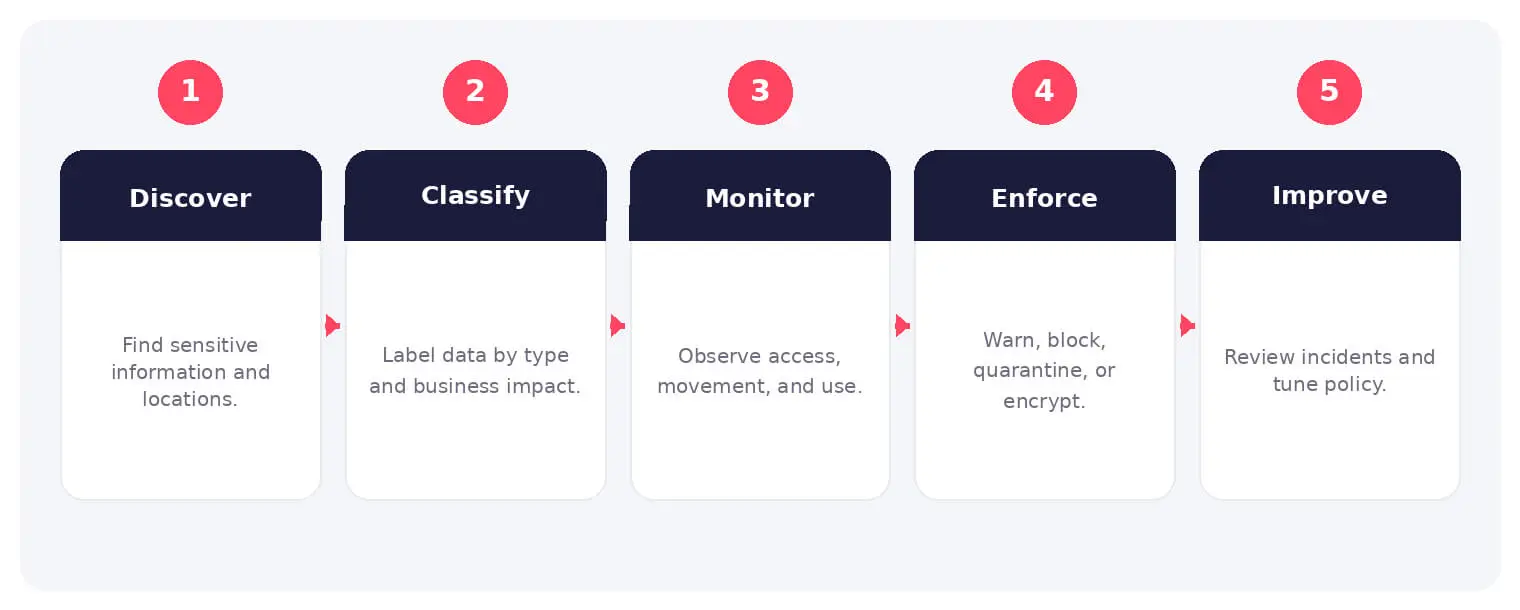
How It Works
The operating flow above turns a broad security objective into observable steps. Exact implementations vary, but each stage needs an owner, trusted inputs, documented policy, and evidence that analysts can use during investigation and review.
DLP can operate across endpoints, email, networks, cloud services, and data stores. Effective programs combine content inspection with identity, destination, device, business purpose, and data-owner context to avoid excessive noise.
Common Types and Capabilities
- Network and email DLP
- Endpoint DLP
- Cloud and SaaS DLP
- Data discovery and storage scanning
Security and Business Risks
- Accidental sharing and misdelivery
- Malicious insider exfiltration
- Cloud and removable-media leakage
- Compliance, financial, and reputational harm
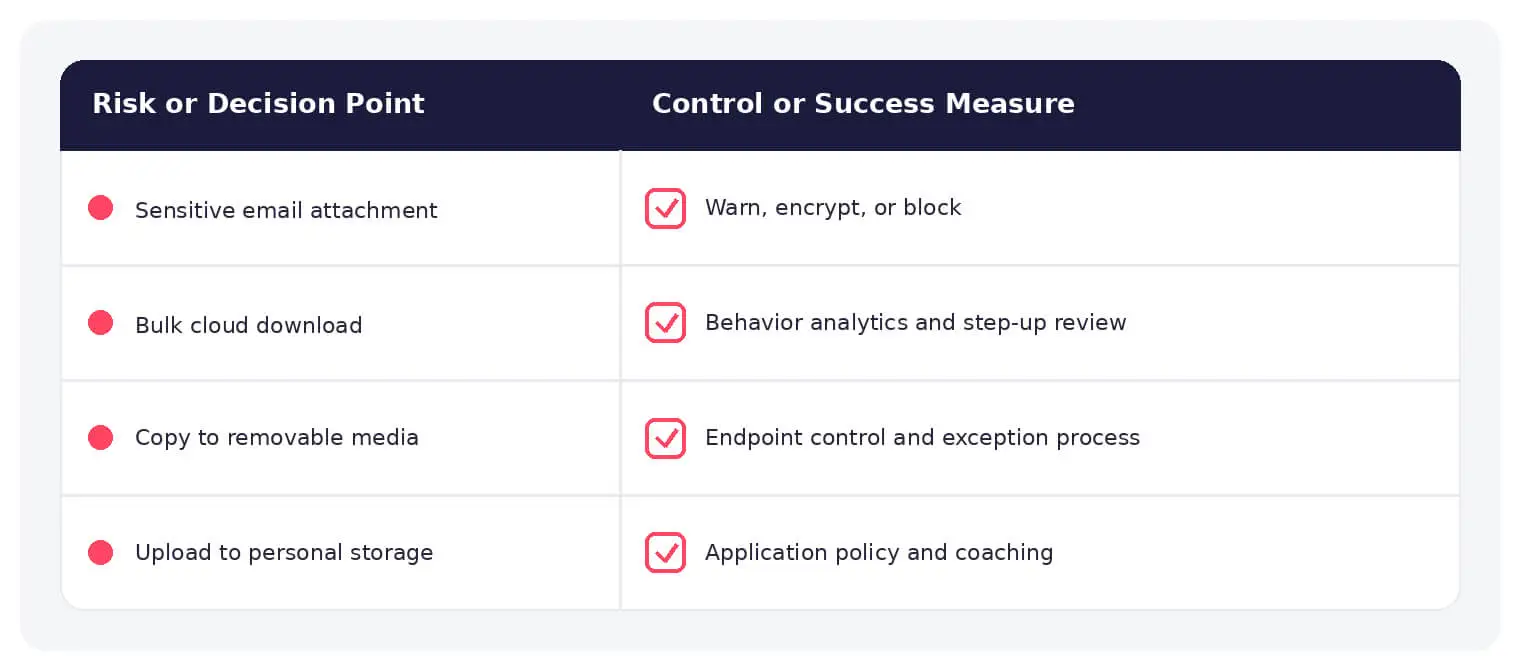
Warning Signs and Detection
Review large transfers, unusual destinations, personal email or storage use, sensitive printing, clipboard or USB activity, abnormal downloads, policy overrides, repeated near-misses, and encrypted archives.
Best Practices
Build a data inventory, classify high-value information, apply least privilege, start in monitor mode, tune with owners, control egress channels, protect keys, and maintain an incident workflow.
How SOCRadar Can Help
SOCRadar adds outside-in asset visibility, threat intelligence, exposure context, and continuous monitoring that help security teams validate and prioritize risks related to data loss prevention. This context complements internal cloud, data, network, and identity controls.
Explore SOCRadar Extended Threat Intelligence or request a demo to strengthen threat-informed prevention and response.
Frequently Asked Questions
What Is Data Loss Prevention (DLP)?
Data Loss Prevention (DLP) is a set of policies and controls that discovers, classifies, monitors, and restricts sensitive data wherever it is stored, transmitted, or processed. Programs typically span endpoints, email, networks, cloud services, and data stores, combining content inspection with context such as identity, destination, and business purpose to keep alert volume manageable.
Which Data States Does DLP Cover?
DLP addresses three data states: at rest (data in databases, file shares, and endpoints), in motion (data crossing networks or leaving via email), and in use (data being processed, printed, or copied). The available control points differ per state, so mature programs define separate policies for each rather than applying one rule everywhere.
What Is the Most Common Risk DLP Addresses?
Accidental sharing and misdelivery, such as sending files to the wrong recipient, uploading records to personal storage, or leaving sharing links open. These mistakes occur far more often than deliberate theft but can trigger the same regulatory, financial, and reputational consequences.
How Does DLP Identify Sensitive Data?
Most platforms combine content inspection techniques, such as pattern matching, keyword dictionaries, data identifiers, and document fingerprinting, with decision context: who is sending the data, to which destination, from what device, and for what business reason. This layered approach reduces the false positives that content matching alone tends to produce.
Where Can DLP Controls Be Deployed?
Endpoint DLP governs local actions like copying to USB drives, clipboard use, and printing; network and email DLP inspect outbound traffic and attachments; cloud and SaaS DLP enforce sharing policies in services like file collaboration platforms; and discovery scanning locates sensitive data sitting in unmanaged or forgotten storage.
Which Warning Signs Suggest Possible Data Exfiltration?
Indicators include unusually large transfers, uploads to personal email or storage accounts, sensitive printing, clipboard or USB activity, abnormal download volumes, policy overrides, repeated near-misses, and sensitive files packed into encrypted archives. Any of these in isolation may be benign, so patterns and context matter more than single events.
What Should Teams Do When a DLP Policy Violation Occurs?
Follow a documented incident workflow: confirm whether the event is a true positive, identify what data and recipient were involved, contain the egress channel if data is still moving, and notify the data owner. Recurring near-misses should feed back into policy tuning rather than being dismissed as noise.
Why Start DLP in Monitor Mode Instead of Blocking Immediately?
Monitor mode lets teams measure real positive rates, understand legitimate business workflows, and tune rules with data owners before enforcement begins. Blocking too early tends to disrupt valid processes, generate user friction, and undermine confidence in the entire program.
How Does DLP Support Compliance Efforts?
Frameworks such as GDPR, HIPAA, and PCI DSS expect organizations to know where sensitive data resides and to demonstrate that it is protected. DLP provides the discovery, classification, and control evidence that auditors and regulators typically ask for, along with records of incidents and responses.
Does DLP Guarantee No Data Will Ever Leave the Organization?
No. Determined insiders, encrypted channels, screenshots, unmanaged personal devices, and channels outside policy coverage can all bypass DLP controls. DLP is intended to work alongside least-privilege access, encryption, user training, and monitoring as part of a broader data protection program.
Oct 16, 2026
CVE-2026-102764: BeyondTrust Zero-Day Exploited
BeyondTrust has disclosed CVE-2026-102764, a critical Remote Support vulnerability exploited as a zero-day weeks before customers received a patch. The attack began…
Oct 15, 2026
Cisco Secure Email & PAN-OS Zero-Days Exploited
Cisco Secure Email & PAN-OS Zero-Days Exploited Cisco and Palo Alto Networks have patched two actively exploited zero-day vulnerabilities that can lead…
Oct 15, 2026
SOCRadar Splunk Integration: New MSSP and Vulnerability Apps
SOCRadar Splunk Integration: New MSSP and Vulnerability Apps Your analysts live in Splunk. Your external risk does not: SOCRadar alarms for dozens…
Intelligence in your inbox every Thursday.
Join 30,000+ security professionals reading SOCRadar research.
Subscribe