

Mar 10, 2026
Jun 25, 2026
6 Mins Read
Sep 13, 2026
Table Of Content
Related Articles
SMS Bombing
Threat Actors
Jan 08, 2026
Dark Web Monitoring
Feb 19, 2026
Ransomware
Jan 31, 2026
Dark Web
Jan 31, 2026

What Is E-Skimming?
E-skimming is the theft of payment or personal data from an online checkout flow through malicious code, compromised scripts, or unauthorized changes to the supporting environment. The browser sends entered data to an attacker while the legitimate transaction may continue normally.
Magecart is an umbrella term often used for groups and campaigns associated with web skimming. The attack can affect a merchant directly or enter through a tag manager, extension, payment integration, analytics script, content delivery service, or other trusted dependency.
Key Takeaways
- E-skimming steals data at the point of entry, before payment information reaches a protected backend.
- Third-party JavaScript and tag-management access expand the checkout trust boundary.
- Visual monitoring alone is insufficient because skimmers can activate only for selected users or conditions.
- Response must remove malicious code, close initial access, assess affected sessions, and meet payment and breach obligations.
How E-Skimming Works
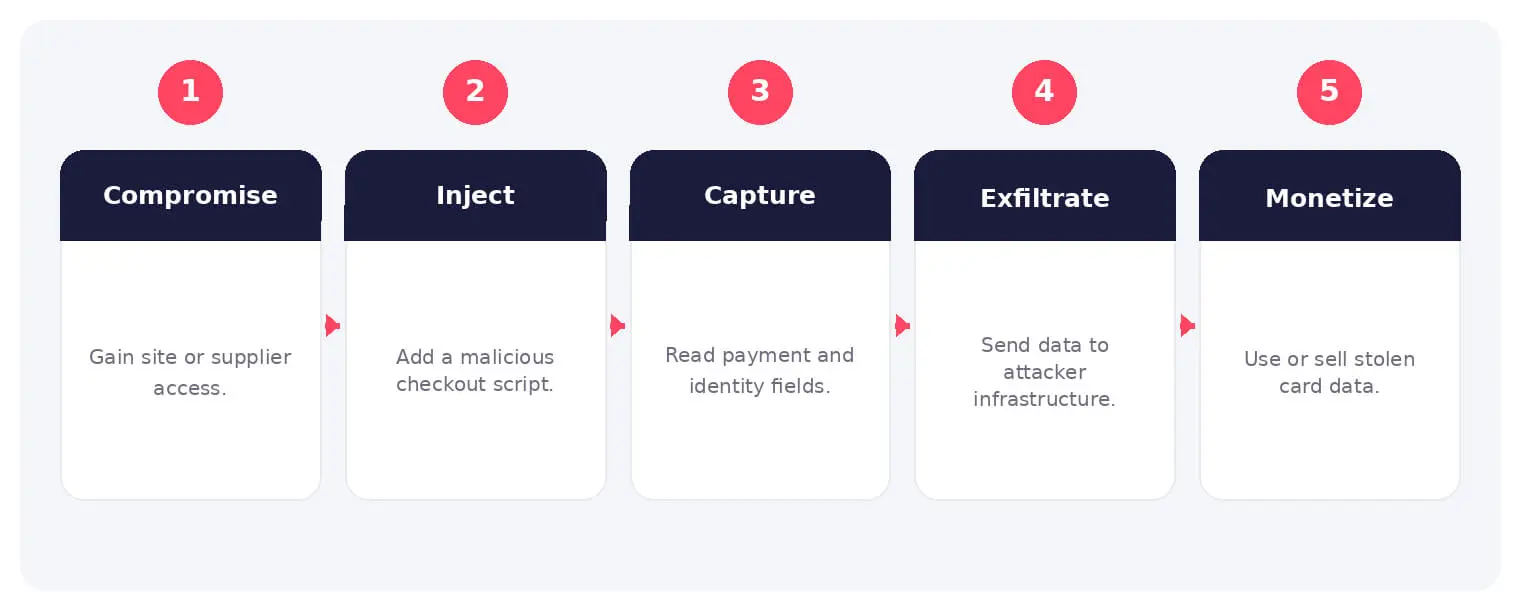
Attackers compromise a website, administrator account, deployment process, plugin, or third-party script. They insert JavaScript that watches checkout fields, overlays a false form, or intercepts values before submission.
The skimmer sends captured data to attacker-controlled infrastructure, sometimes using look-alike domains or encoded requests. Conditional logic, delayed execution, and anti-analysis checks help the code avoid automated scanners.
Common Types and Techniques
- Direct compromise of merchant checkout code
- Third-party script or supply-chain injection
- Fake payment forms and checkout overlays
- Tag manager, plugin, or administrator account abuse
Security and Business Risks
- Theft of payment-card and customer identity data
- Fraud, chargebacks, and payment-brand penalties
- Breach notification and forensic investigation duties
- Damage to customer confidence and online revenue
Warning Signs and Detection
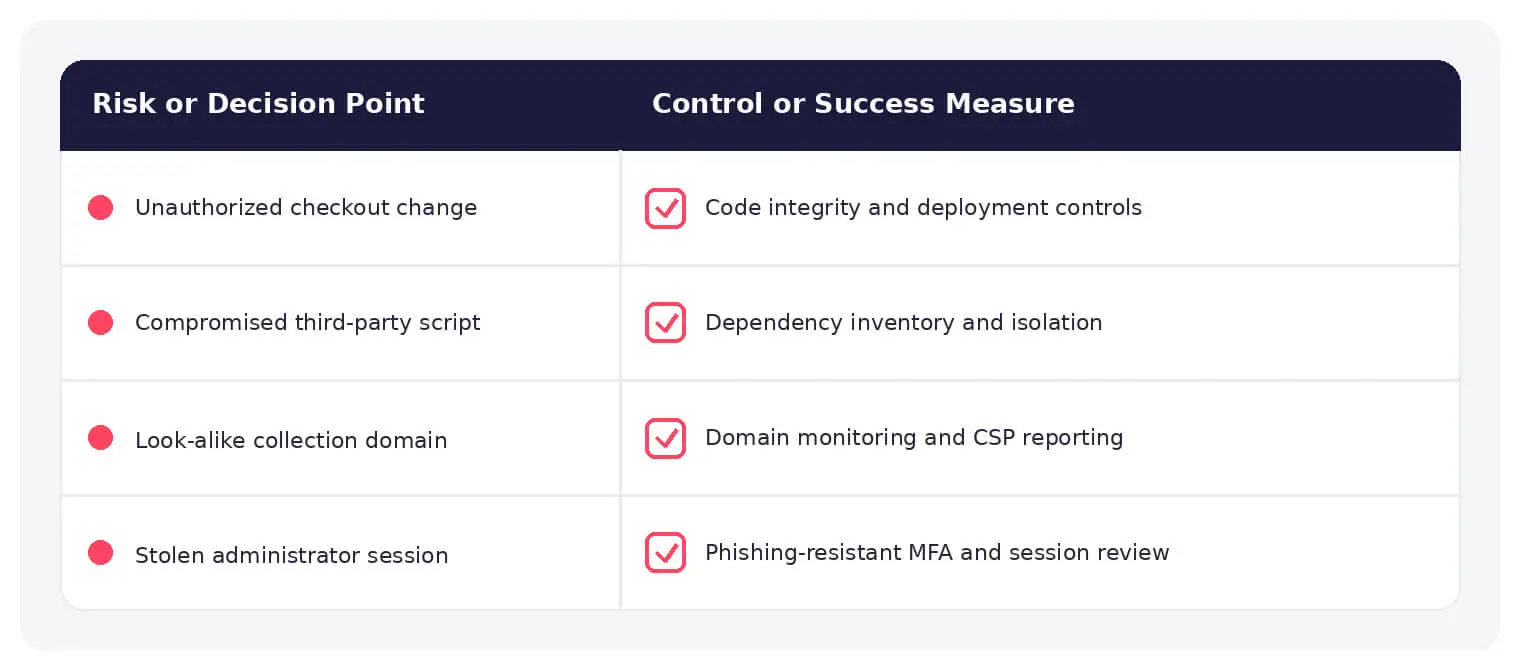
Use file and script integrity monitoring, browser-side telemetry, content security policy reporting, change review, domain analysis, and synthetic checkout tests. Investigate new scripts, unauthorized tags, obfuscated code, and outbound requests from payment pages.
Prevention and Response
Reduce third-party code on checkout pages, isolate payment entry, enforce strong administrative access, use allowlists, deploy Content Security Policy and Subresource Integrity where appropriate, secure build and tag-management workflows, and continuously inventory client-side dependencies.
How SOCRadar Can Help
SOCRadar combines external asset visibility, threat intelligence, Dark Web monitoring, vulnerability context, and indicator enrichment to help teams identify exposure and investigate activity connected to e-skimming.
Explore SOCRadar Brand Protection or request a demo to strengthen threat-informed prevention and investigation.
Frequently Asked Questions
What Data Do E-Skimming Attacks Target?
Skimmers primarily capture card numbers, expiration dates, and security codes as they are typed into checkout fields. Many also collect names, email addresses, phone numbers, and billing addresses, which support identity fraud beyond card misuse. Some variants target account credentials when checkout is tied to a customer login.
Why Is Third-Party JavaScript a Common Entry Point?
Checkout pages routinely load analytics, tag managers, chat widgets, and advertising code from outside domains. If one of those suppliers is compromised, or an attacker abuses tag-manager, plugin, or administrator access, the malicious code runs inside the merchant’s own page. Reliance on these dependencies extends the attack surface beyond the merchant’s own infrastructure.
How Do Digital Skimmers Avoid Automated Scanning?
Common techniques include obfuscated code, delayed activation, and conditional logic that fires only for chosen browsers, countries, devices, or referrers. Some skimmers check for developer tools, scanner signatures, or internal IP ranges before running. A page can therefore look normal during manual testing while still skimming real customers.
Do Hosted Payment Fields Eliminate E-Skimming Risk?
Hosted fields and processor-side controls protect card data once it reaches their environment, but they do not cover every path. An attacker who controls the page can overlay a fake form, alter surrounding scripts, or capture values before they enter the fields. Isolation reduces exposure when implemented correctly, and it should be paired with monitoring of everything the page loads.
How Can Teams Detect a Skimmer on a Payment Page?
Useful signals include unexpected scripts or tags, obfuscated code, outbound requests to look-alike or newly registered domains, and content security policy violation reports. Script and file integrity monitoring, client-side telemetry, and synthetic checkout transactions add coverage because skimmers can activate only under selected conditions. Periodic visual checks alone often miss active code.
What Should Be Done First After Discovering a Skimmer?
Remove the malicious code and any unauthorized scripts or tags, then close the access path, which is often an administrator account, plugin, or tag-manager integration. Rotate credentials for affected systems and revoke active sessions where the platform supports it, since a password change does not end every live session. Preserve files, logs, deployment history, and network indicators so the exposure window and affected transactions can be established.
What Reporting Obligations Follow an E-Skimming Incident?
Payment brands may require PCI DSS incident procedures or a forensic investigation when card data is involved, and data protection laws set notification deadlines that vary by jurisdiction. Scope depends on which data elements the skimmer captured and how many sessions were affected. Legal and compliance teams should be involved early, because notification timelines can start once the incident is confirmed.
Which Controls Reduce the Risk of Checkout Skimming?
No single control removes the risk, but layered measures narrow the paths attackers can use:
- Reduce third-party scripts on payment pages and allowlist approved sources.
- Apply Content Security Policy and Subresource Integrity where the environment supports them.
- Secure administrator accounts, build pipelines, and tag-management workflows with least privilege and phishing-resistant MFA.
- Keep a current inventory of client-side dependencies and review changes before they reach production.
What Business Impact Can an E-Skimming Incident Cause?
Direct costs include fraud losses, chargebacks, and payment-brand penalties or increased compliance requirements. Indirect costs include forensic work, breach notification, possible regulatory fines, and lost customer confidence that shows up as abandoned checkouts. Well-publicized skimming incidents can affect online revenue well after the code is removed.
Is Magecart a Single Group or Many Different Operators?
Magecart is an umbrella label for several threat groups and campaigns associated with web skimming, not a single malware family. Operators differ in initial access, code sophistication, infrastructure, and how stolen data is monetized. Treating the name as one actor can lead to inaccurate attribution and incomplete blocking decisions.
How Can Threat Intelligence Support an E-Skimming Investigation?
Investigators commonly check whether stolen card data surfaces in underground markets and whether the skimmer’s infrastructure overlaps with known campaigns or indicators. SOCRadar’s Dark Web monitoring can flag leaked payment or customer data tied to a brand, which helps scope an incident and assess whether it is isolated or part of a wider campaign.