

Mar 10, 2026

Mar 30, 2026
5 Mins Read
Sep 13, 2026
Table Of Content
Related Articles

SMS Bombing

Threat Actors
Jan 08, 2026

Dark Web Monitoring
Feb 19, 2026

Ransomware
Jan 31, 2026

OSINT Framework
Apr 17, 2026

What Is Software-Defined WAN (SD-WAN)?
Software-Defined Wide Area Network (SD-WAN) uses centralized software policy to route traffic across multiple wide-area links according to application, performance, cost, and security requirements.
SD-WAN can combine broadband, MPLS, cellular, and other links while simplifying branch management. Centralized orchestration improves agility, but controllers, edge devices, overlays, APIs, and internet breakouts become important security dependencies.
Key Takeaways
- Software-Defined Wide Area Network (SD-WAN) uses centralized software policy to route traffic across multiple wide-area links according to application, performance, cost, and security requirements.
- SD-WAN can combine broadband, MPLS, cellular, and other links while simplifying branch management. Centralized orchestration improves agility, but controllers, edge devices, overlays, APIs, and internet breakouts become important security dependencies.
- Compromised orchestrator or edge device is a primary concern.
- Effective security combines prevention, continuous visibility, ownership, and tested response.
How It Works
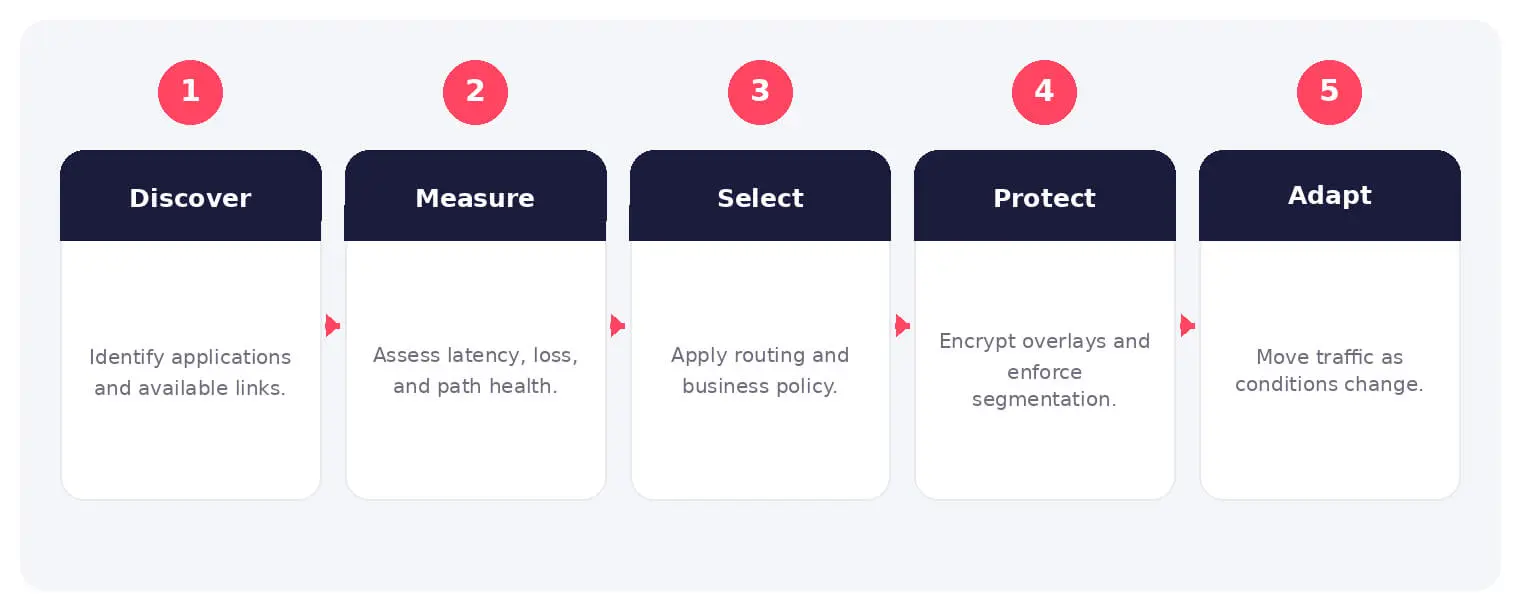
The operating flow above turns the concept into observable steps. Exact implementations vary, but each stage needs accountable ownership, trusted inputs, documented policy, and evidence that analysts can use during investigation and review.
SD-WAN can combine broadband, MPLS, cellular, and other links while simplifying branch management. Centralized orchestration improves agility, but controllers, edge devices, overlays, APIs, and internet breakouts become important security dependencies.
Common Types and Capabilities
- On-premises and cloud-managed SD-WAN
- Appliance, virtual, and secure-access edges
- Transport-independent encrypted overlays
- Application-aware routing and segmentation
Security and Business Risks
- Compromised orchestrator or edge device
- Insecure direct internet breakout
- Segmentation and policy mistakes
- Provider outage and path instability
Warning Signs and Detection
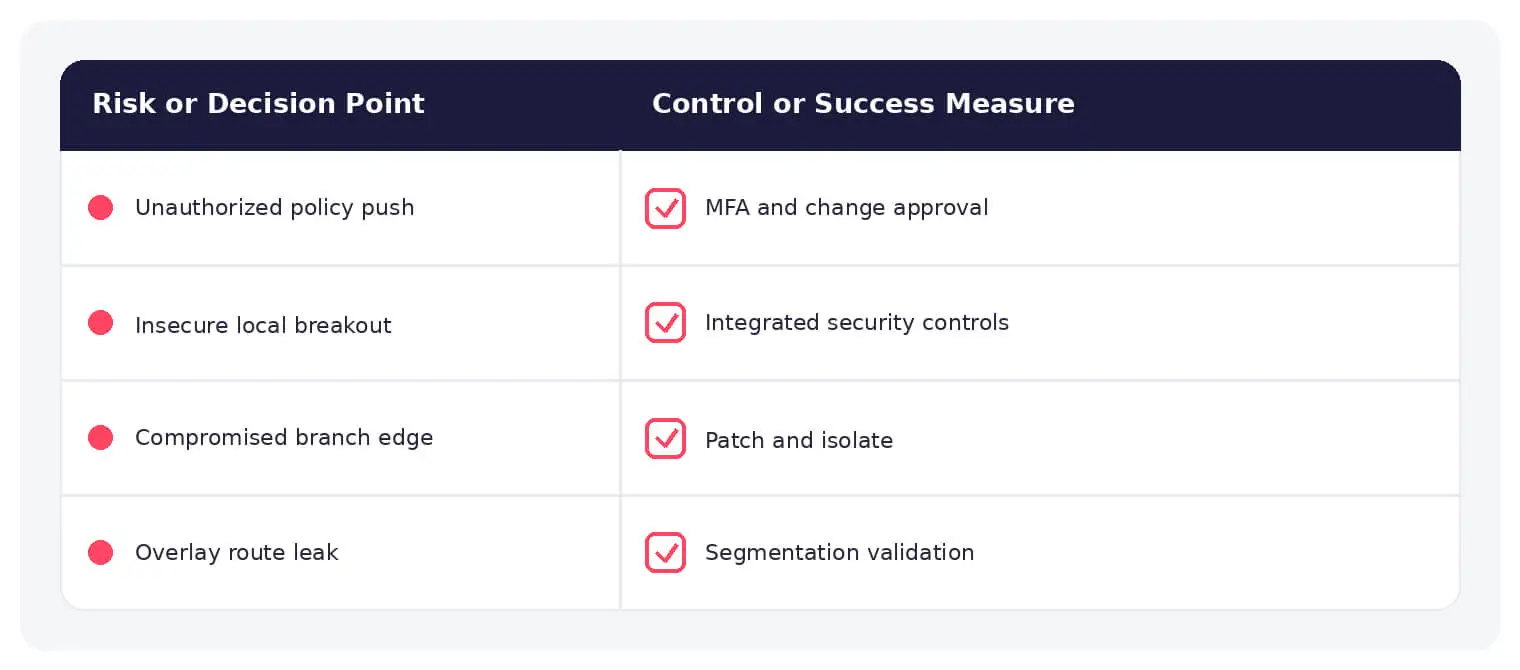
Monitor controller logons, configuration pushes, certificate changes, new edges, tunnel failures, route anomalies, unexpected internet breakouts, policy drift, firmware gaps, API activity, and traffic crossing intended segments.
Best Practices
Protect orchestration with MFA and restricted administration, patch edges, use certificate-based overlays, segment applications, secure local breakout, validate templates, deploy redundant paths, monitor changes, and test failover.
How SOCRadar Can Help
SOCRadar adds external visibility, threat intelligence, exposure context, and continuous monitoring to help teams validate and prioritize risks related to software-defined wide area network. This context complements internal network, endpoint, identity, and vulnerability controls.
Explore SOCRadar Supply Chain Intelligence or request a demo to strengthen threat-informed prevention and response.
Frequently Asked Questions
How Is SD-WAN Different From a Traditional WAN?
A traditional WAN typically relies on dedicated circuits such as MPLS and static, hardware-driven routing configured separately at each branch. SD-WAN separates control from the underlying transport, using centralized software policy to steer traffic across broadband, MPLS, and cellular links based on application needs. This centralization simplifies branch management but also makes the controller a critical dependency for the entire network.
How Does Application-Aware Routing Work?
The SD-WAN controller classifies traffic by application and applies policy rules that weigh performance, cost, and security requirements. Paths can adjust dynamically based on measured latency, jitter, and packet loss. For example, voice traffic may be steered onto a low-latency link while bulk backups use a lower-cost broadband connection.
Does SD-WAN Replace MPLS?
Not necessarily. Many deployments run SD-WAN alongside MPLS, keeping MPLS for latency-sensitive or critical workloads while using broadband and cellular links for general traffic. The core value is transport independence, meaning organizations can add or reduce link types as requirements change rather than eliminating any single technology.
Why Are SD-WAN Controllers and Edge Devices High-Value Targets?
The orchestrator pushes policy to every edge in the overlay, so compromising it can let an attacker reroute traffic, weaken segmentation, or open unauthorized internet breakouts across many branches at once. Edge devices often sit at the network perimeter with direct internet exposure, so unpatched firmware or a reachable management interface can serve as an entry point into the whole overlay.
What Security Risks Come With Direct Internet Breakouts?
Local internet breakout improves performance for cloud applications, but traffic that bypasses centralized inspection may reach malicious destinations unfiltered. Weak breakout rules, missing encryption, or policy drift can allow sensitive data to leave without adequate controls. Pairing local breakout with cloud-delivered security services and reviewing breakout policies regularly reduces this exposure.
What Warning Signs Suggest an SD-WAN Compromise?
Watch for unusual controller logons, configuration pushes outside approved change windows, unknown edges joining the overlay, certificate changes, and repeated tunnel failures. Route anomalies, unexpected internet breakouts, policy drift, unexplained API activity, and traffic crossing intended segments are also worth investigating promptly.
What Should Teams Do After Suspecting a Compromised Edge Device?
Isolate the edge from the overlay and revoke its certificates so it cannot rejoin while untrusted. Review recent controller activity for unauthorized changes, then restore the device from a trusted baseline before readmitting it. Teams should also determine whether any traffic was rerouted or policies were altered during the exposure window.
How Can Organizations Protect SD-WAN Orchestration and Policy Management?
Restrict administrative access with MFA and least-privilege roles, patch controllers and edges promptly, and log every configuration change. Validate templates before deployment, lock down API access, and maintain tested failover paths so a controller outage or path failure does not leave branches disconnected.
How Does Segmentation Reduce Risk in an SD-WAN Deployment?
Segmentation isolates applications, user groups, and guest traffic so a compromise in one zone cannot move freely into others. Because SD-WAN defines these segments through centralized policy, mistakes such as overly broad rules or unvalidated templates can quietly undermine the isolation. Regular policy reviews and monitoring of cross-segment traffic help keep the design intact.
Is SD-WAN the Same as SASE?
No. SD-WAN is a networking approach that routes wide-area traffic under centralized policy, while SASE (Secure Access Service Edge) is a broader architecture that combines networking with cloud-delivered security such as SWG, CASB, and ZTNA. SD-WAN is frequently a component within a SASE deployment, but the two terms describe different scopes and are not interchangeable.