
What Is a Stateful Firewall?
A stateful firewall tracks active network connections and evaluates packets in the context of an established session rather than treating every packet independently.
The firewall maintains a state table with information such as addresses, ports, protocol, and connection stage. Return traffic that belongs to a permitted session can pass without a separate static rule, while unexpected packets can be rejected.
Key Takeaways
- A stateful firewall tracks active network connections and evaluates packets in the context of an established session rather than treating every packet independently.
- The firewall maintains a state table with information such as addresses, ports, protocol, and connection stage. Return traffic that belongs to a permitted session can pass without a separate static rule, while unexpected packets can be rejected.
- State-table exhaustion attacks is a primary concern.
- Effective security combines prevention, continuous visibility, ownership, and tested response.
How It Works
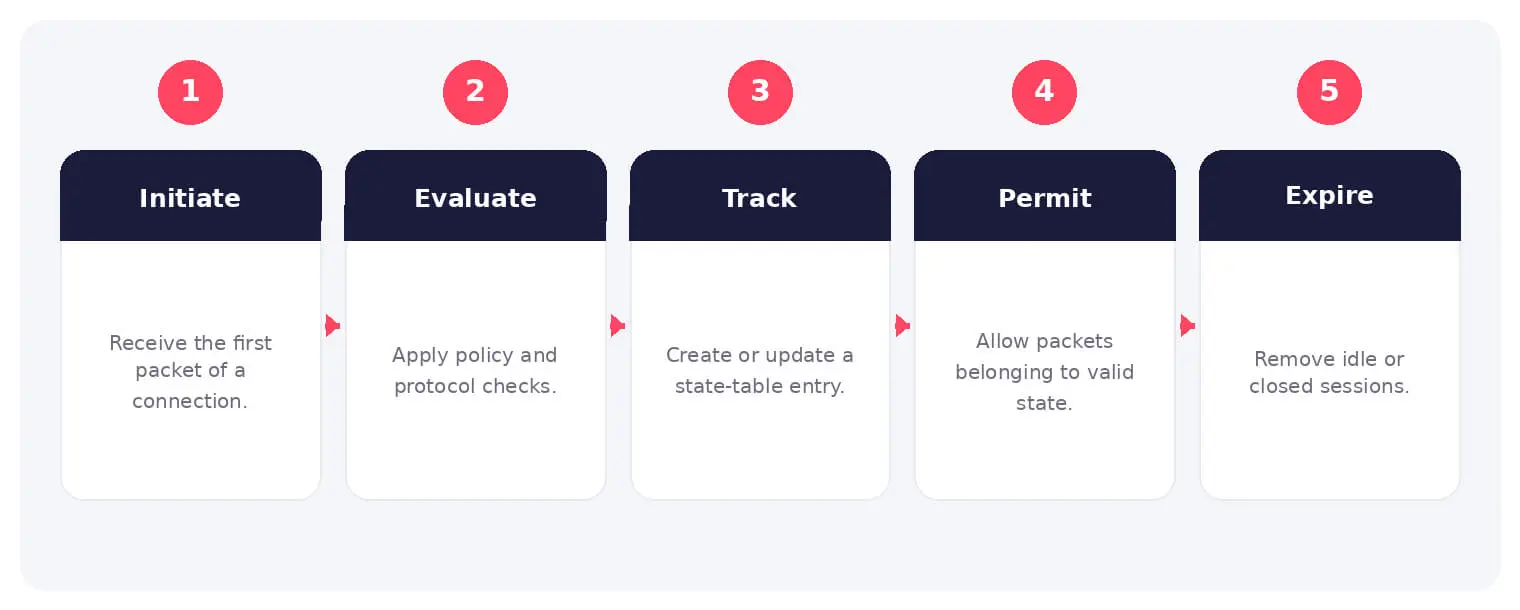
The operating flow above turns the concept into observable steps. Exact implementations vary, but each stage needs accountable ownership, trusted inputs, documented policy, and evidence that analysts can use during investigation and review.
The firewall maintains a state table with information such as addresses, ports, protocol, and connection stage. Return traffic that belongs to a permitted session can pass without a separate static rule, while unexpected packets can be rejected.
Common Types and Capabilities
- Stateful packet inspection
- Dynamic return-traffic handling
- TCP, UDP, and connection tracking
- Network address translation with state
Security and Business Risks
- State-table exhaustion attacks
- Protocol evasion and malformed sessions
- Asymmetric routing that breaks tracking
- Limited application and user context
Warning Signs and Detection
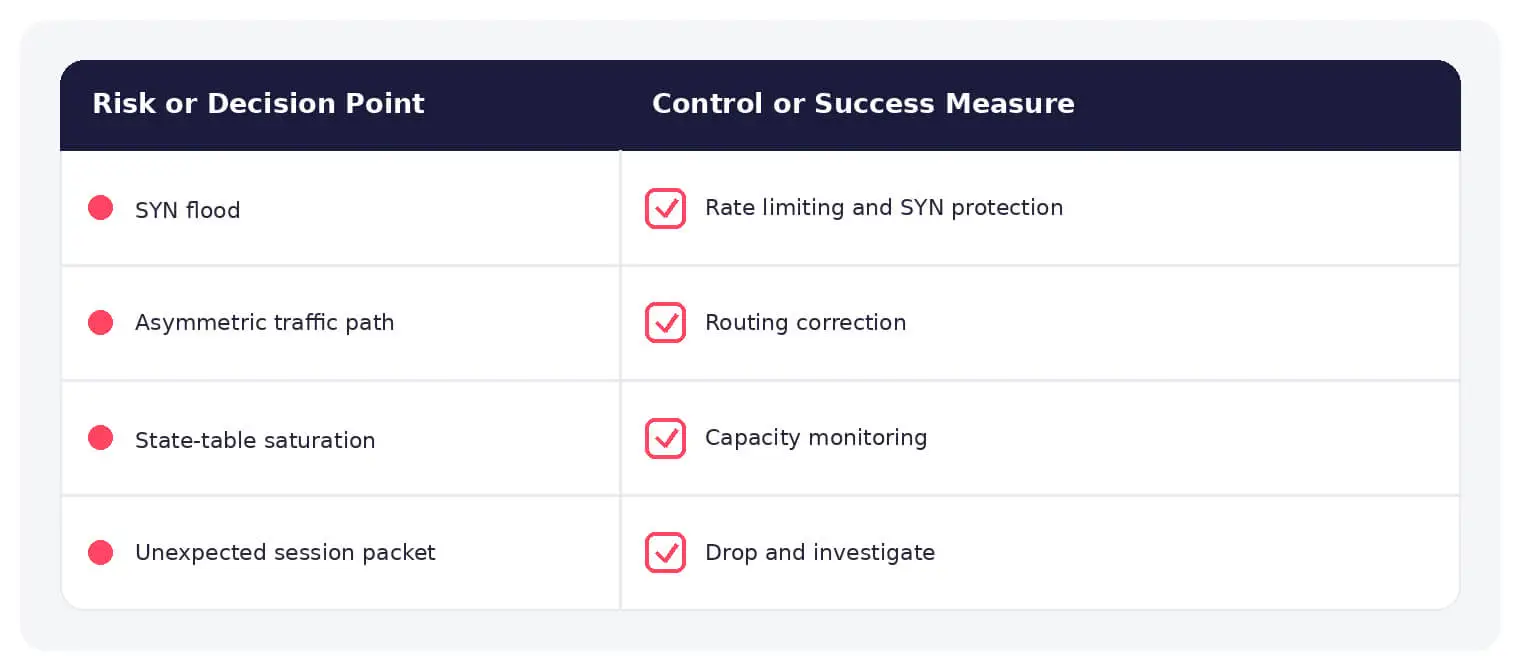
Monitor state-table utilization, incomplete TCP handshakes, unusual session duration, asymmetric paths, rapid connection bursts, protocol anomalies, unexpected inbound packets, policy changes, failover synchronization, and dropped legitimate return traffic.
Best Practices
Size connection tables correctly, use SYN protection and rate limits, maintain symmetric routing, patch devices, tune timeouts, restrict broad rules, monitor capacity, protect management, and test high availability.
How SOCRadar Can Help
SOCRadar adds external visibility, threat intelligence, exposure context, and continuous monitoring to help teams validate and prioritize risks related to stateful firewall. This context complements internal network, endpoint, identity, and vulnerability controls.
Explore SOCRadar Attack Surface Management or request a demo to strengthen threat-informed prevention and response.
Frequently Asked Questions
What Is a Stateful Firewall?
A stateful firewall monitors active network connections and evaluates each packet within the context of its session. It maintains a state table containing addresses, ports, protocol details, and the connection stage, so legitimate return traffic passes without a separate static rule while unexpected packets can be rejected.
How Does a Stateful Firewall Differ From a Stateless Firewall?
A stateless firewall evaluates each packet in isolation against fixed rules and remembers nothing about prior traffic. A stateful firewall tracks sessions, which allows it to accept reply packets that belong to a permitted connection and discard traffic that does not match an established session.
What Is a State Table?
The state table is the firewall’s live record of active sessions. Each entry typically holds source and destination addresses, ports, protocol, sequence information, and the current connection stage, and entries are removed when sessions close or time out.
What Is a State-Table Exhaustion Attack?
It is an attack that floods the firewall with new connection attempts, often incomplete TCP handshakes, until the state table reaches capacity. Once the table is full, the device may begin dropping legitimate traffic, which disrupts availability even if no packet bypasses the policy itself.
Why Does Asymmetric Routing Break Stateful Inspection?
Stateful inspection expects both directions of a conversation to pass through the same firewall. If outbound and return traffic follow different paths, the firewall sees only half of each session and may treat legitimate reply packets as unsolicited and drop them.
What Warning Signs Indicate a Firewall’s State Table Is Under Stress?
Look for rising state-table utilization, spikes in incomplete TCP handshakes, rapid connection bursts, unusual session durations, and legitimate return traffic being dropped. Asymmetric paths, protocol anomalies, and failover devices that fail to synchronize state are also strong indicators.
How Should Teams Respond to a Suspected State-Table Exhaustion Attack?
Enable SYN protection and rate limits on new connections, and shorten idle timeouts so stale entries free up capacity faster. Confirm that routing remains symmetric, identify the source of the flood in firewall logs, and coordinate with upstream providers if the traffic originates outside your network.
What Preventive Measures Keep a Stateful Firewall Reliable?
Size connection tables for peak load, apply SYN protection and rate limits, and tune session timeouts to match actual traffic patterns. Keep devices patched, restrict overly broad rules, monitor table capacity continuously, and test high-availability failover so sessions synchronize correctly between devices.
What Business Impact Can Stateful Firewall Failures Have?
When the state table fills or tracking breaks, legitimate traffic can be dropped silently, interrupting applications, remote access, and customer-facing services. Because the symptoms often resemble generic network degradation, root-cause analysis can take longer and extend downtime.
Does Stateful Inspection Detect Threats Inside Application Payloads?
Stateful inspection confirms that packets belong to legitimate sessions but does not deeply analyze their payloads. Malicious activity carried inside permitted traffic, such as exploitation over an allowed port, generally requires next-generation or application-layer inspection to identify.

Oct 27, 2026
September 2026: FBI Breach, Clop Hijack & IDScan Leak
The major cyber attacks of September 2026 hit federal law enforcement, a rival cybercrime gang, and the companies that verify identities. ShinyHunters…

Oct 27, 2026
Australia’s Annual Cyber Threat Report 2025-26 Shows Cyber Incidents Up 20%
Australia’s cyber security authority responded to 1,524 cyber security incidents in the 2025-26 financial year, a 20% increase from the previous year…

Oct 27, 2026
PHP2Shell Weaponized After Japanese Real Estate Extortion
An exposed server ties an extortion wave on about 20 Japanese property sites to an operator who later weaponized PHP2Shell (CVE-2026-109618, CVE-2026-109619)…
Intelligence in your inbox every Thursday.
Join 30,000+ security professionals reading SOCRadar research.
Subscribe