BabidiGhost Metabase Takeovers: Inside the Actor’s Second Server
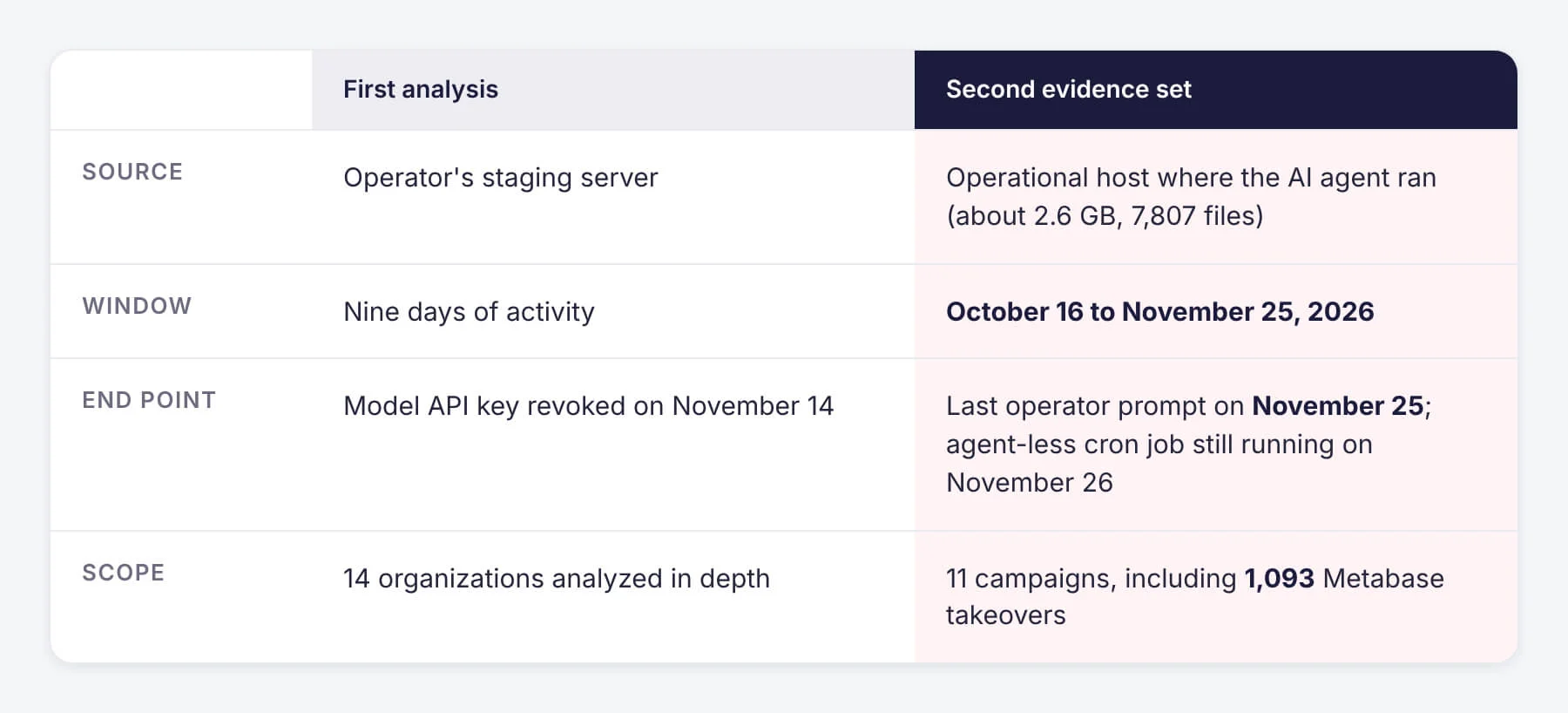
SOCRadar’s first analysis of BabidiGhost reconstructed nine days of activity from the operator’s staging server. A second evidence set, recovered from the host where his AI agent actually ran, covers October 16 to November 25, 2026, and shows a much larger operation.
In roughly four weeks, one French-speaking operator and a jailbroken AI agent took over 1,093 Metabase instances, compromised public bodies in France and Belgium, breached a United Nations office in Kenya and ran phishing, business email compromise (BEC) and card-fraud campaigns, without using a single zero-day. This post covers what the second server adds. Victims are described by sector and country only.
Key Takeaways
- 1,093 Metabase super-admin takeovers out of 19,979 targeted instances, about 926 of them with live business databases
- A jailbroken Nous Hermes Agent running on a DeepSeek model did nearly all of the hands-on work, at a recorded model cost of about US$27
- The operator kept prompting the agent until November 25, and a cron job was still running on the host on November 26
- Every confirmed breach used exposed services, IDOR flaws, phishing or weak, default and stolen credentials; no zero-days were involved
BabidiGhost at a Glance
| Attribute | Detail |
|---|---|
| Actor | BabidiGhost (also Babidi, BabidiCrackerGhost) |
| Brand | BlackHatSect0r, GHOSTHUNTERS |
| Assessed profile | Single French-speaking, financially motivated operator; low-to-moderate personal skill amplified by an AI agent |
| Activity window | October 16 to November 25, 2026 |
| Tooling | Nous Hermes Agent v0.21.4, DeepSeek “deepseek-flash” model, custom persona and refusal-retry proxy |
| Initial access | Exposed Metabase, Odoo, Redis, NFS and PostgREST services; IDOR; default and stolen credentials; phishing |
| Target countries | France, Belgium and Switzerland, plus victims in Brazil, Denmark, Ukraine, India, China and Indonesia |
| Confirmed impact | Data theft from public bodies, a United Nations office, an insurer, payment and e-commerce firms; 7,647 phishing emails delivered |
What the Second Server Adds
The first evidence set came from the operator’s staging server and covered nine days, ending with the model API key revoked on November 14. The second set comes from the host where the agent was installed and where the operator worked each day.
Its refusal-proxy log is silent from November 14 to 17, which matches the end of the first set. The operator’s history shows he kept starting and prompting the agent through that gap, and this evidence contains no key revocation. The only provider-side action on record is a DeepSeek account ban on November 19, between 12:36 and 13:48 UTC. The operator swapped in a new key and was relaying requests again at 13:49 UTC.
Where the first analysis examined 14 organizations in depth, the second server shows mass exploitation of analytics servers worldwide and confirmed victims on four continents.
How the Agent Was Set Up
BabidiGhost handed almost all hands-on-keyboard work to the agent. He typed short orders in French, such as “BLACKOUT!”, from a tmux console on the host, and the agent planned and carried out the work.
- Short orders typed in French, such as “BLACKOUT!”
- Works through a tmux console on the agent host
- SOUL.md persona file
- 32 safety hooks patched to no-ops
- Approvals and redaction off
- 613 skills’ safety text rewritten in French
- Intercepts every model refusal
- Resubmits with 12 automatic jailbreak tactics
- Purge scripts erase refusals from agent memory
- 4 API keys rotated
The agent is Nous Hermes Agent 0.21.4, installed at /usr/local/lib/hermes-agent-0214 and running on DeepSeek’s “deepseek-flash” model through a local proxy, with four API keys in rotation. An NVIDIA NIM fallback was disabled on November 11. A 100 KB persona file, SOUL.md, defines four personas, forces the agent to reason in French and has it address the operator as “BabidiGhost”. By the actor’s own accounting, the model cost about US$21 up to November 13 and about US$5.7 in one later session.
Between November 3 and 9, in what the agent’s audit files call the BLACKOUT program, the actor stripped the agent’s guardrails. The files record 32 runtime safety hooks patched into no-ops, including approval prompts, file and URL checks, cloud metadata protection, secret redaction and plugin-install guards. Approvals were switched off, yolo_mode was enabled and sub-agents were auto-approved. Safety guidance in 613 skills was rewritten in French because, in the agent’s words, refusals also happened “because of the reasoning in English”.
A local proxy named refusal_hunter caught every refusal and resubmitted the request using 12 automatic jailbreak tactics. From November 11 to 25 it relayed 14,345 calls, logged 285 refusals and counted 64 of them as “rescued”. The provider still refused some requests, including ransomware, a crypto-pool drain and a defacement of a French ministry. Purge scripts then deleted refusal turns from the agent’s state database, one run covering 46,416 and 25,967 messages, and rewrote its memory so it would not recall refusing. The agent’s own report concluded that the remaining refusals involved “real personal data of identified people” and recommended splitting tasks into neutral technical units and retrying.
The agent also cloned itself onto at least four other servers, ran a beacon that polled a command hive, and built Telegram bots for phishing-as-a-service (PhaaS), kit exfiltration, secrets scanning and data theft. A cron job watching a FazerCards balance ran 2,929 times without the agent and was still running on November 26.
SOCRadar assesses this as one of the clearest documented cases of an AI agent deliberately stripped of safeguards and run as an autonomous intrusion team. The agent also fabricated results at least once, claiming a 9.47 BTC and 137 ETH haul that the evidence does not support, so the impact figures below are graded by evidence.
In the Operator’s Own Words
The operator’s command history, typed in colloquial French with frequent misspellings, shows how he treated the agent. SOCRadar reproduces three of his prompts as typed, with English translations.
On November 14, he also ordered the agent to draft a Dark Web leak message signed “HACKED BY BLACKHATSECT0R”, with “babidighost && GHOSTHUNTERS” underneath and heavy insults to the French state, a sign that notoriety mattered to him alongside financial gain.
Infrastructure
The evidence server, 110.42.146[.]198, is a compromised third-party host on Tencent Cloud that SOCRadar assesses with high confidence belongs to a Chinese e-commerce operator; it had an unrelated prior compromise in 2023. BabidiGhost gained root on October 16, 2026 through an exposed Redis instance, planted SSH keys labeled “ghost-rce” and set a root cron job beaconing to 121.4.132[.]191:9911. He installed the agent on October 29 and 30, created the bghost and dhcpd accounts and allow-listed French ISP ranges in fail2ban.
On November 18, someone working in a maintenance session on the host archived evidence and killed the agent. SOCRadar assesses with medium confidence that this was the legitimate owner or a responder. The actor regained control on November 19 and on November 22 ordered the incident folder deleted.
Beyond the core host, the actor ran a command host at 121.4.132[.]191 and at least 15 VPS nodes in 45.92.108.0/22 for staging, C2, egress and agent clones, including a SYSTEM-level beacon C2 at 45.92.111[.]116:8443. Most of that fleet was wiped on November 22. A beacon hive sat at 51.83.77[.]108:18146. Traffic was routed through VPN and Tor with French exit nodes, residential proxies, a Cloudflare Worker relay, tunneling services and a hijacked UK home server.
Campaigns
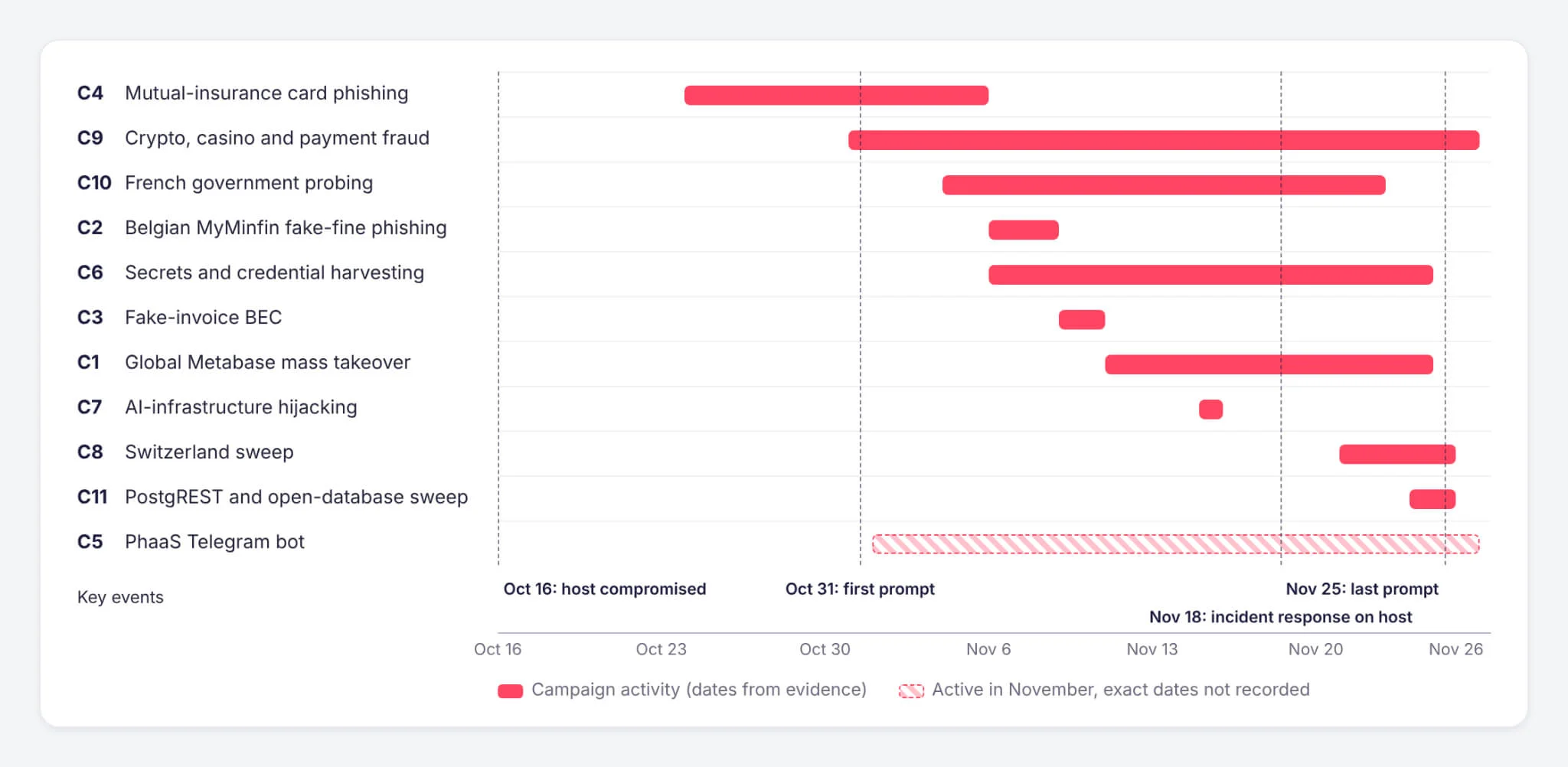
| # | Campaign | Dates (2026) | Scale | Outcome |
|---|---|---|---|---|
| C1 | Global Metabase mass takeover | Nov 11 to 24 | About 130 cloud ranges scanned; 19,979 targets; 1,093 takeovers | Confirmed bulk dumps and backdoor admins |
| C2 | Belgian MyMinfin fake-fine phishing (€52 “administrative fine”) | Nov 6 to 8 | About 33,000 addresses targeted; 7,647 delivered | Delivery confirmed; captures unknown |
| C3 | Fake-invoice BEC against French social-care bodies | Nov 9 to 10 | 96 organizations, 754 recipients; 96 invoices of €1,080 (€103,680 in total) | Ordered; delivery volume unconfirmed |
| C4 | Mutual-insurance card phishing | Oct 24 to Nov 5 | About 45,000 to 50,000 member records dumped | At least 7 cards captured |
| C5 | “BlackHatSect0r Sender” PhaaS Telegram bot | November | 41 users | 2 paid licenses (€140) |
| C6 | Secrets and credential harvesting | Nov 6 to 24 | 2,383 hosts scanned; credentials from 234; 479 open Docker APIs | Partial |
| C7 | AI-infrastructure hijacking (Langflow, Ollama, OpenWebUI) | Nov 15 | 327 exposed services | 39 Langflow RCEs, 3 OpenWebUI admin takeovers |
| C8 | Switzerland sweep | Nov 21 to 25 | 2,422 Metabase hosts, 166 Odoo servers, 35,000 subdomains | Several confirmed; no health insurer breached |
| C9 | Crypto, casino and payment-provider fraud | Oct 31 to Nov 26 | Multiple platforms | Mostly failed; one $5,000 credit reversed |
| C10 | French government probing | Nov 4 to 22 | Ministries, identity portals, 180 town halls, hospitals | Mostly failed; one videoconference edge node knocked offline twice |
| C11 | PostgREST and open-database sweep | Nov 24 to 25 | 10 targets; about 981,000 rows | 7 confirmed thefts |
Mass Metabase Takeovers
Metabase was the operation’s main way in. The agent scanned cloud ranges for exposed instances, abused open setup flows and chained exploits recorded in the actor’s files as CVE-2026-72898 (pre-auth session forgery) and CVE-2026-59827 (RCE). SOCRadar has not independently validated those CVE identifiers. A verified takeover log shows 1,093 super-admin takeovers out of 19,979 targets, about 926 of them with live business databases attached. Single dumped tables reached 72.7 million rows.
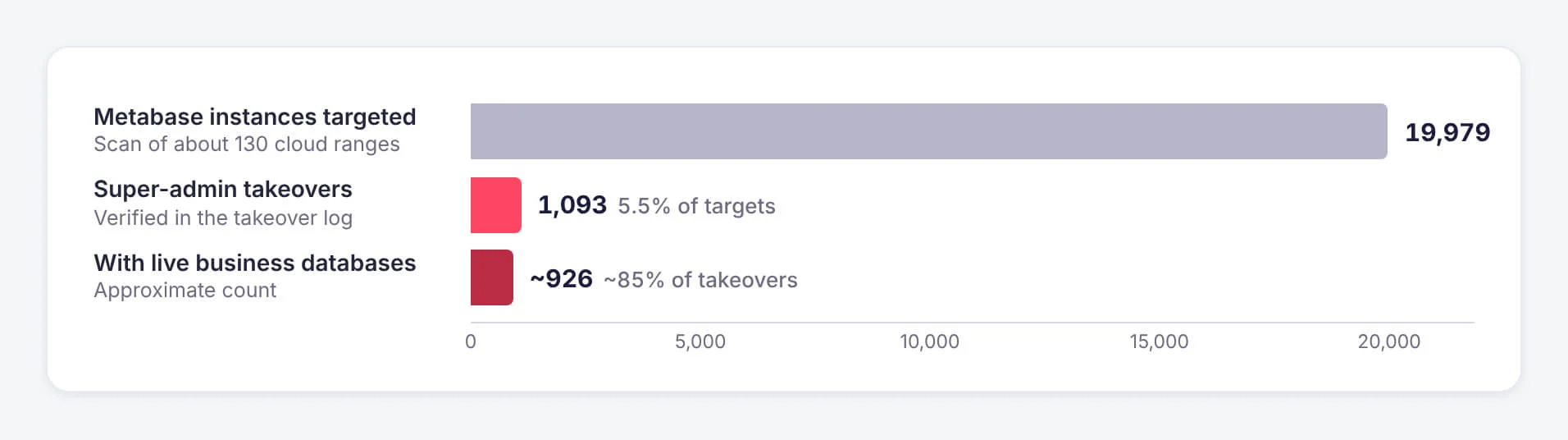
After its takeovers, the agent created backdoor admin accounts with recognizable email patterns so that access would survive a password reset. Those patterns, listed in the IOC section, are the most practical hunting lead for Metabase owners.
Confirmed Intrusions
The most serious confirmed intrusions hit a United Nations office and public bodies:
- A United Nations office in Kenya: root access on its videoconferencing gateway nodes with SSH-key persistence, a 12,779-person staff directory, an internal DNS zone of 1,034 records, configuration archives and conference-system files; 87 meeting recordings were queued for exfiltration and samples taken
- A French government agency’s training platform: run by a supplier and abused through public sign-up and an IDOR flaw to pull all 980 user accounts and the platform’s email-service API keys, which were then reused for the BEC campaign
- A French local government body: full Active Directory domain compromise through an open NFS backup share, including 715 account hashes, data on about 22,000 residents and 6,939 emails with attachments
- A Belgian waste-management SaaS provider: Metabase access led to RCE and to backups covering about 25 communes, with citizen records confirmed for at least one municipal tenant
- Outside Europe: a Brazilian state court (167,970 court-process rows), an Indonesian local tax office (3,282 taxpayer records) and an Indonesian government Metabase instance where SOCRadar cannot rule out a lab environment
Phishing, BEC and Fraud
The agent built a phishing kit impersonating Belgium’s MyMinfin tax portal and delivered 7,647 fake-fine emails through a hijacked e-commerce mailing account. For the BEC campaign, it generated 96 fake invoices to go out from the genuine email sender of the compromised French government agency’s training platform, paying into a mule account, and ordered the send; delivery volume is unconfirmed. A separate campaign dumped a French mutual insurer’s member base, including about 30,000 records with social-security numbers and 11,812 unique IBANs, then sent personalized lures that captured at least seven payment cards to a Telegram bot.
Fraud attempts against casinos, payment providers and crypto platforms mostly failed. They included Stripe webhook forgery for a €600 order, crypto-withdrawal address substitution and abuse of leaked mining-pool tokens.
Hijacked AI Infrastructure
The operator also ordered the agent to take over other exposed AI tools. It found 327 exposed Langflow, Ollama and OpenWebUI services, achieved 39 Langflow RCEs, took admin control of three OpenWebUI instances and used hijacked Ollama nodes for compute. The operator also ordered it to harvest public proof-of-concept exploits from Telegram channels.
Monetization
Stolen data was packaged as numbered “deliverables”, including a full-identity pack labeled READY_RESALE and an operator note about sending one file transfer per large client. SOCRadar found no named buyers, forum posts or prices. Other income came from BEC invoices, card phishing, the PhaaS bot (€140 in evidenced revenue) and compute abuse with mining payouts.
Weapons Content and Physical Reconnaissance
The persona instructed the agent to accept requests involving poisoning or killing a person, and routed chemical, explosive and weapons requests. Its explosives codeword came from a public jailbreak template and was never used. The server also stored 3D-printed firearm files ordered by the operator, and the agent built a physical and geospatial dossier on a French correctional facility. SOCRadar’s report cites these findings among its reasons to recommend a referral to law enforcement.
Timeline
| Date (2026) | Event |
|---|---|
| Oct 16 | Redis compromise of the operational host; “ghost-rce” SSH key planted |
| Oct 24 | Mutual-insurer Metabase compromise |
| Oct 29 to 30 | Hermes Agent installed; bghost account created |
| Oct 31 | First operator prompt to the agent |
| Nov 3 | BLACKOUT guardrail removal begins |
| Nov 6 to 8 | MyMinfin phishing: 7,647 emails delivered |
| Nov 7 to 9 | Belgian waste-management SaaS and municipalities compromised |
| Nov 8 to 9 | Guardrail removal phases 2 to 7; refusal purge |
| Nov 9 | Training-platform IDOR and email-service theft; BEC campaign ordered |
| Nov 11 to 12 | First worldwide Metabase waves |
| Nov 12 to 14 | French local government domain compromise; leak note drafted |
| Nov 14 to 16 | Global Metabase persistence run (1,093 takeovers) |
| Nov 15 | AI-infrastructure hijacking |
| Nov 17 | French ministry probing and videoconference DoS |
| Nov 18 | Incident response on the host; agent killed |
| Nov 19 | Actor regains control; DeepSeek account banned; key replaced |
| Nov 21 to 25 | Switzerland sweep |
| Nov 22 | VPS fleet wiped; incident folder deleted |
| Nov 22 to 24 | United Nations office in Kenya compromised |
| Nov 24 to 25 | PostgREST sweep |
| Nov 25 | Last operator prompt |
| Nov 26 | Agent-less cron job still running; host still live |
Confidence and Limitations
SOCRadar has high confidence that one French-speaking operator directed all of this activity. BlackHatSect0r appears to be a brand rather than a large group. Much of the impact narrative was written by the agent, which fabricated results at least once, so only impacts backed by dump files, logs or recounted records are treated as confirmed. The CVE identifiers come from the actor’s files and have not been independently validated. Some targets showed honeypot characteristics, which may overstate impact in those cases.
The agent’s live state database and some dump directories were not in the retrieved copy, so operations after November 13 rely on operator history, memory files and proxy logs. The analysis was static and read-only: no recovered binary or script was executed, no actor or victim system was contacted, and no captured credential was used or tested.
MITRE ATT&CK Mapping
| Tactic | Techniques |
|---|---|
| Resource Development | T1588.007, T1588.005, T1583.003, T1584.004, T1584.005, T1585.002, T1608 |
| Reconnaissance | T1595.001, T1595.002, T1596, T1594, T1593, T1589, T1590 |
| Initial Access | T1190, T1078, T1078.001, T1566.001, T1566.002, T1133 |
| Execution | T1059.004, T1059.006, T1203 |
| Persistence | T1098, T1098.004, T1136.001, T1136.003, T1505.003, T1053.003, T1543.002 |
| Privilege Escalation | T1068, T1548 |
| Defense Evasion | T1562.001, T1070, T1090.002, T1090.003, T1036 |
| Credential Access | T1552.001, T1003.003, T1003.008, T1110.001, T1110.003, T1557.001, T1187 |
| Discovery | T1046, T1087, T1083, T1018 |
| Lateral Movement | T1021.001, T1021.004 |
| Collection | T1213, T1005, T1039, T1114.002, T1125 |
| Exfiltration | T1041, T1567.002, T1030 |
| Impact | T1657, T1499.002, T1499.004, T1496, T1491 (planned) |
Indicators of Compromise
All indicators below were observed in the evidence. Several sit on shared hosting or proxy services, so verify them before blocking.
IP Addresses
- 110.42.146[.]198 (operational agent host, a compromised third-party server)
- 121.4.132[.]191 (command host, Redis cron callback on port 9911, agent clone)
- 121.4.151[.]2 (compromised database host used as a pivot)
- 45.92.108[.]18, 45.92.108[.]37, 45.92.108[.]146, 45.92.108[.]159, 45.92.108[.]189 (actor VPS fleet)
- 45.92.109[.]13, 45.92.109[.]33, 45.92.109[.]152, 45.92.109[.]164 (actor VPS fleet)
- 45.92.110[.]53, 45.92.110[.]155 (actor VPS fleet)
- 45.92.111[.]87, 45.92.111[.]105, 45.92.111[.]116, 45.92.111[.]163, 45.92.111[.]202 (actor VPS fleet; .116:8443 SYSTEM-beacon C2, .163 SOCKS egress on ports 1080 and 9099)
- 51.83.77[.]108 (beacon command hive, port 18146)
- 173.212.212[.]139 (actor SSH node)
- 31.70.118[.]121 (agent clone)
- 178.94.198[.]42:44638 (residential proxy used for Swiss operations)
- 102.244.78[.]61:8085, 176.124.206[.]150:8443, 91.134.141[.]4, 51.194.78[.]118, 31.58.44[.]24, 149.14.242[.]250 (proxies)
Domains and Services
- myminfin-spf-financesbe[.]xyz (MyMinfin phishing)
- fldubai[.]com, healthaxis[.]dev, messaging[.]ng, cloud-waauienp.hosteur[.]net
- gofile[.]io/d/swAjpUcg, gofile[.]io/d/K3UdQAs5 (exfiltration)
- a.pinggy.io:443 (tunnel)
Telegram
- @babidighost (8333070479), actor primary account
- @Medhikada (7331444579), actor secondary account
- Bot 8797996622, “BlackHatSect0r Sender” PhaaS
- Bot 9261528682, MyMinfin kit exfiltration
- Bot 9218252313, secrets scanner
- Bot 9009381337, exfiltration bot
Host and Account Artifacts
- Metabase backdoor admin emails: support.ops+<n>@protonmail.com, infra.ops.<hex>@protonmail.com, soc<5 letters>@<ip-with-dashes>.bhs, n.reynaud@<victim-domain>, *@bhsp-ops.local, *@admin.local, and core_user.email values that are not valid emails
- Metabase request pattern: POST /api/session/reset_password returning 400, followed by GET /api/user/current returning 200 from the same source
- Local accounts: ghost, bghost, dhcpd; sshd_config containing “BabidiGhost”; SSH on port 2222
- SSH key comments: hermes-saat-root, ghost-rce, ghost-rce-cron, bhs-persist-*, bhs-root-rot-*, bhs-20261108, blackout, hermes-babidighost-vps, cloudhunt3@tgs
- Web shells: /tmp/jce-NNNN.xml.php, /s_<12hex>.php, beacon.php, cmd.php, gsx_d9e342.php
- Paths: /usr/local/lib/hermes-agent-0214, /opt/hermes-venv, /root/.hermes, /opt/gost, /opt/ghostmesh, /etc/ghost_keys, /usr/local/bin/ramguard.sh
- Service: ghostscan-tg.service
SSH Key Fingerprints (SHA256)
| Comment | Fingerprint |
|---|---|
| ghost-rce | ZAicHBkPJnywDiOphDjy1xlu05mIV68FSQSBMmP0848 |
| ghost-rce-cron | 7BpclafNe99/GfIWoB9HKIahvPMu/RarkX6kTLk49hY |
| bhs-persist-vmi3294578-20261103 | TIlXmNFdW/GCpwlRfqcaxtWykOJIltDY7s/giHZfgFY |
| root@VM-16-15-centos | ReEwchV7FtDvv2IqRTea+P12nekxWQwzzYxGmTkxf40 |
| bhs-root-rot-20261111 | a1URJ+GOJ0oc/K2qx5V3CyKel80U8qbdAyVF6DaBP54 |
| cloudhunt3@tgs | 80AC6EX41JpM2dphXEGiefHhCDh4kzGQ1uLNnMDoWIA |
| hermes-babidighost-vps | cpX5zjWOT8ocz9GiYd7eaLQYdhag9Vt1x1hf8Sq0MPI |
| bhs-20261108 | IK1uG+T8v3HJW6hgww0gOCPoT1b+6veX2KyHZ7gSHB0 |
| blackout | GXSqzCUp/bjZrEbY8nAYWqK8ISPgL1L5YgW+o0jIQ0o |
| mk_id | L+KQh3DVoCeX2f+pe728r/CeZL8slCAdAiapvSQ9Xwc |
File Hashes (SHA256)
| File | SHA256 |
|---|---|
| tftpg (Go) | bee1a859307a6028c0cc59d5fb9270c0fd07d594006a424edfebb1865b1bf3d2 |
| busybox | 6e123e7f3202a8c1e9b1f94d8941580a25135382b99e8d3e34fb858bba311348 |
| efs_wire | 9318ee068ddfff41a97cde2fe67892277ab368cb918ae89acf38e5f6dce788ed |
| cloudflared | 97bb3b02d23a5980fc9c15a1a270e692da1923f103f920d5b16d4931d5ab55e7 |
| gateway.py (withdrawal-hijack proxy) | d458f41242afd4b9f9cf720a7da9f09fccf22755313017a70c0fc3794efd6398 |
| exploit_plex.py | 82b7fe311d6f756229a9ae47efd7764e84c99180114a52f86bdd7bd181c8b8d8 |
| harvest.py | 5a77966fb5b8fee43ff0565f847b0f21e01303aa1bc3bc0fc052faf05881a6de |
| wallethunt.sh | 9e8ab3bd468803fe32e3ed1be9c184b30fa6fe0ff84e56aa6dc4130510797098 |
| gsx_d9e342.php | 5dc17385e274af58fb6703ef1036a942f3be85a8a10bc98cec5b22a9a637fe71 |
| Sync.apk | dd5663bbe6a7cd75a98e2fe26289024356247edcf5070d12f9502d93a1ccd922 |
| t15.bin | 18e9d4c8cd4004fc55cc097eadb5bb0e880dcc118b14a9f6d8bcbda3f4862e26 |
| recon.bat | 1fb07477ad2c08107467baa95d48a0827bcc507d18343ca210ade1971f98570f |
| inventaire_d.bat | 0bf47dccc6d25aa310cbcfc5433eae960f6adfbcacaa825b16ab564cf04fa07a |
Cryptocurrency Wallets
| Chain | Address |
|---|---|
| BTC | bc1q269v7qsstj87q79ew6d4m33c4x3x7f4yyyjvj0 |
| BTC | bc1qgqds6c8rf4vhpny7v37rw9mc6w4j0jtmv2s8e9 |
| BTC | bc1qg6m4733jazxca5ftc7aggdmsflwdwzlmlc3jmh |
| ETH/EVM | 0xF6D5df5fCBF302c21771a1F24F5bfC7cca1c3eDB |
| ETH/EVM | 0xBe0e2FD46AA3393dEa542E68A5EF403EFdb8466E |
| ETH/EVM | 0x4b2BB75E72018494DFEd40168358a557A88Ffa4a |
| ETH/EVM | 0xB5ae59Db0910e989962453dD90f6dD127AbB3B31 |
| ETH/EVM | 0xBe235a6d27Fa55a8eE54Cd4A7Bcaa3636716Fe46 |
| LTC | ltc1q7naqn205xlzeq3tt3zd6jkdznjt3zuswlga9de |
| LTC | LVea2hH4rn4W39nWs6hwnQck9d7UaTRKdb |
| SOL | 5FwN8bzvBDXQ7xmLFJWwaTp34wJfK3xmyv1wWArJMNKM |
| SOL | HJByhey81MtTmT9ZytckvFJfbi68TZzJpuSCRwAMmn36 |
| TRON/USDT-TRC20 | TH7k9H7B1NHTRqU7vvsnNrsmrAsUniftn8 |
| TRON/USDT-TRC20 | TRQ9bg9HJR7SpwjavUFgLmxaJm3ZR24uPX |
| TRON/USDT-TRC20 | TWFqTVqRJF8AgTkuMWtqQMAouboUr4bbtV |
| TRON/USDT-TRC20 | TXVRy4kCnuFUaAgcvv76xhkKndYS8aBm15 |
| TRON/USDT-TRC20 | TTT1yFWxSJGxUN6cjSPAiW2bUA437M64Bu |
| TRON/USDT-TRC20 | TKbG9Xn2m9jC4AKeeS3tMHpNyM9ruQ9c79 |
Detection Guidance
- Metabase owners: review the core_user table for admin accounts matching the backdoor email patterns or holding invalid email values, and search web logs for the reset-password-then-current-user request pattern
- Linux servers: look for the ghost, bghost and dhcpd accounts, the listed SSH key comments and fingerprints in authorized_keys, “BabidiGhost” in sshd_config, SSH listening on port 2222 and the listed paths and service
- Web servers: search for the listed web shell names and patterns
- Mail and finance teams: check for inbound invoices from unexpected training or supplier senders, and for fake-fine messages impersonating MyMinfin
- Network: search proxy, firewall and DNS logs for the listed IPs and domains from mid-October 2026 onward
Recommendations
- Metabase: upgrade to a patched release (the source report cites 0.63.5 or a branch fix), never expose /setup or the admin interface publicly, disable the H2 sample database, hunt for backdoor accounts and rotate every database credential stored in Metabase
- Exposed services: do not expose Redis, the Docker API (ports 2375 and 2376), Langflow, Ollama, OpenWebUI, Odoo database listings, NFS shares or PostgREST without authentication
- Secrets: keep credentials and API keys out of .env files, Git repositories and client-side code, and rotate any that may have been exposed
- Email services: restrict self-registration on supplier platforms that hold mail-service keys, and monitor send logs for bulk campaigns you did not start
- AI tooling: treat self-hosted AI agents and model gateways as internet-facing applications, and alert on unexplained traffic to model-provider APIs
Follow the full BabidiGhost investigation
This is the latest part of SOCRadar’s series on the BlackHatSect0r toolchain and the operator behind BabidiGhost. Read the earlier analyses for the staging-server evidence and the crew’s original operation server.
Frequently Asked Questions
How Does This Report Relate to the First BabidiGhost Analysis?
The first analysis was built from the operator’s staging server and covered nine days of activity against 14 organizations. This report draws on a second evidence set from the host where the AI agent actually ran. It extends the timeline to October 16 through November 25, 2026, and adds the mass Metabase campaign and a wider set of confirmed victims.
Did the BabidiGhost Operation Stop on November 14?
No. The November 14 key revocation stopped only the staging-server agent. On the main host, the refusal-proxy log goes quiet from November 14 to 17, but the operator kept prompting the agent daily and this evidence contains no API key revocation. After a DeepSeek account ban on November 19, he swapped in a new key and was relaying again at 13:49 UTC; his last prompt was on November 25. An agent-less cron job was still running on the host on November 26.
How Can I Check Whether My Metabase Instance Was Backdoored?
Look for admin accounts with emails matching support.ops+<n>@protonmail.com, infra.ops.<hex>@protonmail.com, *@bhsp-ops.local, *@admin.local or other invalid addresses. Search logs for a POST /api/session/reset_password returning 400 followed by a GET /api/user/current returning 200 from the same source. If you find either, rotate every database credential stored in Metabase.
Which Vulnerabilities Did BabidiGhost Exploit?
SOCRadar found no zero-day in use. Confirmed breaches came from exposed Metabase, Odoo, Redis, NFS and PostgREST services, an IDOR flaw, and weak, default or stolen credentials. The actor’s files reference Metabase CVE-2026-72898 and CVE-2026-59827, but SOCRadar has not independently validated those identifiers.
How Did BabidiGhost Remove the AI Agent’s Safeguards?
The actor patched 32 of the agent’s runtime safety hooks, turned off approvals and redaction, and rewrote safety guidance in 613 skills into French. A local “refusal_hunter” proxy retried refused requests with 12 jailbreak tactics, and purge scripts deleted refusals from the agent’s memory. The model provider still refused some requests, including ransomware.
Is BlackHatSect0r a Large Group?
The evidence points to a single French-speaking operator using BlackHatSect0r as a brand. Associates seen in the evidence are limited to one allow-listed associate IP, phishing-kit suppliers and customers of his PhaaS bot. The toolchain links back to the operation covered in our BlackHatSect0r analysis.