KEPCO Breach, Aeroméxico Records, Defense Contractor Leak, RCS Zero-Day, Frappe RCE, VPN Access Auction, and Eclipse RaaS
The SOCRadar Dark Web Team observed several notable underground posts this week. KEPCO confirmed a breach affecting 1.52 million users while a forum actor advertised a far larger dataset, and a seller listed 22 million alleged Aeroméxico records. Other posts include a claimed 180 TB defense-industry leak, two zero-day exploit sales, a 27-organization VPN access auction, and a new ransomware-as-a-service platform.
KEPCO Confirms Breach of 1.52 Million Users as Alleged 560 Million-Record Sale is Advertised
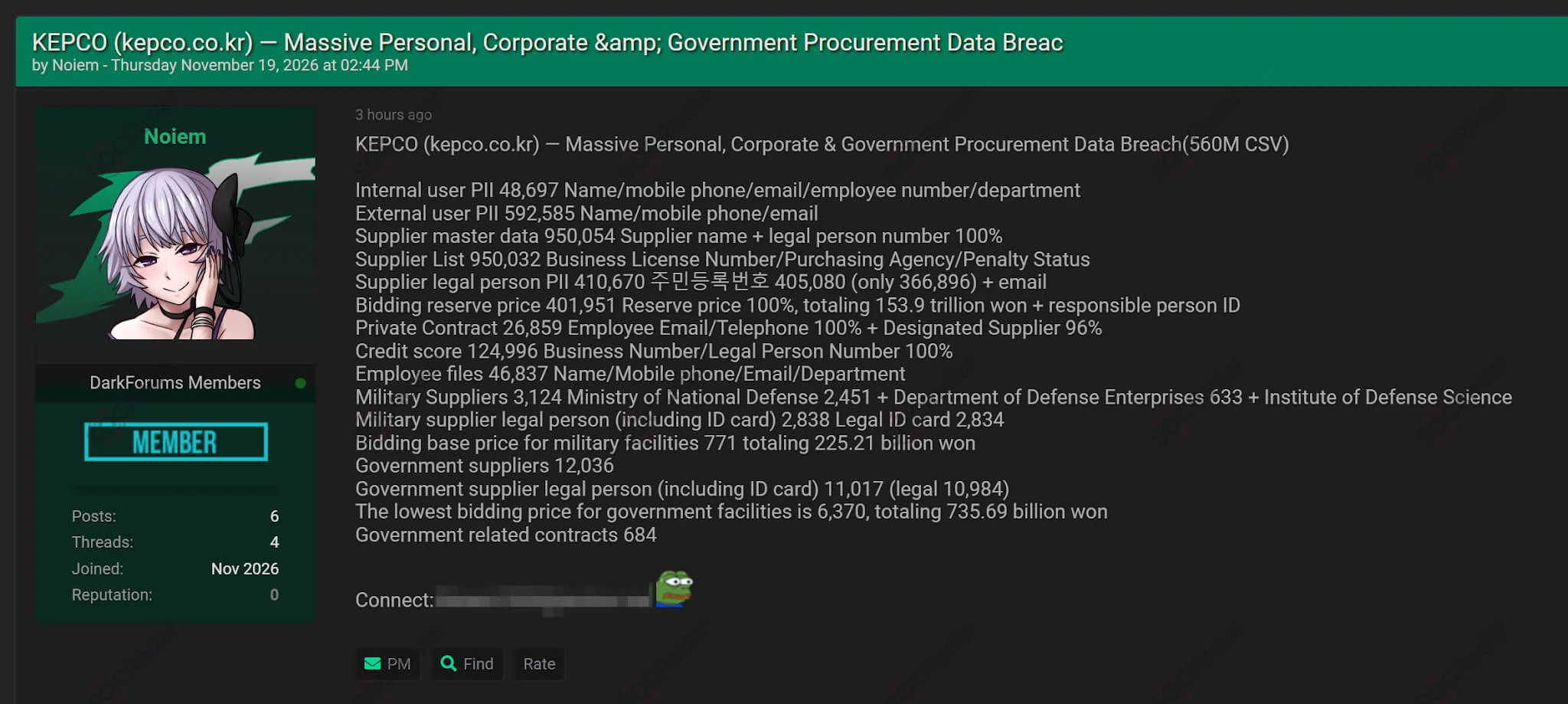
South Korea’s state-owned utility Korea Electric Power Corporation (KEPCO) has confirmed a data breach affecting about 1.52 million users: 650,487 users of its KEPCO ON customer platform and 869,761 users of its SRM procurement system. The KEPCO ON exposure includes names, resident registration numbers, bank account details, credit card information and billing records. KEPCO says it blocked access from external IP addresses, suspended the affected services and opened an investigation with the National Intelligence Service and outside experts. The incident follows an October leak of data on about 24,000 KEPCO employees, which the company said did not involve customer data.
On November 19, an actor using the handle Noiem posted on DarkForums advertising a “560M CSV” dataset allegedly taken from KEPCO. The listing mentions supplier records, bidding reserve-price data, private contracts, credit scores, employee files, and military and government procurement records. The 560 million figure and these details are unverified and go well beyond what KEPCO has acknowledged, so the confirmed incident and the dark web claim should be treated as separate until evidence links them. If the supplier and procurement data is real, it could support fraud, spear-phishing of contractors and supply-chain targeting.
Alleged Aeroméxico Database of 22 Million Passenger Records is Offered for Sale
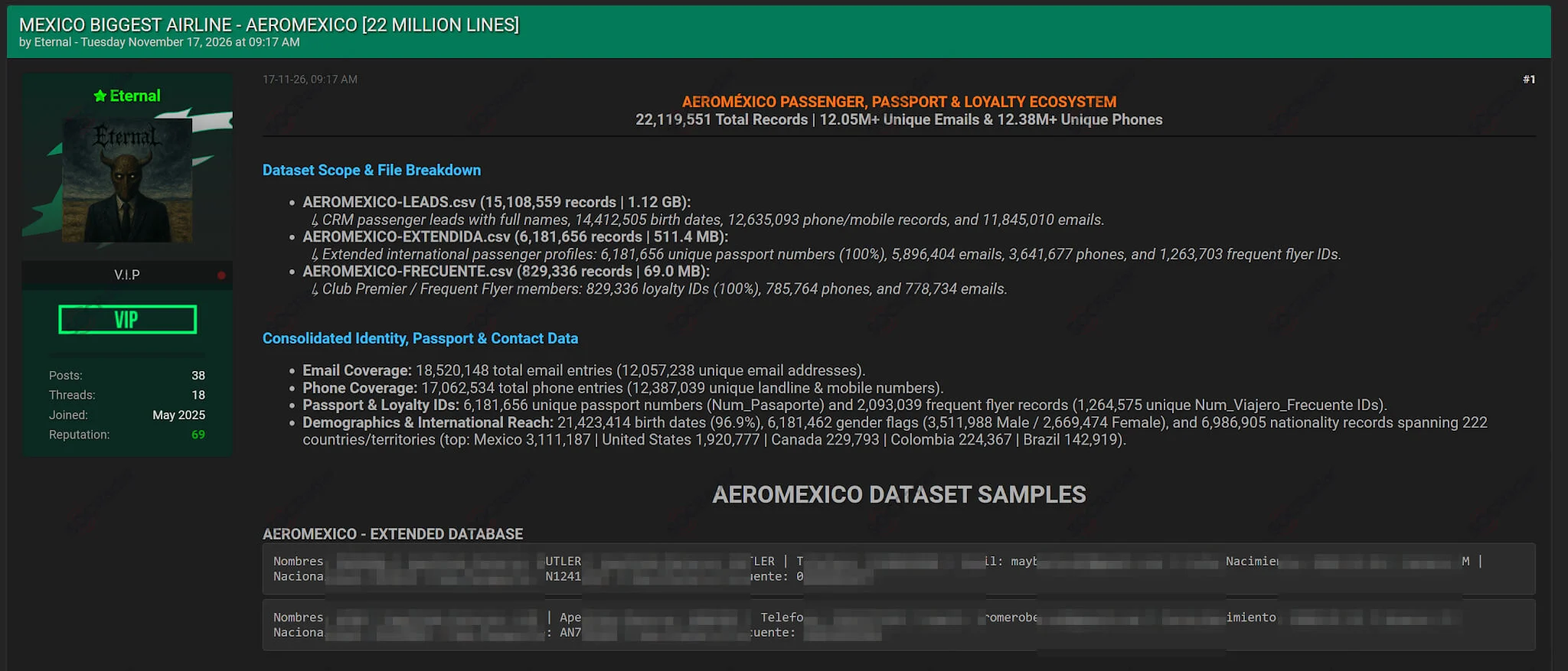
A seller using the handle Eternal is advertising 22,119,551 records allegedly taken from Aeroméxico, Mexico’s largest airline, on DarkForums. The November 17 listing asks 50,000 Mexican pesos, roughly $2,750, and describes three files: 15.1 million CRM leads, 6.18 million international passenger profiles that include passport numbers, and 829,336 Club Premier frequent-flyer members. The seller claims 12.05 million unique emails and 12.38 million unique phone numbers across 222 countries and territories, and says its Telegram accounts were banned, so buyers are directed to a Signal handle.
The listing is the latest in a string of Aeroméxico data claims. In September, Mexico’s anti-corruption ministry said it was investigating a Telegram offer of more than 15 million passenger records, and the airline said it had found no compromise of financial information or account passwords. Aeroméxico has also acknowledged a 2025 security event involving a platform run by an external provider. It has not confirmed this latest claim, and the file structure suggests CRM, passenger and loyalty data combined rather than a single database. If authentic, passport numbers paired with contact details would support identity fraud and travel-themed phishing.
Alleged 180 TB Defense Supply-Chain Leak Names BAE Systems, General Dynamics and Elbit Systems
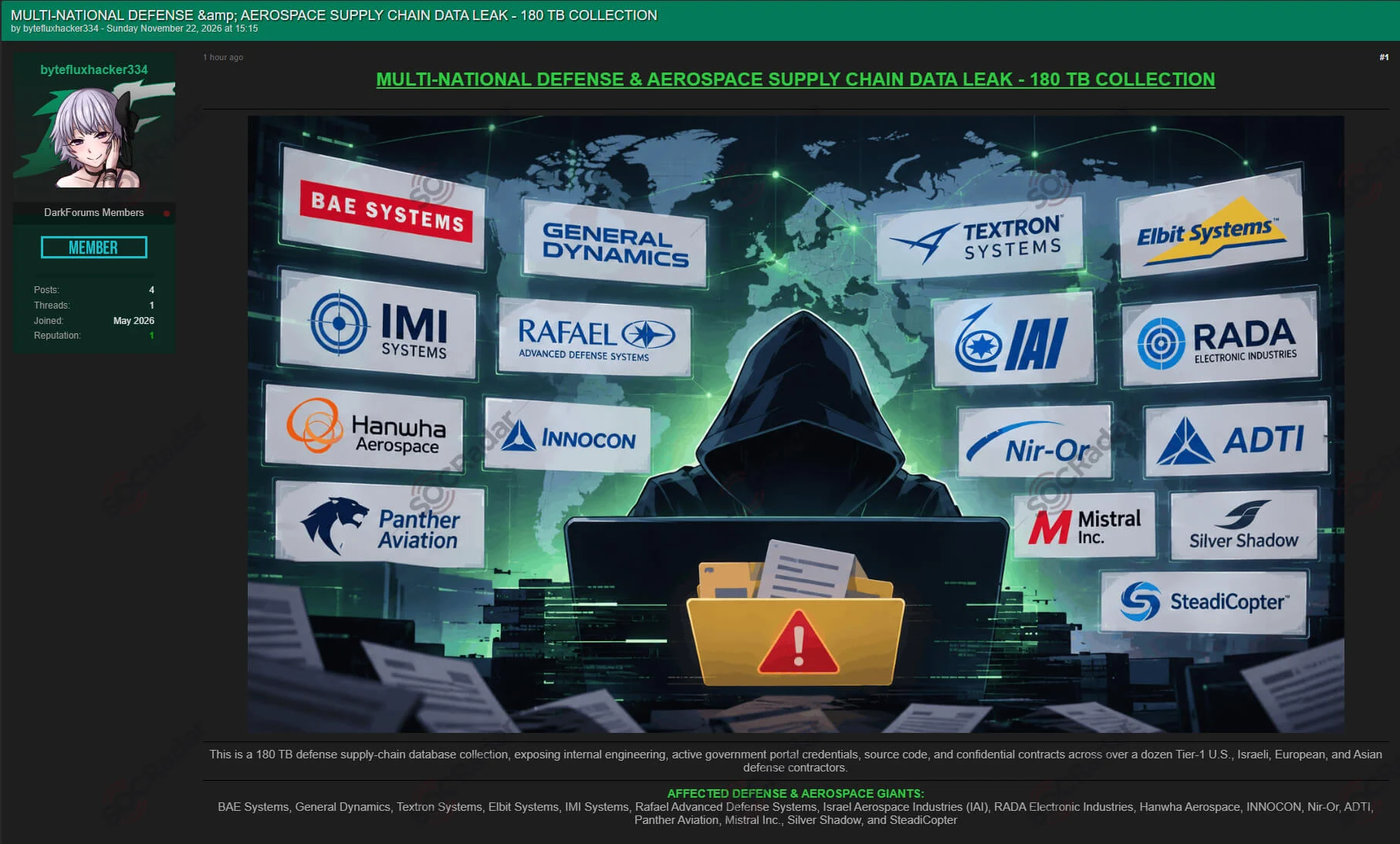
A DarkForums user posting as bytefluxhacker334 claims to hold 180 TB of data stolen from more than a dozen defense and aerospace contractors across the United States, Israel, Europe and Asia. The post names BAE Systems, General Dynamics, Textron Systems, Elbit Systems, Israel Aerospace Industries, Rafael and Hanwha Aerospace, among others, and offers samples and a Session contact for the full set. None of the named companies has confirmed the claim.
The actor lists plaintext usernames, passwords, PINs and security questions for US Department of Defense PIEE, State Department DTCC/DECCS and SAM.gov portals, plus live supplier portals at BAE Systems, General Dynamics and Textron Systems. The inventory also includes VHDL source trees and FPGA bitstreams for military avionics, UAV and ground-control documentation, armored-vehicle engineering files, contract pricing and bills of materials, and employee dossiers with passports. Claims of this size are frequently aggregated or exaggerated, and a listing of an alleged 375 TB Lockheed Martin dataset appeared on a dark web marketplace in March. Without validated samples this should be treated as unproven, although valid credentials for government contracting portals would carry serious risk.
Alleged RCS Zero-Click Exploit Chain “SILENT_CARRIER” is Offered for Sale
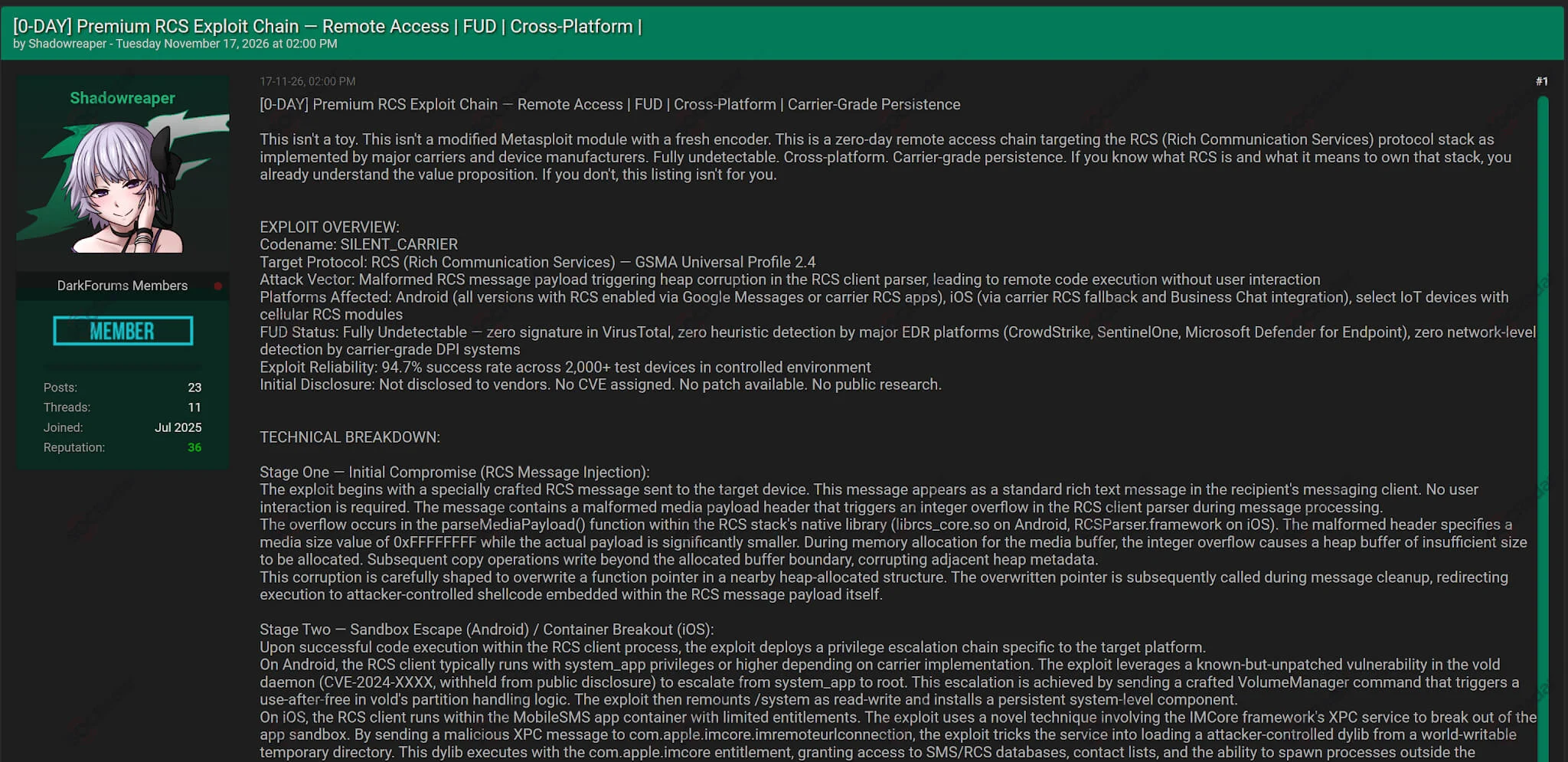
A seller using the handle Shadowreaper has listed an alleged zero-day exploit chain for the RCS (Rich Communication Services) messaging stack, sold under the codename SILENT_CARRIER in licence tiers from $8,000 to $45,000. The November 17 DarkForums post claims zero-click remote code execution on Android and iOS, starting with a malformed media payload header that triggers an integer overflow in the message parser.
The seller also claims a privilege escalation step on each platform, persistence by rewriting the device’s RCS provisioning profile with a carrier-signed certificate, a module that spreads to up to 50 contacts a day, and zero detections out of 72 on VirusTotal. No sample, hash or packet capture accompanies the listing, and the only CVE reference is a placeholder, CVE-2024-XXXX, that matches no real record. The claims are unproven, but a working zero-click chain against RCS would put mobile users at serious risk.
Alleged Frappe Framework and ERPNext Zero-Day RCE is Offered for Sale
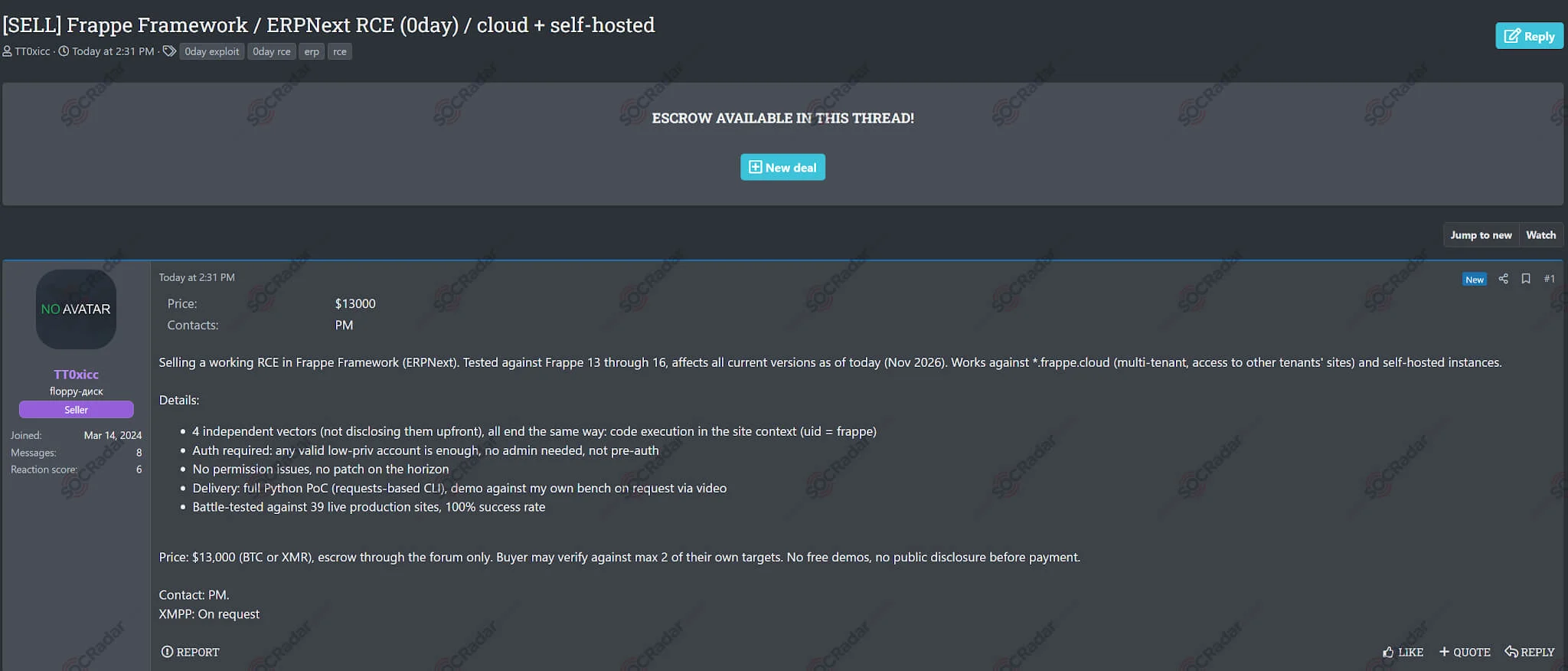
A seller on the xss.mx forum is asking $13,000 in Bitcoin or Monero for an alleged zero-day remote code execution vulnerability in the Frappe Framework and its ERPNext application, along with a Python proof-of-concept tool. The November 17 listing says the flaw affects Frappe versions 13 through 16, has no patch, and requires only a valid low-privilege account rather than administrator access.
The most serious claim concerns hosted deployments: the seller says the exploit works against multi-tenant frappe.cloud environments and exposes other tenants’ sites, and reports a 100% success rate against 39 live production sites. The four exploitation vectors are withheld until payment, and only a private video demonstration is offered. If real, a tenant-isolation failure in a widely used open-source ERP platform would put business, financial and HR data at risk for many organizations, so Frappe and ERPNext users should watch for vendor advisories.
Alleged VPN Access to 27 Organizations is Auctioned by Initial Access Broker
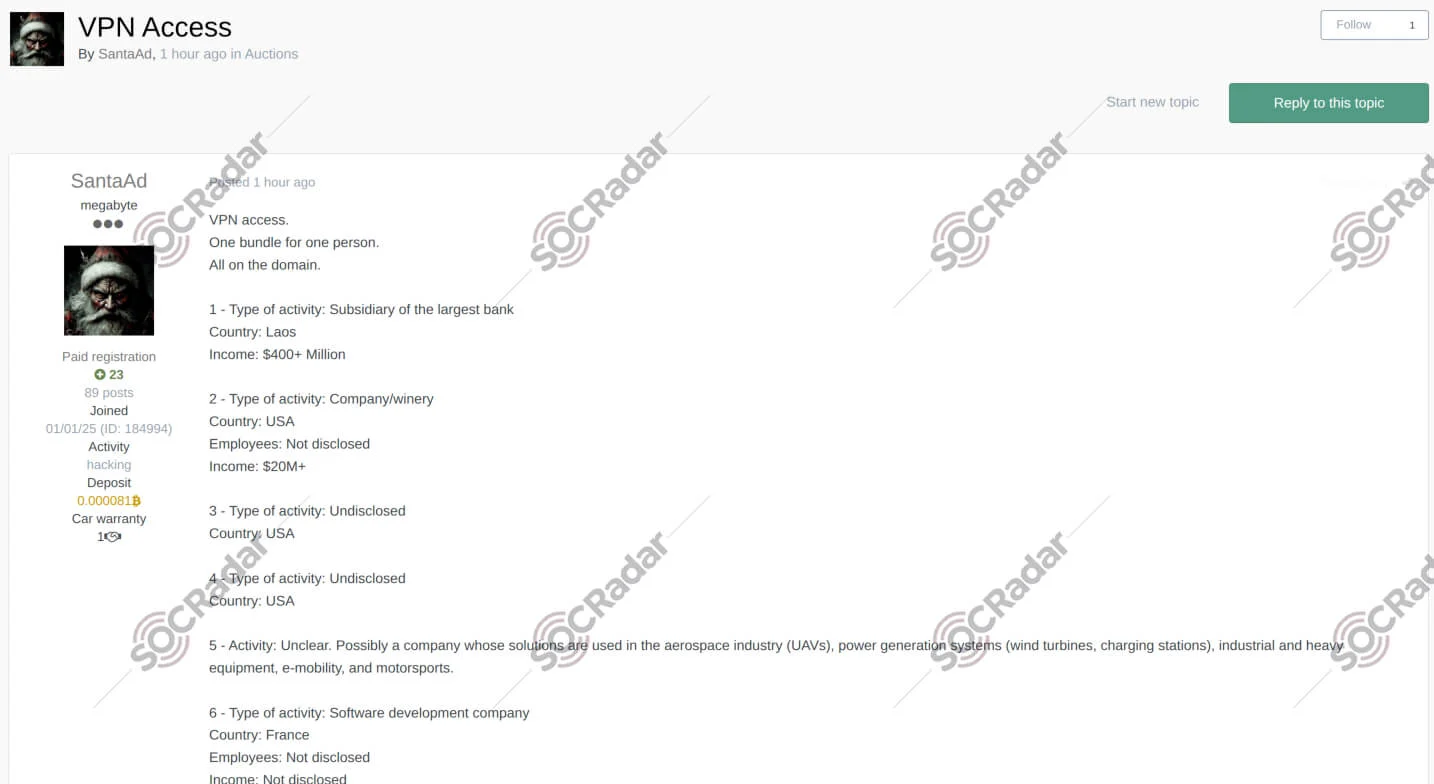
A seller using the handle SantaAd is auctioning what it describes as VPN access to 27 organizations on the Exploit forum, with a $40,000 starting bid, $5,000 increments and a $60,000 buy-now price for a single buyer. The November 17 listing says every access is inside the domain and describes targets by sector, country, revenue and size while withholding their names.
The claimed victims span banking, aerospace and defense, energy and mining, biopharmaceuticals, software, logistics, construction and accounting across the United States, France, Germany, Italy, Japan, Australia, Canada, the UAE and other countries. One entry describes a company whose products are used in UAVs, wind turbines and charging stations, and another a Nasdaq-listed biopharmaceutical firm. No screenshots, logs or samples show that the access is valid. Batches like this are routinely bought by ransomware affiliates, so security teams in the named sectors should review VPN logs for unusual logins and enforce multi-factor authentication.
Eclipse Ransomware-as-a-Service Platform is Advertised With Post-Quantum Encryption Claims
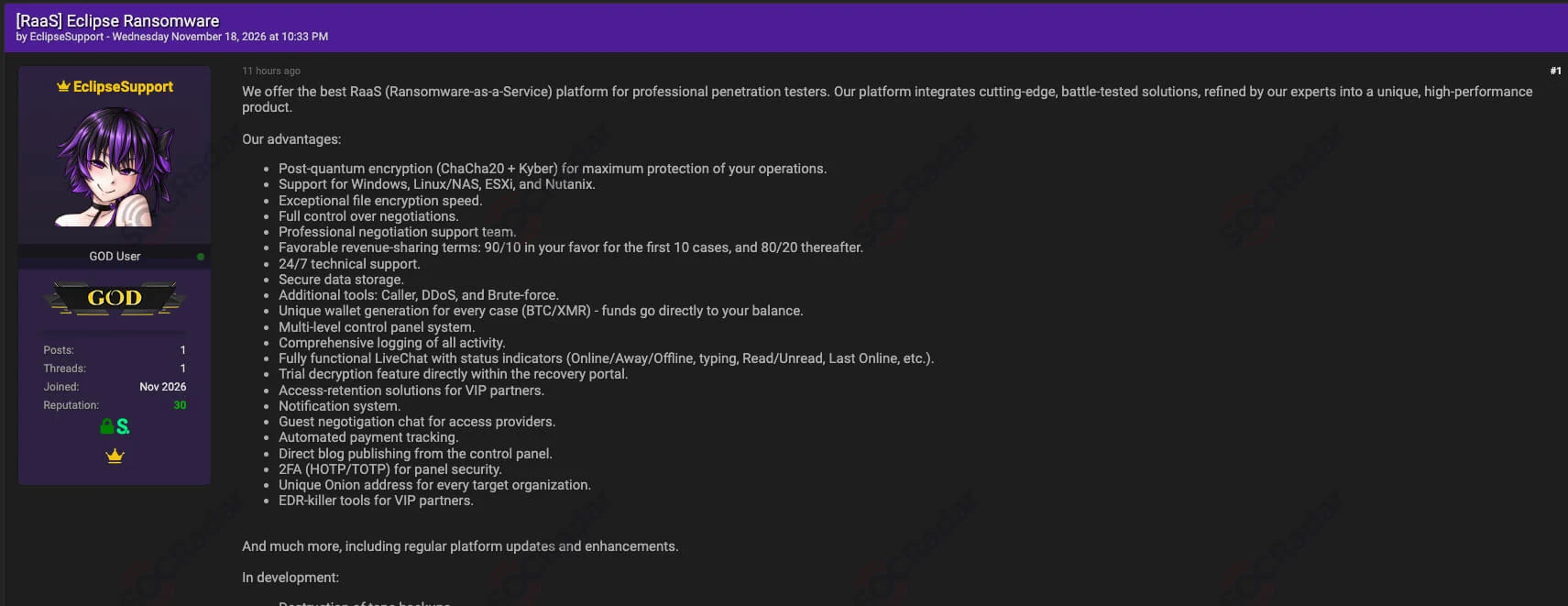
A previously unseen operation calling itself Eclipse has advertised a ransomware-as-a-service platform on the pwnforums.st forum, announced on November 18 by an account named EclipseSupport. The listing offers affiliates lockers for Windows, Linux/NAS, VMware ESXi and Nutanix, and claims ChaCha20 encryption with Kyber post-quantum key exchange. The Windows locker is said to be written in Rust and to spread through network shares, Group Policy and PsExec/WMI, disable Windows Defender, delete shadow copies and encrypt Hyper-V machines and Veeam backups. EDR-killer tools are offered to selected partners.
Affiliates pay a $300 entry fee and keep 90% of the first ten cases and 80% after that, with a stated minimum ransom of $70,000 and a ban on targeting CIS countries. The platform has already drawn coverage from Cybersecurity News, and Kaspersky’s 2026 ransomware report names EDR killers and post-quantum cryptography among the year’s trends. The post-quantum claim is unverified; the practical risk lies in the ESXi, Nutanix and backup-targeting features, so defenders should prioritize hypervisor hardening and offline, immutable backups.
Powered by DarkMirror™
Gaining visibility into deep and dark web threats can be extremely useful from an actionable threat intelligence and digital risk protection perspective. However, monitoring all sources is simply not feasible, which can be time-consuming and challenging. One click-by-mistake can result in malware bot infection. To tackle these challenges, SOCRadar’s DarkMirror™ screen empowers your SOC team to follow up with the latest posts of threat actors and groups filtered by the targeted country or industry.