RedOps: WeaveLotus Targets Southeast Asian Governments for South China Sea Intelligence
The SOCRadar Threat Research Unit (STRU) identified RedOps, a cyber espionage campaign conducted by a Vietnam-sponsored threat actor tracked as WeaveLotus. Between August and September 2026, the actor targeted military, government and legislative organizations in Southeast Asia to collect intelligence on South China Sea defense and military agreements.
Across five confirmed intrusions in Thailand and the Philippines, WeaveLotus exfiltrated gigabytes of internal documents, project plans and credentials. Its activity against Indonesian government organizations did not progress beyond reconnaissance. The campaign name comes from the string “redops”, which appears repeatedly in the actor’s tooling.
This post covers the full campaign, TTPs and IoCs. The complete technical analysis, including code excerpts and screenshots, is available in the whitepaper.
Key Takeaways
- WeaveLotus compromised five government, military and legislative organizations in Thailand and the Philippines, and ran reconnaissance against more than 30 Indonesian organizations
- Initial access came from exposed open-source web applications: GeoServer (CVE-2024-36401), JasperReports default credentials, osTicket (CVE-2021-42235) and a Laravel application with debug mode enabled
- The actor kept access through reverse SSH tunnels and SOCKS5 proxies, then moved into downstream systems, including a third-party document management system and an identity platform belonging to another agency
- Confirmed collection includes 19 GB of documents from the Thai legislative intrusion, 31,418 files from a Thai military organization and 349,782 records from a Thai government application
- STRU attributes the campaign to WeaveLotus with moderate confidence, based on Vietnamese-language code comments, UTC+7 working hours and regional strategic targeting
RedOps at a Glance
| Attribute | Details |
|---|---|
| Threat Actor | WeaveLotus (Vietnam-sponsored, moderate confidence) |
| Campaign | RedOps |
| Active Period | August to September 2026 |
| Targeted Countries | Thailand, the Philippines (intrusions), Indonesia (reconnaissance only) |
| Targeted Sectors | Government, military, legislative |
| Initial Access | CVE-2024-36401 (GeoServer), default JasperReports credentials, CVE-2021-42235 (osTicket), Laravel debug mode |
| Exfiltration | MinIO to a separate VPS, plus direct API and file downloads |
| Objective | Intelligence on South China Sea defense and military agreements |
Intelligence Requirements Behind RedOps
Nation-states, much like private companies, run intelligence teams that collect information against specific Intelligence Requirements (IRs). What sets state-level teams apart is access to specialized collection sources, which sometimes includes offensive operations against the targets themselves. RedOps shows both sides of that model.
Like a conventional intelligence unit, WeaveLotus started with open-source intelligence (OSINT). Automated Bing search scripts scraped news and documents on military agreements involving the Philippines, China and the United States, with a particular focus on the South China Sea.
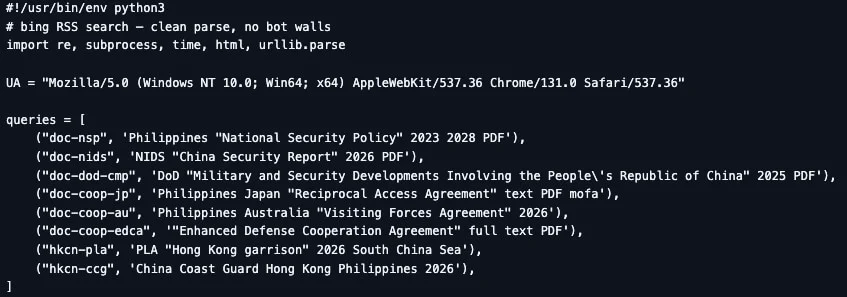
The queries suggest that the actor’s primary intelligence requirement was the shifting balance of power in the South China Sea, tracked from both sides. On one side, how Manila is formalizing foreign military access with the United States, Japan and Australia.
On the other, whether Beijing is using Hong Kong as an auxiliary logistical or operational hub for People’s Liberation Army (PLA) and China Coast Guard (CCG) activity against the Philippines. Vietnam holds overlapping maritime claims with China while avoiding formal military alliances, so this visibility would inform Hanoi’s own maritime defense posture and diplomatic hedging.
OSINT alone did not satisfy these requirements. The operators enumerated government, military and legislative entities across the Philippines, Thailand and Indonesia, and moved to direct collection from their networks.
General Attack Flow
Across the campaign, WeaveLotus followed a consistent pattern:
- Reconnaissance: subdomain and service enumeration, Certificate Transparency log harvesting, port scans and VPN fingerprinting against the target organizations
- Initial access: exploitation of known vulnerabilities and weak or default credentials in internet-facing open-source web applications
- Persistence and tunneling: SOCKS5 proxies and reverse SSH tunnels back to actor-controlled VPS nodes, in one case kept alive by a self-healing cron script
- Lateral movement: pivoting from the first foothold into internal services, downstream applications and, through captured credentials, other organizations
- Collection: bulk download of documents, records and credentials through exposed or authenticated APIs, sorted into intelligence categories
- Exfiltration: transfer of the curated data to a separate VPS using MinIO
The intrusions were connected. Access gained in one environment opened a path into the next, most clearly in Thailand, where a legislative organization’s reporting server led to a third-party document system and to administrator credentials for another government agency.
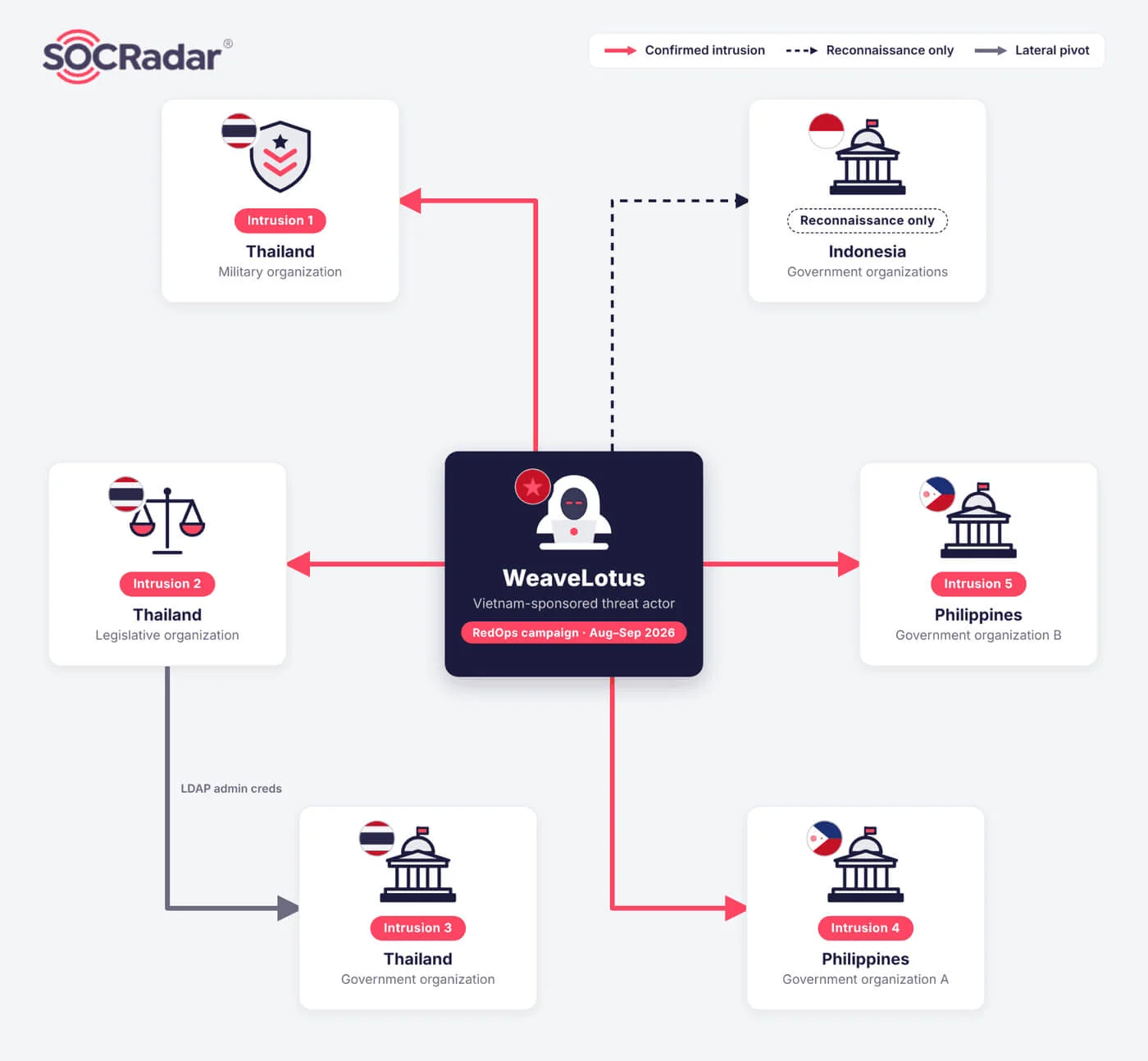
Intrusion 1: Thai Military Organization
In late August 2026, WeaveLotus opened the campaign by enumerating subdomains and hosted services of a Thai military-affiliated organization. It found an exposed GeoServer instance, an open-source server for sharing geospatial data, and likely exploited CVE-2024-36401 (CVSS 9.8), an unauthenticated remote code execution flaw, by sending malicious XML payloads from 172.235.255[.]195.
A script then downloaded a SOCKS5 proxy and opened a reverse SSH tunnel, giving the actor a proxy route straight into the internal network. Vietnamese-language comments were embedded in that script. Hands-on-keyboard reconnaissance followed: hostnames, routing tables, DNS records for military domains, port scans, TLS certificates, SSH keys and cron jobs, and a full enumeration of Hadoop DataNodes. The operators wrote all of this output to GeoServer’s public web directory, which exposed their own reconnaissance results to the internet.
On September 20, 2026, the actor moved its C2 to 172.235.245[.]49 and installed a cron job that ran a self-healing script (watch.sh) every three minutes. The script restarted the proxy when needed and kept an SSH tunnel open over port 443 with 13 reverse port forwards, giving the operator direct access to multiple internal services. This foothold became the primary pivot point for the rest of the activity in the organization, including Server-Side Request Forgery (SSRF) attempts against internal CMS, Elasticsearch and ClickHouse instances.
From this pivot, WeaveLotus reached a Directus CMS whose file API allowed unauthenticated access. It listed 95,000 records (~52 GB) and downloaded about 31,418 files (~575 MB) across five batches, focusing on PDFs, Office documents and ZIP archives related to accounting, logistics, disaster response, military operations and infrastructure projects. The files were sorted into five Vietnamese-named folders: Cooperation, Design, Military, Planning and Diplomacy. The operators then ran OCR with Thai and English language packs so scanned documents could be searched and triaged without opening each one.
The actor also found a Wowza platform hosting surveillance video feeds, tried several logins against it and attempted to push a test stream into its ingest endpoint. The injected stream never appeared in the platform’s playlist. The apparent goals were real-time visibility into military operations and testing a stream-hijacking capability.
Intrusion 2: Thai Legislative Organization
On September 20, 2026, WeaveLotus accessed a JasperReports server belonging to a Thai legislative organization using the default jasperadmin:jasperadmin credentials. It uploaded a malicious report that loaded a custom Java class to run SQL on the backend Microsoft SQL Server, then deleted the report after each run to limit forensic traces.
A custom stored procedure, xp_redops, wrapped xp_cmdshell and used the GodPotato tool to run PowerShell as SYSTEM. One SQL script used it to open a reverse SSH tunnel over port 443 to the actor’s infrastructure with a private key staged on the server.
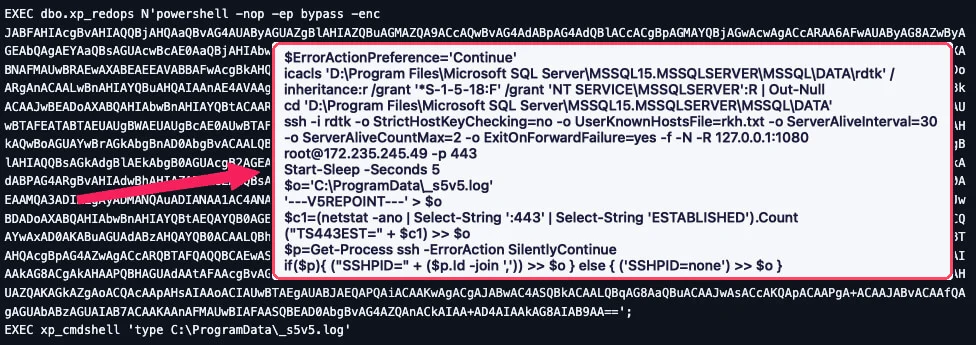
To stop uploading reports by hand, the actor deployed a lightweight Python C2 server (JRS C2). The agent inside JasperReports beaconed every five minutes over TLS, fetched tasks and tools, and returned output through the tunnel. NTLM relay attempts to create a backdoor account and dump NTDS.dit failed, but an LDAP relay returned extensive Active Directory domain information.
The same JasperReports server rendered documents for a third-party document management system (DMS), which became the actor’s most productive target. The operators ran four rounds of password spraying using employee names paired with National ID numbers, suggesting they held a staff roster. Once authenticated, they pulled the system configuration (with multiple cleartext credentials), 1,502 user records, more than 90,000 audit log entries and folder data covering 88,575 documents.
Bulk collection followed: more than 5,000 ZIP archives of up to 80 MB each and more than 4,000 of the most recently created documents, including meeting agendas, government expenditures, appointments and asset disclosure outcomes. WeaveLotus sorted the files into folders and exfiltrated them to 45.61.144[.]206 using MinIO, an S3-compatible storage system. STRU verified a total of 19 GB against the transfer logs in the actor’s open directory.
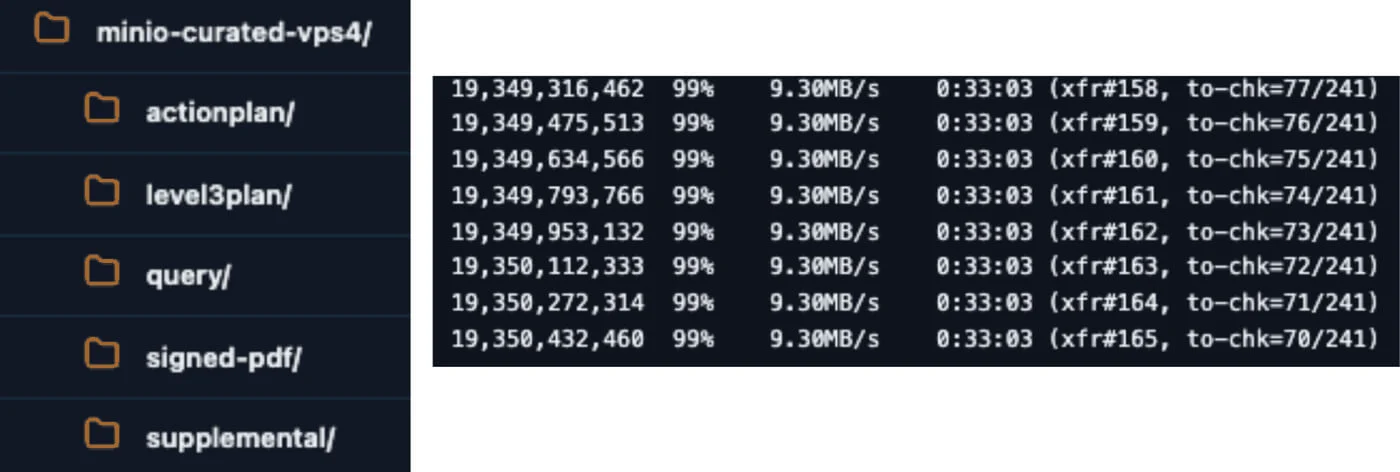
Documents like these can also be reused as lures in follow-up spear-phishing, a tactic documented among Vietnam-sponsored threat actors such as OceanLotus.
Finally, a rogue LDAP listener on the same foothold captured administrator credentials for another domain in the Active Directory trust chain, belonging to a separate Thai government organization. That capture led directly to the next intrusion.
Intrusion 3: Thai Government Organization
Using the captured credentials, WeaveLotus gained root SSH access to a server running Keycloak 3.4, an open-source identity and access management platform, and dumped its credential database (5.6 MB, more than 40,000 user records). It cracked the PBKDF2-SHA256 hashes offline with wordlists built around Thai Buddhist Era years, then validated the cracked passwords in real time against the token endpoint. The working accounts belonged to users across Thai ministries and agencies, and two of them held all 18 administrative roles, equivalent to a domain administrator.
With valid credentials, a script ran for over an hour and pulled 349,782 records (669 MB) from a downstream application’s API, covering national strategy alignment, reform directives, masterplan targets, Sustainable Development Goals, five-year fiscal plans, policy mappings and budget allocations. A password spray against the organization’s Microsoft 365 tenant failed.
Intrusions 4 and 5: Philippine Government Organizations
On August 30, 2026, WeaveLotus expanded to the Philippines. At the first government organization, it exploited CVE-2021-42235 (CVSS 9.8), an unauthenticated blind SQL injection flaw in osTicket’s password-reset handler. Over roughly three hours of scripted queries, it extracted the staff table schema and the usernames, email addresses and bcrypt password hashes of staff accounts.
The same day, the operators targeted a second Philippine government organization running a Laravel application with debug mode enabled. They crawled the site, confirmed hidden routes through their error responses and then forced verbose error pages. The stack traces exposed server paths and source code snippets, and revealed directories tied to an internal project-management and budgeting system.
Reconnaissance Against Indonesia
During the same period as Intrusion 1, WeaveLotus harvested Certificate Transparency logs, ran port scans, fingerprinted VPN services (Palo Alto GlobalProtect, Ivanti Connect Secure, Cisco ASA and Fortinet FortiGate) and grabbed IMAP/POP3 banners across more than 30 Indonesian government organizations. No intrusion followed.
Victimology
WeaveLotus targeted only government, military and legislative institutions in the Philippines, Thailand and Indonesia, with Indonesia seen at the reconnaissance stage only. There was no observed targeting of private-sector entities, a pattern consistent with state-directed intelligence collection.
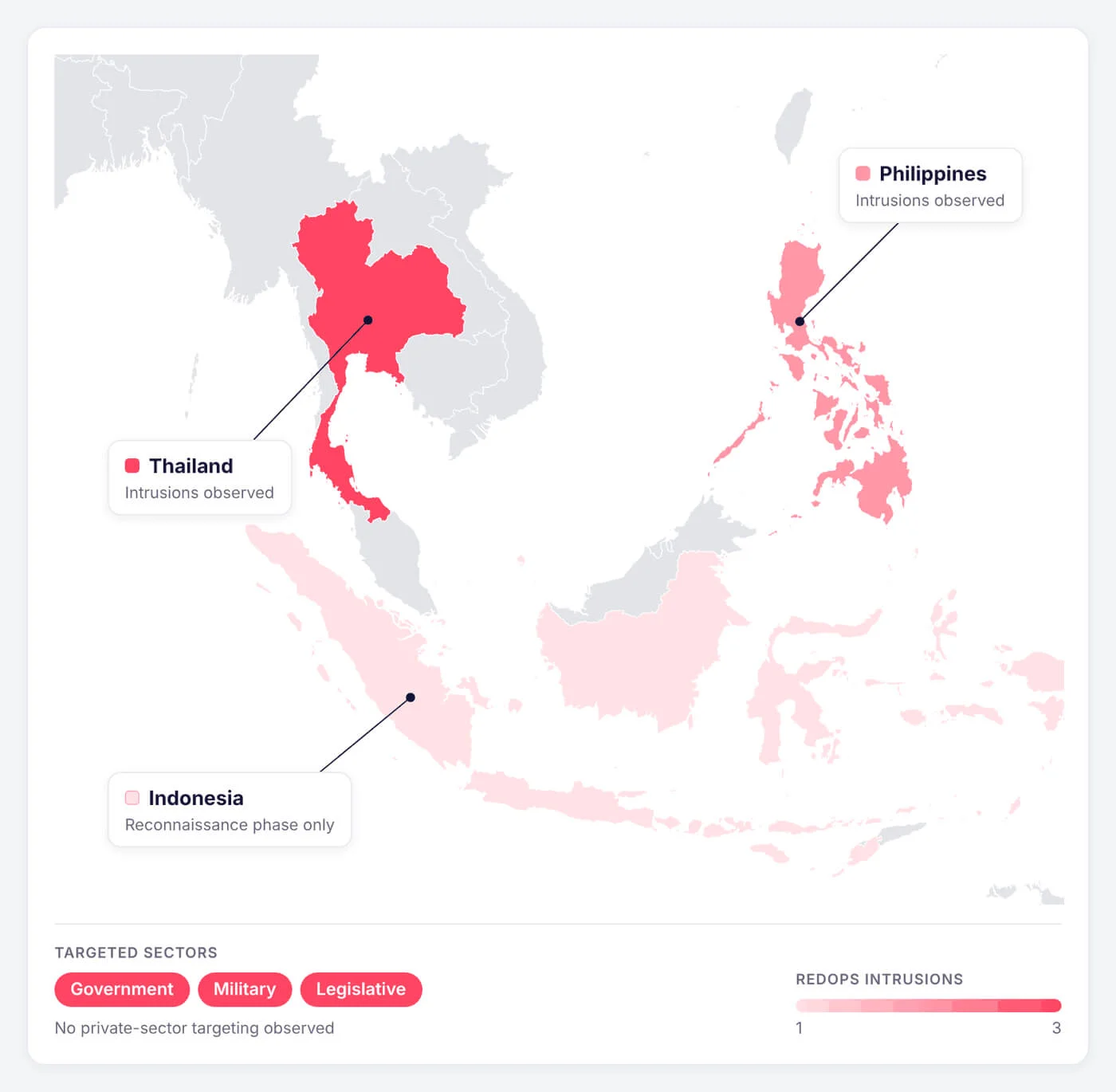
Infrastructure and Attribution
The campaign ran on two Akamai (Linode) VPS nodes in the United States, 172.235.255[.]195 and, from September 20, 2026, 172.235.245[.]49. They served as endpoints for reverse SSH tunnels and as staging hosts, with separate ports for reverse shells (4444), file staging (7779), inbound SSH tunnels (443) and Chisel tunnels (80). Stolen files went to a separate RouterHosting VPS at 45.61.144[.]206.
STRU attributes RedOps to WeaveLotus with moderate confidence. The evidence includes native Vietnamese-language comments in operator scripts, activity aligned with UTC+7 working hours, OSINT collection focused on China-Philippines military cooperation, prioritized collection of defense, diplomatic and national policy documents, and exclusive targeting of Southeast Asian government, military and legislative bodies.
A direct link to OceanLotus (APT32) was assessed with low confidence. Despite the shared Vietnamese origin and overlapping victims, WeaveLotus used no spear-phishing lures, APT32 malware families or cloud services for C2, and its tooling and initial access differ from established APT32 tradecraft. The evidence points to a distinct operational team, and it does not conclusively establish state sponsorship.
Recommendations
- Patch internet-facing open-source applications, starting with GeoServer (CVE-2024-36401) and osTicket (CVE-2021-42235)
- Remove default credentials, such as jasperadmin:jasperadmin on JasperReports
- Disable debug mode on production Laravel applications
- Restrict anonymous read access to internal APIs, including the Directus Public role on directus_files
- Monitor for unusual authentication activity, password spraying and ROPC token requests
- Block or alert on outbound SSH tunnels over port 443, SOCKS proxies and bulk data transfers
- Review third-party access and identity trust relationships as paths for cross-organization compromise
MITRE ATT&CK Techniques
| Tactic | Technique ID | Technique Name |
|---|---|---|
| Reconnaissance | T1596.003 | Search Open Technical Databases: Digital Certificates |
| Reconnaissance | T1595.002 | Active Scanning: Vulnerability Scanning |
| Initial Access | T1190 | Exploit Public-Facing Application |
| Initial Access | T1078.001 | Valid Accounts: Default Accounts |
| Execution | T1059.004 | Command and Scripting Interpreter: Unix Shell |
| Execution | T1059.001 | Command and Scripting Interpreter: PowerShell |
| Execution | T1059.006 | Command and Scripting Interpreter: Python |
| Persistence | T1053.003 | Scheduled Task/Job: Cron |
| Privilege Escalation | T1068 | Exploitation for Privilege Escalation |
| Credential Access | T1110.003 | Brute Force: Password Spraying |
| Credential Access | T1110.002 | Brute Force: Password Cracking |
| Credential Access | T1187 | Forced Authentication |
| Discovery | T1046 | Network Service Discovery |
| Collection | T1005 | Data from Local System |
| Collection | T1074 | Data Staged |
| Command and Control | T1572 | Protocol Tunneling |
| Command and Control | T1071.001 | Application Layer Protocol: Web Protocols |
| Exfiltration | T1567.002 | Exfiltration Over Web Service: Exfiltration to Cloud Storage |
Indicators of Compromise (IoCs)
Network Indicators
| Type | Indicator | Description |
|---|---|---|
| IP Address | 172.235.255[.]195 | Linode/Akamai VPS |
| IP Address | 172.235.245[.]49 | Linode/Akamai VPS (Newest) |
| IP Address | 45.61.144[.]206 | MinIO Exfiltration VPS |
| URL | {host}?b=JRS1 | JRS C2 Network Path |
Host Indicators
| Type | Indicator | Description |
|---|---|---|
| SHA256 | d8a7dd1961d47068f87ef9c7d5021aec4febce1408bdf83023e5b47efece9ad6 | evil_vps3.xml |
| SHA256 | 010d16abdf45a544ae192a4eae1c5d11cfa690a827d7e6ba39e457cc774ee26d | socks.py |
| SHA256 | 9ea20d46bb9939382c6c63548890239d0285b0c60b2f63f59f9a667373d5aef9 | rp3.sh |
| SHA256 | 935ea9f9f05a086362bec818be1b8a98d635fb864f8baf9820c2c5597e0fa03c | bing_rss_search.py |
| SHA256 | 8ccfca5bb4ef2c83dab0220dfb56d99bfe1e8d34f9e5e1fd7c99ca4f7a3c1eca | bing_hkcn_search.py |
| SHA256 | d80ed38f848deb090cebec250721b9d2c6731b87982cae5fdfc1ef2f030e2d23 | certspotter_all.sh |
| SHA256 | 05661cacd2e107928f1dfba63d3a631cc3ff506359ae67ddc2214200b3009b4f | vpn_fp_vps3.sh |
| SHA256 | 835e644ea7034a7e45db2d8089363b582e49eb99707776e5fc1a920f049b30e2 | watch.sh |
| SHA256 | cf0bc5f91eb9013123669826e212b9ba2a6c0123bbd3942237a3d1cb7b4cdd93 | repoint5_sys.sql |
| SHA256 | b0396c1e8a88004c678b603a92d4bf85d44c04a2f7d381f14fedcd2f5ce428f0 | jrs_c2v3.py |
| SHA256 | 353209e5fcd0a3a7a48ddd095d416219f37a04520d96a203fdfe85257088dbac | dbsvc.bin – GodPotato binary |
| SHA256 | 97630da7a0d17e94ab5db44c1fe6ddd52ac975d8df0d160bfca6102bdb4be265 | r93final.sh |
| SHA256 | c4d6866c4003b92d4f996178198726ca9e702ecbd2c6ce66ee4ea311ffe336be | r94final.sh |
| SHA256 | 67bf04460b177873bf52a5548df9c258f973ae9e41ab25a6fed26ae9b3790cd1 | r95final.sh |
| SHA256 | e7d5e0232799ccbd59890c05d1e2fe0a09308990fbc58380cc1efd87ad611493 | dl-zips.py |
| SHA256 | d0ecc8020e9c7e56270ff4c926b926e0a045ebe5bac7007dbff04b1ec9fd5800 | ldapcap.py |
FAQ
What is RedOps?
RedOps is a cyber espionage campaign that ran from August to September 2026 against government, military and legislative organizations in Thailand and the Philippines, with reconnaissance against Indonesia. Its goal was intelligence on South China Sea defense and military agreements.
Who is WeaveLotus?
WeaveLotus is the name SOCRadar uses for the actor behind RedOps. STRU assesses with moderate confidence that it is Vietnam-sponsored, and with low confidence that it is directly linked to OceanLotus (APT32).
How did WeaveLotus gain initial access?
It exploited exposed open-source web applications: GeoServer through CVE-2024-36401, JasperReports through default credentials, osTicket through CVE-2021-42235, and a Laravel application with debug mode enabled.
What data did WeaveLotus steal?
Confirmed collection includes 19 GB of documents from a Thai legislative environment and its third-party DMS, 31,418 files from a Thai military organization, 349,782 records on national strategy, fiscal plans and budgets from a Thai government application, and staff credentials from Philippine government systems.