
Binance Hack: Inside the $6.3B Hot Wallet Theft
[Update] November 10, 2026: Binance Denies Breach Claim by Alleged ShinyHunters Seller
[Update] November 4, 2026: Binance Traces the Breach to a Fake Job Interview
[Update] November 3, 2026: Binance Reopens Withdrawals for More Assets, Binance Makes Its Proof of Reserves Verifiable
[Update] November 2, 2026: FBI Attributes Binance Hack to North Korea’s TraderTraitor
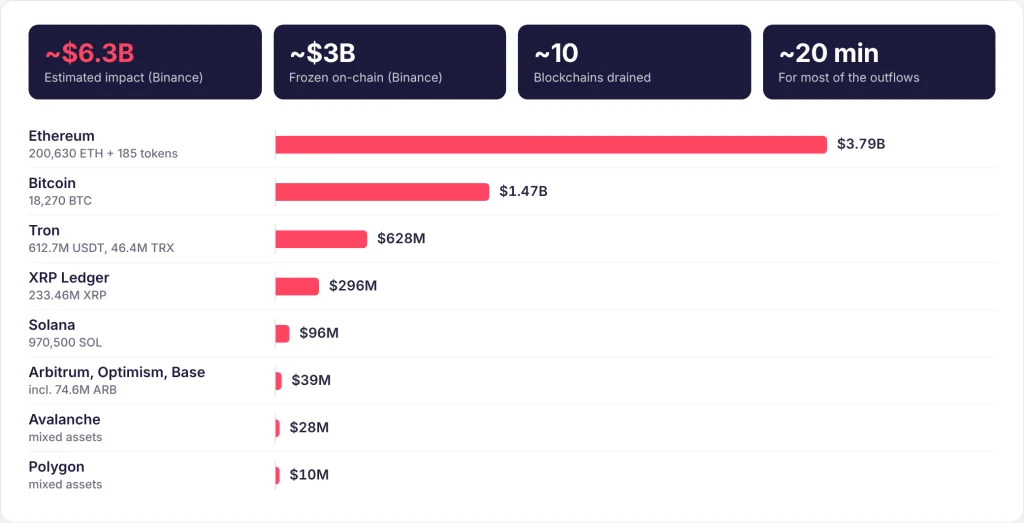
The Binance hack drained an estimated $6.3 billion from the exchange’s hot wallets across roughly 10 blockchains on the evening of October 29, 2026. The Binance hack is a hot wallet compromise in which an attacker made Binance’s own withdrawal infrastructure sign and send funds to attacker-controlled addresses, mostly within about 20 minutes.
Binance has confirmed the incident, and the evidence points to a serious, well-resourced operation: staged in advance, executed across chains at once, and built to get unauthorized transactions through the controls meant to stop them. About $3 billion has been blocked through on-chain freezes, and Binance has committed to paying for the rest.
Key Takeaways
- Record loss: Binance estimates the impact of the October 29, 2026 hot wallet theft at around $6.3 billion, about four times the $1.5 billion Bybit theft and the largest crypto heist on record
- Highly prepared operation: The attacker drained about 10 blockchains in roughly 20 minutes, with withdrawals pushed through Binance’s own signing path as if they were legitimate
- Entry point: Binance first linked the breach to a compromised DevOps engineer’s laptop, then said its investigation uncovered additional points of breach in what it calls a complex attack
- Half contained: About $3 billion is frozen on-chain, and Binance has reserved more than $6.34 billion in company funds to cover losses
- Attribution: Two blockchain analytics firms link the theft to North Korea’s TraderTraitor; Binance and governments have not confirmed attribution
Binance Hack at a Glance
| Incident | Unauthorized hot wallet withdrawals at Binance |
| Date | October 29, 2026, starting around 20:05 UTC |
| Estimated Loss | Around $6.3 billion (Binance estimate); independent estimates range from $6.36 billion to $6.4 billion |
| Blockchains Affected | About 10, including Ethereum, Bitcoin, Tron, XRP Ledger, Solana, Arbitrum, Optimism, Base, Avalanche and Polygon |
| Initial Access | Fake job interview planted a malicious code repository on an engineer’s computer, followed by abuse of an internal AI tool (Binance, November 3, 2026) |
| Private Key Exposure | No evidence found (Binance) |
| Frozen So Far | About $3 billion on-chain (Binance) |
| Loss Coverage | About 98% of the impacted amount replenished as of November 4, 2026; the rest is less liquid tokens still being acquired (Binance) |
| Attribution | Assessed by blockchain analysts as TraderTraitor (North Korea); not confirmed by Binance or governments |
| Service Status | Withdrawals reopening in phases: 15 networks from November 1, 2026; more assets on nine networks from 04:00 UTC on November 3, 2026; remaining assets paused; deposits unaffected |
Binance Hack Timeline
November 9, 2026 Binance
Binance denies an alleged ShinyHunters data breach claim
A seller using the ShinyHunters name claims to hold records on about 335 million Binance users and demands $900,000. Binance says it found no evidence of a compromise of its systems, KYC data, credentials or wallet private keys.
November 3, 2026, 14:33 UTC Binance
Binance traces the breach to a fake job interview
Binance publishes its initial findings: a tampered Homebrew installer in June, a fake job interview that planted a malicious code repository in September, and abuse of an internal AI tool on October 20 led to the wallet signing service used in the theft.
November 3, 2026, 04:00 UTC Status
Binance reopens withdrawals for more assets
Binance starts the second phase of its withdrawal restoration, reopening more assets across nine networks: BNB Smart Chain, Ethereum, Solana, XRP Ledger, Sui, Arbitrum, Optimism, Tron and Base. The progressive rollout adds stablecoins including RLUSD, USD1, FDUSD and USDe, tokens such as ADA, LTC, DOT, LINK, ONDO and JUP, and all bSTOCKS on BNB Smart Chain, ordered by user demand. Assets outside both phases remain paused, and deposits stay open.
November 2, 2026, 12:45 UTC Binance
Binance makes its Proof of Reserves verifiable
Binance completes the zero-knowledge proof for its October 31 snapshot, letting users verify that ten assets, including BTC, ETH, USDT and BNB, are backed at least 1:1. It says about 95% of the impacted amount is now covered.
November 1, 2026, 06:00 UTC Status
Binance begins restoring withdrawals in phases
Binance starts reopening withdrawals in phases, beginning with the most requested networks, including BTC, ETH, USDT, USDC, BNB and XRP. It says it has now covered about 95% of the impacted amount with company funds, up from 90% the day before. Deposits are unaffected.
October 31, 2026 Attribution
FBI attributes the theft to North Korea’s TraderTraitor
The FBI, with the U.S. Secret Service and IRS Criminal Investigation, attributes the theft of more than $6 billion in virtual assets to North Korea’s TraderTraitor. It says the stolen assets are being converted mainly into ETH, publishes the linked wallet addresses, and asks crypto services to block transactions with, or derived from, those addresses.
October 30, 2026 Binance
Binance reserves $6.34 billion and targets Proof of Reserves by Monday
Binance says it has reserved more than $6.34 billion in company funds, about $5 billion of it already held in the stolen token types, and is buying the rest through market and OTC channels. Co-CEO Richard Teng says the attack was not carried out by one person, the attacker used a self-destruct mechanism to wipe tooling and traces, and a full Proof of Reserves report is planned for Monday.
October 30, 2026, 08:47 UTC Binance
Binance finds additional points of breach
Binance says its investigation has uncovered additional points of breach beyond the compromised laptop identified earlier, calling it a complex attack. The outflows stopped when withdrawals were paused, about $3 billion is frozen, and withdrawals remain on track to resume in about 45 hours. Deposits are unaffected.
October 30, 2026, 04:17 UTC Status
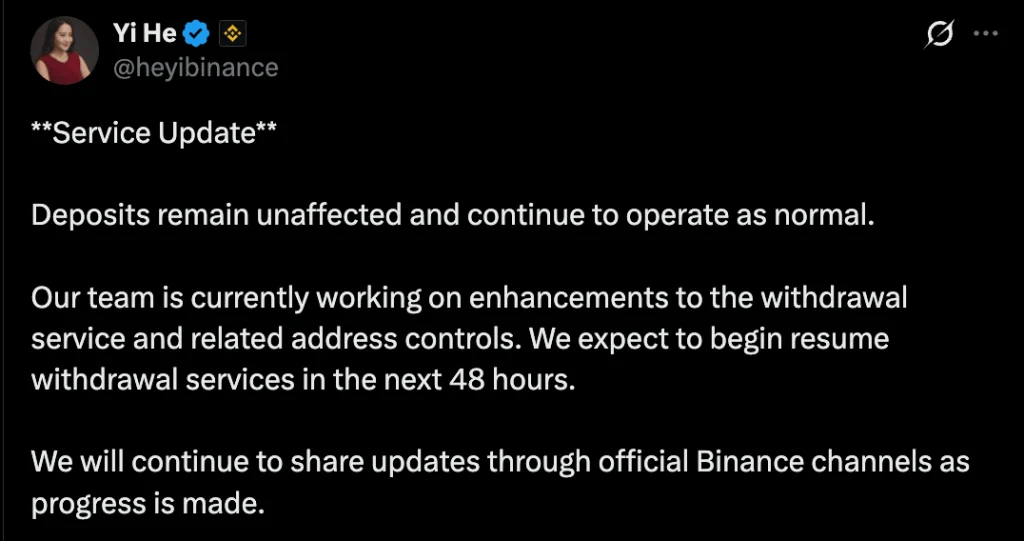
Withdrawals expected to resume within 48 hours
Binance co-CEO Yi He says withdrawals remain paused while the team improves controls on the withdrawal service and related addresses, and should begin resuming within 48 hours. Deposits are operating normally.
October 30, 2026, early morning UTC Attribution
Second firm links the theft to TraderTraitor and a possible Bitget connection emerges
- Attribution: A second blockchain analytics firm says North Korea’s TraderTraitor likely carried out the hack and raises its loss estimate to about $6.4 billion
- Bitget link: An independent investigator finds that funds from the Binance hack and the September 2026 Bitget exploit were mixed at the same address after passing through THORChain
October 30, 2026, 02:23 UTC Binance
Binance publishes its Security Incident Update
Binance’s initial investigation suggests a compromised DevOps engineer’s laptop gave the attacker access to a service container that submitted unauthorized withdrawals. Binance says it found no evidence of a wallet private key leak, estimates the impact at around $6.3 billion with about $3 billion frozen on-chain, and will cover all losses from SAFU and company funds.
October 30, 2026, 00:30 UTC Attribution
Blockchain analysts attribute the theft to TraderTraitor
Blockchain analysts attribute the theft with high confidence to North Korea’s TraderTraitor and value the stolen assets at $6.36 billion. As of 00:30 UTC, about $2.4 billion remains under attacker control, mostly more than 420,000 ETH and 18,270 BTC. Binance and government agencies have not confirmed the attribution.
October 30, 2026, 00:08 UTC Response
Arbitrum Security Council moves funds out of an attacker wallet
The council forces 8,426 ETH and 74.6 million ARB, worth about $30 million, out of the attacker’s Arbitrum wallet.
October 29, 2026, 23:05 UTC Attack
Second wave hits Avalanche and Polygon
Binance wallets on Avalanche and Polygon send out funds in a second wave, and smaller sweeps continue until about 23:56 UTC.
October 29, 2026, about 22:30 UTC Binance
Binance confirms a security incident and pauses withdrawals
Binance suspends withdrawals on multiple networks as a precaution, says user funds are safe, and warns users not to trust unofficial links or messages about the incident.
October 29, 2026, 22:01 to 22:26 UTC Response
Ripple and World Liberty Financial freeze stablecoins
Ripple freezes the RLUSD the attacker had not yet sold, and World Liberty Financial freezes 27.8 million USD1 in the attacker’s main receiving wallet.
October 29, 2026, 21:01 to 21:04 UTC Response
Tether and Circle freeze about $1.8 billion
Within about 40 minutes of the main Ethereum sweep, Tether freezes 971.1 million USDT in the attacker’s main receiving wallet and Circle freezes 823 million USDC, in coordination with law enforcement.
October 29, 2026, 20:20 to 20:24 UTC Attack
Ethereum hot wallet emptied in under four minutes
- EIP-7702 sweep: One transaction carries 50 authorizations signed by a Binance Ethereum hot wallet, each pointing to an attacker-controlled sweeper contract
- Main drain: About three and a half minutes later, 167,464 ETH and 1.615 billion USDT leave the wallet
- Other chains: 18,270 BTC and 612.7 million USDT on Tron leave Binance in the same window
October 29, 2026, 20:05 UTC Attack
Multi-chain drain begins
Five Binance wallets send 233.46 million XRP to a single attacker address. Within roughly 20 minutes, Binance wallets on about 10 blockchains have sent funds out.
October 28, 2026 Staging
Attacker prepares an operator wallet
A fresh operator wallet starts receiving small Tornado Cash withdrawals on the morning of October 28, and the attack code is deployed and tested early on October 29.
What Happened in the Binance Hack?
Attackers pushed unauthorized withdrawal transactions through Binance’s hot wallet infrastructure on October 29, 2026, moving an estimated $6.3 billion in crypto to attacker-controlled wallets. The outflows hit about 10 blockchains at once. Binance confirmed a security incident, suspended withdrawals, and revoked authorization for the affected address.
What Did Binance Say in Its Official Statement?
Binance published a Security Incident Update on October 30, 2026, laying out its preliminary findings and response. The key points:
- Initial finding: The initial investigation suggests the incident may involve a compromised DevOps engineer’s laptop, which let the attacker reach a service container and submit unauthorized withdrawal transactions
- Keys: Binance has found no evidence of any wallet private key leak
- Impact: The estimated total impact is around $6.3 billion, with about $3 billion frozen on-chain through blockchain partners
- Coverage: Binance will cover all losses from the SAFU fund and company funds, and says user funds are safe
- Containment: Binance suspended deposits and withdrawals during security checks and revoked the affected address authorization
- Next steps: Law enforcement and blockchain intelligence partners are engaged, and Binance will publish a technical post-mortem and an updated Proof of Reserves
In an October 30 update at 08:47 UTC, Binance said its investigation had identified additional points of breach beyond the laptop, indicating a more complex attack. The exchange confirmed that outflows stopped after withdrawals were suspended, approximately $3 billion remains frozen, and asset recovery for affected users is underway. Binance is also cooperating with law enforcement. In a video statement, co-CEO Richard Teng said the attack “was not carried out by one person.”
How Did Attackers Get Into Binance’s Systems?
Binance first traced the breach to a compromised DevOps engineer’s laptop, which gave the attacker access to a service container that could submit withdrawal transactions. The company adds that the compromised computer was only the first stage, and that its investigation has not assigned responsibility to any individual employee. Its latest update goes further: the investigation has uncovered additional points of breach, which Binance describes as part of a complex attack.
As of October 30, 2026, Binance has not said what the additional points of breach are or published a full root cause.
Binance Traces the Breach to a Fake Job Interview
On November 3, 2026, Binance published its initial findings, describing a multi-stage campaign that began months before the theft:
- June 2026: A Wallet DevOps engineer downloaded a tampered Homebrew installer while looking for an AI coding tool. Binance removed it, but the attacker had already learned about the engineer’s role and team
- September 2026: A fake recruiter approached a second engineer on a job-hunting platform. After staged interviews, the engineer downloaded a take-home “assignment” containing a malicious code repository
- October 20, 2026: From that computer, the attacker abused an internal AI tool to reach two wallet engineers and found a container deployment token
- October 29, 2026: With the stolen credentials, the attacker deployed a container that reached Binance’s internal wallet signing service and started the withdrawals
Fake job offers with malicious coding tasks are a known TraderTraitor lure, which fits the FBI’s attribution. Binance says it has rebuilt the affected systems and closed the entry points used in the attack.
How Sophisticated Was the Binance Attack?
The on-chain evidence points to a carefully engineered operation. Blockchain tracing shows the attacker funded an operator wallet on October 28, then deployed and tested code early on October 29. When the theft began, Binance wallets on about 10 chains sent funds out within roughly 20 minutes.
The withdrawals carried valid signatures from Binance’s own hot wallet infrastructure, so the approval path that should have blocked them signed them instead. Analysts assess that the attacker gained the ability to make Binance’s signing system approve transactions of its choosing across chains. Binance itself now describes the incident as a complex attack involving more than one point of breach. Co-CEO Richard Teng added that the attacker used a self-destruct mechanism that destroyed tooling and traces along the way, making the investigation harder.
How Much Crypto Was Stolen From Binance?
Binance puts the total impact at around $6.3 billion. Independent tracing values the stolen assets at $6.36 billion at the moment they were taken, and another analytics firm raised its estimate to about $6.4 billion on October 30. The gap reflects different pricing snapshots and timing.
When Did the Binance Hack Happen?
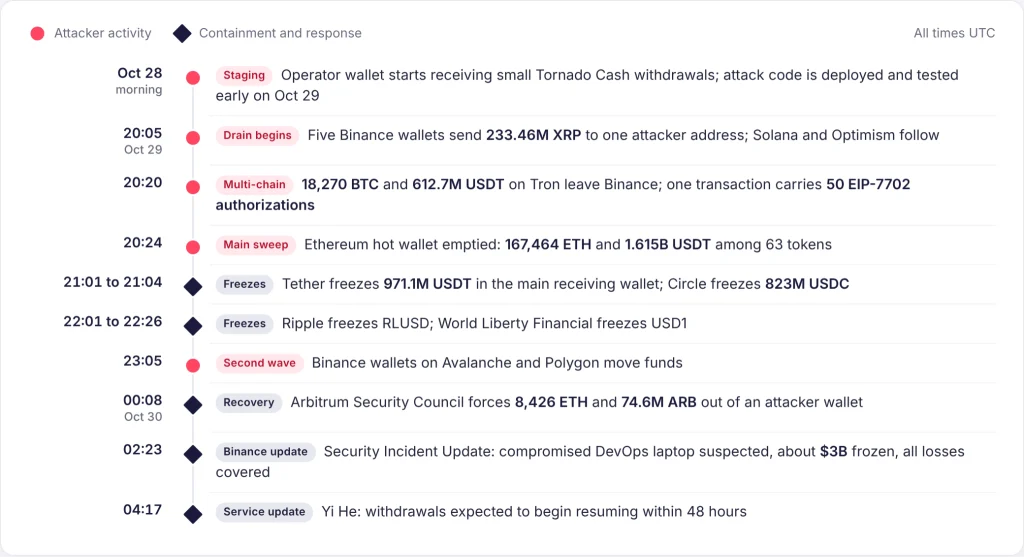
The first unauthorized transfers began around 20:05 UTC on October 29, 2026, when five Binance wallets sent XRP to a single attacker address. Bitcoin, Tron, Solana and Ethereum outflows followed within roughly 20 minutes. A second wave hit Avalanche and Polygon around 23:05 UTC, and smaller sweeps continued until about 23:56 UTC.
What Role Did EIP-7702 Play in the Ethereum Drain?
EIP-7702, an Ethereum feature that lets a regular account delegate its behavior to smart contract code, was used to empty one of Binance’s Ethereum hot wallets. The attacker submitted a single transaction carrying 50 authorizations signed by that wallet, each pointing to an attacker-controlled sweeper contract.
The 50 authorizations covered consecutive nonces, guaranteeing one would be valid at execution time. About three and a half minutes later, the wallet’s full balance, including 167,464 ETH and 1.615 billion USDT, moved to the attacker. EIP-7702 only provided the sweep mechanism; the authorizations still carried the hot wallet’s signature. Binance says the delegation did not pass through its normal approval controls.
Were Binance Private Keys Leaked?
Binance says it has found no evidence of any wallet private key leak. The on-chain pattern is consistent with that: apart from the EIP-7702 sweep, funds on Ethereum and the other chains left through ordinary signed transfers. That pattern fits an attacker who controlled what the signing system approved, rather than one holding stolen keys.
Binance Denies Breach Claim by Alleged ShinyHunters Seller
On November 9, 2026, an actor claiming to be ShinyHunters on an underground forum listed alleged records of 335 million Binance users for $900,000, threatening a leak. The listing includes KYC data, passwords, emails, phone numbers, transaction histories, internal infrastructure details, and wallet private keys, though the seller may be an impersonator.
Binance denies any breach. A spokesperson confirmed no compromise of systems, KYC data, credentials, or private keys, calling the claim a likely scam. Binance noted it does not store external private keys or plaintext passwords, no longer operates in several listed jurisdictions, and attributed similar past claims to user-side infostealer malware.
Users should beware of related phishing lures and never share credentials or keys. Exchanges should cross-reference sample data with infostealer logs before treating claims as legitimate breaches.
Who Is Behind the Binance Hack?
Blockchain analysts attribute the theft with high confidence to TraderTraitor, a North Korean state-backed cluster often grouped under the Lazarus umbrella. Their assessment cites on-chain and off-chain intelligence and overlaps with earlier thefts, including small Tornado Cash withdrawals for staging and signatures obtained in advance. A second analytics firm says TraderTraitor likely carried it out.
Other investigators are more cautious. One person familiar with crypto investigations told reporters the theft is not yet definitively attributed. As of October 30, 2026, neither Binance nor any government agency has publicly named the attackers.
FBI Attributes Binance Hack to North Korea’s TraderTraitor
The FBI has officially attributed the Binance hack to TraderTraitor, the North Korean cyber actor that blockchain analysts had already linked to the theft on October 30, 2026. In a statement issued on October 31, 2026, with the U.S. Secret Service (USSS) and IRS Criminal Investigation (IRS-CI), the FBI said North Korea was responsible for the theft of more than $6 billion in virtual assets from Binance on or about October 29, 2026. This moves the attribution described in this post from an analyst assessment to a government finding. Binance has not named the attacker.
The FBI said it observed TraderTraitor converting the stolen assets mainly into Ethereum (ETH) and expects further laundering through DeFi platforms and instant swap services. It released the associated wallet addresses, more than 600 on Ethereum, 19 on Bitcoin and one on Solana, and asked THORChain node operators, RPC node operators, instant exchanges, DeFi services, blockchain analytics firms and other virtual asset service providers to block transactions with, or derived from, those addresses.
Binance began restoring withdrawals in phases at 06:00 UTC on November 1, 2026, starting with BTC, ETH, USDT, USDC, BNB and XRP, after covering about 95% of the impacted amount with company funds. Exchanges, custodians and payment providers should load the FBI address list into their screening and blocklists and apply it to funds that reach them through intermediate hops.
Is the Binance Hack Linked to the Bitget Hack?
Possibly. An independent on-chain investigator found that funds from the Binance hack and from the September 2026 Bitget exploit were commingled at the same address after passing through THORChain, and said the same actor is likely behind both. Bitget had already said it suspected North Korean attackers in its roughly $387 million loss. Neither exchange has confirmed a shared attacker.
How Much of the Stolen Crypto Has Been Frozen?
Binance reports about $3 billion frozen on-chain as of October 30, 2026, close to half of the estimated loss. Stablecoin issuers did most of the work because they can blacklist addresses holding their tokens, and the first large freezes landed within about 40 minutes of the main Ethereum sweep.
- Tether: Froze more than $1.567 billion in USDT tied to the theft
- Circle: Froze more than $800 million in USDC, in coordination with law enforcement
- Other issuers and protocols: Ripple froze RLUSD, World Liberty Financial froze USD1, First Digital froze FDUSD, and Aave froze affected lending markets
- Arbitrum Security Council: Forced about $30 million in ETH and ARB out of an attacker wallet
Where Is the Rest of the Stolen Money Going?
Roughly $2.4 billion remained under attacker control as of 00:30 UTC on October 30, 2026, mostly more than 420,000 ETH and 18,270 BTC. The bitcoin is moving through a peel chain that splits it into 1,000 BTC and 100 BTC pieces.
The cash-out moved fast, and the attacker accepted heavy losses to stay ahead of the freezes:
- Discounted swaps: About 325 million USDT went to market makers through UniswapX and other intent-based contracts for roughly 122,300 ETH, an implied price near $2,650 per ETH while ether traded around $2,300 to $2,350, a discount of more than 10%
- DeFi borrowing: A second wallet supplied 60 million USDT to Aave and borrowed about 19,760 ETH before Aave froze the affected markets
- Tron routing: 300 million USDT moved to a wallet supplying JustLend, while another 200 million USDT passed through hop wallets to Uniswap, where 30 million was frozen
- Stablecoin dumping: About 48 million RLUSD was sold on decentralized exchanges between 21:42 and 22:01 UTC, until Ripple froze the remaining 40.5 million
Later reporting shows some funds moving through THORChain, a cross-chain swap protocol, an early sign of the cross-chain laundering stage seen after earlier North Korea-linked thefts.
Are Binance User Funds Safe?
Binance says user funds are safe and that it will cover all losses from its Secure Asset Fund for Users (SAFU) and company funds. With about $3 billion frozen, that commitment means Binance absorbs the unfrozen remainder itself. The stolen assets came from Binance’s hot wallets, and an updated Proof of Reserves will follow remediation.
More than $6.34 billion in company funds were reserved to cover the losses. About $5 billion of that is already held in the same token types that were stolen, such as USDT, USDC, BTC, ETH and BNB, and Binance is buying the rest through market and OTC channels, which may take longer for low-liquidity tokens. The reserve excludes the roughly $3 billion in frozen assets, which remain subject to recovery. Teng said Binance never uses customer funds, and that most user assets sit in cold wallets and move to a hot wallet only when a user withdraws. A full Proof of Reserves report is targeted for Monday, November 2, 2026.
The SAFU fund was created in 2018 to protect users in extreme cases and reportedly holds about $1 billion in bitcoin, so it cannot absorb a loss of this size alone; Binance says company funds will cover the rest. SAFU last covered a major theft in May 2019, when attackers stole 7,000 BTC from Binance.
Binance Reopens Withdrawals for More Assets
Binance started the next phase of its withdrawal restoration at 04:00 UTC on November 3, 2026, reopening withdrawals for more assets across nine networks: BNB Smart Chain, Ethereum, Solana, XRP Ledger, Sui, Arbitrum, Optimism, Tron and Base. The rollout is progressive, so not every listed asset becomes available at once.
The new list adds stablecoins including RLUSD, USD1, FDUSD and USDe, tokens such as ADA, LTC, DOT, LINK, ONDO and JUP, and all bSTOCKS on BNB Smart Chain. As in the first phase, Binance ordered assets by user demand over the past week.
This follows the first phase on November 1, 2026, which reopened 15 networks, including Bitcoin, Ethereum, BNB Smart Chain, Tron, Solana and XRP Ledger. Assets not covered by either phase remain paused, and deposits have stayed open throughout. Binance says further updates will come through its official X account.
Can I Withdraw From Binance Right Now?
On October 30, 2026, Binance paused withdrawals while it rebuilt and retested the withdrawal service, saying it would not switch the service back on until it passed rigorous testing. Co-CEO Yi He first expected withdrawals to resume within 48 hours. Co-CEO Richard Teng later said users would be able to withdraw before Sunday, November 1.
Binance began reopening withdrawals in phases on November 1, 2026, starting with 15 networks, including Bitcoin, Ethereum, BNB Smart Chain, Tron, Solana and XRP Ledger. A second phase from 04:00 UTC on November 3, 2026, added more assets across nine networks, including stablecoins such as RLUSD, USD1, FDUSD and USDe, and all bSTOCKS on BNB Smart Chain. Some assets remain paused, and in its November 4 update Binance says it is still reopening withdrawals in phases. Deposits are unaffected. Before withdrawing, check Binance’s announcements for the current status of the asset and network you plan to use.
What Is Binance Doing to Recover From the Hack?
Richard Teng outlined four priorities in his video statement on X:
- Rebuilding withdrawals: The withdrawal service is being rebuilt and will stay off until it passes rigorous testing
- Company-wide security review: Endpoints, cloud, key management and signing are all under review
- Covering the shortfall: Binance is completing its token purchases and will verify holdings through Proof of Reserves
- Tracing funds: Binance is working with law enforcement, blockchain intelligence firms, token issuers and other exchanges to trace and recover stolen assets
Binance Makes Its Proof of Reserves Verifiable
On November 2, 2026, Binance completed the zero-knowledge proof for its October 31 Proof of Reserves snapshot, so users can now check it themselves on the Proof of Reserves page. Binance says ten assets are backed at least 1:1: BTC, ETH, USDT, BNB, SOL, USDC, XRP, USD1, RLUSD and ZEC.
In its November 4 update, Binance says it has replenished about 98% of the impacted amount and taken a new snapshot covering 44 tokens, with the proof expected in 50 to 60 hours. The figures are self-reported, and the October 31 snapshot predates the withdrawals that reopened on November 1.
Was Binance.US Affected?
Binance.US was not affected, as live incident coverage of the exchange’s statements noted. Binance.US runs as a separate platform, and the unauthorized withdrawals came from Binance’s global hot wallets. Customers of either platform should treat unsolicited messages that reference the hack with suspicion, since attackers often use major incidents as phishing bait.
How Did the Crypto Market React to the Binance Hack?
Prices fell as news of the theft spread. Bitcoin slid below $77,000, BNB dropped about 7% and ether lost about 5% over 24 hours. Leveraged traders took the brunt, with about $1.55 billion in liquidations over the same period, $1.34 billion of them long positions.
The estimated loss equals roughly 4% of the about $144 billion in assets Binance held before the hack. Market makers Wintermute and GSR disclosed exposure to Binance of less than 20% and less than 5% of net equity, respectively, while Coinbase said it is blocking transfers to compromised wallets.
How Does the Binance Hack Compare to the Bybit Hack?
The Binance hack is about four times the size of the $1.5 billion Bybit theft in February 2025, which the FBI attributed to TraderTraitor. Both began with a compromised developer machine: in Bybit’s case, one belonging to its wallet provider Safe{Wallet}. In both, legitimate signing systems ended up approving the attacker’s transactions.
What Indicators Should Defenders and Exchanges Track?
Binance has not published indicators of compromise, so the indicators below come from public on-chain analysis and explorer labels. Exchanges, bridges and DeFi protocols can screen deposits against these addresses, and wallet operators can watch for the transaction pattern behind the Ethereum drain.
| Type | Indicator | Context |
| Ethereum address (attacker) | 0x8532FA14ACAf483729C449b8458aedDb900543D4 | Received about 195,460 ETH from the main receiving wallet at 20:38 UTC on October 29, 2026; labeled Binance Hot Wallet Exploiter 8 on Etherscan |
| Ethereum address (attacker, frozen) | 0x5227f603C1eE34CE3C06eFe6477003BDfCCB2f8c | Main receiving wallet funded by the Binance 14 hot wallet; holds 971.1M USDT and 823M USDC frozen by Tether and Circle |
| Transaction pattern | EIP-7702 (type-4) transaction carrying 50 authorizations across consecutive nonces | Delegated a Binance Ethereum hot wallet to an attacker-controlled sweeper contract at 20:20 UTC |
| Funding pattern | Small Tornado Cash withdrawals into a fresh operator wallet | Staging that began on the morning of October 28, 2026 |
Recommendations for Exchanges, Custodians and Crypto Users
Engineer and DevOps endpoints are now a direct path to hot wallet funds. TraderTraitor has a long record of targeting crypto staff, including DevOps personnel, with social engineering such as fake job offers carrying trojanized applications. The priorities below aim to make sure a single compromised laptop can never reach a service that submits withdrawals.
- Isolate signing paths: Separate hot wallet signing infrastructure by chain and wallet tier so one foothold cannot drain every network
- Harden privileged endpoints: Treat DevOps and engineering laptops as tier-zero assets with strict device posture checks, phishing-resistant MFA and short-lived credentials for production access
- Restrict EIP-7702 use: Configure signers to reject unexpected EIP-7702 authorizations, and alert on batches of authorizations spanning a range of nonces
- Add withdrawal circuit breakers: Enforce velocity limits and anomaly-based holds on hot wallet outflows, especially simultaneous drains across chains
- Screen counterparties: Exchanges, market makers and DeFi protocols should screen deposits and fills against addresses labeled as linked to the Binance theft
- Train for recruiter lures: Brief staff on fake job offers, coding tests and trojanized tools, which North Korean operators favor for initial access
- Watch for scams: Users should rely only on official Binance channels and ignore messages offering refunds, “recovery” services or account verification links
How SOCRadar Supports Crypto Platform Defense
Thefts like this one typically begin before any funds move, with targeted lures, stolen sessions and reconnaissance on staff. SOCRadar helps crypto platforms catch those early signals:
- Cyber Threat Intelligence: Tracks North Korea-linked activity such as TraderTraitor’s tooling and lure themes, so teams can tune detections early
- Dark Web Monitoring: Alerts when employee credentials or session data from infostealer logs surface in underground markets, a common precursor to privileged access
- Brand Protection: Spots fake recovery sites and impersonation domains that appear after high-profile incidents and target worried users
Combined with internal telemetry and strict signing controls, these signals give exchanges and custodians more time to act before an attacker reaches the systems that can move funds.