

Oct 12, 2026
Table Of Content
What Dark Web Chatter Tells Us About Threats U.S. Firms Are Facing
Why the U.S. Represents a High-Exposure Cyber Target Landscape
The Dark Web as a Structured Marketplace
Initial Access Brokers: The Silent Enablers
Which U.S. Industries Are in the Crosshairs?
Fresh from the Underground: Dark Web Posts Targeting U.S. Firms
What These Posts Tell Us
Related Articles
Dark Web Profile: Blue Locker Ransomware
Sep 25, 2026
ShinyHunters Claims Access to FBI Systems
Sep 24, 2026
Feb 27, 2026
16 Mins Read

Summarize with:
What Dark Web Chatter Tells Us About Threats U.S. Firms Are Facing
The cyber threat landscape targeting the United States is not shaped by isolated incidents or opportunistic actors alone. It is increasingly defined by a structured underground economy where stolen data, network access, and attack infrastructure are bought, sold, and traded at scale. Dark Web forums, Telegram channels, and closed marketplaces have become the operational backbone of cybercrime, and they reveal a great deal about what comes next.
According to SOCRadar’s US Threat Landscape Report 2026, based on data collected between January 2025 and January 2026, the United States remains one of the most heavily targeted countries in the cybercrime ecosystem. Among posts that reference U.S. targets, 88.3% focus exclusively on American organizations, while 11.7% involve cross-border campaigns. This indicates that threat actors often run U.S.-specific operations rather than bundling U.S. entities into broader international campaigns.
Why the U.S. Represents a High-Exposure Cyber Target Landscape
The concentration of threats on U.S. organizations is not accidental. It reflects structural forces that create the world’s largest and most complex digital attack surface:
- Cloud and SaaS scale: U.S. companies deploy approximately 105 SaaS applications on average (global average: 93), each introducing new authentication endpoints, API keys, and identity dependencies
- Breach economics: The average U.S. breach costs $10.22 million—more than double the global average of $4.44 million—increasing attacker ROI
- Credential exposure: Stolen or compromised credentials account for 19% of breaches, with phishing close behind at 17%
- FBI IC3 scale: 859,532 complaints and over $16 billion in reported losses in 2024 alone
- Underground monetization: Dark Web marketplaces actively monetize American data and access, creating a self-reinforcing cycle of targeting
Cloud growth expands identity surfaces, identity sprawl increases credential risk, credential risk fuels access markets, and access markets sustain ransomware ecosystems. The result is a compounding exposure effect that makes the U.S. the highest-value target globally.

The Dark Web as a Structured Marketplace
Dark Web activity targeting the United States is overwhelmingly commercial in nature. The distribution of threat categories makes this clear: selling accounts for 70.76% of all observed posts, while sharing adds 23.56%. Together, they represent over 94% of underground activity, confirming that the Dark Web is not merely a place for boasting or hacktivism. It is a functioning marketplace with supply, demand, and pricing dynamics.
Hack announcements remain limited at 4.26%, and buying activity stays below 1%. Targeted attack posts are almost absent, indicating that planning and execution rarely occur on public forums. Instead, the real action happens in private channels and direct negotiations, with public posts serving as advertisements.
What’s Being Sold: Data Dominates, Access Follows
When we break down what threat actors are trading, the picture sharpens further:
61.53%, of threats involve data or database leaks, personal, financial, and corporate records
29.31%, involve direct access sales, VPN credentials, RDP sessions, and domain admin rights
3.98%, target websites, while tools/services and vulnerability offerings remain below 3% each
This distribution is highly significant for defenders. It tells us that threat actors prefer trading the outcomes of attacks (data, credentials, access) rather than the technical tools used to execute them. The implication: the cybercrime supply chain has matured to a point where specialization drives efficiency. One actor breaches, another monetizes, and a third deploys ransomware.
Initial Access Brokers: The Silent Enablers
Perhaps the most consequential finding from Dark Web monitoring is the rise of Initial Access Brokers (IABs). These specialized threat actors focus exclusively on the earliest phase of a cyberattack: gaining entry. They don’t steal data or deploy ransomware. They compromise networks and sell that access to other attackers, turning an initial intrusion into a service.
According to SOCRadar’s Dark Web monitoring data, the volume of initial access listings has more than doubled between Q1 2023 and Q1 2025, showing over a 100% increase. The United States alone accounts for approximately 24.7% of all global access-for-sale advertisements, making it the single most targeted country for IAB activity.
How IABs Operate
IABs follow a structured workflow: identify a target, gain access, establish persistence, and sell. Their entry methods include:
- Credential theft and reuse: leveraging infostealer malware, phishing, or previous breaches to test stolen credentials against VPNs, RDP, and webmail portals
- Exploiting known vulnerabilities: targeting unpatched CVEs in Citrix ADC, Fortinet FortiGate, VMware ESXi, and Microsoft Exchange, often within hours of proof-of-concept releases
- Brute force and credential stuffing: automated testing of large credential sets against known login portals
- Phishing and loader malware: delivering lightweight malware that establishes footholds for reverse shells or Cobalt Strike beacons
Access listings typically include the target’s industry, country, estimated revenue, type of access (e.g., “VPN + Domain Admin”), and price ranging from $200 to over $10,000. Ransomware groups like Desolator have been observed openly recruiting IAB partners on underground forums, offering revenue-sharing models instead of upfront payments.
Two IAB listings detected within weeks of each other provide a stark illustration of how corporate America’s network access is priced and traded on the Dark Web:
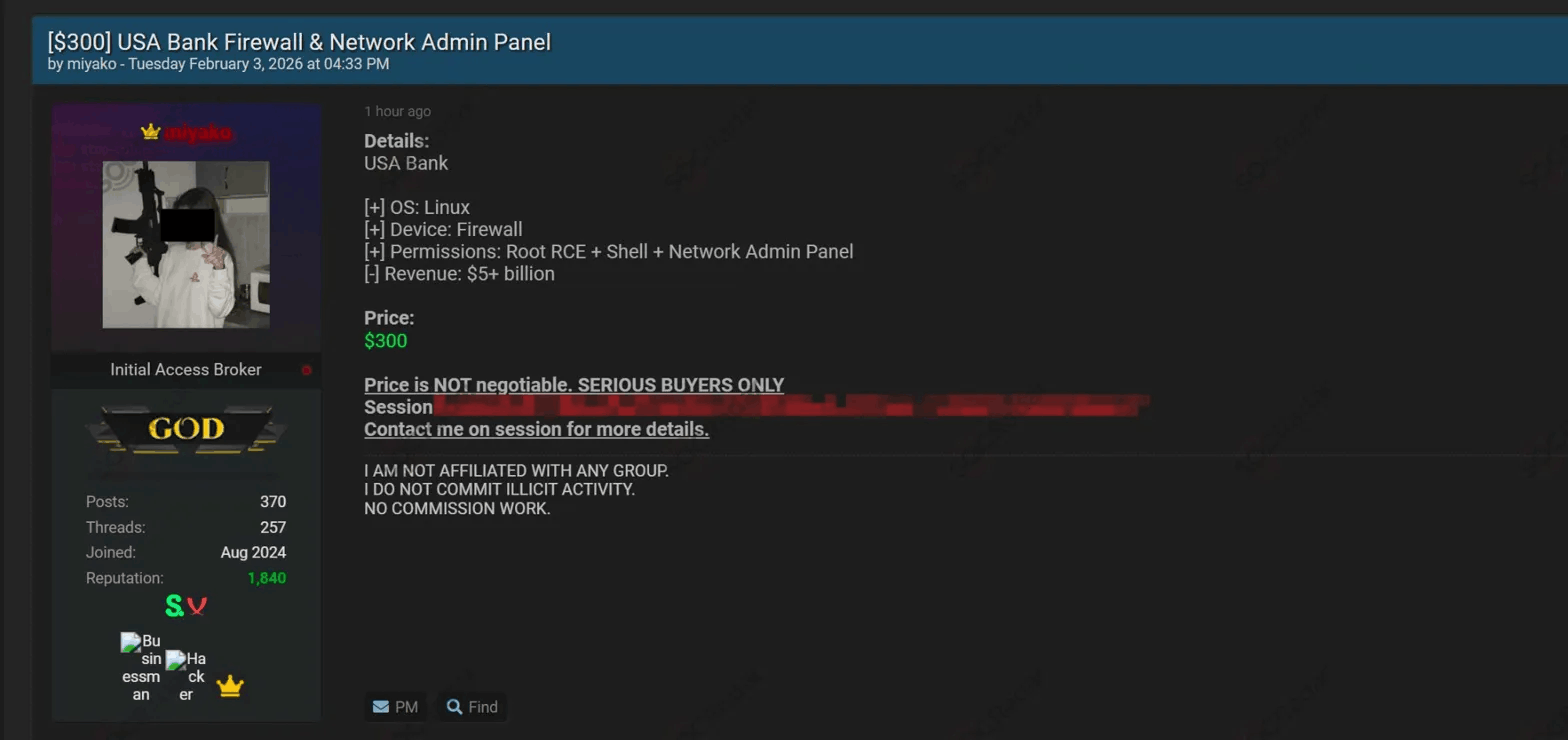
Root access to a $5B+ U.S. Bank
A threat actor on a hacker forum, with 370 posts, 257 threads, and a reputation score of 1,840, posted root-level access to a U.S. bank’s firewall and network admin panel for sale.
The technical specifications are alarming: Linux operating system, firewall device, with Root RCE, Shell, and Network Admin Panel permissions. The target bank’s revenue exceeds $5 billion. The asking price? $300. Non-negotiable. Serious buyers only.
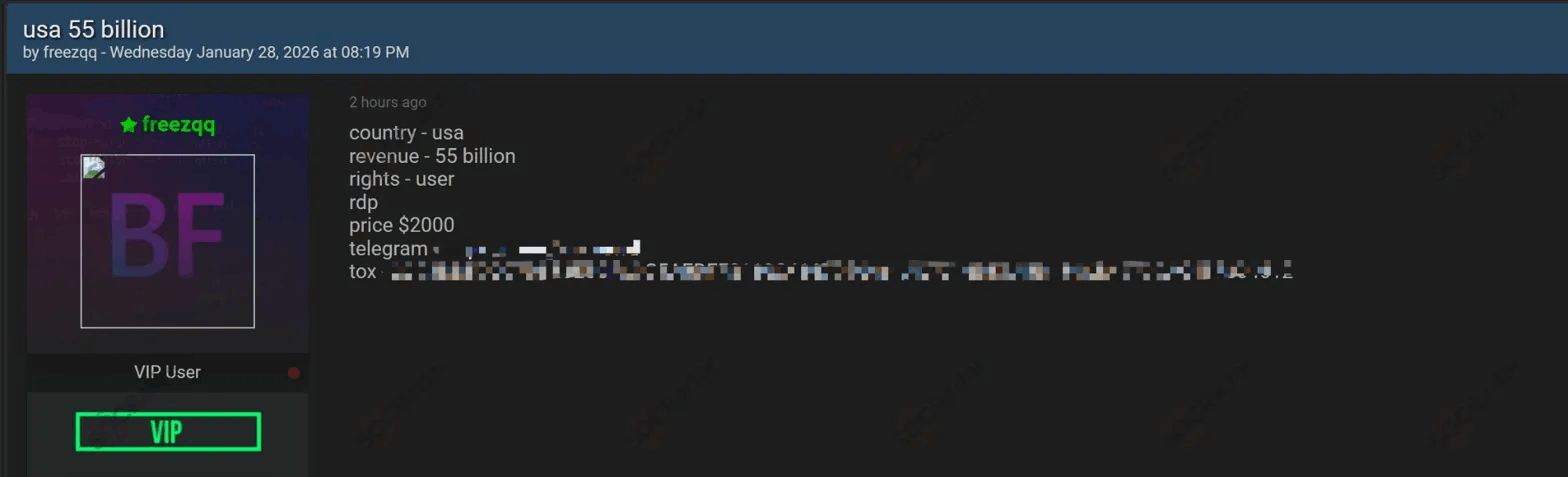
RDP access to a $55B U.S. company (SOCRadar Dark Web News)
A second listing, posted on January 28, 2026 by a VIP-status threat actor, offers RDP access to a U.S. company with a staggering $55 billion in revenue. The access provides user-level rights via RDP, priced at $2,000. Communication channels include both Telegram and Tox—the latter being an encrypted, peer-to-peer messaging protocol favored for its anonymity.
Which U.S. Industries Are in the Crosshairs?
Dark Web targeting is not random. It concentrates on sectors that manage money, data, or public trust. The SOCRadar 2026 report reveals a clear hierarchy:
| Industry | Dark Web Threat Share |
| Finance and Insurance | 14.39% |
| Information Services | 10.19% |
| Public Administration | 9.79% |
| Retail Trade | 8.23% |
| Electronic Shopping | 5.39% |
| Scientific and Technical | 5.32% |
| Cryptocurrency & NFT | 5.00% |
| Commercial Banking | 3.99% |
| Manufacturing | 3.01% |
Finance and insurance lead because of their direct exposure to fraud, ransomware, and data resale markets. Retail trade and electronic shopping together exceed 13%, driven by demand for payment data and account takeovers. Public administration’s prominence reflects sustained interest in sensitive government records and access credentials.
Phishing Mirrors the Same Pattern
Phishing campaigns reinforce the targeting hierarchy. Public administration leads phishing activity at 24.08%, followed by information services at 19.45%. Cryptocurrency, NFT services, banking, and finance together account for nearly 30% of phishing attacks. Critically, 77.9% of phishing pages now use HTTPS—meaning encryption is no longer a reliable indicator of legitimacy for end users.
Most phishing pages rely on generic, reusable templates: 37.41% have no clear title, and generic labels like “Home” and “Login” exceed 30%. This signals mass deployment of standardized phishing kits that can scale quickly across sectors.
Fresh from the Underground: Dark Web Posts Targeting U.S. Firms
Theory and statistics tell one part of the story. But the most compelling evidence of what’s coming next lies in the actual posts circulating on Dark Web forums and Telegram channels right now. SOCRadar’s continuous monitoring has captured a range of recent activities that illustrate the breadth and operational sophistication of the underground economy targeting U.S. organizations. Below is a selection of representative posts detected in the current threat cycle.
Targeted Employee Data Harvesting: Healthcare in the Crosshairs
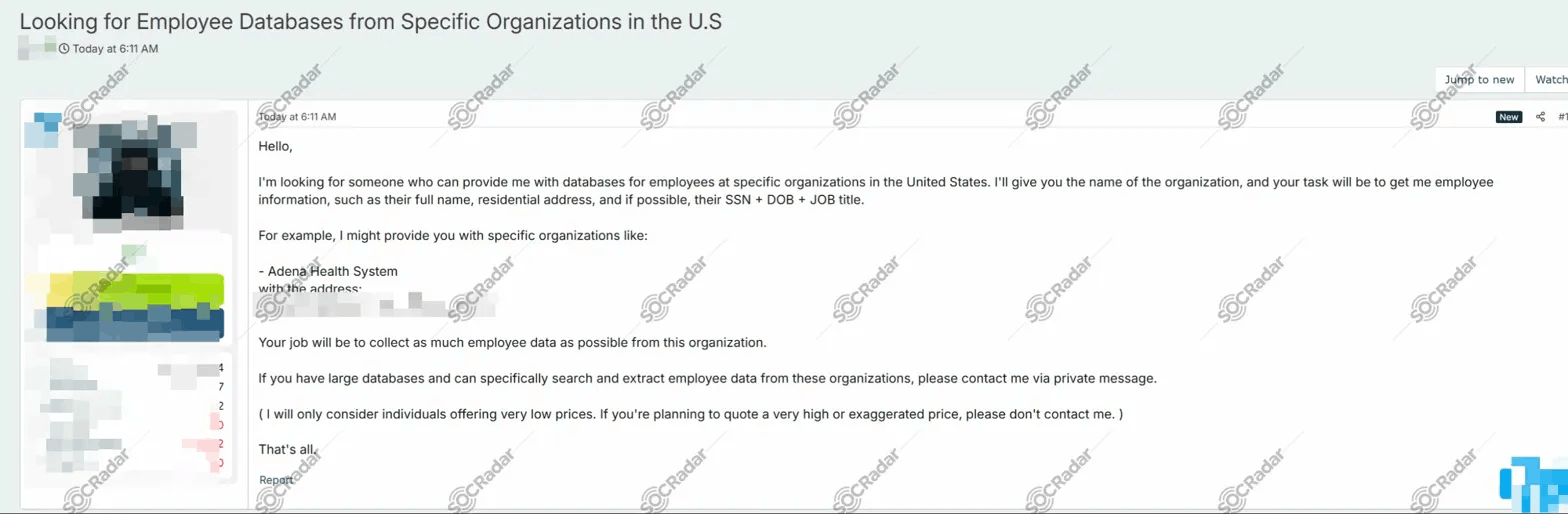
A Dark Web forum post seeking employee databases from specific U.S. organizations, including healthcare targets. The actor requests full names, addresses, SSNs, and job titles. (Source: SOCRadar Dark Web News)
A recruitment-style post was detected on a Dark Web forum in which a threat actor actively seeks partners who can supply employee databases from specific U.S. organizations. The actor specifies the data they require: full names, residential addresses, Social Security Numbers, dates of birth, and job titles.
This post is significant because it demonstrates demand-driven targeting: the actor is not selling a breach that already happened. They are commissioning one against specific organizations. The focus on healthcare aligns with broader trends, organizations hold some of the most valuable PII datasets (SSN, medical records, insurance data), and the sector historically underinvests in cybersecurity relative to the value of its data. The actor’s emphasis on “very low prices” suggests they plan to scale this across multiple targets.
Ransomware Partnerships: ANUBIS Recruits Access Brokers
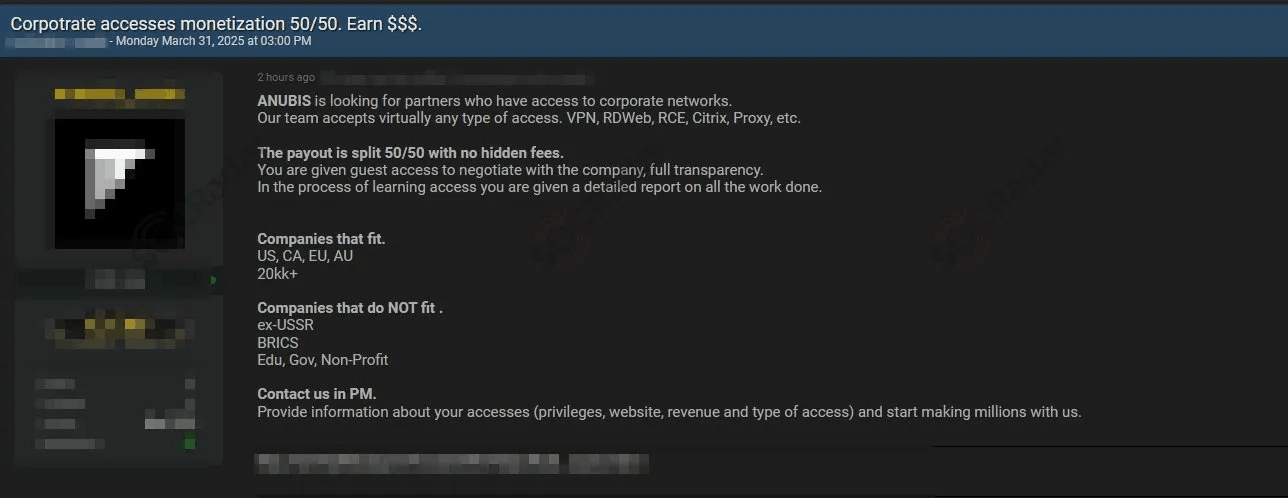
ANUBIS partnership recruitment post offering a 50/50 revenue split for corporate network access. The listing specifies target criteria: U.S., Canada, EU, and Australia-based companies with $20M+ revenue. (Source: SOCRadar Dark Web News)
A partnership recruitment post was detected from a group identifying itself as ANUBIS, seeking partners who hold access to corporate networks. The post accepts virtually any type of access (VPN, RDWeb, RCE, Citrix, Proxy) and offers a 50/50 revenue split with full transparency on negotiations with victims.
The targeting criteria are precise and revealing. Companies that “fit” must be located in the US, Canada, EU, or Australia and have revenues of $20 million or more. Companies that do not fit include those in ex-USSR countries, BRICS nations, and the education, government, and non-profit sectors. This exclusion list reveals the actor’s operational logic: they target organizations with high revenue and high ransom-payment probability, while avoiding entities with geopolitical sensitivities or lower financial capacity.
This post is a textbook example of the IAB-ransomware supply chain in action. ANUBIS does not need to breach networks themselves—they outsource intrusion to partners and focus on monetization. The request for details on privileges, website, revenue, and access type mirrors the structured listings seen across Dark Web access marketplaces.

Banking Credential Fraud: U.S. Banking Sector Targeted
Two separate posts targeting the U.S. banking sector were detected in quick succession:
Corporate Bank Login Acquisition with Token Bypass
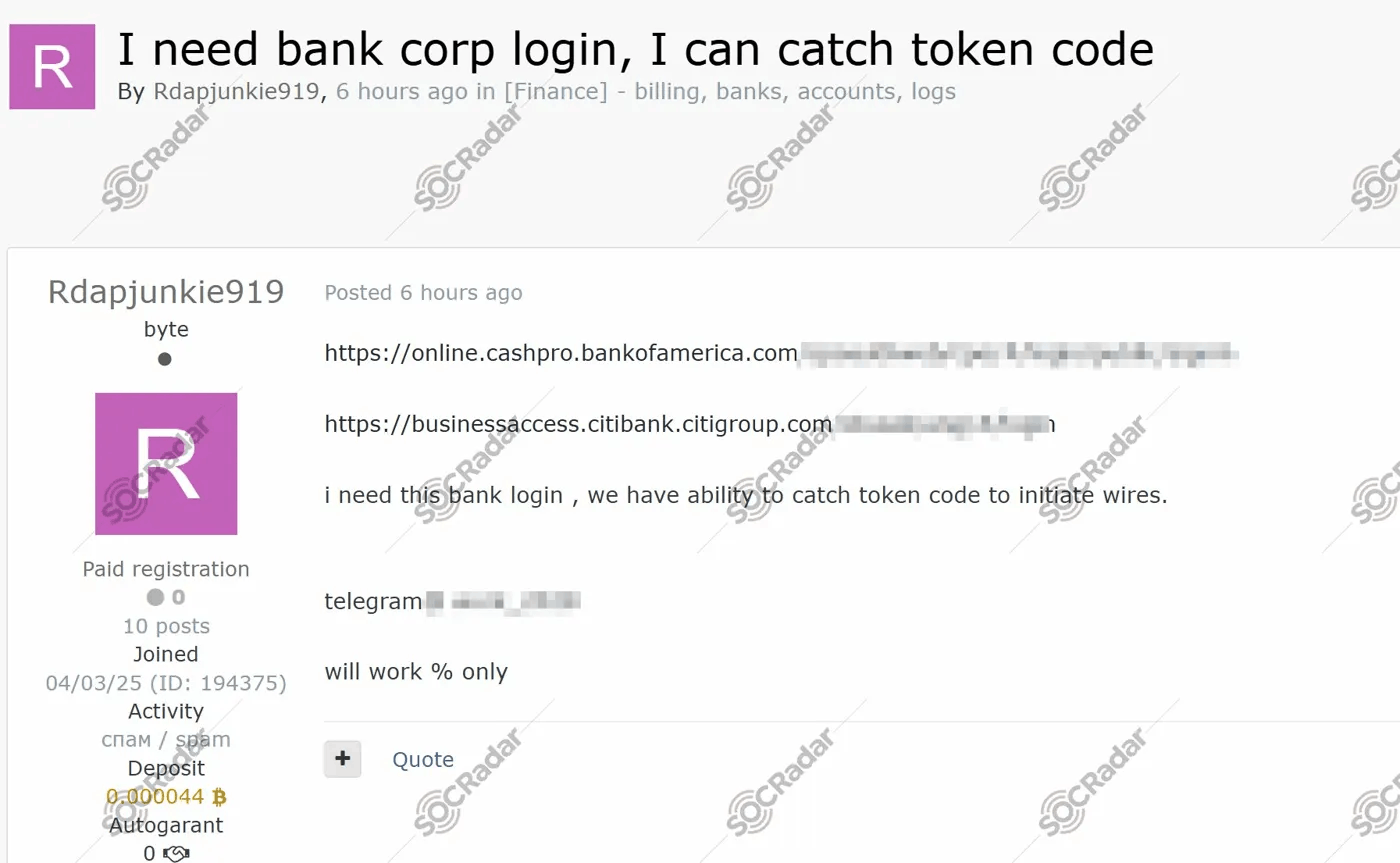
A threat actor seeking corporate banking credentials for Bank of America CashPro and Citibank Business Access, claiming token interception capability to initiate wire transfers. (Source: SOCRadar Dark Web News)
A threat actor posted a request for corporate banking login credentials specifically for Bank of America’s CashPro platform and Citibank’s Business Access portal. The threat actor claims to have the ability to intercept token codes to initiate wire transfers—i MFA bypass capabilities, likely through real-time phishing proxies or SIM-swapping. They offer to work on a percentage basis, signaling an organized fraud operation.
This post directly validates why finance and insurance lead Dark Web targeting at 14.39%. When attackers can bypass multi-factor authentication and initiate wire transfers, the ROI per compromised credential becomes extraordinary. It also underscores why phishing-resistant MFA (FIDO2/passkeys) is no longer optional for financial institutions.
US Bank Corporate Leads for Sale
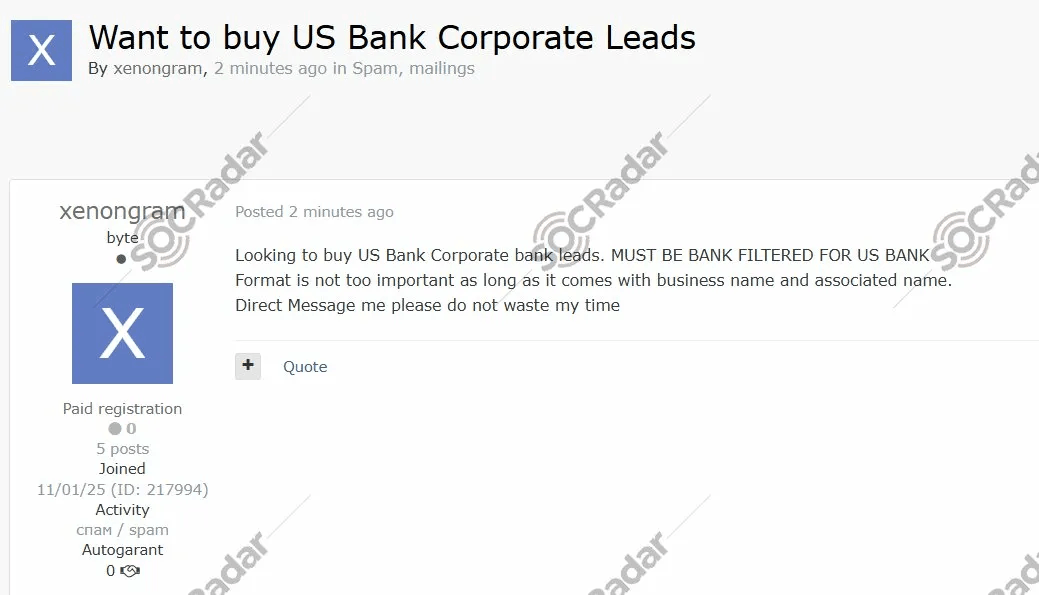
A purchasing announcement for U.S. bank corporate leads, filtered by bank name with associated business and contact information. (Source: SOCRadar Dark Web News)
In a complementary post, another actor seeks to purchase corporate bank leads filtered specifically for U.S. banks—requesting business names and associated contact names. The format is secondary; the filtering is what matters. These leads feed the upstream pipeline: once acquired, they enable targeted spearphishing, Business Email Compromise (BEC), and social engineering campaigns against banking customers and employees.
Read together, these two posts reveal a complete fraud supply chain: one actor gathers leads, another acquires credentials, and a third initiates fraudulent transfers. Each link operates independently, specializing in their part of the chain.
Hacktivist DDoS: RuskiNet Strikes U.S. Satellite Communications
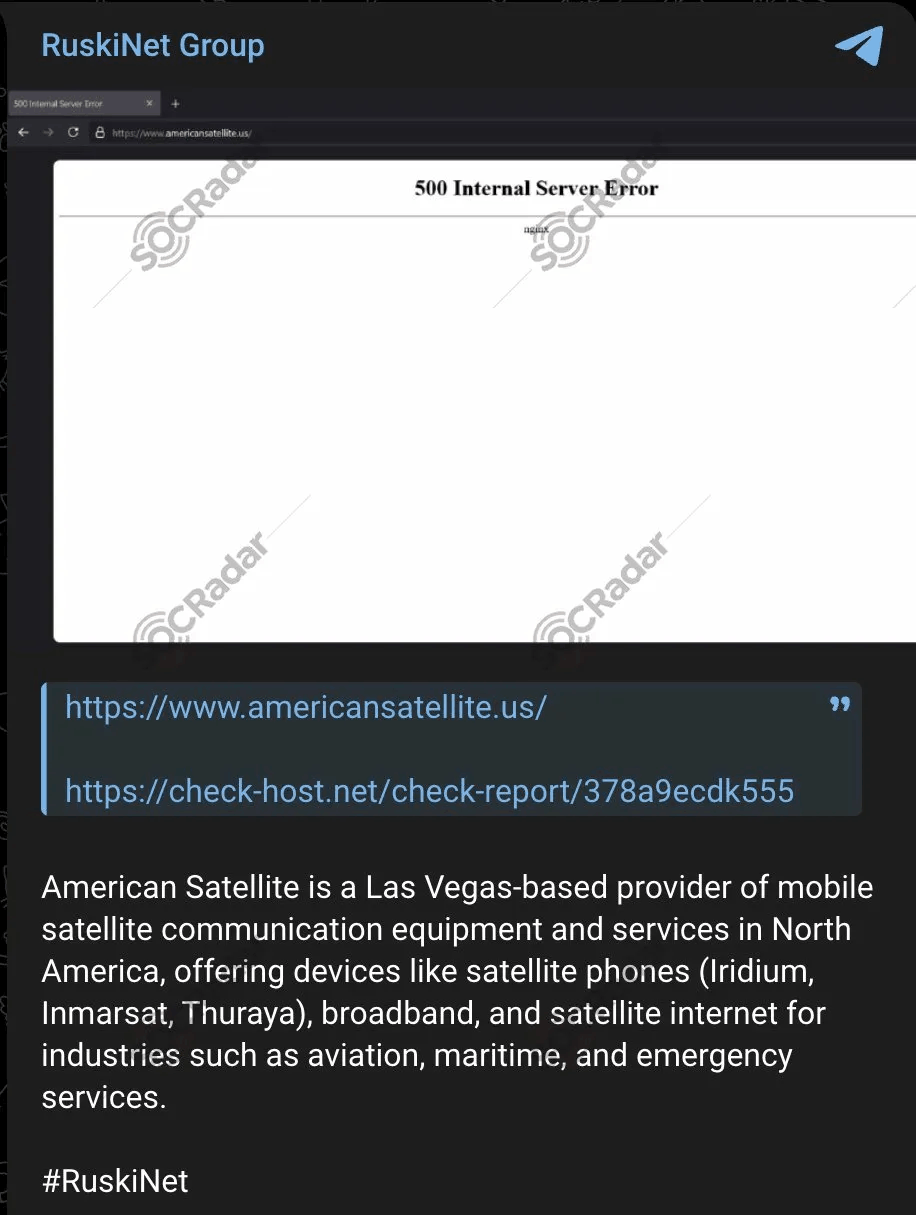
RuskiNet Group’s Telegram announcement of a DDoS attack against American Satellite, a Las Vegas-based provider of satellite communications for aviation, maritime, and emergency services. (Source: SOCRadar Dark Web News)
The pro-Russian hacktivist group RuskiNet announced a DDoS attack against American Satellite, a Las Vegas-based provider of mobile satellite communication equipment and services serving the aviation, maritime, and emergency services sectors. The group published a check-host verification link showing the target returning a “500 Internal Server Error” as proof of disruption.
This attack is strategically significant on multiple levels. American Satellite provides communications infrastructure for critical sectors—aviation, maritime, emergency services—making it a high-impact target for disruption. The attack aligns perfectly with the patterns described in the 2026 NDS: Russian-nexus actors targeting U.S. communications infrastructure through hacktivist proxies that provide plausible deniability. RuskiNet’s Telegram-based operation reflects the evolution of hacktivism into a state-adjacent force multiplier, executing DDoS campaigns timed to geopolitical tensions.
Credit Card Data Trade: 7,350+ Fresh U.S. Cards from Skimmers
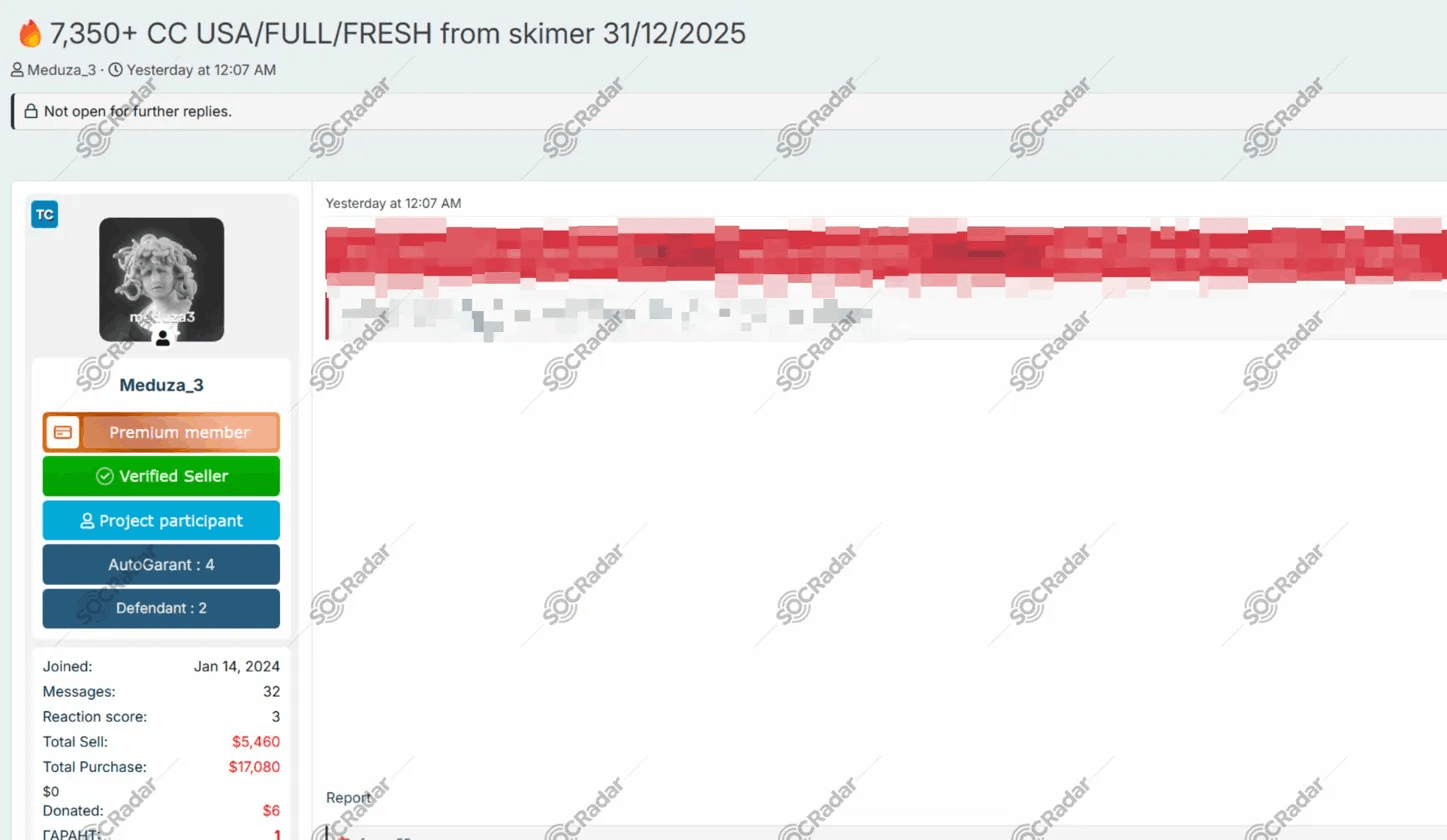
A seller (Meduza_3, Premium Member) offering 7,350+ fresh U.S. credit cards sourced from skimmer devices, demonstrating the established marketplace infrastructure for financial data trade. (Source: SOCRadar Dark Web News)
A seller identified as Meduza_3 (Premium Member, Verified Seller status on the forum, with $5,460 in confirmed sales) posted 7,350+ U.S. credit cards described as “FULL/FRESH” and sourced from skimmer devices. The listing date of December 31, 2025 indicates recently harvested data with high validity rates.
The seller’s established reputation ($17,080 in total purchases, verified status) demonstrates the professional marketplace infrastructure that sustains financial data trade. Skimmer-sourced cards represent the intersection of physical and digital crime—devices installed at point-of-sale terminals feed directly into the underground economy. This listing reinforces why retail trade and electronic shopping together account for over 13% of Dark Web targeting: these sectors generate the payment card data that fuels the carding economy.
What These Posts Tell Us
Viewed collectively, these Dark Web posts are not isolated incidents. They represent a functioning ecosystem with distinct roles, supply chains, and market dynamics:
- Demand-driven targeting: Actors commission breaches against specific organizations, not just opportunistic scanning
- Industrialized partnerships: Ransomware groups recruit access brokers with revenue-sharing models, complete with qualification criteria
- Financial fraud pipelines: Lead acquisition, credential theft, and MFA bypass capabilities operate as separate specializations in a coordinated chain
- Geopolitical cyber operations: Hacktivist groups target critical infrastructure in alignment with state-level adversary interests
- Established market trust systems: Verified sellers, reputation scores, and escrow mechanisms enable reliable criminal commerce
For defenders, the message is clear: the underground economy is watching your organization, your sector, and your credentials. The question is not whether threat actors are interested in your data or access—it is whether you can detect that interest before it becomes an incident.
Strategic Recommendations: Turning Intelligence into Action
The data from underground sources provides defenders with a critical advantage but only if it translates into operational action. Based on the threat patterns identified across Dark Web chatter, ransomware activity, phishing campaigns, and nation-state operations, the following recommendations apply:
- Treat Identity as the Front Line
With credentials driving the majority of initial access, enforce phishing-resistant MFA across all critical systems. Monitor for suspicious OAuth grants, mailbox rule changes, and anomalous login patterns. Treat personal email compromise of high-value employees as a corporate security event. Proactively track exposed corporate and executive credentials through platforms such as SOCRadar Threat Intelligence – Identity Intelligence to detect leaked or stealer-derived account data before attackers operationalize it.
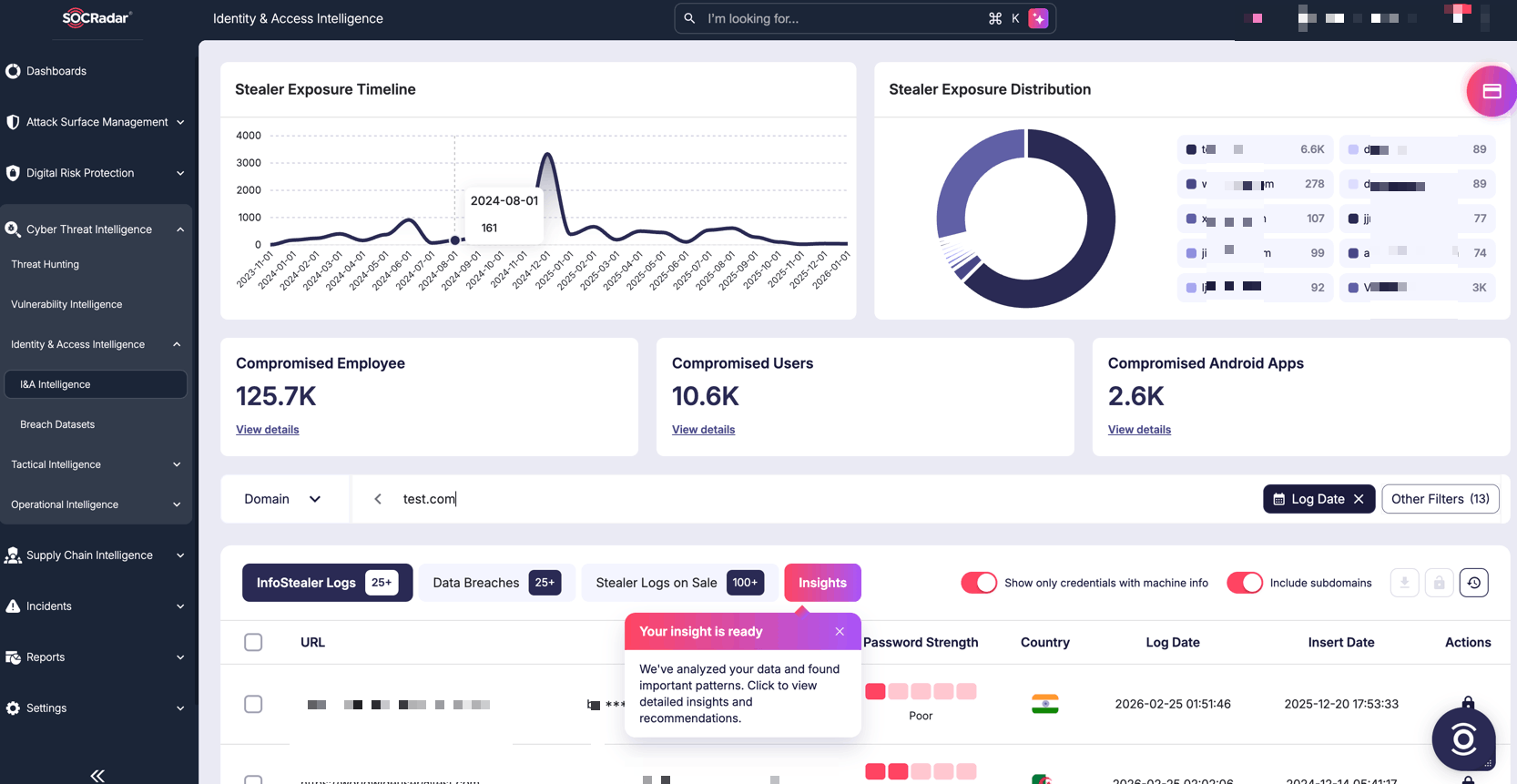
SOCRadar Identity & Access Intelligence
- Monitor the Dark Web Proactively
Use Dark Web monitoring to detect exposed credentials, access-for-sale listings, and data leaks targeting your organization. When your network access appears on underground forums, the window to act is measured in days, not weeks. Continuous tracking of threat actor chatter and marketplace listings through SOCRadar Threat Intelligence – Dark Web Monitoring enables earlier detection of emerging risks tied to your brand, infrastructure, or personnel.
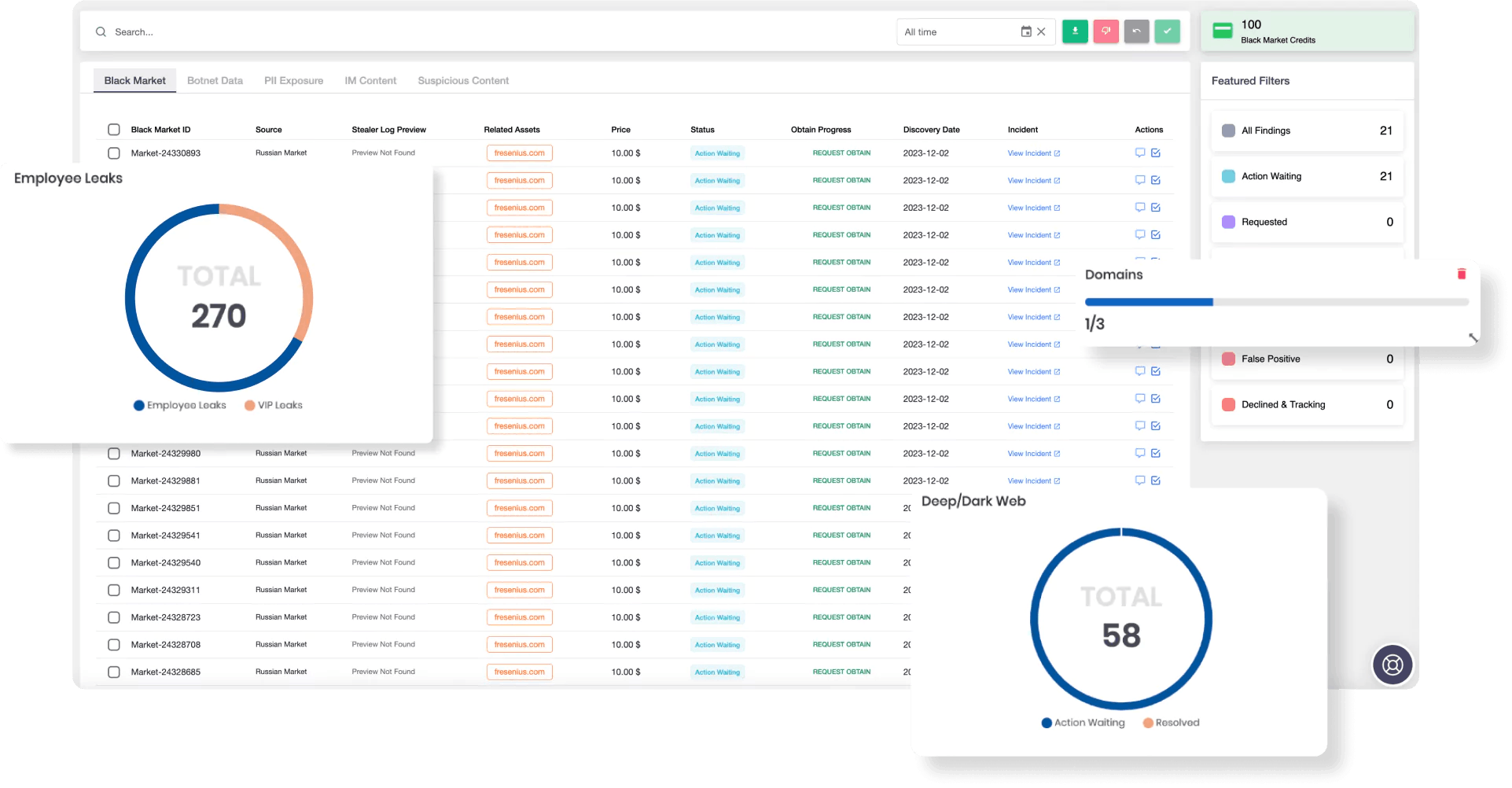
SOCRadar Dark Web Monitoring
- Reduce Your External Attack Surface
Continuously inventory internet-facing assets. Identify shadow IT, misconfigured services, forgotten subdomains, and exposed remote access points. Prioritize patching of commonly exploited CVEs in Citrix, Fortinet, VMware, and Microsoft Exchange environments. Attack surface visibility solutions such as SOCRadar Attack Surface Management can help uncover unmanaged assets and risky exposures before adversaries do. - Prepare for Ransomware Diversity
With 67% of ransomware activity coming from smaller groups, incident response plans must account for varied TTPs. Regularly back up data, segment networks, test restoration procedures, and develop playbooks for multiple adversary profiles. - Strengthen Phishing and Social Engineering Defenses
Invest in phishing detection systems that go beyond URL reputation. Train employees to recognize QR-based lures, recruitment-themed bait, and HTTPS-enabled phishing pages. Run regular simulations across all departments. - Build Collaborative Threat Intelligence
Share indicators and threat patterns with industry peers. Participate in ISACs, engage with government advisories from CISA and FBI, and operationalize CTI to inform detection engineering, vulnerability management, and executive risk reporting. - Assume Third-Party Risk
Nation-state and threat actors alike pivot through suppliers and trusted connections. Map your vendor relationships, assess third-party security postures, and monitor for compromise indicators in your supply chain.