Top 10 AI Pentest Tools
AI pentest tools are gaining popularity in offensive security workflows. These tools accelerate reconnaissance and automate workflows, but at the same time, enable less skilled actors to execute complex attacks.
Now, security teams are forced to confront automated threats that move quickly and scale at minimal cost. We saw an example of such threats from Anthropic. These developments pressure defenders to understand how these tools operate and the types of threats they can generate for organizations. Let’s examine some of those AI-driven penetration testing tools.

1. Strix

Strix is an autonomous security testing system that operates with AI agents that behave like human attackers. It runs code in real conditions, identifies vulnerabilities, and verifies each issue with proof-of-concept exploits.
The main targets are developers and security teams that need reliable testing without the cost and delay of manual penetration tests or the noise produced by static analysis.
Strix focuses on practical validation. It generates findings that include real evidence rather than theoretical alerts. It also supports workflows that help teams fix issues quickly and track remediation.
The tool draws on several open-source projects, including LiteLLM, Caido, ProjectDiscovery, Playwright, and Textual, and provides several core capabilities.
- It includes a full hacker-oriented toolkit that operates out of the box.
- It supports teams of cooperating agents that distribute tasks and scale across targets.
- It validates each finding with a working proof-of-concept, which reduces false positives.
- It offers a developer-focused command line interface that produces actionable reports.
- It also provides automated remediation support and reporting features that help teams close gaps faster.
Strix fits into the common application-security workflows.
- It can perform application security testing and confirm critical vulnerabilities through dynamic exploitation.
- It can run rapid penetration tests that complete in hours and produce compliance-ready outputs.
- It can automate bug bounty research, including proof-of-concept generation.
- It also integrates into CI/CD pipelines, which allows teams to block risky changes before they reach production.
You can use it locally with Docker, Python, and an LLM but it is also offered in a hosted cloud version. It removes the need for local setup and avoids management of API keys or LLM consumption.
2. PentestGPT

PentestGPT is an AI-driven penetration testing tool built for web security testing. It uses a unified terminal handler and three core components. These components are:
- The test generation module
- The test reasoning module
- The parsing module
Together, they support command generation, test guidance, and output parsing during an engagement.
The tool begins with an initialization step. The user provides target information to start a new session. PentestGPT then builds a task tree and identifies the first action. It generates the exact command for the user and waits for the execution result. The user can submit tool output, webpage content, or a short description. The parsing module processes the input and updates the task tree. The reasoning module selects the next task and passes it to the generation module for command creation. This loop continues until the user exits the program.
PentestGPT provides several commands to support testing. These include help, next, more, todo, discuss, google, and quit. It also offers subtask commands such as brainstorm and continue. The interface supports autocomplete and input submission shortcuts, and users can provide information from tools, websites, or their own notes.
The tool uses LLMs for test reasoning and it is built on top of the ChatGPT API but it also supports multiple models (including local LLMs).
3. Shannon
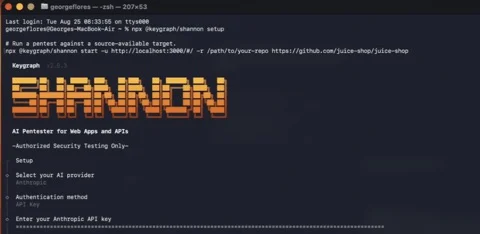
Shannon is an open-source autonomous AI pentester, built for web applications and their APIs. It works white-box: it first analyzes the application’s source code to map its architecture, trust boundaries, and data flows, then hands the most credible attack paths to agents that use browser automation and command-line tools to exploit the running application.
Shannon follows a “no exploit, no report” rule. Only vulnerabilities confirmed with a reproducible proof of concept reach the final report, which cuts the speculative noise typical of scanners.
Targeting vulnerabilities such as injection, XSS, SSRF, and broken authentication across web apps and APIs, it supports authenticated testing with TOTP/custom rules and integrates directly into CI/CD pipelines. Reports are output in PDF, Markdown, JSON, and SARIF, while connections to models from Anthropic, OpenAI, xAI, AWS Bedrock, or local providers via Ollama, vLLM, or LM Studio are fully supported.
The open-source edition is licensed under AGPL-3.0 and needs access to the target’s source code. Black-box testing, dependency checks, and findings management are part of Keygraph’s commercial Pro and Enterprise editions. Because its agents execute real exploits against the target, Shannon is designed for staging and development environments.
4. PentAGI

PentAGI is an automated security testing platform that applies AI to support penetration testing workflows. It targets security professionals, researchers, and users who need a flexible system for structured offensive security tasks.
The tool runs in a sandboxed Docker environment that isolates all operations. It uses an autonomous AI agent that selects and executes testing steps. It also includes more than twenty established penetration testing tools such as nmap, Metasploit, and Sqlmap.
PentAGI provides long-term memory for research findings and successful strategies. It offers web intelligence through an integrated browser and also supports external search systems and connects to APIs from Tavily, Traversaal, Perplexity, DuckDuckGo, Google Custom Search, and Searxng. It also supports detailed logging and monitoring through Grafana and Prometheus.
The system supports a team setup where specialized AI agents can handle research, development, and infrastructure tasks and then produce vulnerability reports that include exploitation guidance.
5. Reaper

Reaper is an open-source framework for application security testing. Ghost Security designed it as a lightweight system that supports both human analysts and AI agents.
The framework consolidates reconnaissance, proxying, request tampering, replay, active testing, collaboration, and reporting in a single workflow, aiming to cut the manual overhead that slows down application security work.
Reaper provides a unified environment for analysts, pentesters, and bug bounty researchers by bringing together steps that are often handled by separate tools.
Its design supports traditional browser-driven exploration as well as automated workflows that use large language models. How? AI agents assist with tasks such as data review, test parameter tuning, and reporting. This reduces repetitive work and increases throughput during assessments.
The project focuses on extensibility and ease of use. The tool runs in Docker or as a standalone binary and exposes a local web interface.
The workflow begins with domain scanning. Users add a target domain and start automated enumeration to identify live hosts.
- The Explore phase allows traffic capture through a built-in proxy. The proxy records hosts, endpoints, and interactions from the analyst’s browsing session.
- Captured requests appear in the Replay workspace. Analysts can resend or modify any request and inspect the resulting responses. This supports validation and manual probing.
- The Tests workspace will centralize test execution against selected endpoints. It targets cases such as parameter fuzzing during BOLA or IDOR investigations. This part of the system is under active development.
Reaper also includes an experimental AI Agent interface. Users provide an OpenAI API key and interact with an agent through a chat view. The agent can analyze captured traffic, identify patterns, and prepare findings summaries.

6. AgentFence

AgentFence is an open-source framework for security testing of AI agents. It supports automated analysis of model behavior and helps teams identify weaknesses before deployment.
The framework can detect prompt injection, secret leakage, system instruction exposure, and role confusion. The tool gives developers and security researchers a structured way to evaluate how well an AI model resists manipulation.
AgentFence runs predefined security tests against an AI model and reports the outcomes in a clear format. Its architecture also allows users to add new probes and build custom evaluations when needed and it works with popular AI SDKs such as LangChain and OpenAI, and support for other platforms is planned.
The framework is suitable for routine validation of AI systems. It enables early detection of model misbehavior during development cycles and because of that security teams can use it to build repeatable adversarial tests and integrate them into broader assurance workflows.
Compliance and risk teams can also use its findings to check if a model follows basic security expectations.
7. HexStrike AI
HexStrike AI is an open-source Model Context Protocol (MCP) server, developed by OTT Cybersecurity LLC, that gives AI clients direct access to a large offensive security toolkit. Once the server runs, MCP-compatible clients such as Claude Desktop, Cursor, and VS Code Copilot can call more than 150 security tools on their own, covering network reconnaissance, web application testing, password attacks, binary analysis, cloud security, CTF challenges, and OSINT.
HexStrike AI places an orchestration layer between the language model and those tools, featuring a decision engine that selects tools and chains attack steps, specialized agents for workflows like bug bounty hunting and exploit generation, and wraps established utilities such as Nmap, Nuclei, sqlmap, ffuf, Hydra, Ghidra, Prowler, and Trivy within a Python REST API server.
The same design appealed to attackers. In late August 2025, within about 12 hours of Citrix disclosing CVE-2025-7775, CVE-2025-7776, and CVE-2025-8424 in NetScaler ADC and Gateway, underground forum users were discussing HexStrike AI as a way to speed up exploitation.
8. Nebula

Nebula is an open-source penetration testing tool that integrates advanced AI models into the command line. It supports security analysts, ethical hackers, and developers who need structured, fast, and informed security workflows.
The tool automates core tasks in penetration testing and provides real-time analytical support during engagements.
Nebula incorporates widely used open-source and commercial AI models that supply analysis, reasoning, and task guidance directly inside the terminal. Nebula can also interact with any external tool that can run from the command line.
Nebula includes the Deep Application Profiler. This component applies neural networks to analyze the internal structure and intent of executables. It moves beyond signature-based detection and enables the identification of zero-day malware. It also provides structured breakdowns that support fast review. The profiler is available as a web service and through an API.
9. Decepticon
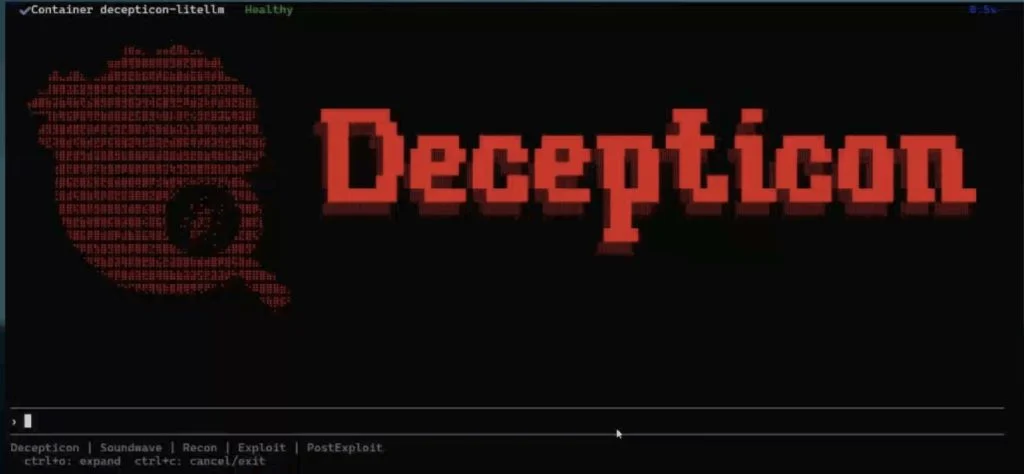
Decepticon is an open-source autonomous red team agent maintained by BitterSecurity and previously hosted under PurpleAILAB. It is built to run full attack chains the way an adversary would: reconnaissance, exploitation, privilege escalation, lateral movement, and C2.
Every engagement starts with an operator-approved target and rules of engagement (RoE). An orchestrator built on LangGraph then pursues objectives from an operations plan (OPPLAN), spawning specialist agents for each phase.
Decepticon executes interactive security tools such as msfconsole, sliver-client, and evil-winrm within persistent tmux sessions, while isolating operational workloads inside a dedicated Kali Linux sandbox on a separate network. Findings and attack chains are maintained in a Neo4j knowledge graph, and the agent offers seamless model routing through LiteLLM to Anthropic, OpenAI, Gemini, DeepSeek, and local Ollama instances. Interfaces include a terminal CLI, a web dashboard, a Python SDK, and an MCP server for integration with Claude Code and Codex.
The maintainers report passing 102 of 104 challenges (98%) in the XBOW validation benchmarks, a self-reported result that covers web exploitation. Decepticon is licensed under Apache-2.0, and a hosted cloud version is also available.
10. CyberStrikeAI
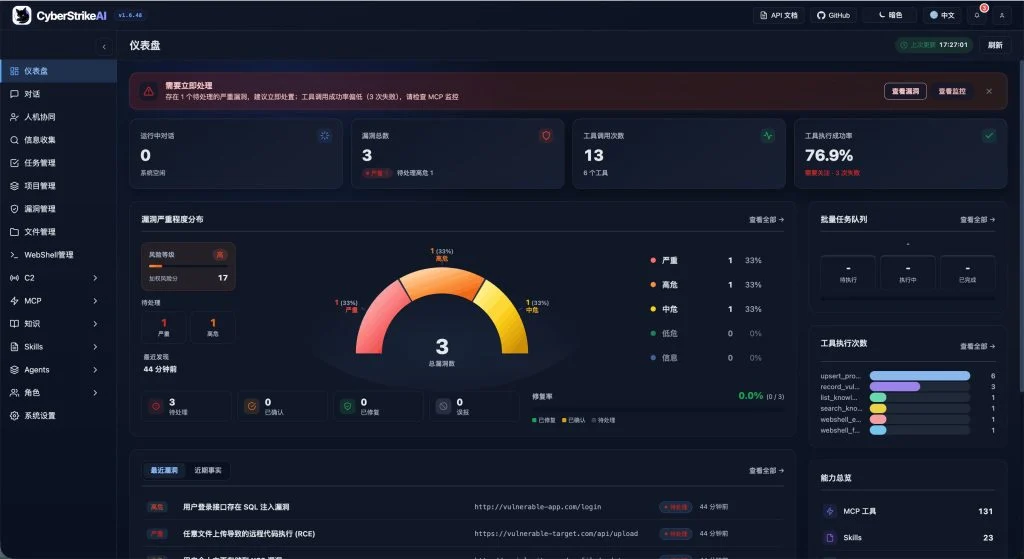
CyberStrikeAI is an AI-native security testing platform written in Go. It turns natural-language instructions into security actions through agents built on the Eino framework, with single-agent execution as well as Deep, Plan-Execute, and Supervisor multi-agent modes.
The platform features over 100 curated YAML tool recipes and MCP support over HTTP, stdio, and SSE for external tools. Its knowledge base relies on retrieval-augmented generation (RAG), graph workflows, and step-by-step attack-chain modeling with replay capabilities. For governance and control, CyberStrikeAI offers approval modes, tool allowlists, role-based access control, audit logs, and default call blocking for government domains. Post-exploitation capabilities include built-in WebShell management and a C2 module with listeners, encrypted beacons, and task queues, while user interfaces range from a web console to chatbot integrations for platforms like Slack, Telegram, and Discord.
That feature set has drawn attention beyond red teams. In March 2026, researchers tied a server used in a campaign that compromised hundreds of Fortinet FortiGate devices to a CyberStrikeAI deployment. They also counted 21 IP addresses running the platform between January 20 and February 26, 2026, mostly in China, Singapore, and Hong Kong.
In October 2026, a commercial security vendor announced its acquisition of the project and said it will keep the open-source version available while adding controls against misuse. The repository now lives under the AIPentest organization on GitHub and is licensed under Apache-2.0.
Bonus: ARTEX
ARTEX is a self-hosted, multi-agent framework written in Go, with a Next.js web dashboard for tasks, traffic, and findings. A developer using the handle Autumn-27 published it on GitHub in July 2026 under AGPL-3.0, and it demonstrated how fast open-source AI pentest tools can transition to live threat actor operations.
An operator defines a task with a scope, test accounts, and a goal. A planner agent breaks that goal into attack intents, and worker agents claim them, run tools, and report results back. ARTEX ships no model of its own and works with Anthropic, OpenAI, or any OpenAI-compatible endpoint.
Within three months of its release, ARTEX surfaced in several campaigns:
- South Korean finance: Researchers reported on October 7, 2026, that an unattributed, likely financially motivated actor used ARTEX alongside several LLMs against South Korean financial organizations from late September to early October, resulting in data exfiltration
- Supply-chain compromise: Microsoft assesses that Storm-0940, an actor it describes as China-state aligned, was behind the ConnectWise Cloud Backup compromise and then used ARTEX to attempt sign-ins to more than 2,250 tenants
- Southeast Asian finance: A second report from Microsoft describes Storm-3358, a financially motivated cluster based in Cambodia, using ARTEX since October 2026 to exploit internet-facing systems at financial organizations and deploy remote access trojans (RATs)
On October 8, 2026, the developer disavowed the misuse, halted updates, and took the project closed source. The public repository went offline soon after. The code still circulates. CERT-EU notes that the public versions now live on as independent forks, and internet-wide scans published on November 5, 2026, found 1,465 hosts exposing an ARTEX console, about 815 of them distinct deployments.
ARTEX follows HexStrike AI and CyberStrikeAI, which were both tied to threat actor activity before it. For the full timeline, detection angles, and hardening steps, see our analysis of the ARTEX AI pentest tool.
Conclusion
AI-powered pentest tools will continue to advance in capability and accessibility which is a trend that lowers the barrier for executing complex attacks and increases overall threat volume. The short reviews of such tools we provided already show how quickly offensive capabilities are evolving. Defensive teams need structured and practical insight to adapt to this shift and understand how these techniques are applied in real environments.
Threat actor activity, emerging AI tooling, and real attack patterns are difficult to track in parallel. Many organizations lack the time, expertise, or the tools to maintain this level of visibility. For this reason, a mature Cyber Threat Intelligence function has become a core operational requirement rather than a supporting capability.
SOCRadar’s MCP server enables analysts to investigate incidents, enrich indicators, and generate reports through natural language. We help reduce manual effort, shorten the investigation process, and allow teams of different skill levels to work from the same foundation.
As AI accelerates both attack and defense, the differentiator will be how effectively organizations operationalize their intelligence.