Top 5 Phishing Domain Takedown Service
Phishing attacks remain one of the most persistent and scalable threats facing organizations today. In Q1 2026 alone, approximately 8.3 billion email-based phishing threats detected.
Phishing-as-a-Service (PhaaS) platforms now account for a growing share of campaigns, enabling threat actors with minimal technical skill to launch credential-harvesting operations at an industrial scale. By mid-2025, a single kit, Tycoon 2FA, accounted for 62% of all phishing attempts blocked by Microsoft. AI-generated lure pages have largely eliminated the typos and awkward phrasing that once made phishing easier to spot.
SOCRadar’s own threat research recently exposed The Quarry, a PhaaS operation supplying phishing kits, cloaking infrastructure, and remote access tooling to nearly 200 operators, with campaigns still active in 2026.
Against this backdrop, takedown services have become a core part of the brand protection stack. Manual reporting workflows are no longer viable at the speed and volume these campaigns operate. This article covers five leading phishing domain takedown services.
Understanding Phishing Domains
Phishing domains are fraudulent web addresses designed to impersonate legitimate websites and trick users into disclosing credentials, personal details, or financial data. They are typically deployed as part of broader campaigns combining look-alike infrastructure, cloned login pages, and targeted lures across email, SMS, and social media.
How Does Phishing Domains Work:
- Look-alike and typosquatted URLs: Phishing domains mimic legitimate brand URLs using character substitution, added prefixes, or homoglyph swaps. A domain like “micros0ft-login.com” can be indistinguishable from the real site at a glance.
- PhaaS-powered infrastructure: Phishing-as-a-Service platforms provide ready-made kits, hosting, and management dashboards that let attackers launch campaigns without technical expertise. These kits rotate infrastructure quickly to evade detection and can spin up hundreds of fraudulent sites within hours.
- Adversary-in-the-Middle (AiTM) session hijacking: Modern kits, including Tycoon 2FA and EvilProxy, sit between the victim and the legitimate site, proxying real login pages in real time to capture session tokens and bypass multi-factor authentication.
- AI-generated lure pages: Large language models now produce polished, localized phishing content at scale. The grammar errors and awkward phrasing that once served as detection signals are largely gone from well-resourced campaigns.
- Multi-channel delivery: Phishing is no longer limited to email. Smishing (SMS-based phishing), vishing (voice call impersonation), and social media lures have become primary delivery vectors, extending the attack surface well beyond the inbox.
- SSL certificate abuse: Most phishing domains now use HTTPS with valid SSL certificates. The traditional advice to check for the padlock no longer holds. Certificate issuance has become a detection signal rather than a safety indicator.
1. Phish Report
Phish Report is a self-serve phishing takedown platform built for security teams that want direct control over the detection and reporting process. Where managed services handle everything on the client’s behalf, Phish Report provides tooling to run takedowns internally, making it a more cost-effective option for small to medium teams without a dedicated brand protection function.
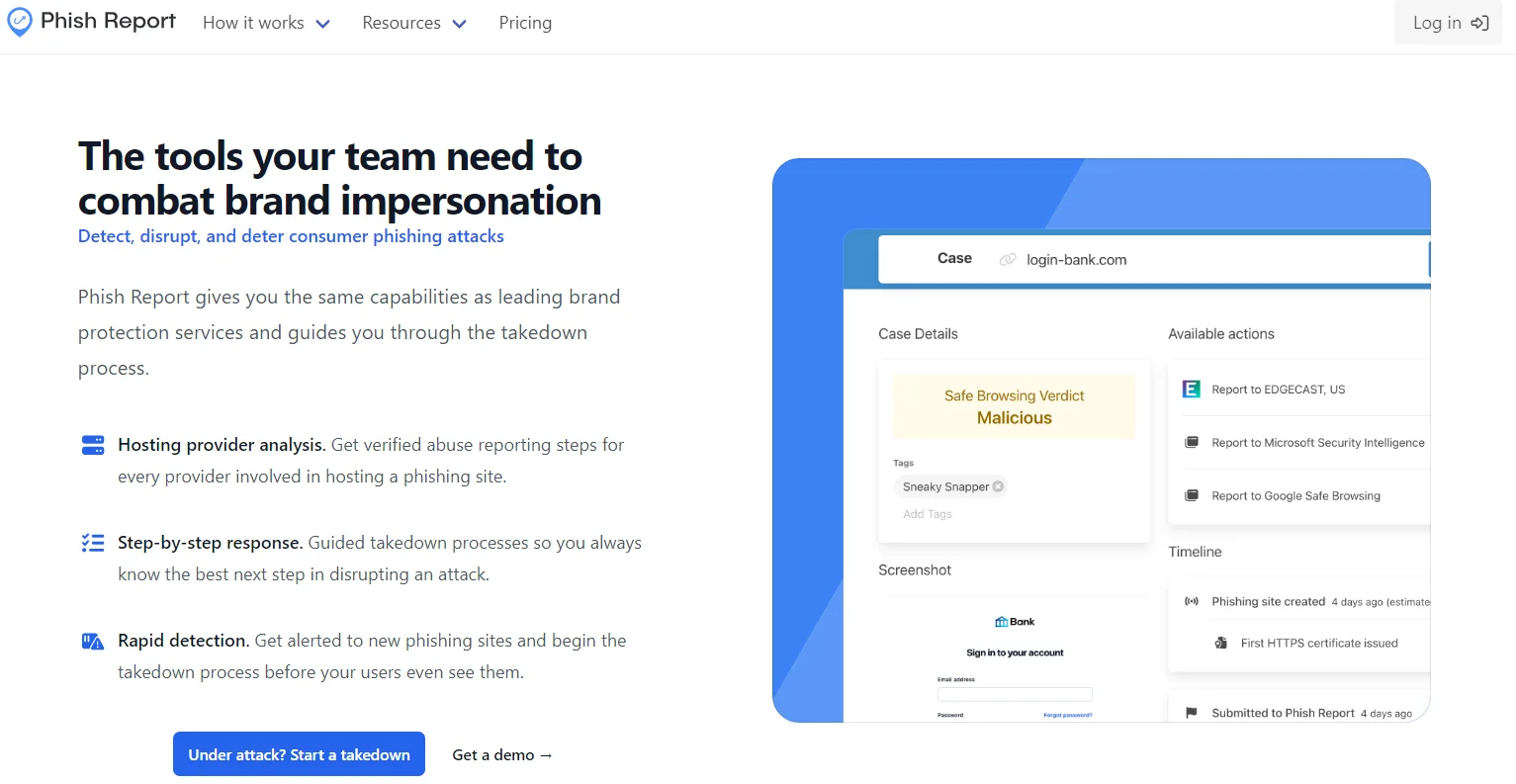
Phish Report main page
The platform scans millions of URLs daily using real-time feeds and detection signatures to identify brand impersonation and malicious activity. When a phishing site is detected, it is automatically reported to the relevant hosting provider, triggering takedown actions without requiring manual coordination from the security team.
Phish Report’s API allows integration with existing case management and incident response systems, giving teams flexibility in how they operationalize phishing defense. The platform supports integrations with Slack, TheHive, and Cortex, so teams can manage incidents directly within tools they already use.
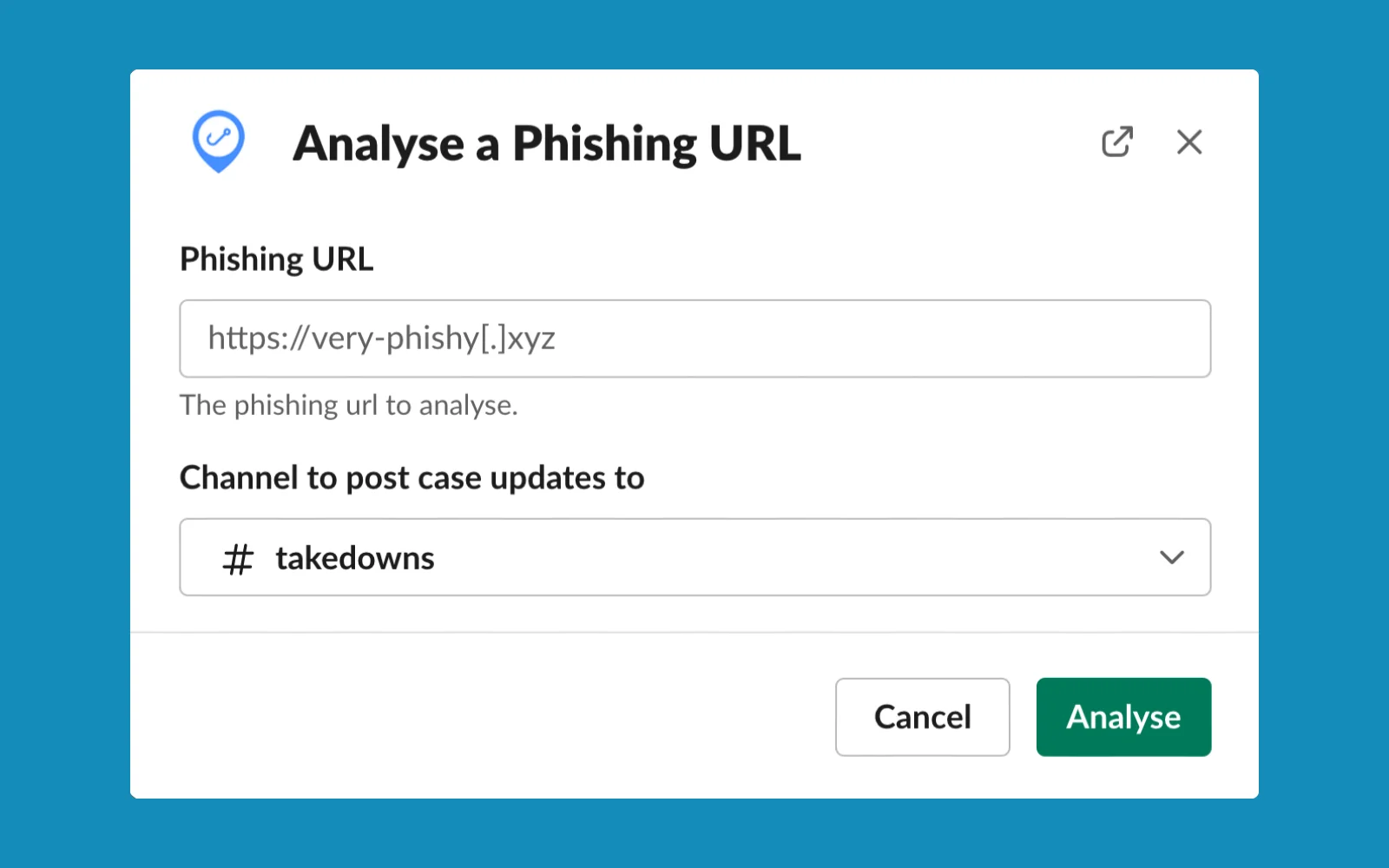
Using Phish Report to report fraudulent links in Slack by using their shortcut (image source: Phish Report)
For enterprise customers, Phish Report offers unlimited takedowns and premium features, including API integrations and priority support. The platform’s analytics provide visibility into phishing campaign patterns over time, making it a practical choice for teams that want detailed reporting alongside operational tooling.
2. PhishFort
PhishFort is a managed phishing domain takedown service that combines AI-powered detection with direct registrar relationships and 24/7 analyst oversight. The service targets phishing domains, fake mobile applications, look-alike URLs, and social media impersonation infrastructure, and has reported a 99%+ takedown success rate across its customer base.
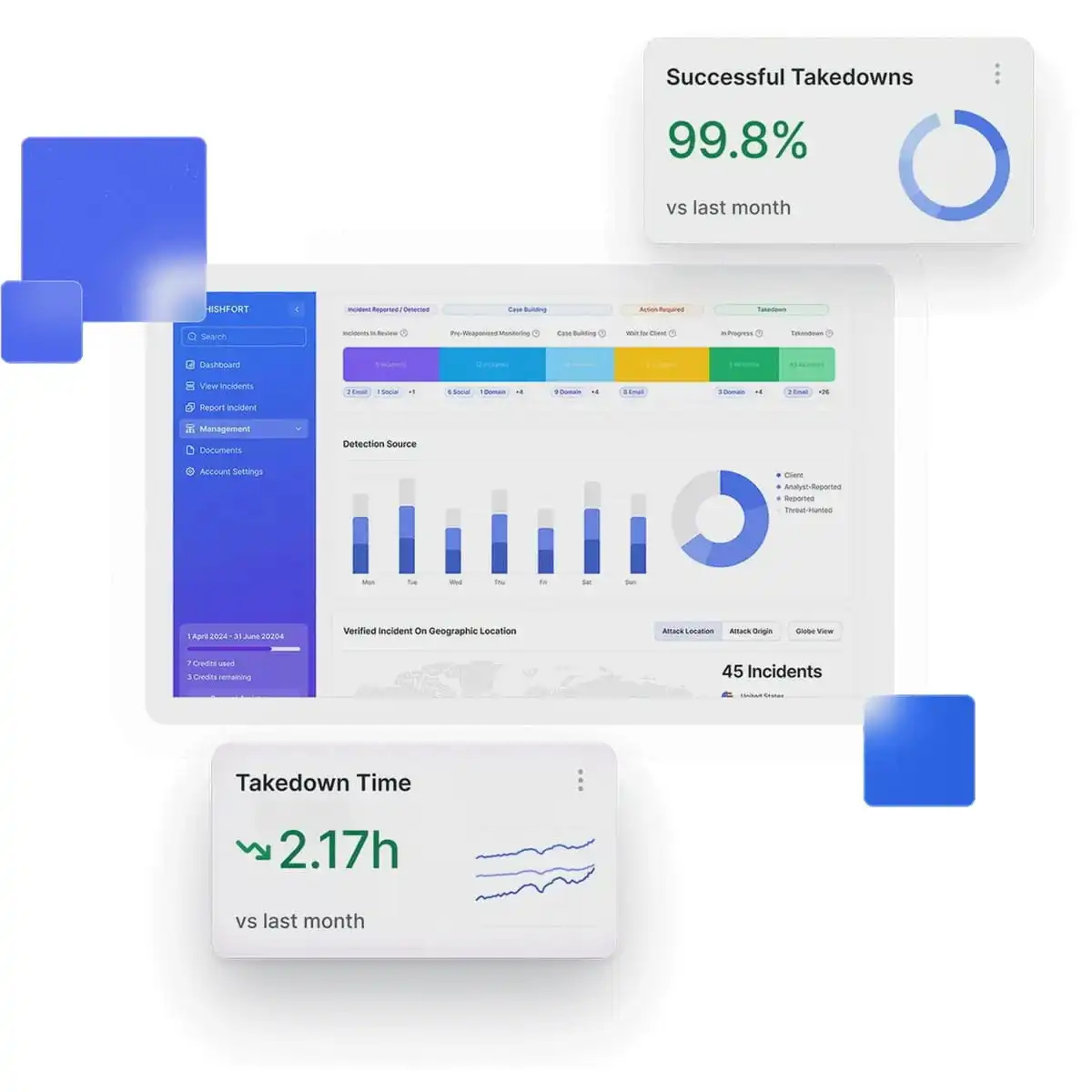
PhishFort domain takedown service
PhishFort’s global reach is backed by a continuously updated blocklist that currently protects over 418 million users. Every confirmed malicious domain is added to this feed and made available in STIX, JSON, and CSV formats, as well as through a custom API, making it compatible with existing threat intelligence and SIEM workflows. One enterprise customer reported moving from roughly 300 to 400 manually handled cases per year to 29,000 fake websites and domains taken down through PhishFort, with an average removal time of four to six hours.
The service operates across financial services, healthcare, retail, technology, crypto, and gaming, all sectors where brand trust and response speed are operationally critical. PhishFort’s enforcement relationships with registrars allow it to escalate cases through direct channels rather than generic abuse reporting queues, which translates to faster and more consistent outcomes on difficult takedowns.
3. Netcraft
Netcraft is one of the most established providers in the takedown space, with over 20 years of operational history and deep integrations across global internet infrastructure. The service uses machine learning and AI alongside thousands of detection rules to identify phishing sites targeting any organization, and covers more than 100 attack types including phishing, malware, fraudulent social media profiles, and fake shops.
Netcraft’s phishing domain takedown page
Netcraft currently handles nearly one-third of the world’s phishing site takedowns. Between March 2024 and March 2025 alone, it disrupted 1.3 million phishing websites impersonating more than 16,000 real-world organizations. To date, the service has disrupted over 25 million phishing domains and blocks more than 225 million malicious URLs. Its median phishing website takedown time is 33 minutes, with 75% of cases processed through a custom API or direct point of contact. A five-year study of Netcraft clients showed a 44% drop in attacks over the period, while attacks against comparable non-clients increased.
The platform takes a dual approach of blocking and removal, using Safe Browsing providers, DNS sinkholing, and email gateway integrations to protect users immediately while pursuing registrar suspension and host removal for permanent disruption. Takedowns are monitored for seven days post-removal and restarted automatically if malicious content resurfaces. In October 2025, Netcraft expanded its capabilities with Phone Scam Disruption, a new module that automates the detection and takedown of fraudulent phone numbers used in smishing and vishing campaigns, reflecting the broader shift in how phishing is delivered.
4. Bolster AI
Bolster, now operating as Bolster AI, uses artificial intelligence trained on over a billion websites to detect and remove phishing infrastructure with a consistently low false positive rate. The platform is built for security, fraud, and trust and safety teams, focusing on threats that operate outside the corporate perimeter and often go undetected by traditional email security tools.
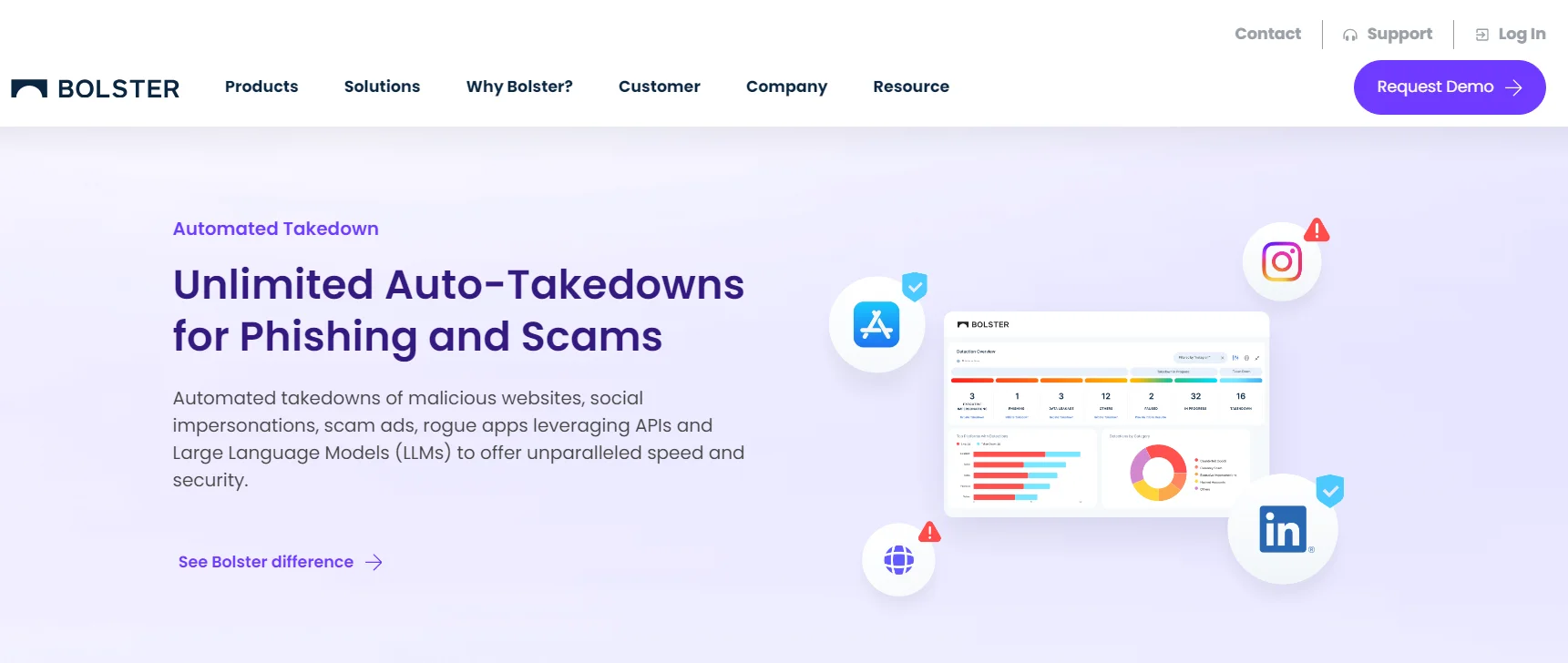
Bolster AI phishing domain takedown page
Bolster AI removes 75% of detected threats in under 60 seconds, with the remaining cases handled through analyst-led workflows. Its monitoring covers web, email, social media, app stores, and the Dark Web, including dark web forums and Telegram channels where threat actors coordinate campaigns and sell phishing infrastructure. Throughout 2025, Bolster tracked approximately 11.9 million malicious domains, with a daily peak average of over 378,000 malicious domains active at any given time. The platform maintains relationships with over 1,500 registries and hosting providers, enabling consistent takedown outcomes without relying solely on generic abuse reporting.
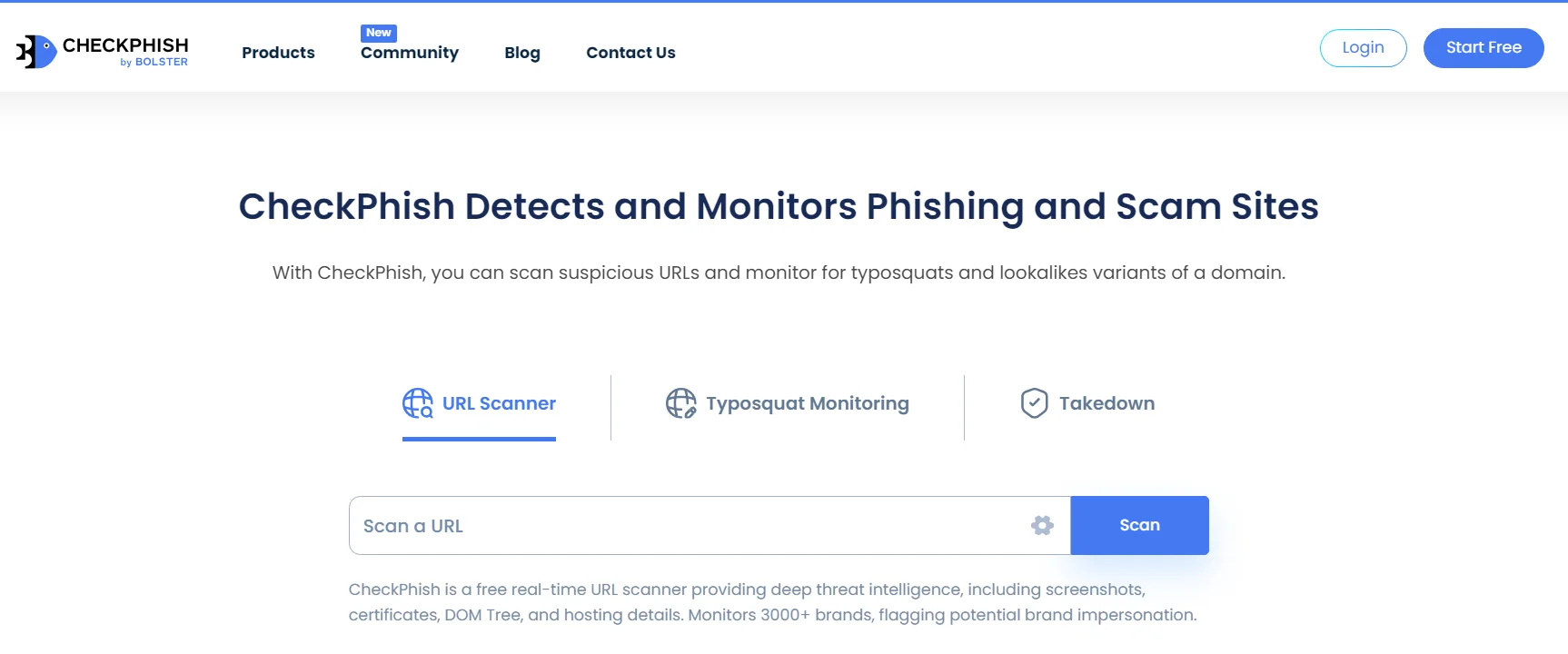
Bolster’s CheckPhish tool
In June 2025, Bolster AI launched a CheckPhish plugin for Microsoft Security Copilot, bringing URL and domain scanning directly into the Microsoft security ecosystem. CheckPhish.ai remains available as a free public tool, with 25 free API scans per day and no sign-up required for individual URL checks. For enterprise customers, the platform automates takedowns, alerts, and escalations across the full external attack surface.
5. SOCRadar’s Domain Takedown Service
SOCRadar’s Integrated Takedown service is built into the platform’s Brand Protection module, enabling security teams to initiate takedowns with a single click. The service covers phishing domains, malware sites, fraudulent social media profiles, rogue mobile applications, and brand abuse pages, coordinating through SOCRadar’s global contact network without placing additional legal or procedural burdens on the team.
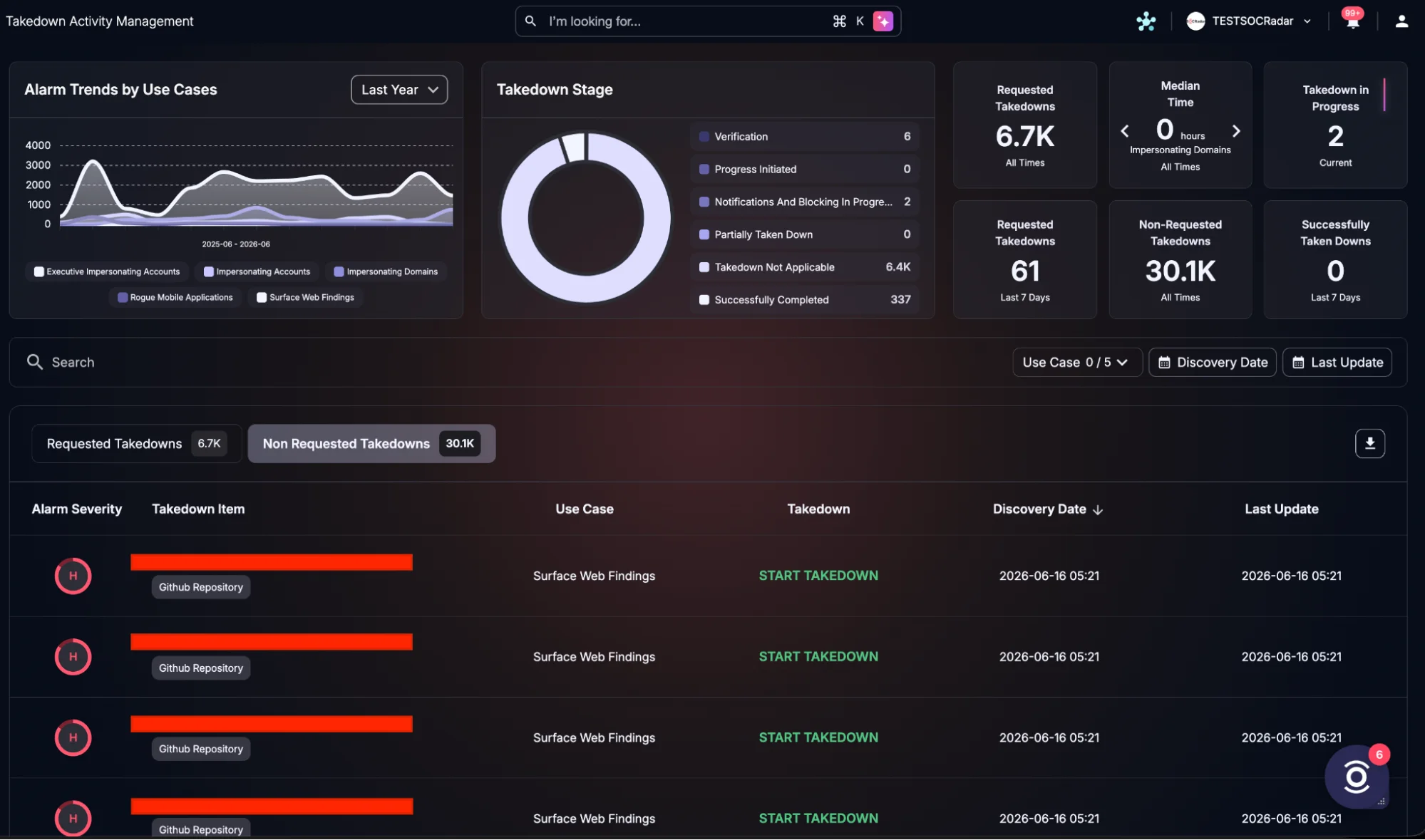
SOCRadar’s Domain Takedown Service, Management Panel
Phishing domain detection is powered by AI-based workflows that combine specialized detection agents with domain analysis steps, including lookalike and typosquatted domain monitoring, SSL certificate tracking, and continuous scanning across surface and Dark Web sources. SOCRadar’s modular workflow builder allows teams to customize detection logic and automate escalation paths. Alerts fire whenever a monitored suspicious domain changes state, keeping teams informed at every stage from discovery through to takedown.
SOCRadar’s takedown capability integrates with the platform’s Dark Web Monitoring and broader threat intelligence modules, giving organizations a unified view of their external exposure. After a takedown request is submitted, the platform continues monitoring and allows for fast follow-up if the threat resurfaces or new infrastructure appears. For teams managing high volumes of phishing reports or coordinating across brand protection, threat intelligence, and incident response, the integrated approach reduces context switching and accelerates time to resolution.
Phishing campaigns are moving faster than ever. For a broader view of how threat actors build and deploy.