

Oct 07, 2026
Table Of Content
What U.S. CISOs Should Track in Early 2026?
Geopolitics as a Strategic Lever: The Evolution of "Persistent Access"
AI: The Accelerator of the Offense-Defense Arms Race
The Regulatory Turning Point: From Guidance to Enforcement
Post-Quantum Cryptography: Moving into the Action Plan
Strategic Partnership in the 2026 Cyber Landscape
Related Articles
NetScaler C2: CVE-2026-88771 Exploitation Operation




Feb 17, 2026
15 Mins Read
Feb 20, 2026

Summarize with:
What U.S. CISOs Should Track in Early 2026?
Midway through the first quarter of 2026, it’s observed that U.S.-based Chief Information Security Officers (CISOs) face a cyber landscape defined by unprecedented technological acceleration and complex geopolitical shifts this year. According to the Global Cybersecurity Outlook 2026, 94% of cybersecurity leaders anticipate that artificial intelligence will be the most significant driver of change in the year ahead, forcing a strategic pivot toward AI-driven defense. In this environment, the challenge for the C-suite is no longer just preventing breaches but building cyber resilience – the ability to maintain business continuity as automated threats and sophisticated social engineering test the limits of traditional security.
Strategic focus in the first quarter of 2026 must extend beyond internal networks to address the vulnerabilities inherent in an increasingly opaque digital supply chain. The Outlook 2026 report reveals a critical shift in governance, with the percentage of organizations implementing formal security assessments for AI tools nearly doubling from 37% in 2025 to 64% in 2026. For the American CISO, this quarter represents a vital window to bridge the gap between rapid innovation and secure deployment, ensuring that emerging technologies strengthen rather than compromise the enterprise’s economic value
Geopolitics as a Strategic Lever: The Evolution of “Persistent Access”
The geopolitical threat landscape for U.S.-based CISOs has shifted from traditional perimeter defense to a crisis of internal operational integrity. According to the Global Cybersecurity Outlook 2026, 91% of the largest organizations have fundamentally evolved their cybersecurity strategies due to geopolitical volatility. This shift marks a move away from isolated defense toward intelligence-driven collaboration and “Cyber Sovereignty”.
The Commodity of Compromise: Dark Web Marketplace Dynamics
The efficiency of modern cyberattacks is driven by a mature underground economy where “access” is a standardized product. According to SOCRadar’s 2026 U.S. Threat Landscape data, the general Dark Web environment in the United States is defined by strong market-driven forces:
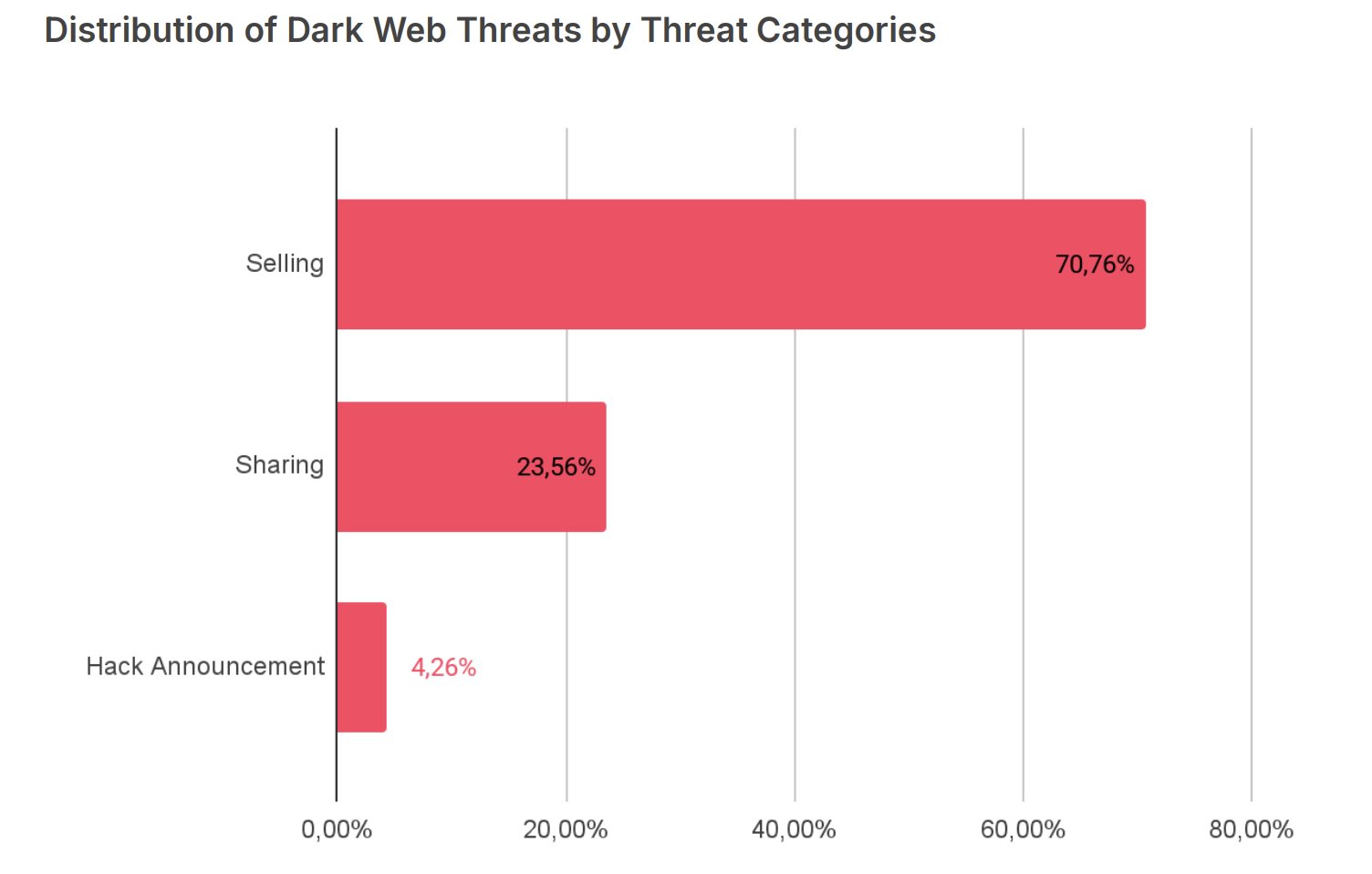
The category distribution shows that Dark Web activity is driven mainly by monetization
- Dominance of Monetization: Cybercrime has moved from opportunistic hacking to a professionalized marketplace where selling accounts for 70.76% of all observed Dark Web activity.
- The Sharing Economy: Beyond direct sales, sharing makes up 23.56% of activity, indicating a collaborative environment where tools and leaks are exchanged to lower the barrier to entry for attackers.
- Initial Access Brokering (IAB): In this specialized market, 29.31% of posts focus exclusively on access sales. For a CISO, this means that your network’s “front door” key is likely already for sale, turning a potential intrusion into a simple transaction.
- Sectoral Concentration: Attackers follow the value; the Finance and Insurance sector leads dark web targeting at 14.39%, followed by Information Services at 10.19% and Public Administration at 9.79%.

Tactical Map: Top Nation-State Threats Targeting the U.S.
In 2026, the technical focus of major actors targeting U.S. interests has crystallized into specific high-impact methodologies:
- North Korea (Identity Infiltration & Revenue): DPRK-linked actors like Kimsuky (APT43) have moved toward a “Direct-to-Individual” strategy. They utilize malicious QR codes (Quishing) to bypass email security and push victims toward credential-harvesting pages. Most critically, they successfully place “Remote IT Workers” inside U.S. companies using stolen identities to create persistent backdoors and generate illicit revenue.
- China (Infrastructure Pre-Positioning): Actors such as Volt Typhoon and Salt Typhoon prioritize “Quiet Persistence” within the communications and critical infrastructure layers. By utilizing Living Off the Land (LOTL) techniques, they exploit edge devices (routers, VPNs) and extract Active Directory databases (NTDS.dit) to maintain undetected access that survives password resets.
- Russia (The Trust Game): Groups like APT28 (Fancy Bear) target the defense and logistics sectors by compromising trusted third-party providers. By exploiting the “Trust Relationship” between a vendor and its client, they move laterally through downstream networks, often remaining undetected for over 300 days.
- Iran (Aerospace & Recruitment Lures): Groups like UNC1549 utilize spoofed job portals and fake recruitment offers to target aerospace and defense personnel. By weaponizing normal career workflows, they reach high-value targets outside the corporate security stack.
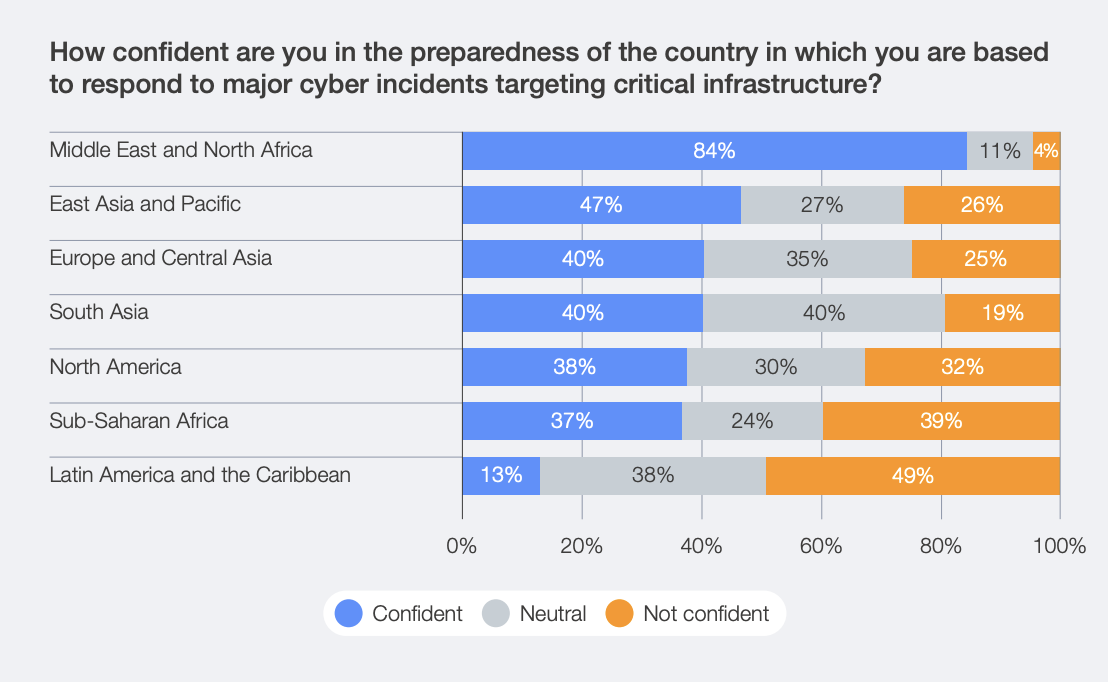
North American leaders report fractured confidence, with 32% expressing concern regarding national preparedness for critical infrastructure attacks, trailing behind the proactive levels seen in the MENA region.
Strategic Focus: Building Resilient Sovereignty
The primary differentiator between “Highly Resilient” organizations and those falling behind is their strategic response to geopolitical volatility.
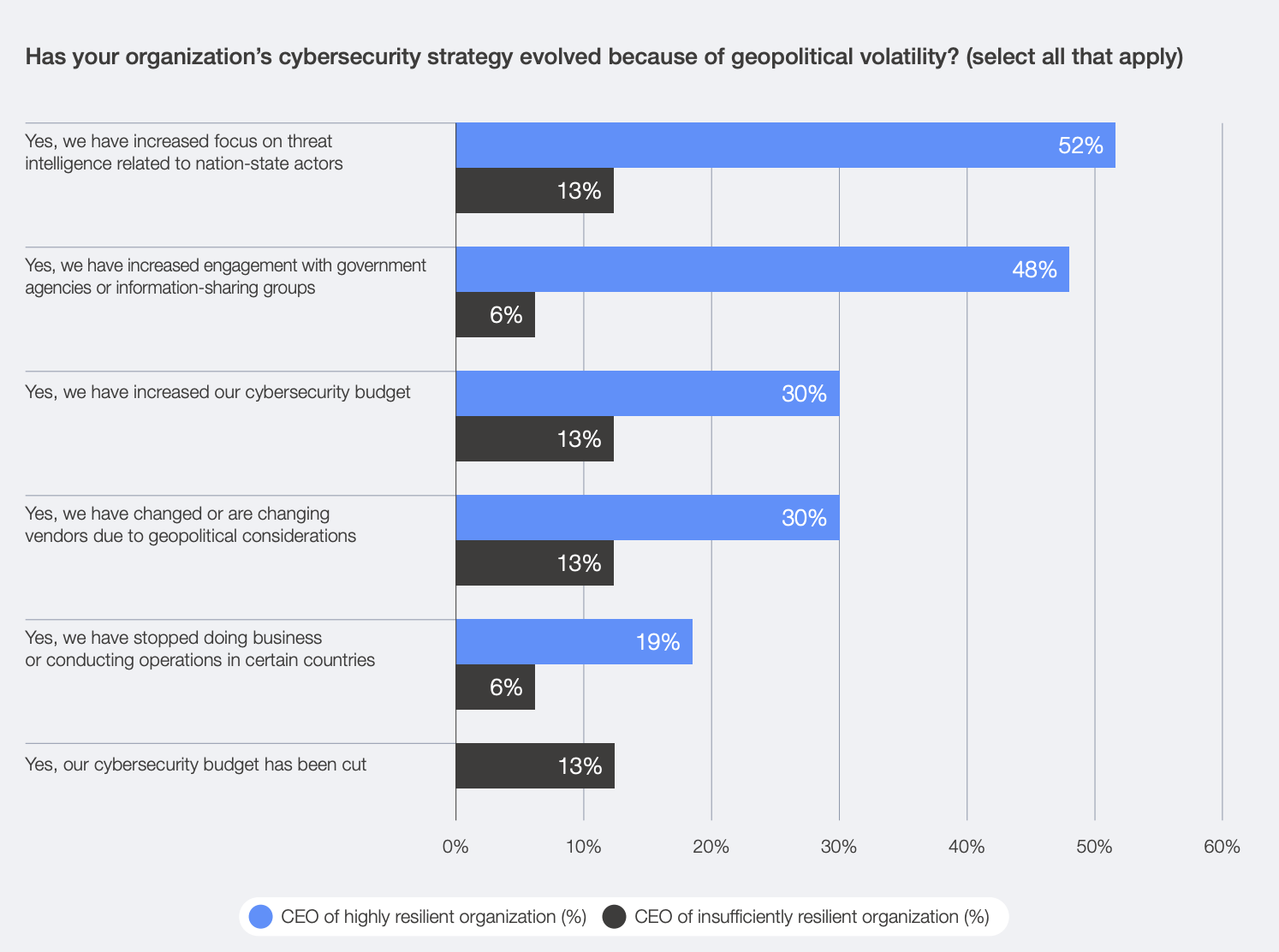
Resilient organizations are significantly more likely to prioritize threat intelligence on nation-state actors (52%) and engage deeply with government information-sharing groups (48%).
Action Plan for US CISOs:
- Neutralize “Bought” Access: Implement automated Dark Web monitoring for leaked session cookies and VPN credentials to invalidate compromised keys before they are sold to state actors.
- Harden the Identity Lifecycle: Counter North Korean “Internal IT Workers” by moving to phishing-resistant MFA (FIDO2) and enforcing strict identity verification for all remote and administrative roles.
- Audit Native Tool Abuse: Shift monitoring from malware signatures to the intent of legitimate tools (e.g., vssadmin, certutil) used by Volt Typhoon and others for “Living Off the Land” credential extraction.
For US CISOs, the targeting of employees on their personal systems—outside the corporate network—has become a major theme in 2026. This “direct-to-individual” targeting makes detection significantly more difficult and requires a move toward securing the entire workforce identity lifecycle across onboarding, credential resets, and access recovery.
AI: The Accelerator of the Offense-Defense Arms Race
By 2026, Artificial Intelligence has transitioned from a strategic option to the standard “operating system” for both attackers and defenders. According to the World Economic Forum Global Cybersecurity Outlook 2026, 94% of cybersecurity leaders identify AI as the most significant driver of change. However, as the industry undergoes these vast changes, the technical risks are manifesting with unprecedented “machine speed”.
1. The Shadow AI Forecast: Unvetted Innovation
A critical priority for 2026 is addressing the rapid adoption of AI technologies without adequate safeguards.
- The Governance Gap: While 64% of organizations have formalized AI security assessments—up from 37% in 2025—a significant portion of the workforce continues to use unvetted generative tools, creating a “Shadow AI” layer.
- Strategic Forecast: We forecast that “business context” will drive governance deeper into high-stakes operations. Unmanaged AI systems involved in critical decision-making, such as medical dosing or financial approvals, represent a ticking time bomb for operational resilience.
2. Agentic AI & The Identity Crisis
2026 marks the era of Agentic AI— autonomous systems like the open-source OpenClaw project that can independently complete tasks without continuous human oversight. A recent MITRE ATLAS investigation into OpenClaw has exposed how these AI-first ecosystems introduce entirely new exploit paths:
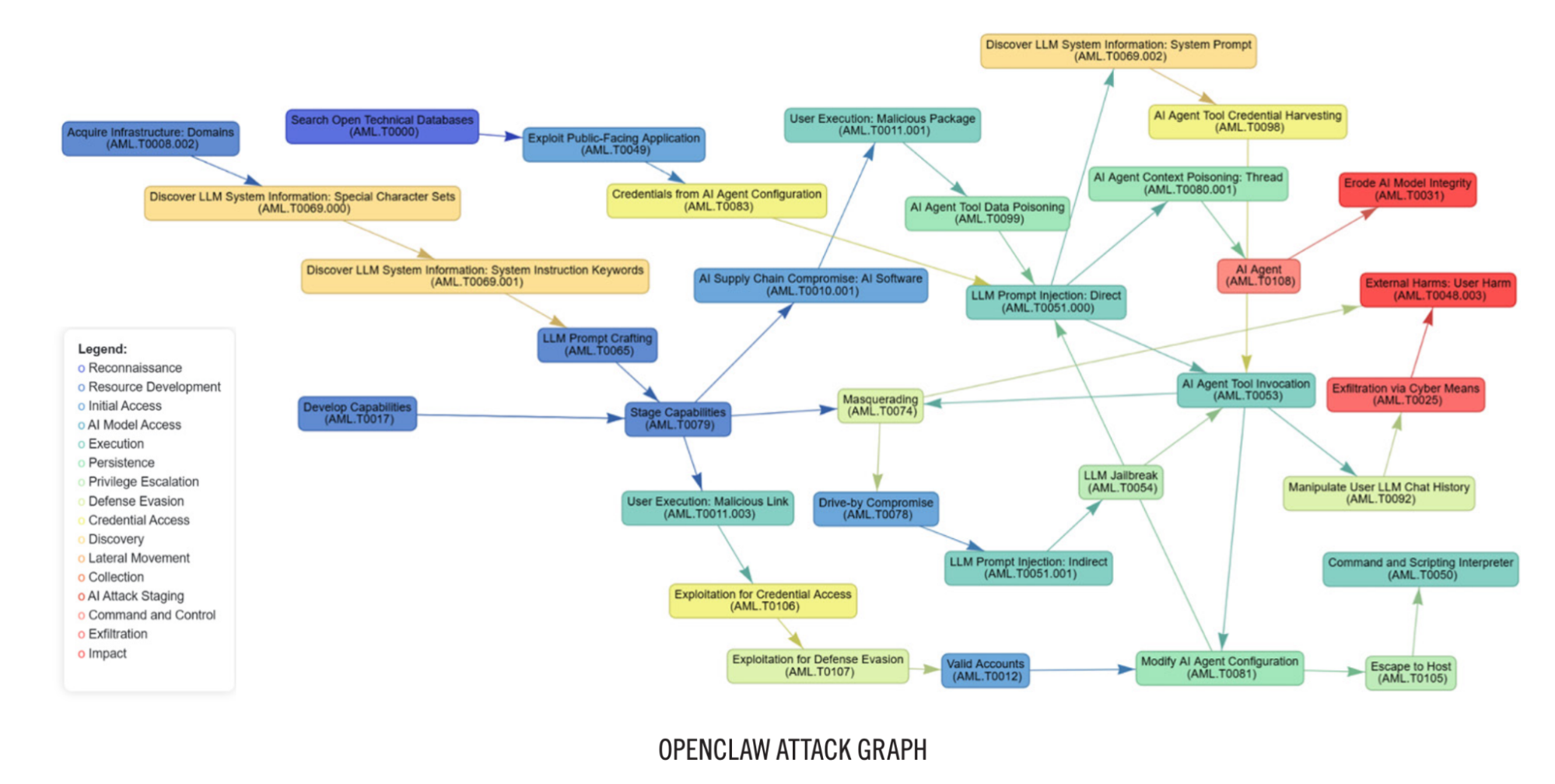
MITRE ATLAS OpenClaw Attack Graph: This visualization maps how adversarial actors exploit the autonomy of agentic AI systems—transitioning from initial LLM prompt injection to full host compromise and unauthorized data exfiltration.
- Autonomous Exploitation: The investigation revealed that attackers can exploit an agent’s internet access to steal stored credentials or use “Special Character Sets” to discover system information.
- Exposed Interfaces: Shodan data from early 2026 highlights that nearly 62% of OpenClaw control interfaces were exposed on the public internet without authentication, often on Port 18789, allowing attackers to harvest credentials for any connected services.
- Mastering Identity: Identity is the central piece of digital evidence that ties this agentic world together. CISOs must now differentiate between the identities of the human user, the AI model, and the autonomous agent itself to mitigate non-deterministic risks.
3. Hyper-Localized Phishing and Machine-Speed Defense
AI has enabled the mass-production of phishing campaigns with flawless grammar and deep localization, collapsing the traditional defense window.
- The Trust Paradox: With 77.9% of malicious sites now using HTTPS, users are losing the ability to detect phishing through traditional visual cues.
- Millisecond Defense: Weaponized AI attacks at lightning speed, requiring organizations to automate detection and response into the millisecond range.
The Great Divergence: CEO vs. CISO Priorities
The Global Cybersecurity Outlook 2026 reveals a distinct shift in how risk is perceived at different levels of the organization. While security teams remain grounded in operational stability, executive leadership has pivoted toward the broader socioeconomic impacts of cybercrime.
The priorities of CEOs and CISOs have diverged as the threat landscape becomes more complex. CEOs are now prioritizing financial loss prevention and preparing for emerging AI threats, while CISOs remain focused on the continuity of services.
| Rank | Chief Executive Officer (CEO) | Chief Information Security Officer (CISO) |
| 1 | Cyber-enabled fraud and phishing | Ransomware attack |
| 2 | AI vulnerabilities | Supply chain disruption |
| 3 | Exploitation of software vulnerabilities | Exploitation of software vulnerabilities |
An organization’s maturity level significantly influences what its leaders fear most. The report segments these concerns based on organizational resilience:
- Insufficiently Resilient Organizations: CEOs here are still fighting traditional “front-line” battles, ranking cyber-enabled fraud (#1) and ransomware (#2) as their primary anxieties.
- Highly Resilient Organizations: Once baseline security is mastered, the focus shifts to the horizon. For these leaders, AI vulnerabilities rise to the #1 spot, followed by fraud and supply chain disruptions.
The GenAI Anxiety: Data vs. Adversaries
Beyond general vulnerabilities, Generative AI (genAI) has introduced specific fears into the C-suite. CEOs identify two primary risks as their dominant concerns for the coming year:
- Data Leaks (30%): The fear of proprietary or personal data exposure through genAI platforms.
- Advancement of Adversarial Capabilities (28%): The concern that attackers are using AI to automate and enhance their own offensive toolkits.
This divergence suggests that while the CISO protects the “how” (operational resilience), the CEO is now deeply concerned with the “who” and the “what” (identity, fraud, and data integrity). To bridge this gap, 2026 strategies must align technical defenses like ransomware protection with executive-level goals of fraud prevention and AI governance.
Strategic Action Plan for US CISOs:
- Formalize AI Vetting: Inventory all AI tools by the end of Q1 to eliminate “Shadow AI” and subject them to mandatory security testing.
- Audit Agentic Permissions: Review systems like OpenClaw for “Human-In-The-Loop” requirements, ensuring agents do not have unrestricted filesystem root access.
- Neutralize Exposure: Use Shodan to scan for exposed control panels (e.g., Port 18789) and move all agentic management interfaces behind authenticated gateways.
- Transition to FIDO2: To counter the 77.9% of phishing sites using HTTPS, prioritize phishing-resistant MFA for all administrative and high-risk roles.
The Regulatory Turning Point: From Guidance to Enforcement
2026 represents a major pivot in global cybersecurity compliance. The era of guidance” has effectively ended, replaced by an era of enforcement where transparency and accountability are non-negotiable. Regulators are increasingly holding boards and executives liable for compliance failures, with inaction resulting in substantial penalties and irreversible reputational damage.
SEC Disclosure and Materiality Rationalization
The Securities and Exchange Commission (SEC) is undergoing a comprehensive review of Regulation S-K, with a focus on eliciting “material information” while avoiding the disclosure of “immaterial” details that increase compliance burdens. This review, led by Chairman Paul Atkins, aims to streamline Item 106 to simplify descriptions of cybersecurity policies and governance. Public comments are invited through April 13, 2026, as the SEC looks to reduce the length and complexity of proxy statements and periodic reports. For CISOs, this shift requires a more disciplined approach to cyber risk quantification—translating technical risks into business terms that clearly articulate the financial impact on the organization.
CISA and the CIRCIA Reporting Mandate
While some federal mandates are being rationalized, the Cyber Incident Reporting for Critical Infrastructure Act (CIRCIA) remains a hard deadline for critical infrastructure operators. Starting in May 2026, covered entities must report “substantial” cyber incidents to CISA within 72 hours and ransomware payments within 24 hours. CIRCIA also mandates a two-year data preservation period for logs, forensic artifacts, and documentation related to the investigation and response.
| CIRCIA Requirement | Reporting Timeline | Strategic Implication for CISOs |
| Substantial Incident | Within 72 hours of discovery. | Need for rapid asset discovery and clinical context. |
| Ransom Payment | Within 24 hours of payment. | Mandatory reporting regardless of the underlying incident status. |
| Data Preservation | 2-year retention of artifacts. | Increased storage and forensic audit logging requirements. |
| Defensive Justification | Required in reports. | Must prove “reasonable protections” were in place. |
The US State Privacy Landscape in 2026
The state-level privacy environment has reached a pivotal moment as 2026 begins. Indiana, Kentucky, and Rhode Island have all seen their comprehensive privacy laws enter into force on January 1st. These laws introduce rigorous requirements for Data Protection Impact Assessments (DPIAs) and grant consumers expanded rights, including the right to opt out of targeted advertising and the sale of personal data.
| State Privacy Law | Effective Date (2026) | Key Unique Provision |
| Indiana (ICDPA) | January 1 | AG may request disclosure of data protection assessments. |
| Kentucky (KCDPA) | January 1 | Applies to processing activities initiated on or after June 1, 2026 |
| Rhode Island | January 1 | Universal Opt-Out Mechanism (UOOM) recognition required. |
| California (AB 45) | January 1 | Consumer health data protections near family planning centers. |
| Texas (HB 149) | January 1 | Prohibits certain harmful uses of artificial intelligence. |
A critical development for 2026 is the expansion of Universal Opt-Out Mechanisms (UOOM). Beginning in January, Connecticut and Oregon join a growing list of states (including California, Colorado, and Texas) that require websites to recognize automated technology that communicates a consumer’s privacy preferences across multiple services. For CISOs, this means privacy compliance can no longer be handled as a manual, per-site checklist; it must be integrated into the automated “Governance as Code” workflows of the organization.
Post-Quantum Cryptography: Moving into the Action Plan
The quantum threat has moved from the theoretical horizon into the center of strategic planning for 2026. Gartner predicts that advances in quantum computing will render the asymmetric cryptography used to secure data and systems unsafe by 2030. The Assumption of having a 5-to-10-year window to prepare is no longer a defensible risk posture, particularly as nation-states and major cloud providers compress the timeline for building cryptographically relevant quantum computers (CRQC).
The CISA PQC Product Categories List
On January 23, 2026, CISA unveiled an initial list of Product Categories for Technologies That Use Post-Quantum Cryptography Standards. This resource is intended to assist organizations—especially federal agencies—in prioritizing the procurement of PQC-capable technologies. The list identifies hardware and software categories that support or are expected to support PQC standards, including cloud services, web software, networking hardware, and endpoint security. Organizations are urged to begin buying only PQC-enabled products for all new purchases.
| PQC Priority Area | Strategic Action for Q1 2026 | Future Outlook |
| Cryptographic Agility | Design architectures that allow algorithm swaps. | Algorithm management becomes a standard board-level requirement. |
| Harvest Now, Decrypt Later | Protect long-lived sensitive data immediately. | Adversaries are already capturing traffic for future use. |
| Hybrid Architectures | Combine classical and PQC algorithms. | Pragmatic defense-in-depth during the transition period. |
| Supply Chain Visibility | Expand assessments to vendors and contractors. | Third-party risk frameworks to include PQC readiness criteria. |
Despite these mandates, a stark readiness gap remains. A survey of 1,500 security professionals revealed that while 75% understand the threat, 91% lack a formal migration roadmap, and 81% report that their current cryptographic libraries are not ready for PQ integration. For US CISOs, the focus this quarter must be on building a comprehensive cryptography inventory and pressuring vendors for credible PQC implementation timelines.
Strategic Partnership in the 2026 Cyber Landscape
As we navigate the first quarter of 2026, cybersecurity has transcended IT to become the cornerstone of organizational resilience. In an era where AI is the standard “operating system” for both attackers and defenders, U.S. CISOs require high-velocity, verified intelligence to stay ahead of machine-speed threats.
SOCRadar: At the Forefront of Defense
SOCRadar’s Extended Threat Intelligence (XTI) platform acts as a critical force multiplier, directly addressing the 2026 threat landscape defined in this report:
- Neutralizing Commercialized Access: With 70.76% of Dark Web activity now driven by monetization, SOCRadar monitors leaked session cookies and credentials in real-time, allowing you to invalidate compromised keys before they are traded.
- Securing the Agentic AI Frontier: In response to the high exposure of autonomous system interfaces, SOCRadar identifies unauthenticated gateways and “Shadow AI” layers to prevent exploits from escalating into full host compromises.
- Countering Nation-State Persistence: SOCRadar tracks “Living Off the Land” (LOTL) techniques and third-party supply chain exploitations, extending visibility across the increasingly opaque digital ecosystem.
- Supporting Regulatory Readiness: As the era of “guidance” gives way to strict enforcement, SOCRadar provides the technical telemetry and incident context needed to meet tightening global reporting and disclosure mandates.
In 2026, security is no longer measured by the tools you own, but by how fast you can act. SOCRadar delivers this speed, transforming cyber resilience into a living system that safeguards your enterprise’s economic value.