What Is External Cybersecurity?
External cybersecurity protects an organization against risks visible or originating beyond its controlled internal environment.
The discipline centers on the internet-facing attack surface, leaked identities and data, impersonation, third-party exposure, and threat-actor activity. External Attack Surface Management operationalizes a major part of this work through continuous outside-in discovery and monitoring.
Key Takeaways
- External cybersecurity protects an organization against risks visible or originating beyond its controlled internal environment.
- The discipline centers on the internet-facing attack surface, leaked identities and data, impersonation, third-party exposure, and threat-actor activity. External Attack Surface Management operationalizes a major part of this work through continuous outside-in discovery and monitoring.
- Unknown internet-facing assets is a primary concern.
- Effective programs combine prevention, continuous visibility, accountable ownership, and tested response.
How It Works
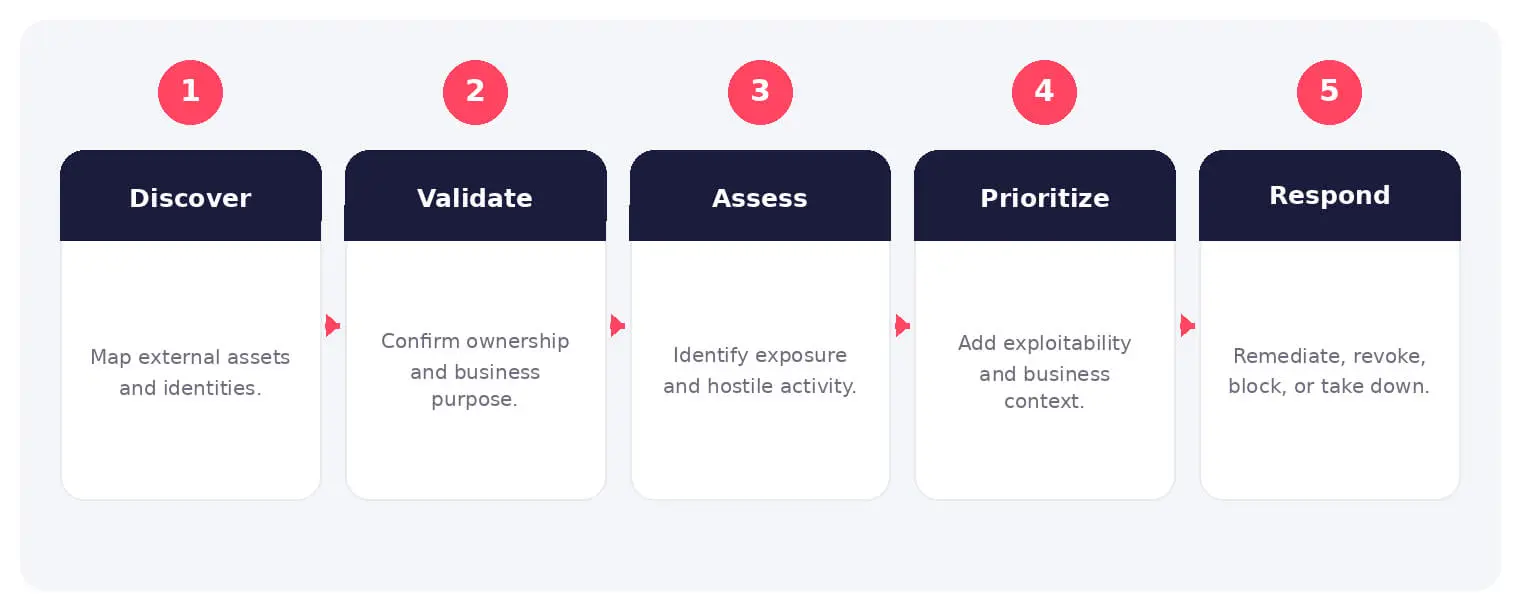
The operating flow above turns the concept into observable steps. Exact implementations vary, but each stage needs accountable ownership, trusted inputs, documented policy, and evidence that analysts can use during investigation and review.
The discipline centers on the internet-facing attack surface, leaked identities and data, impersonation, third-party exposure, and threat-actor activity. External Attack Surface Management operationalizes a major part of this work through continuous outside-in discovery and monitoring.
Common Types and Capabilities
- External attack-surface management
- Digital risk and brand protection
- Dark Web and credential monitoring
- Third-party and threat intelligence
Security and Business Risks
- Unknown internet-facing assets
- Leaked credentials and sensitive data
- Brand impersonation and phishing
- Supplier exposure and active exploitation
Warning Signs and Detection
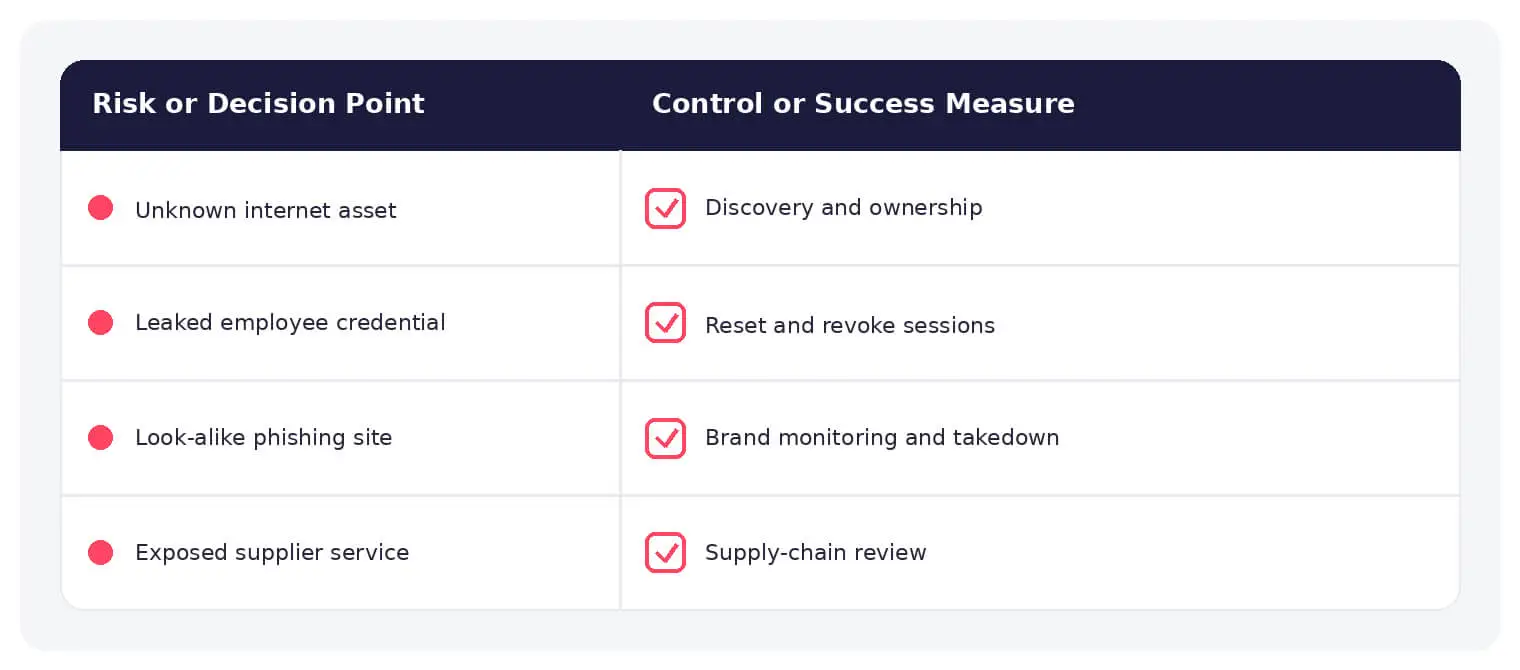
Monitor new domains, subdomains, certificates, exposed services, public cloud resources, leaked credentials, look-alike sites, mobile applications, supplier changes, vulnerabilities under exploitation, and targeting by relevant threat actors.
Best Practices
Define organizational seeds and ownership, discover continuously, validate findings, prioritize by exposure and threat context, integrate remediation, protect identities, monitor suppliers, maintain takedown workflows, and measure closure and recurrence.
How SOCRadar Can Help
SOCRadar adds external visibility, threat intelligence, exposure context, and continuous monitoring to help teams validate and prioritize risks related to external cybersecurity. This context complements internal security operations, identity, response, and governance controls.
Explore SOCRadar Attack Surface Management or request a demo to strengthen threat-informed prevention and response.
Frequently Asked Questions
How Does External Cybersecurity Differ From Internal Network Security?
Internal security focuses on assets, identities, and traffic inside the corporate perimeter, while external cybersecurity addresses what attackers can see or reach from outside it. The external scope includes internet-facing systems, leaked data, brand impersonation, supplier exposure, and active threat-actor activity. The two disciplines complement each other, and gaps often appear where they meet.
Why Are Unknown Internet-Facing Assets So Dangerous?
Forgotten subdomains, abandoned cloud storage, unpatched services, and expired certificates remain live attack paths even when no one is managing them. These assets typically lack logging, patch schedules, and an accountable owner, which slows both detection and response. Attackers scan for them continuously, so exposure often exists before the organization knows the asset is there.
What Does an Outside-In Discovery Process Involve?
It maps the attack surface the way an attacker would, starting from seeds such as known domains, IP ranges, and certificates, then expanding through DNS records, certificate transparency logs, and open-source data. Each finding is matched to a business owner and checked for exposure, and the inventory is refreshed continuously so newly deployed assets are caught shortly after they appear.
Which External Signals Suggest an Organization Is Being Targeted?
Watch for combinations of signals rather than any single event:
- Newly registered look-alike domains or cloned login pages
- Stealer logs containing employee credentials
- Actively exploited vulnerabilities on exposed services
- Threat-actor chatter naming your sector or suppliers
One signal alone rarely proves intent, but several appearing together usually justify closer investigation.
What Should Teams Do When Leaked Employee Credentials Surface Online?
Confirm the credentials are genuine and still valid, then reset the affected accounts and revoke active sessions, because a password change alone does not always invalidate a stolen session on every platform. Review authentication logs for signs the credentials were already used, enforce phishing-resistant MFA where it is missing, and trace the source, since the leak may point to infostealer infections or a compromised supplier.
How Can Organizations Reduce Third-Party and Supplier Exposure?
Set external security expectations in vendor contracts, track which partners hold your data or connect to your infrastructure, and keep an eye on their exposed assets and breach history. Supplier changes such as acquisitions or infrastructure migrations can shift your risk quickly, so continuous monitoring matters as much as the initial assessment.
What Business Impact Can Brand Impersonation Cause?
Look-alike domains and fake login pages support phishing that steals credentials, redirects payments, and erodes customer trust. Email authentication with SPF, DKIM, and DMARC helps against direct domain spoofing, but it does not stop every phishing variant, so documented takedown workflows remain part of the response. Impersonation can also hurt legitimate email deliverability and increase support workload.
Is the Dark Web the Same as the Deep Web?
No. The deep web is any content not indexed by standard search engines, including ordinary pages behind logins. The dark web is a small, deliberately hidden portion that requires specific software such as Tor to access, and it is where stolen credentials, stealer logs, and underground marketplace listings are commonly traded.
How Often Should External Attack Surface Monitoring Run?
Continuously. A single cloud deployment can expose a new asset in minutes, so weekly or monthly scans leave exposures undetected for days. Ongoing discovery with alerts on changes keeps the inventory current and shortens the time between an exposure appearing and remediation starting.

Oct 27, 2026
Australia’s Annual Cyber Threat Report 2025-26 Shows Cyber Incidents Up 20%
Australia’s cyber security authority responded to 1,524 cyber security incidents in the 2025-26 financial year, a 20% increase from the previous year…

Oct 27, 2026
PHP2Shell Weaponized After Japanese Real Estate Extortion
An exposed server ties an extortion wave on about 20 Japanese property sites to an operator who later weaponized PHP2Shell (CVE-2026-109618, CVE-2026-109619)…

Oct 27, 2026
Wasmtime Sandbox Escape Flaws Patched in Cranelift
Two critical Wasmtime sandbox escape flaws, CVE-2026-115889 and CVE-2026-115893, let a crafted WebAssembly (Wasm) module push the Cranelift compiler into generating unsafe…
Intelligence in your inbox every Thursday.
Join 30,000+ security professionals reading SOCRadar research.
Subscribe