
What Is Network Traffic Analysis (NTA)?
Network Traffic Analysis (NTA) examines network communications and metadata to identify suspicious behavior, operational anomalies, and threats that other controls may miss.
NTA commonly uses flow records, packet metadata, protocol analysis, behavioral baselines, and threat intelligence. It provides broad visibility, but analysts must account for encryption, asymmetric routing, cloud traffic, normal business variation, and incomplete sensor coverage.
Key Takeaways
- Network Traffic Analysis (NTA) examines network communications and metadata to identify suspicious behavior, operational anomalies, and threats that other controls may miss.
- NTA commonly uses flow records, packet metadata, protocol analysis, behavioral baselines, and threat intelligence. It provides broad visibility, but analysts must account for encryption, asymmetric routing, cloud traffic, normal business variation, and incomplete sensor coverage.
- Command-and-control communication is a primary concern.
- Effective security combines prevention, continuous visibility, ownership, and tested response.
How It Works
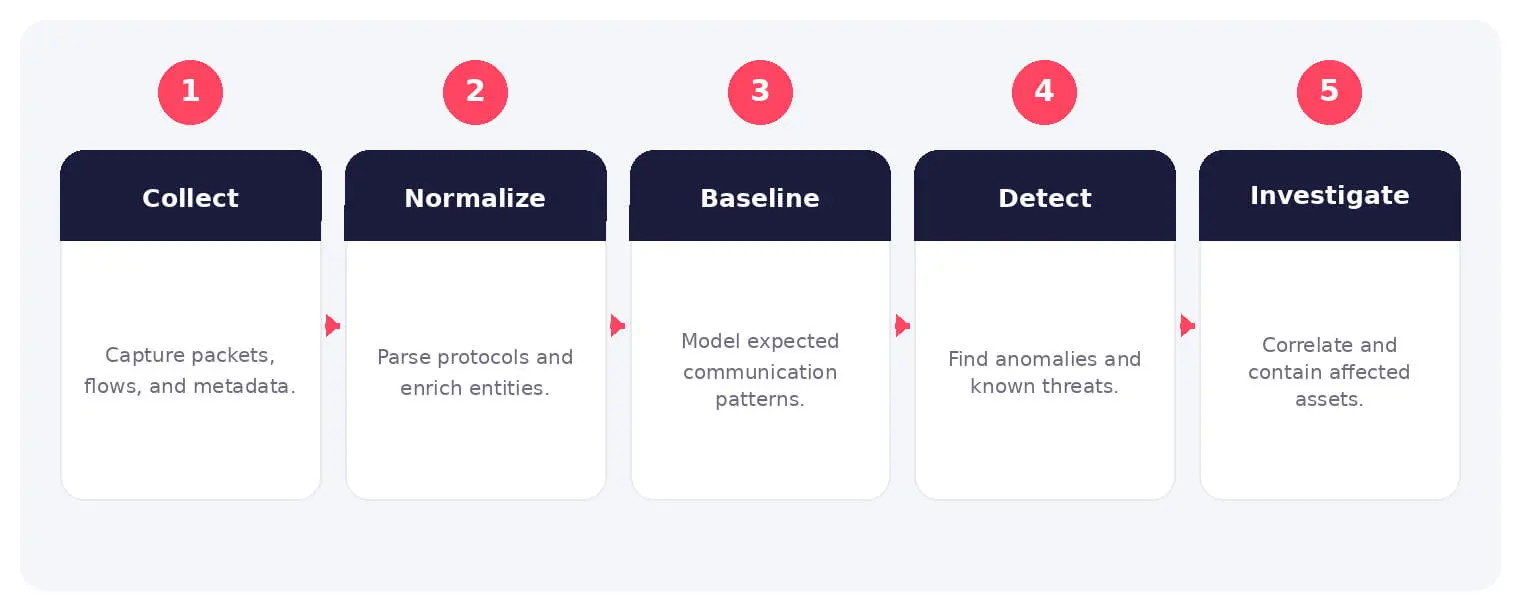
The operating flow above turns the concept into observable steps. Exact implementations vary, but each stage needs accountable ownership, trusted inputs, documented policy, and evidence that analysts can use during investigation and review.
NTA commonly uses flow records, packet metadata, protocol analysis, behavioral baselines, and threat intelligence. It provides broad visibility, but analysts must account for encryption, asymmetric routing, cloud traffic, normal business variation, and incomplete sensor coverage.
Common Types and Capabilities
- Flow-based traffic analysis
- Deep packet and protocol analysis
- Network detection and response
- Cloud and east-west traffic analytics
Security and Business Risks
- Command-and-control communication
- Lateral movement and reconnaissance
- Data exfiltration and tunneling
- Blind spots caused by encryption or placement
Warning Signs and Detection
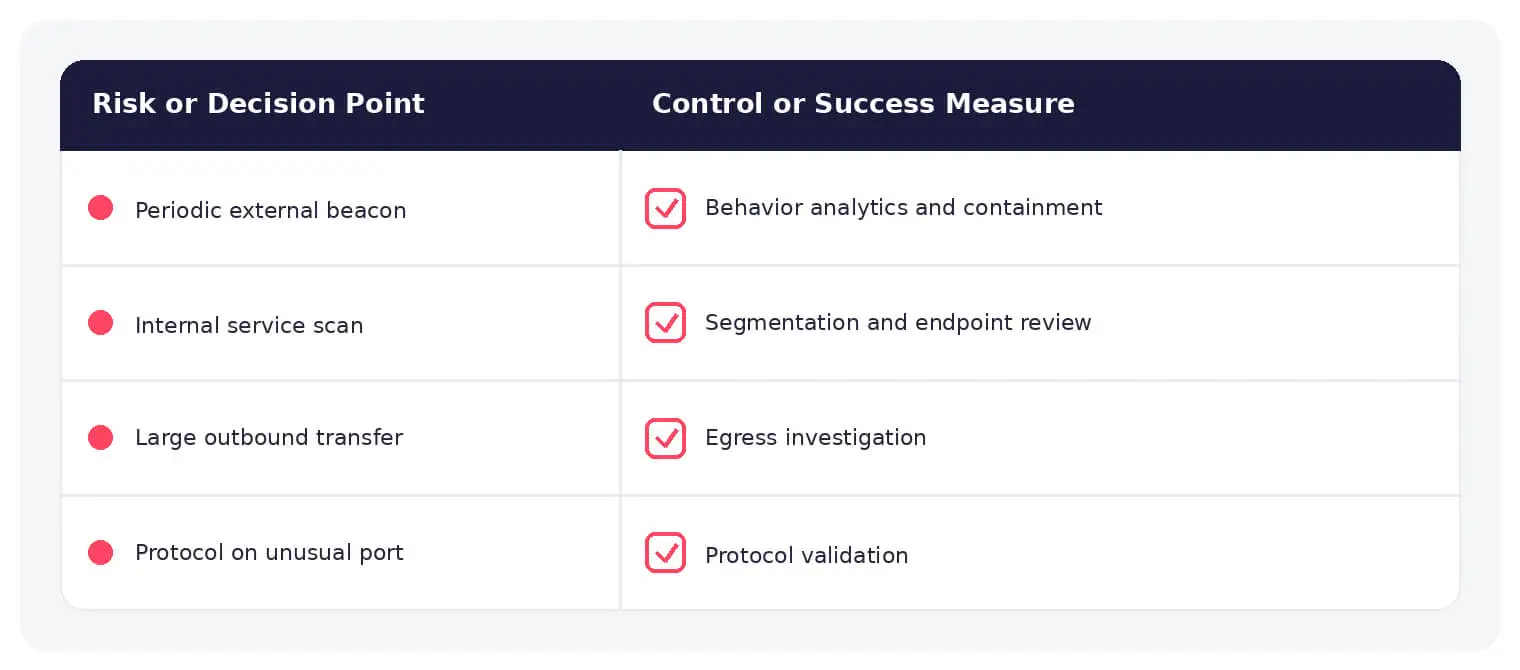
Look for beaconing, rare destinations, unusual ports, internal scans, new service relationships, DNS anomalies, large transfers, long-lived sessions, protocol misuse, traffic from unmanaged assets, and abrupt baseline changes.
Best Practices
Place sensors around critical paths, combine flow and selective packet data, cover east-west and cloud traffic, maintain time synchronization, enrich assets, tune baselines, protect telemetry, and connect alerts to response.
How SOCRadar Can Help
SOCRadar adds external visibility, threat intelligence, exposure context, and continuous monitoring to help teams validate and prioritize risks related to network traffic analysis. This context complements internal network, endpoint, identity, and vulnerability controls.
Explore SOCRadar Cyber Threat Intelligence or request a demo to strengthen threat-informed prevention and response.
Frequently Asked Questions
What Data Does Network Traffic Analysis Examine?
NTA works primarily with flow records such as NetFlow, IPFIX, and sFlow, along with packet metadata, protocol-level details, and DNS activity. It builds behavioral baselines of normal communication and enriches findings with threat intelligence. Full payload capture is usually selective rather than continuous, due to storage cost and privacy considerations.
Why Is Command-and-Control Communication a Primary Concern?
Command-and-control (C2) traffic indicates that an internal system is communicating with attacker infrastructure, often over allowed protocols such as HTTPS or DNS. Because the connection initiates from inside the network, controls focused on inbound blocking can miss it. NTA surfaces the beaconing patterns, rare destinations, and timing irregularities that reveal this activity.
How Does NTA Detect Threats That Signature-Based Tools Miss?
Signature-based tools match traffic against known patterns, so novel or modified threats can slip through. NTA builds baselines of normal behavior and flags deviations such as rare destinations, new service relationships, unusual ports, and protocol misuse. This behavioral approach can surface unknown activity, although it requires baseline tuning to keep noise manageable.
Can NTA Analyze Encrypted Traffic?
Encrypted payloads limit content inspection, but they do not hide the metadata around a connection. NTA can still analyze who is communicating with whom, session timing, data volume, duration, and TLS handshake characteristics. Some organizations add TLS inspection where policy and privacy rules permit, but it introduces complexity and does not cover every protocol or client.
What Warning Signs Point to Beaconing or Data Exfiltration?
Common indicators include:
- Repeated connections to the same external destination at regular intervals, which suggests beaconing
- Large outbound transfers, unusual ports, or long-lived sessions to new destinations
- DNS queries with unusually long or random-looking labels, a hallmark of tunneling
- Internal scans and new service relationships between internal systems, which can indicate reconnaissance or lateral movement
No single indicator is conclusive on its own, so analysts weigh them against asset context and baseline behavior.
How Should Analysts Respond to a Suspicious NTA Alert?
Start by validating the alert against the baseline and gathering asset context such as ownership, criticality, and known vulnerabilities. Correlate the finding with endpoint, identity, and DNS data to establish scope. If the activity is confirmed malicious, isolate the affected host or block the destination, then preserve the evidence for investigation and post-incident review.
Where Should Organizations Place Network Sensors?
Sensors are commonly deployed at egress points, internet gateways, and boundaries around critical network segments. Coverage should also extend to east-west paths and cloud environments, for example through virtual network flow logs. Accurate time synchronization across sensors is essential so that events from different locations can be correlated reliably.
What Business Risks Does Limited Network Visibility Create?
Limited visibility allows attackers to maintain C2 channels, move laterally, and exfiltrate data for extended periods, which increases dwell time and breach costs. It also obscures unmanaged assets, shadow IT, and policy violations. Many compliance frameworks expect evidence of network monitoring, so visibility gaps can create audit findings as well as security risk.
What Is the Difference Between East-West and North-South Traffic?
North-south traffic enters or leaves the network, such as client-to-server and internet-facing communication. East-west traffic moves between systems inside the environment, such as server-to-server transfers. Perimeter controls concentrate on north-south paths, while east-west coverage matters because lateral movement often stays entirely internal.
How Does NTA Differ from Network Detection and Response (NDR)?
NDR builds on NTA by adding response capabilities, such as guided or automated actions to isolate hosts, block traffic, or trigger workflows after detection. The terms overlap in practice, and vendors draw the line differently. In general, NTA describes the analysis discipline, while NDR describes detection plus response as a platform capability.
What Commonly Causes False Positives in NTA?
Legitimate variation such as backup windows, patch deployments, batch jobs, seasonal load, and new application rollouts can look anomalous against a stale baseline. Incomplete sensor coverage and asymmetric routing can also distort what analysts see. Regular baseline reviews and asset-aware tuning keep detections meaningful.

Oct 27, 2026
Australia’s Annual Cyber Threat Report 2025-26 Shows Cyber Incidents Up 20%
Australia’s cyber security authority responded to 1,524 cyber security incidents in the 2025-26 financial year, a 20% increase from the previous year…

Oct 27, 2026
PHP2Shell Weaponized After Japanese Real Estate Extortion
An exposed server ties an extortion wave on about 20 Japanese property sites to an operator who later weaponized PHP2Shell (CVE-2026-109618, CVE-2026-109619)…

Oct 27, 2026
Wasmtime Sandbox Escape Flaws Patched in Cranelift
Two critical Wasmtime sandbox escape flaws, CVE-2026-115889 and CVE-2026-115893, let a crafted WebAssembly (Wasm) module push the Cranelift compiler into generating unsafe…
Intelligence in your inbox every Thursday.
Join 30,000+ security professionals reading SOCRadar research.
Subscribe