

Mar 10, 2026
May 14, 2026
5 Mins Read
Sep 13, 2026
Table Of Content
Related Articles
SMS Bombing
Threat Actors
Jan 08, 2026
Dark Web Monitoring
Feb 19, 2026
Ransomware
Jan 31, 2026
OSINT Framework
Apr 17, 2026
What Is a State-Sponsored Cyber Attack?
A state-sponsored cyber attack is a digital operation conducted, directed, funded, or materially supported by a government to advance national interests. Objectives may include espionage, intellectual property theft, military preparation, influence, disruption, or pressure against another state, industry, or population.
State sponsorship does not require an operator to be a uniformed government employee. States may use intelligence services, military units, contractors, criminal groups, front organizations, or tolerated proxies. Attribution therefore requires an evidence-based assessment with stated confidence, not a conclusion drawn from one tool or IP address.
Key Takeaways
- Espionage and strategic intelligence collection is one important form or technique.
- Detection depends on correlated technical and operational context.
- Prevention should reduce both initial access and post-compromise impact.
- Response must preserve evidence and remove every reusable access path.
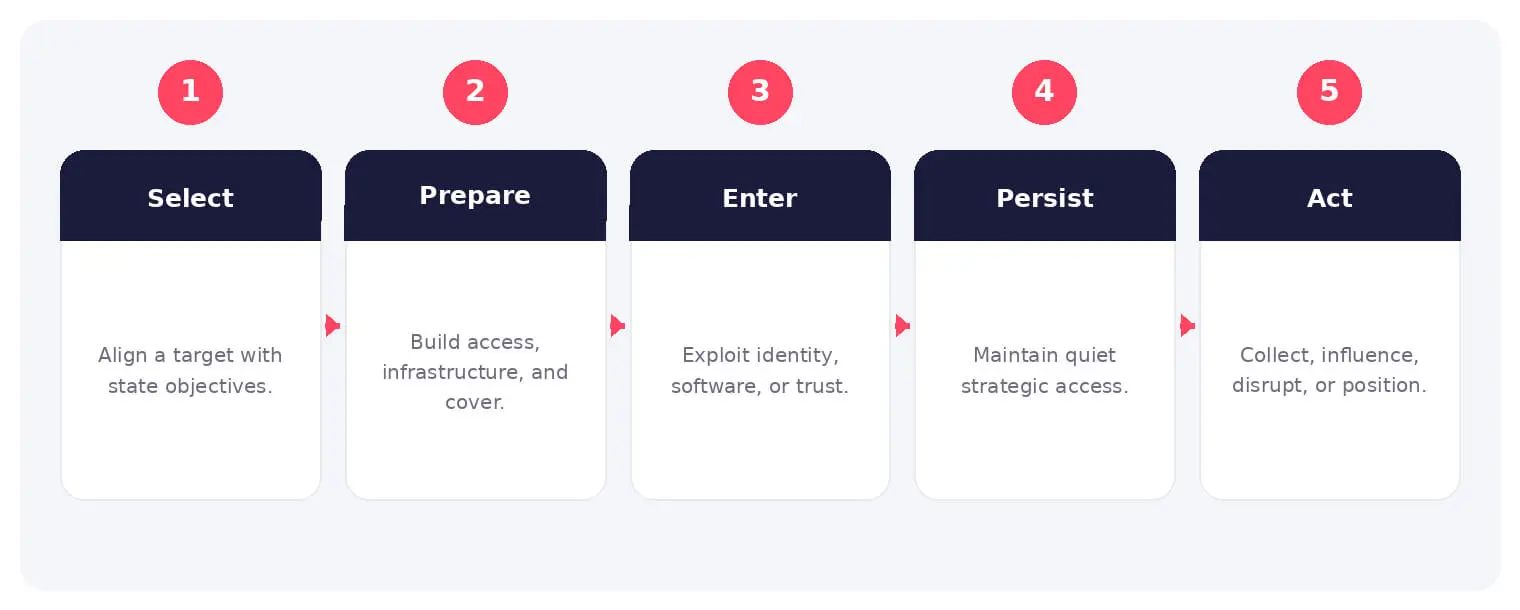
How a State-Sponsored Cyber Attack Works
The sequence shown above is not mandatory in every case, but it provides a practical way to connect initial opportunity with the actor’s objective. Individual steps may occur in parallel, repeat, or be completed by different participants.
State sponsorship does not require an operator to be a uniformed government employee. States may use intelligence services, military units, contractors, criminal groups, front organizations, or tolerated proxies. Attribution therefore requires an evidence-based assessment with stated confidence, not a conclusion drawn from one tool or IP address.
Common Types and Techniques
- Espionage and strategic intelligence collection
- Critical-infrastructure disruption or pre-positioning
- Intellectual property and economic theft
- Influence, information operations, and destructive attacks
Security and Business Risks
- Loss of sensitive government or commercial information
- Disruption of critical and public services
- Compromise of suppliers and strategic dependencies
- Diplomatic, economic, safety, and national-security consequences
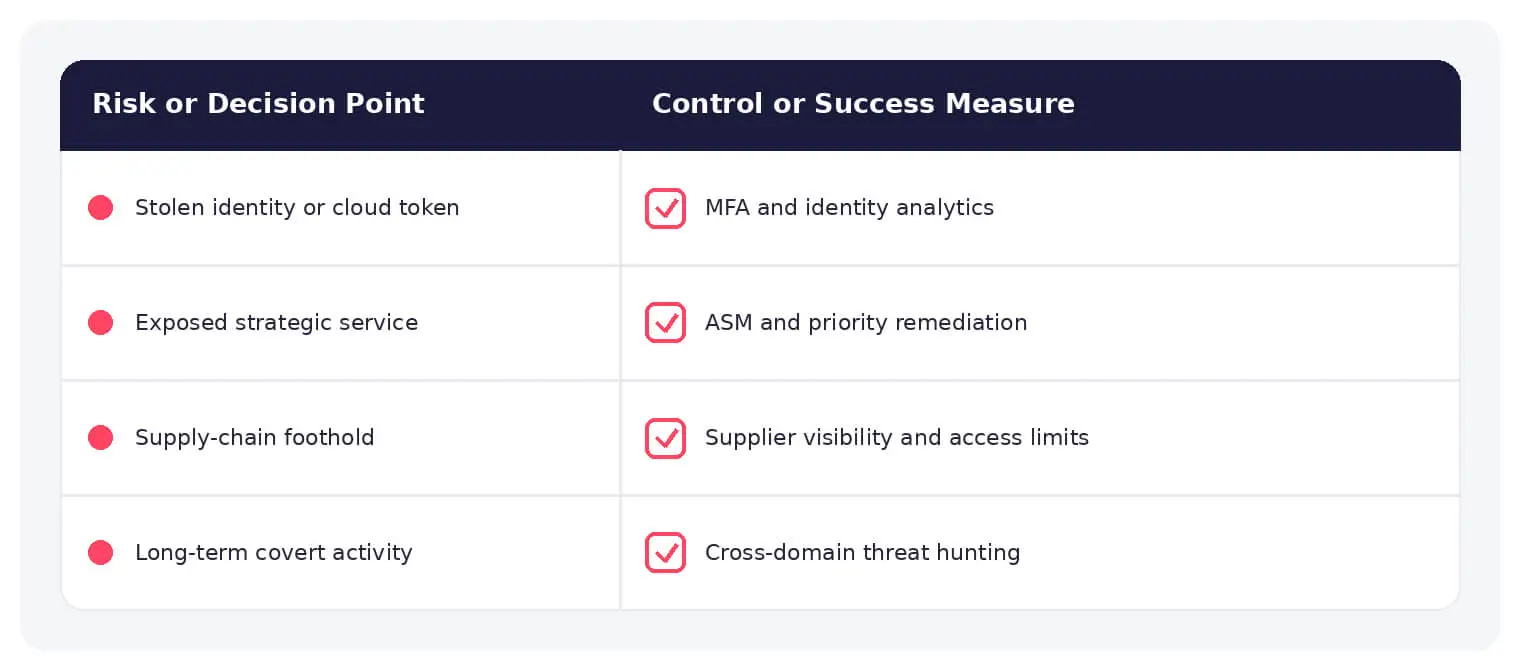
Warning Signs and Detection
Look for low-volume persistence, unusual cloud or privileged access, supply-chain anomalies, lateral movement, covert exfiltration, and infrastructure linked to known campaigns. Correlate technical behavior with targeting and geopolitical context.
Prevention and Response
Use phishing-resistant MFA, segmentation, hardened administration, rapid remediation, broad logging, supply-chain controls, resilient backups, and threat-informed hunting. Separate attribution confidence from containment decisions.
How SOCRadar Can Help
SOCRadar combines external asset visibility, threat intelligence, Dark Web monitoring, vulnerability context, and indicator enrichment to help teams identify exposure and investigate activity connected to state-sponsored cyber attack.
Explore SOCRadar Cyber Threat Intelligence or request a demo to strengthen threat-informed prevention and investigation.
Frequently Asked Questions
What Makes a Cyber Attack State-Sponsored?
An operation is considered state-sponsored when a government conducts, directs, funds, or materially supports it to advance national interests such as espionage, military preparation, influence, or disruption. Sponsorship is defined by backing and objective, not by whether the operator is a uniformed government employee.
Why Do Governments Sponsor Cyber Attacks?
Cyber operations give states access to strategic intelligence, intellectual property and economic advantage, pre-positioning inside critical infrastructure, and a way to apply pressure below the threshold of armed conflict. They are often less costly and less attributable than physical options.
Do States Use Contractors and Criminal Groups as Proxies?
Yes. Governments may task intelligence services, military units, defense contractors, front organizations, or tolerated criminal groups. This layering complicates attribution and gives states distance from operations carried out in their interest.
How Is a State-Sponsored Attack Different From Ordinary Cybercrime?
The primary goal is national advantage rather than direct financial profit, so intruders may dwell quietly for months to collect intelligence or wait for strategic timing. The line can blur in practice, because some states tolerate or co-opt financially motivated groups for access or revenue.
How Do Analysts Attribute a Cyber Attack to a Specific State?
Attribution is an evidence-based assessment, never a conclusion drawn from one IP address or tool. Analysts weigh tradecraft, infrastructure reuse, malware lineage, targeting fit, timing, intelligence reporting, and alternative explanations, then state a confidence level with their findings.
Why Is Attribution Often Difficult and Slow?
Operators share tooling, rent infrastructure, work through intermediaries, and sometimes plant misleading evidence. Distinguishing a state’s own unit from a contractor or proxy can take months of correlated technical and intelligence work.
What Are the Warning Signs of a State-Sponsored Intrusion?
Common indicators include low-volume, long-lived persistence; unusual privileged or cloud service access; supply-chain anomalies; unexpected lateral movement; small, gradual data transfers; and infrastructure overlap with known campaigns. Technical signals carry more weight when correlated with an organization’s sector and geopolitical profile.
What Should an Organization Do After Detecting a Suspected Operation?
Preserve logs and forensic evidence, contain the activity, and remove every reusable access path, including stolen credentials, active session tokens, VPN accounts, and webshells. Hunt for persistence after containment and report the incident to your national CERT or appropriate authority.
Which Controls Reduce the Risk of State-Sponsored Compromise?
High-value measures include phishing-resistant MFA, segmentation around strategic assets, hardened administrative practices, rapid patching of internet-facing systems, broad logging, supplier security requirements, and tested backups. Phishing-resistant MFA makes credential theft through phishing far harder, though a session that was already stolen still needs to be revoked explicitly.
Why Do Attackers Target Supply Chains and Critical Infrastructure?
Compromising a single trusted supplier can reach many downstream organizations at once, and access embedded in energy, water, communications, or transport networks can be held for intelligence value or disruptive leverage. Pre-positioning inside such environments is a recurring pattern in documented campaigns.
Do State-Sponsored Attackers Always Use Sophisticated Techniques?
No. Operators typically choose the least costly method that achieves the objective, which may be a simple phishing email, reused credentials, or an unpatched internet-facing service. Sophistication shows up more often in coordination, patience, and operational security than in exotic malware.