The Hidden Cost of Supply Chain Breaches: 2025 Statistics on Downtime, Disruption, and Financial Loss
Supply chain breaches have become one of the most damaging threats to modern enterprises. They cripple operations, bleed revenue, and damage trust in ways that go far beyond IT departments. As organizations expand their digital ecosystems, vulnerabilities introduced by third-party vendors, partners, and software providers have opened the door to such cascading breaches with devastating consequences.
In this article, we break down 20 statistics that expose the true scope and cost of supply chain attacks. From average downtime and recovery delays to multi-million dollar losses and record-breaking breaches, these insights reveal why securing the supply chain is critical.
Supply Chain Breaches Are Accelerating – No Industry Is Immune
The frequency and impact of supply chain attacks have intensified dramatically in just a few short years. What once seemed like isolated third-party risks have become systemic threats capable of bringing entire organizations to a standstill.
- According to a 2025 analysis, breaches involving supply chains surged by 68%, now accounting for 15% of all data breaches. (Deepstrike)
- In 2024 alone, 35.5% of data breaches were linked to third parties, up from 29% the year before. (Integrate.io)
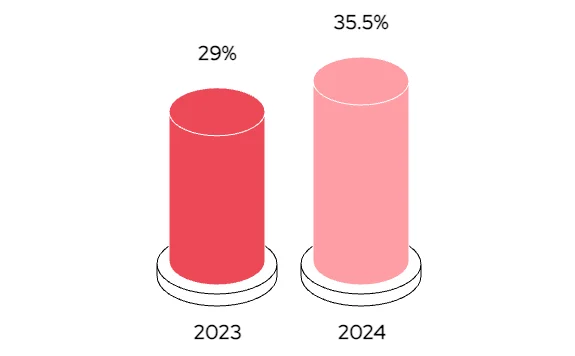
Breaches linked to third parties, 2023-2024
- Another study revealed that nearly one-third of all breaches now stem from third-party vendors or partners. (SecureWorld)
- Gartner forecasts that 45% of organizations will experience supply chain breaches by the end of 2025, a rise of three times from 2021. (Gartner)
These trends are not limited to any one sector. From retail and finance to healthcare and defense, every industry that relies on external technology or service providers is at risk. As companies grow more interconnected, they also grow more vulnerable; especially when trust is placed in partners who may not meet the same security standards.
To close this visibility gap, many organizations are adopting real-time monitoring tools such as SOCRadar’s Supply Chain Intelligence module, which continuously tracks vendor exposures, shared dependencies, and potential breach activity across partner networks. This kind of continuous intelligence helps detect risks before they evolve into costly, full-scale incidents.

Downtime and Operational Chaos
Supply chain breaches don’t just steal data; they paralyze operations. Downtime, halted services, and long recovery periods are among the most devastating consequences of cyberattacks, often causing ripple effects across entire industries.
- A 2025 survey found that 100% of organizations impacted by cyber incidents reported revenue loss due to downtime, facing an average of 86 unplanned outages per year. (Invenio IT)
- 72% of organizations take longer than a week to fully restore operations. For high-stakes sectors like manufacturing and healthcare, recovery times frequently exceed six weeks. (TechRadar)
- For most organizations today, downtime does not come cheap. More than 90% of mid-size and large companies lose over $300,000 for every hour their systems are offline. (ITIC)
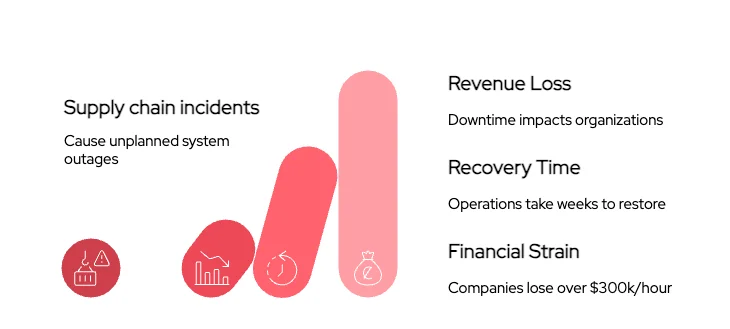
The effects of a supply chain breach
These numbers highlight why downtime is often the most expensive and publicly visible consequence of a breach. Customers experience service outages firsthand, and the pressure to recover quickly can expose even more vulnerabilities if rushed.
The Soaring Cost of Supply Chain Breaches
Beyond operational disruptions, supply chain breaches deal a massive financial blow – through data loss, legal liabilities, reputational damage, and remediation efforts. In recent years, the average cost of these incidents has surged across industries, especially where critical infrastructure and sensitive data are involved.
- Supply chain attacks now cost 17 times more to remediate than direct (first-party) breaches. For Global 2000 companies alone, losses reached an estimated $20–80 billion in just 15 months following major breaches. (Integrate.io)
- In the IBM Cost of a Data Breach Report 2025, the vector “third-party vendor and supply chain compromise” is listed with an average cost of USD 4.91 million.(IBM)
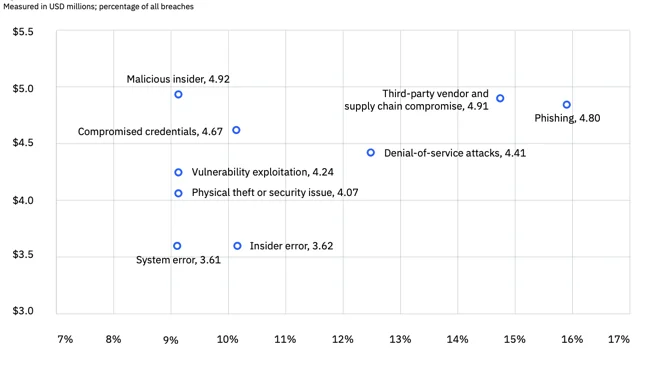
Costs related to breach root causes, 2025
- In the industrial sector, the average breach cost hit $5.56 million in 2024 – an 18% jump over the previous year. Notably, unscheduled downtime in this sector may cost up to $125,000 per hour. (IBM)
- The defense industry is similarly impacted, with the average breach cost reaching $5.46 million – reflecting the extreme sensitivity and security expectations of this sector. (PreVeil)
- Cybersecurity Ventures predicts that software supply chain attacks will cost businesses $138 billion globally by 2031, up from $60 billion predicted for 2025, based on a 15% annual growth rate. (Cybersecurity Ventures)
These rising costs aren’t solely due to recovery. Regulatory fines, loss of customer trust, long-term damage to brand equity, and supply chain restructuring all contribute to the multi-million-dollar price tags – especially when breaches remain undetected for weeks or months.
Notable Breaches and Emerging Trends
Sometimes, a single incident reveals the full scale of supply chain vulnerability – and the last years have delivered several such wake-up calls. From widespread software compromises to a sharp rise in cross-industry impacts, the evidence paints a clear picture: no system is too big, and no supplier too obscure, to be exploited.
- A major software supply chain attack compromised 18 widely-used npm packages – together accounting for an estimated 2.6 billion weekly downloads. Adversaries are now targeting the open-source ecosystem directly, using legitimate developer credentials and infiltration of CI/CD pipelines to reach countless downstream organizations. (SOCRadar)
- Jaguar Land Rover was forced to halt vehicle production across multiple UK plants after a cyberattack targeted its manufacturing systems and supplier communications. The disruption, costing an estimated £72 million per day, highlight the vulnerability of industrial supply chains to operational paralysis when digital systems are compromised. (The Guardian)
- Palo Alto Networks disclosed that a third-party vendor compromise exposed limited customer data, following a chain of access through Salesloft and Drift. The incident demonstrated how service-layer dependencies, rather than direct software flaws, are becoming critical weak points, as attackers exploit trust relationships between connected SaaS platforms. (SOCRadar)
- A ransomware attack on Change Healthcare – an essential payment processor for U.S. healthcare providers – disrupted medical billing and prescription services nationwide for weeks. The breach, later linked to a supply-chain compromise within the healthcare ecosystem, caused widespread financial and operational fallout across hospitals and insurers. (SOCRadar)
Taken together, these incidents highlight three defining trends:
- Operational disruption and data theft now go hand in hand, with attackers not only halting systems and supply flows but also stealing information to maximize leverage and damage.
- Attackers are moving upstream, compromising developer tools, software dependencies, and vendor access to reach thousands of downstream victims at once.
- Trust itself has become exploitable, as service integrations and supplier relationships double as hidden attack surfaces within connected ecosystems.
Root Causes and Defensive Measures
Understanding how supply chain breaches happen is key to preventing them. While no two incidents are identical, many share common origins: vulnerable software, lax third-party oversight, delayed patching, and insufficient investment in threat detection.
- A 2025 TechTarget survey revealed that 32% of cyberattacks exploited unpatched software vulnerabilities, underscoring how overlooked updates can become entry points for major breaches. (arXiv)
- Encouragingly, IBM’s 2025 Cost of a Data Breach Report found that the average breach cost dropped 9% to $4.4 million, largely due to faster identification and containment efforts. (IBM)
- AI-driven defenses are proving especially effective. Organizations using AI and automation saved an average of £600,000 per breach. Those with AI also reported shorter containment windows: 42 days vs. 64 without AI. (TechRadar)
- The top breach vectors in 2025 include third-party vendor access (18%), phishing attacks (16%), and compromised credentials (11%) – all of which are preventable with stronger controls, employee training, and zero-trust architectures. (TechRadar)
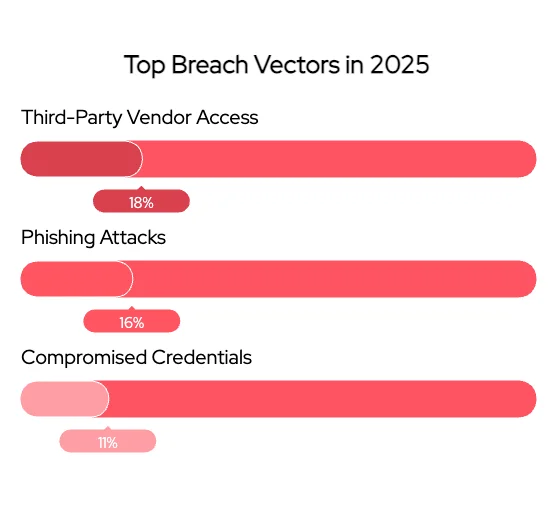
Access to 3rd party vendors is a top cyber breach vector in 2025
The good news? Companies investing in AI, patch management, and proactive risk assessments are beginning to see results. The bad news? A majority still lag behind, creating vulnerabilities not just for themselves, but for everyone they connect with.
Conclusion: Securing the Supply Chain is Everyone’s Business
For all their complexity, supply chain breaches exploit one common weakness: visibility gaps between organizations and their suppliers.
Most companies still evaluate third-party risk once a year – a static snapshot in a dynamic environment. Threat actors, on the other hand, exploit these blind spots in real time. As breaches increasingly originate from software dependencies, open-source packages, or integrated SaaS platforms, traditional risk assessments and vendor checklists simply can’t keep pace.
The future of defense lies in continuous, intelligence-driven visibility. That means:
- Mapping digital supply chains dynamically to detect when a vendor, dependency, or third-party platform becomes compromised.
- Correlating breach intelligence with real-time exposure data, so security teams can prioritize what truly threatens their business.
- Leveraging AI-driven automation to reduce detection and response times before operational impact multiplies.
SOCRadar’s platform, with its Supply Chain Intelligence module embodies this shift. By continuously monitoring the threat landscape, it helps organizations detect compromised vendors, track exploit activity across partner ecosystems, and gain context-rich insights on emerging supply chain threats – before they escalate into outages or breaches. Combined with SOCRadar’s Attack Surface Management and Digital Risk Protection capabilities, it forms a unified approach to defending the extended enterprise.
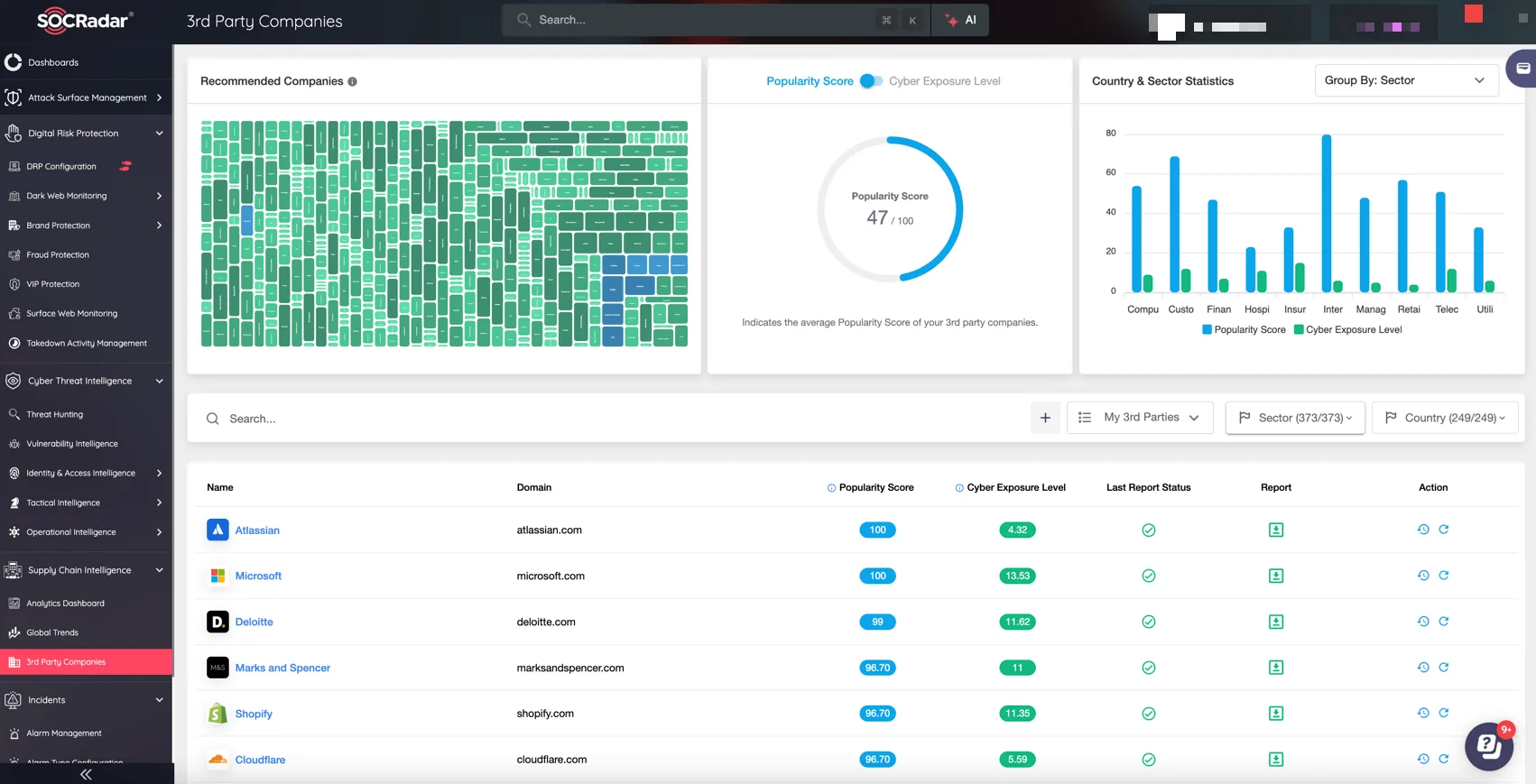
Monitor 3rd party companies with SOCRadar’s Supply Chain Intelligence module
Every organization is now part of someone else’s supply chain. Those that invest in intelligence, transparency, and collaboration will not only prevent breaches; they’ll set the new standard for trust in the digital economy.