What Is Dark Web Monitoring?
Every day, stolen credentials, leaked records, and sensitive data show up in hidden corners of the internet. Most security tools never reach those places. Dark Web Monitoring does.
In this guide, you will learn the Dark Web Monitoring meaning, how it works, the risks it detects, and why it is now a core part of modern cybersecurity strategy.
Dark Web Monitoring Meaning (Quick Definition)
Dark Web Monitoring is the process of scanning hidden areas of the internet to detect stolen credentials, leaked data, and other sensitive information, helping organisations identify threats early and respond quickly. It works by continuously searching underground forums, marketplaces, and leak sites where cybercriminals buy, sell, and share exposed data.
Understanding the Dark Web
The internet has three layers. The surface web is what you find through Google or Bing. It is the open, indexed part of the web. The Deep Web sits below that. It includes password-protected pages, private databases, and content not indexed by search engines. Your online banking portal lives here. So does your email inbox.
The Dark Web is a section of the Deep Web that requires special software to access. The most common is Tor, which routes traffic through multiple servers to hide the user identity. This anonymity is the Dark Web’s defining feature.
That anonymity attracts cybercriminal activity. The Dark Web hosts marketplaces for stolen data, forums where hackers trade tools and techniques, and leak sites where breached databases get posted. It is a hidden internet where transactions happen with little accountability.
Attackers use it precisely because it is difficult to monitor and harder to trace. That is what makes Dark Web monitoring both challenging and essential.
How Does Dark Web Monitoring Work?
Dark Web monitoring works by deploying automated tools that continuously scan sources across the hidden internet. When relevant data is detected, it gets flagged and sent as an alert.
Here is how Dark Web monitoring works in practice, broken down by stage.
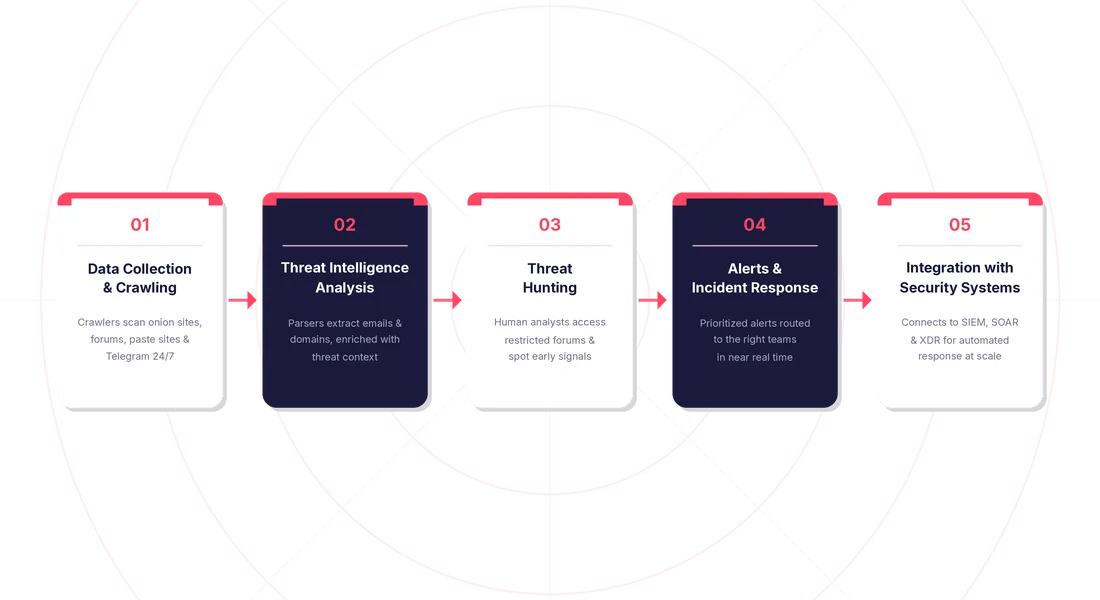
Stages of Dark Web Monitoring
Data Collection and Crawling
Monitoring tools scan Dark Web sources around the clock. These include onion sites, hacker forums, paste sites, criminal marketplaces, and Telegram channels where threat actors operate. Crawlers move through these sources continuously, capturing content as it appears.
Dark Web monitoring works by collecting raw data at scale. The process has to be constant because content appears and disappears quickly.
Threat Intelligence Analysis
Once data is collected, it goes through analysis. Parsers extract structured information such as email addresses, domains, usernames, and file names. This data is then matched against your monitored assets.
Monitoring tools detect matches and apply context. Where did the data come from? Who posted it? Is it linked to a known threat actor? This enrichment turns raw data into actionable threat intelligence.
Threat Hunting
Not everything is caught by automated matching alone. Human analysts play a role in Dark Web monitoring, too. Threat hunters access restricted forums and communities that automated tools cannot easily reach. They look for early signals, planned attacks, and patterns that automation might miss.
The combination of AI-driven scanning and human expertise is what separates strong Dark Web monitoring from basic keyword alerts.
Alerts and Incident Response
When a match is confirmed, the system generates an alert. Good Dark Web monitoring tools prioritize these alerts by severity and relevance. Your security team is notified in near real time, allowing them to begin incident response without delay.
Alerts can be routed to specific teams. A credential leak might go to IT. An executive mention might go to legal or HR. A brand threat might go to communications. Dark Web monitoring works best when its alerts are mapped to the right response workflows.
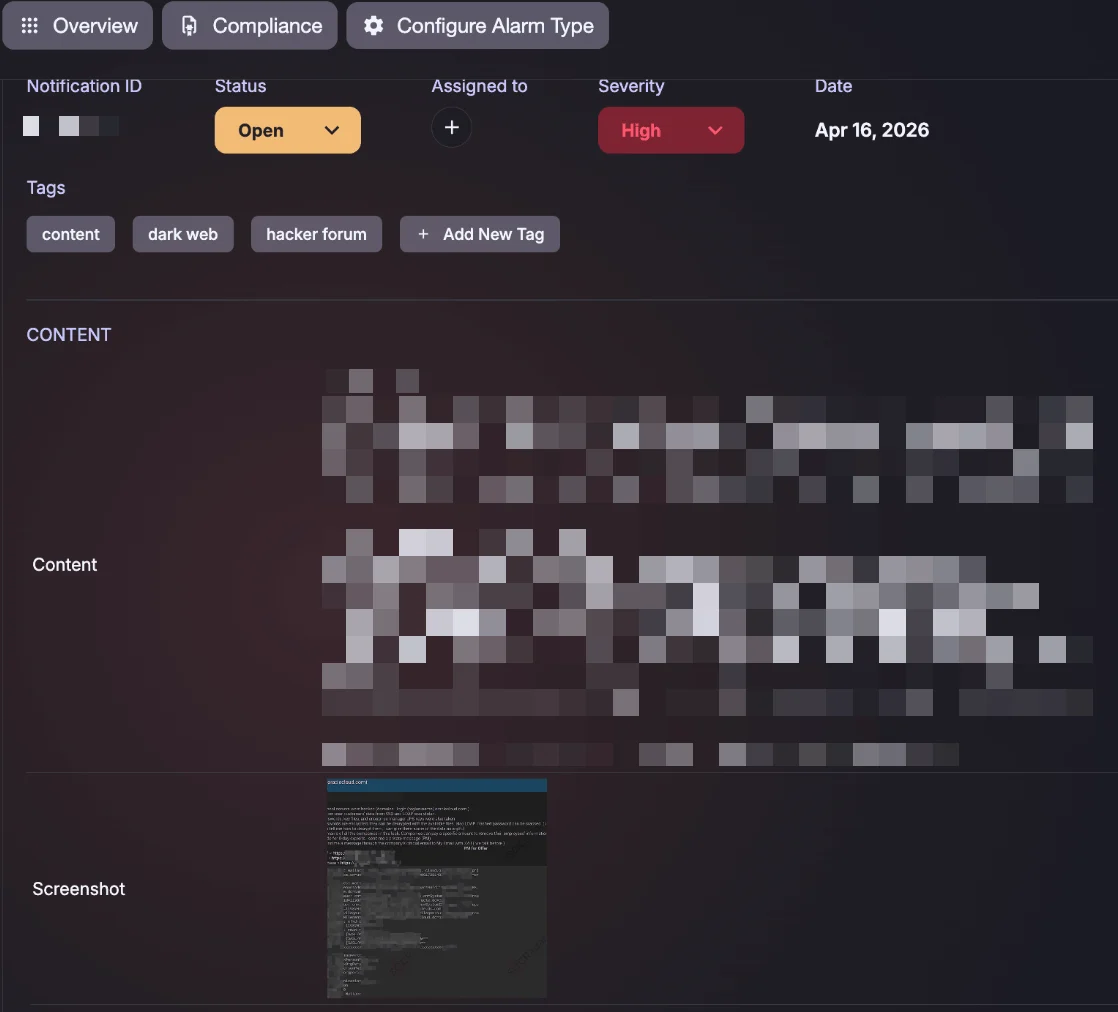
Example SOCRadar Dark Web alert
Integration with Security Systems
Dark Web monitoring does not work in isolation. It connects to your broader security stack. Integration with SIEM platforms allows Dark Web signals to be correlated with internal security events. Connection to SOAR tools enables automated response playbooks. XDR platforms can use Dark Web intelligence to add context to endpoint and network detections.
This integration is what makes Dark Web monitoring genuinely useful at scale rather than just an alert feed.
What Types of Data Are Found on the Dark Web?
After a data breach, exposed data moves fast. Within hours, it can appear on Dark Web forums or be offered for sale in underground marketplaces. Here is what Dark Web monitoring commonly finds:
- Email and password combinations from credential breaches
- Personal identifiable information, including names, addresses, ID numbers, and dates of birth
- Financial data such as credit card numbers, banking credentials, and account details
- Intellectual property, including source code, product designs, and internal documents
- Corporate data such as employee records, contracts, and internal communications
- Access credentials, including VPN logins, RDP access, and admin portal credentials
- Session cookies that allow attackers to bypass authentication entirely
Data exposure on the Dark Web often precedes an attack. Monitoring for sensitive data in these spaces gives organizations time to respond before that exposure becomes an intrusion.
Common Risks Detected by Dark Web Monitoring
Dark Web monitoring surfaces a wide range of threats. Here are the most common ones that help organizations detect.
Credential leaks: Stolen usernames and passwords are the most traded commodity on the Dark Web. A single set of leaked credentials can open access to email, internal systems, or cloud platforms. Dark web monitoring catches these before they are used.
Third-party and supply chain breaches: Your security is only as strong as your weakest vendor. Dark Web monitoring can detect when a supplier or partner’s data has been exposed, giving you early warning of supply chain risk before it reaches your own environment.
Brand impersonation: Cybercriminals create fake domains, spoofed accounts, and fraudulent websites to impersonate trusted organizations. Dark Web monitoring tracks mentions of your brand in contexts that suggest impersonation or fraud.
Phishing kits: Ready-made phishing kits targeting specific organizations are sold and shared on Dark Web forums. When a kit targeting your brand appears, Dark Web monitoring can catch it before the campaign launches.
Ransomware access sales: Before ransomware groups deploy their payloads, they often sell or share initial access to compromised networks. Dark Web monitoring detects these listings, giving you a window to close the vulnerability before an attack happens.
Why Dark Web Monitoring Is Important for Security
Dark Web monitoring is important because threats do not begin when an attacker enters your network. They begin long before that, in the conversations and marketplaces of the hidden internet.
Early threat detection: Dark Web monitoring gives you visibility into the reconnaissance and preparation phase of an attack. You learn about risks before they materialize, not after the damage is done.
Breach prevention: When stolen credentials are spotted early, you can force password resets, revoke sessions, and block access before attackers use what they have stolen.
Reduced attack surface: Dark Web monitoring reveals exposed assets you may not know about. Closing those exposures before they are exploited directly reduces your attack surface.
Faster response: Time matters in security. The faster you know about an exposure, the faster you can act. Dark Web monitoring compresses the gap between breach and response, reducing dwell time and limiting damage.
In short, Dark Web monitoring moves your security posture from reactive to proactive. It shifts protection from cleaning up after an incident to stopping it before it starts.
Benefits of Dark Web Monitoring
Organizations that implement Dark Web monitoring gain several concrete advantages.
Real-time visibility: Dark Web monitoring provides near-instant awareness when your data appears underground. You are not finding out weeks later from a news report.
Faster response time: Alerts tied to incident response workflows mean your team can act immediately. Faster response means less exposure, less damage, and lower remediation cost.
Compliance support: Many regulations require organizations to detect and report data breaches within specific timeframes. Dark Web monitoring helps meet those requirements by surfacing breaches early.
Brand protection. Monitoring for brand mentions, fake domains, and impersonation attempts helps protect customer trust and reduces the risk of fraud targeting your users.
Limitations of Dark Web Monitoring
Dark Web monitoring is a powerful tool, but it is not without limits. Understanding these helps you set realistic expectations.
Not full coverage: Many Dark Web forums are invite-only or encrypted. No monitoring tool reaches every corner of the hidden internet. Some data is traded privately and never appears in scanned sources.
False positives: Not every match is a genuine threat. Common words, shared domains, and partial matches can trigger alerts that require manual review. Poor tuning leads to alert fatigue.
Requires integration to be effective: A Dark Web alert on its own does not stop an attack. It needs to be connected to an incident response process, a security team, and ideally a broader security stack. Dark Web monitoring without integration is just noise.
Who Needs Dark Web Monitoring?
Enterprises: Large organizations are frequent targets. The volume of employee credentials, customer data, and sensitive systems makes them a high-value target. Dark Web monitoring gives enterprise security teams external visibility that they cannot get from internal tools alone.
SMBs: Small and mid-sized businesses are targeted more often than many realize. They often lack dedicated security teams, which makes early detection through Dark Web monitoring even more valuable.
SaaS companies: Software companies hold large amounts of customer data and access credentials. A single breach can affect thousands of downstream users. Dark Web monitoring is essential for protecting customer trust and meeting security obligations.
Supply chain environments: Organizations with complex vendor networks face compounded risk. A compromise with any supplier can become a pathway into your own systems. Dark Web monitoring that covers third-party exposure is especially important here. SOCRadar’s supply chain intelligence capabilities are built specifically for this use case, giving security teams visibility into vendor and partner exposures before they become your problem.
How to Protect Your Organization from Dark Web Threats
Dark Web monitoring is most effective when combined with strong security practices. Here is what that looks like in practice.
Use strong, unique passwords: Reused passwords are a gift to attackers. When one credential is stolen and reused across accounts, a single breach becomes many. Enforce unique passwords across all systems.
Enable multi-factor authentication: MFA makes stolen credentials far less useful. Even if a password is leaked and detected by Dark Web monitoring, MFA buys time and blocks unauthorized access.
Act on monitoring alerts quickly: Dark Web monitoring only helps if alerts trigger action. Define clear response procedures for each alert type so your team knows exactly what to do when exposed data is found.
Run security awareness training: Most breaches start with a human element. Phishing, social engineering, and credential theft all rely on people making mistakes. Regular training reduces that risk.
Monitor your vendors: Vendor risk monitoring extends your security perimeter to the organizations you depend on. Track their Dark Web exposure the same way you track your own.
How SOCRadar Helps with Dark Web Monitoring
SOCRadar’s Advanced Dark Web Monitoring gives security teams early warning about threats that surface outside their organization first.
Threat intelligence coverage: SOCRadar scans forums, marketplaces, Telegram channels, and paste sites continuously. When stolen credentials, leaked documents, or access listings related to your organization appear, you are alerted in near real time.
Supply chain visibility: SOCRadar monitors Dark Web exposure for your vendors and third parties, not just your own assets. This gives security teams a clearer picture of supply chain risk before it reaches your network.
Real-time alerts: Alerts are prioritized by severity and mapped to relevant teams. Security, legal, HR, and communications can each receive the alerts most relevant to them.
External attack surface context: SOCRadar connects Dark Web signals to your external attack surface. This means you see not just what was leaked, but where the vulnerability sits and how to close it.
The result is a security team that does not just react to Dark Web threats. It anticipates them.
FAQs
What is Dark Web monitoring? Dark Web monitoring is the process of scanning hidden areas of the internet to detect stolen credentials, leaked data, and other sensitive information before it is used against your organization.
How does Dark Web monitoring work? Dark Web monitoring works by using automated crawlers to scan Dark Web sources, including forums, marketplaces, and Telegram channels. When data matching your monitored assets is found, it is analyzed, and an alert is sent to your security team.
Is Dark Web monitoring legal? Yes. Scanning publicly accessible Dark Web content is legal in most jurisdictions. Dark Web monitoring tools do not breach any systems. They observe and collect openly available data in the same way a search engine indexes the surface web.
Who needs Dark Web monitoring? Any organization that stores sensitive data, manages employee credentials, or operates within a supply chain can benefit. This includes enterprises, SMBs, SaaS companies, healthcare providers, financial institutions, and government entities.
What happens if my data is found on the Dark Web? If Dark Web monitoring detects your data, the first step is to assess what was exposed and how serious it is. Immediate actions typically include forcing password resets, revoking compromised credentials, notifying affected users if required, and investigating the original source of the breach. The faster you act, the more damage you prevent.