


Mar 10, 2026

Jun 25, 2026
7 Mins Read
Table Of Content
Deepfake Definition and Overview
The Technology Behind Deepfakes: GANs and Diffusion Models
Types of Deepfakes: Video, Audio, and Beyond
Real-World Deepfake Attack Case Studies
Deepfakes as a Cybersecurity Threat: Enterprise Impact
Deepfake Tools on the Dark Web: A Threat Intelligence Perspective
How to Detect Deepfakes
How to Protect Your Organization Against Deepfake Attacks?
How SOCRadar Threat Intelligence Monitors Deepfake Threats?
Frequently Asked Questions
Related Articles

SMS Bombing
Dark Web Monitoring
Feb 19, 2026

Dark Web
Jan 31, 2026

Indicators of Compromise (IoCs)
Jan 31, 2026

Threat Actors
Jan 08, 2026

What Are Deepfakes? The Cybersecurity Threat Every Organization Must Understand
Deepfakes are AI-generated media, including video, audio, and images, that replace a real person’s likeness with a fabricated but convincing version. Deepfake attempts occurred every five minutes in 2024, up from 0.1% to 6.5% of all fraud cases. Losses from deepfake-enabled fraud exceeded $200 million in the first quarter of 2025. A 2025 Gartner survey found 62% of organizations had experienced a deepfake social engineering attack.
This is not a future threat. It is an active threat that is scaling rapidly.
Deepfake Definition and Overview
A deepfake is synthetic media generated using artificial intelligence that convincingly replaces a real person’s face, voice, or both with a fabricated version. The term combines “deep learning,” the AI technique used to create these outputs, with “fake,” indicating their deceptive nature.
Deepfakes have moved far beyond the novelty videos that brought them to public attention. They are now used as tools for fraud, social engineering, disinformation, brand impersonation, and identity document forgery. The AI-generated media produced by current tools is, in many cases, indistinguishable from genuine recordings to the human eye and ear.
The Technology Behind Deepfakes: GANs and Diffusion Models
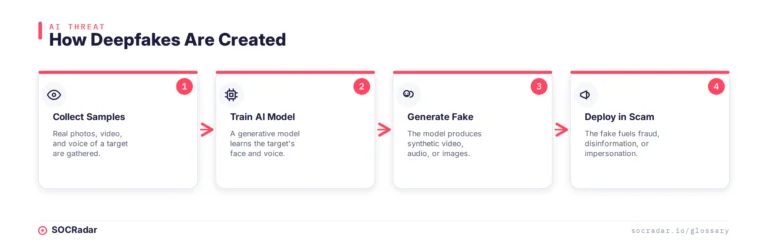
Generative Adversarial Networks (GANs) are the foundational AI architecture behind most face-swapping deepfakes. A GAN consists of two neural networks: a generator that produces synthetic images and a discriminator that evaluates them. The generator learns to produce increasingly convincing output by repeatedly attempting to fool the discriminator. The result is synthetic imagery that passes visual inspection.
Diffusion models are a newer architecture that generates images through a process of iterative refinement, starting from noise and progressively adding detail until a coherent image emerges. Diffusion models underlie several current high-quality image synthesis tools and are increasingly being applied to video and audio generation.
Voice synthesis uses machine learning trained on audio recordings of a target speaker to generate new speech in that person’s voice. A few seconds of audio is sufficient to train a usable voice clone with current tools. Voice synthesis deepfakes are used in phone fraud, particularly to impersonate executives during wire transfer authorization calls.
Face-swapping tools apply the learned representation of a target face to a source video, replacing the face frame by frame. The quality has improved to the point where consumer-accessible tools produce convincing results.
Types of Deepfakes: Video, Audio, and Beyond
Video deepfakes are the most widely recognized type, placing a target’s likeness onto another person’s body or manipulating facial expressions and speech in existing footage.
Audio deepfakes (voice cloning) generate speech in a target’s voice. These are used extensively in fraud, including CEO impersonation calls that arrive immediately after a fraudulent email to verbally confirm a wire transfer.
Image deepfakes produce static images of people who do not exist or place real people in fabricated scenarios. These are used for impersonation in social media profiles, fake executive communications, and identity document fraud.
Text-based synthetic media refers to AI-generated written content that impersonates a specific person’s writing style. This is distinct from traditional deepfakes but serves similar deceptive purposes in email and messaging contexts.
Real-World Deepfake Attack Case Studies
Hong Kong (2024)
A finance employee at Arup transferred $25 million after being convinced by a video conference call in which all other participants, including a person appearing to be the CFO, were deepfakes. This case established that video call verification cannot be assumed to guarantee authenticity.
CEO Fraud with Voice Deepfakes
Multiple documented cases involve attackers calling finance teams with a cloned version of an executive’s voice immediately after a fraudulent email, adding a layer of apparent verification. The voice call is designed to overcome any hesitation created by out-of-band verification instincts.
Gartner 62% stat
A 2025 Gartner survey found that 62% of organizations reported experiencing a deepfake social engineering attack in the previous 12 months. This figure, combined with the documented loss figures, shows that deepfake attacks are now a normalized threat, not an exceptional event.
Deepfakes as a Cybersecurity Threat: Enterprise Impact
Social engineering at scale
Deepfakes allow attackers to impersonate known individuals with much higher believability than text-only approaches. A video message appearing to be from the CEO or a trusted partner is far more convincing than a spoofed email.
Authentication bypass
Biometric authentication systems that rely on facial recognition or voice verification are vulnerable to deepfake bypass. As organizations adopt these controls, attackers develop corresponding deepfake tools to defeat them.
Brand damage and disinformation
Deepfake videos of executives making false statements, accepting bribes, or saying things they never said can cause significant brand and reputational damage even when quickly debunked.
Liveness detection failure
Many KYC (Know Your Customer) and identity verification processes use liveness checks as a security measure. Deepfake tools increasingly include anti-liveness features designed to pass these checks.
Deepfake Tools on the Dark Web: A Threat Intelligence Perspective
The deepfake threat is not limited to sophisticated state-sponsored actors. On the Dark Web and Telegram-based markets, buyers can access deepfake-as-a-service offerings that produce face-swap videos and voice clones on demand for a fee. Underground forums host recruitment ads seeking AI developers to build custom deepfake tools for specific fraud campaigns.
This commercialization has dramatically lowered the barrier to entry. Creating a convincing deepfake of an executive no longer requires specialized AI expertise. It requires a Telegram account and a payment in cryptocurrency.
SOCRadar’s Advanced Dark Web Monitoring tracks these marketplaces, providing organizations with intelligence on deepfake services targeting specific industries or individuals.
How to Detect Deepfakes
AI detection tools
Several commercial and academic tools analyze video and audio for artifacts of synthetic generation, including unnatural blinking patterns, inconsistent skin texture, lighting inconsistencies at the face boundary, and audio-visual synchronization gaps.
Digital forensics analysis
Metadata examination and frame-level analysis can reveal inconsistencies introduced during the synthesis process.
Liveness detection
Systems that require genuine user interaction, such as specific head movements or spoken random phrases, are harder for recorded deepfakes to defeat, though anti-liveness deepfake tools are actively being developed.
Blockchain watermarking
Provenance systems that cryptographically sign genuine media at capture can allow recipients to verify that a video has not been synthetically modified, provided the original was captured by a participating system.
The most reliable detection remains the organizational process: out-of-band verification through a known, pre-established channel whenever a request involves financial authorization or sensitive information access.
How to Protect Your Organization Against Deepfake Attacks?
Establish out-of-band verification protocols
Any financial authorization request, change in banking details, or unusual data request received through email or video call should be verified through a separately established channel, such as a direct phone call to a number on file.
Employee awareness training
Security awareness programs must include deepfake-specific scenarios, particularly for finance, HR, and executive teams who are the most common targets.
MFA and phishing-resistant authentication
Deepfake fraud often targets the human verification layer in addition to technical controls. Strong authentication reduces the risk that a successful social engineering attempt leads to account access.
Incident response planning
Include deepfake scenarios in tabletop exercises. Organizations that have not planned a response to a deepfake fraud attempt will improvise under pressure, which typically does not go well.
How SOCRadar Threat Intelligence Monitors Deepfake Threats?
SOCRadar’s Brand Protection module monitors for deepfake content impersonating an organization’s executives and brand assets. Advanced Dark Web Monitoring provides intelligence on deepfake-as-a-service offerings targeting specific sectors, enabling proactive awareness before a campaign reaches an organization’s employees or customers.
Frequently Asked Questions
What is a deepfake?
A deepfake is AI-generated media that convincingly replaces a real person’s likeness with a fabricated version. Deepfakes are used in fraud, social engineering, and disinformation.
How do you detect deepfakes?
AI detection tools, liveness detection, digital forensics, and out-of-band verification processes are all used to detect deepfake media.
How do deepfakes threaten organizations in 2026?
Deepfakes enable CEO fraud, authentication bypass, brand impersonation, and social engineering attacks that bypass traditional email and identity security controls.