
What Are Insider Threats?
An insider threat is the risk that a person or account with legitimate access will harm an organization, intentionally or unintentionally. Insiders include employees, contractors, partners, service providers, former personnel with lingering access, and external attackers controlling a trusted identity.
Insider-risk programs must protect the organization without treating normal employee behavior as proof of malicious intent. Effective programs combine clearly defined policy, privacy and legal oversight, proportionate monitoring, access governance, human context, and consistent investigation.
Key Takeaways
- Insider threats may be malicious, negligent, or the result of a compromised trusted account.
- Access and data movement must be evaluated against role, business need, timing, and destination.
- Single behavioral indicators are not proof; correlated context and fair investigation are essential.
- Prevention combines least privilege, data controls, supportive reporting, and coordinated offboarding.
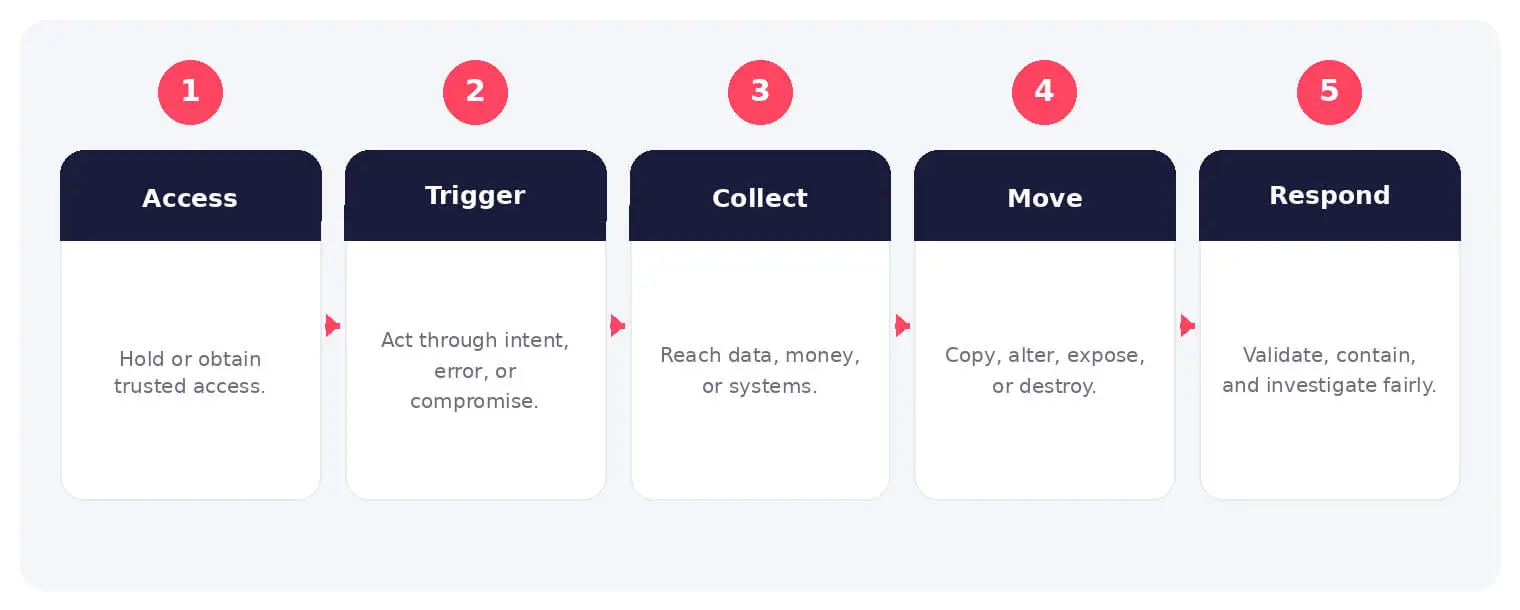
How Insider Threats Works
Malicious insiders may steal data, commit fraud, sabotage systems, or assist an external actor. Negligent insiders can expose information through misdelivery, unsafe sharing, weak security practices, or unauthorized tools.
Compromised insiders begin with a legitimate account or device taken over by an attacker. The resulting activity may resemble the employee’s normal access at first, making identity, device, and sequence context critical.
Common Types and Techniques
- Malicious insiders acting for gain, grievance, or ideology
- Negligent insiders who bypass or misunderstand controls
- Compromised users whose accounts or devices are controlled
- Third-party and former-user access that remains trusted
Security and Business Risks
- Theft of intellectual property, customer data, or funds
- Sabotage and disruption of critical operations
- Regulatory, contractual, and privacy consequences
- Loss of workforce trust if monitoring is opaque or excessive
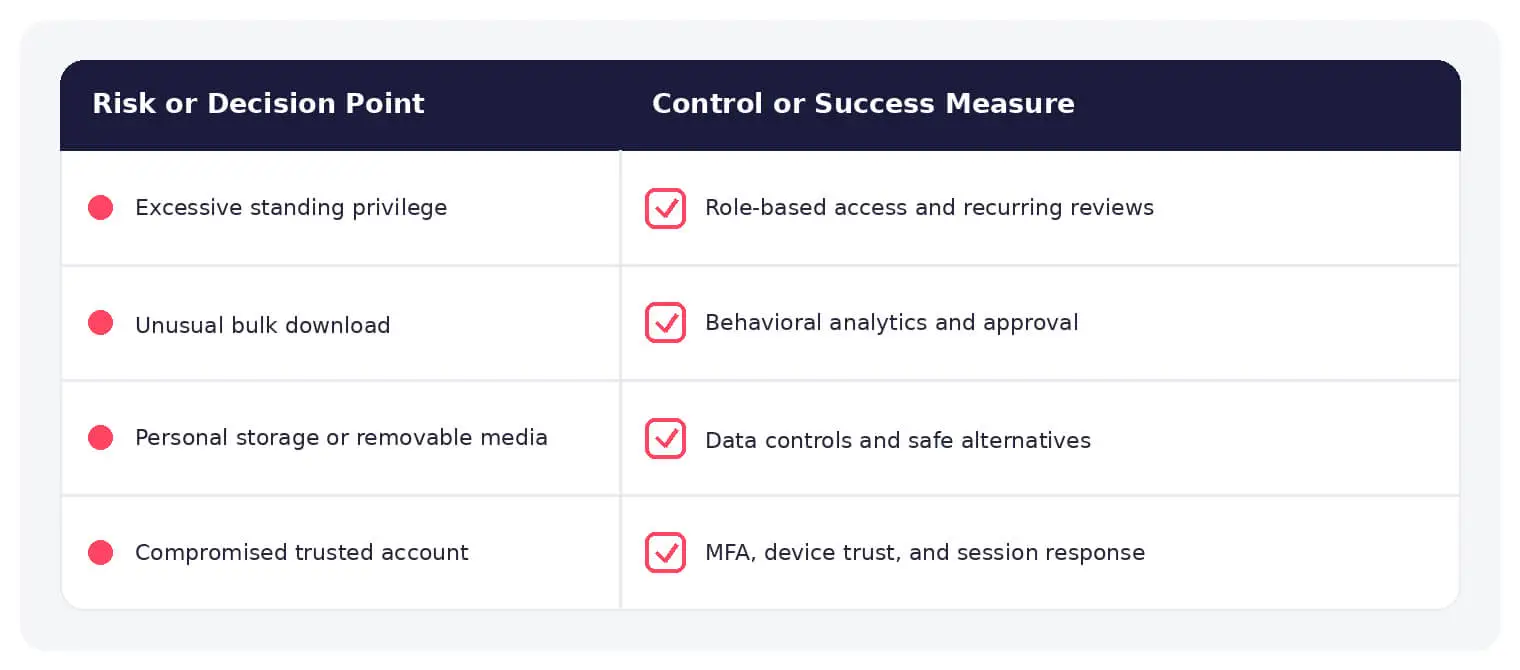
Warning Signs and Detection
Correlate unusual downloads, broad repository access, privilege changes, personal cloud uploads, removable media, source-code transfers, off-hours activity, policy bypass, and employment events. Require human review and document alternative explanations.
Prevention and Response
Apply least privilege, separation of duties, periodic access reviews, data classification, targeted loss-prevention controls, secure collaboration, prompt offboarding, and phishing-resistant MFA. Establish privacy-reviewed investigation and escalation procedures.
How SOCRadar Can Help
SOCRadar combines external asset visibility, threat intelligence, Dark Web monitoring, vulnerability context, and indicator enrichment to help teams identify exposure and investigate activity connected to insider threats.
Explore SOCRadar Extended Threat Intelligence or request a demo to strengthen threat-informed prevention and investigation.
Frequently Asked Questions
What Is an Insider Threat?
An insider threat is the risk that a person or account with legitimate access harms an organization, either intentionally or by accident. Insiders include employees, contractors, partners, service providers, former personnel with lingering access, and external attackers controlling a trusted identity. The resulting harm can involve data theft, fraud, sabotage, or accidental exposure of sensitive information.
What Are the Main Types of Insider Threats?
Most programs group insider threats into three categories: malicious insiders acting for gain, grievance, or ideology; negligent insiders who bypass or misunderstand controls; and compromised insiders whose accounts or devices an attacker controls. Third-party personnel and former users fall into these categories when their access remains trusted after their engagement ends.
How Does a Compromised Insider Account Differ From a Malicious Insider?
In a compromised-account scenario, an external attacker operates through a trusted identity the employee still uses, so the activity can blend into normal behavior at first. Telling it apart from legitimate work requires identity, device, and sequence context rather than access logs alone. The employee is a victim in this case, which changes both the response and how the situation is communicated.
Why Are Negligent Insiders Difficult to Detect?
Negligent insiders follow ordinary work patterns, so their activity rarely produces the escalation signals associated with deliberate harm. Misdelivered email, unsafe sharing links, weak security habits, and unauthorized tools can each expose data without looking like an attack. Data classification, secure sharing defaults, and practical training address this gap more directly than behavioral monitoring alone.
What Warning Signs Correlate With Insider Risk?
Investigators look for patterns such as unusual bulk downloads, broad repository access, privilege changes, uploads to personal cloud storage, removable media use, source-code transfers, off-hours activity, and policy bypass.
- Signals gain meaning when correlated with role, business need, timing, and destination.
- Employment events such as resignation or role changes add important context.
- A single indicator does not prove malicious intent on its own.
What Should Happen During a Suspected Insider Incident?
Security, legal, privacy, human resources, and relevant management should coordinate under a documented process. The team preserves evidence, limits access that could cause further harm, and protects affected people and operations while avoiding premature accusations. Every step should follow established policy and applicable law so the case withstands later review or dispute.
Which Controls Help Prevent Insider Threats?
Core controls include least privilege, separation of duties, periodic access reviews, data classification, targeted loss-prevention rules, and secure collaboration defaults. Prompt offboarding and phishing-resistant MFA reduce two common paths into insider incidents: lingering access and credential phishing. Note that phishing-resistant MFA helps stop phishing-based login theft, but an already stolen session may still require explicit revocation through session management controls.
Why Does Offboarding Matter for Insider Risk?
Former personnel with lingering access are a recognized insider threat category in their own right. Effective offboarding disables accounts, revokes active sessions and tokens, transfers asset ownership, and recovers company devices within defined timelines. Without these steps, departed users or attackers holding their credentials can continue operating inside the environment unnoticed.
How Can Insider Threat Monitoring Respect Employee Privacy?
Programs should define a legitimate purpose, minimize the data collected, restrict who can access it, and document retention periods with legal and privacy oversight. Proportionate monitoring, human review of alerts, and documented alternative explanations help prevent normal behavior from being treated as evidence of wrongdoing. Transparency about policies and acceptable-use expectations supports workforce trust rather than eroding it.
What Is a Common Misconception About Insider Threats?
A frequent misconception is that insider threats are always disgruntled employees acting deliberately. Compromised accounts and everyday negligence are also recognized insider categories, and both require different handling than cases involving malicious intent. Treating one behavioral flag as proof is another mistake, since fair investigation depends on correlated technical and human context.

Oct 16, 2026
CVE-2026-102764: BeyondTrust Zero-Day Exploited
BeyondTrust has disclosed CVE-2026-102764, a critical Remote Support vulnerability exploited as a zero-day weeks before customers received a patch. The attack began…
Oct 15, 2026
Cisco Secure Email & PAN-OS Zero-Days Exploited
Cisco Secure Email & PAN-OS Zero-Days Exploited Cisco and Palo Alto Networks have patched two actively exploited zero-day vulnerabilities that can lead…
Oct 15, 2026
SOCRadar Splunk Integration: New MSSP and Vulnerability Apps
SOCRadar Splunk Integration: New MSSP and Vulnerability Apps Your analysts live in Splunk. Your external risk does not: SOCRadar alarms for dozens…
Intelligence in your inbox every Thursday.
Join 30,000+ security professionals reading SOCRadar research.
Subscribe