Top 10 MSSPs in Canada in 2026
In 2026, Bill C-8 made critical infrastructure cyber security a matter of federal law, and the Canadian Centre for Cyber Security (Cyber Centre) responded to more than 3,200 incidents in a single fiscal year. For buyers weighing the top MSSPs in Canada, the harder question is who actually runs the “24/7 security operations center (SOC)” each provider advertises, since a wave of acquisitions has separated many brands from the teams behind them.
A Managed Security Service Provider (MSSP) is a third-party company that runs an organization’s security monitoring, threat detection, and incident response around the clock, usually from its own SOC. In Canada, a credible MSSP also supports the client’s duties under the Personal Information Protection and Electronic Documents Act (PIPEDA), Quebec’s Law 25, Guideline B-13 from the Office of the Superintendent of Financial Institutions (OSFI), and, for designated operators, the new Critical Cyber Systems Protection Act (CCSPA).
This guide profiles 10 MSSPs serving Canada in 2026, listed in no particular order. Providers were selected editorially for evidence of Canadian SOC or Managed Detection and Response (MDR) delivery, checkable signals such as peer reviews, analyst assessments, and audit attestations, and a mix of sizes and specialties.
Why Canada’s MSSP Market Matters in 2026
Canada’s incident numbers are moving in one direction. The Cyber Centre responded to more than 3,200 cyber security incidents affecting federal institutions and critical infrastructure between April 1, 2025, and March 31, 2026, up from 2,561 a year earlier. Recent breaches at Nova Scotia Power, where attackers stole data on about 280,000 people in 2025, and at the Canadian Investment Regulatory Organization (CIRO), where a phishing attack exposed data on about 750,000 investors, show what is at stake.
Three forces are pushing Canadian organizations toward managed security:
- Federal cyber law arrives: Bill C-8 received Royal Assent in June 2026. Its Telecommunications Act amendments took effect immediately, while the CCSPA comes into force in phases for designated operators in finance, telecommunications, energy, and transportation, with penalties of up to $15 million per violation.
- Sector rules already apply: OSFI’s Guideline B-13 has applied to federally regulated financial institutions since January 1, 2024, PIPEDA requires breach reports to the Office of the Privacy Commissioner (OPC), Quebec’s Law 25 adds provincial duties, and the Canadian Program for Cyber Security Certification (CPCSC) began entering select defense contracts in summer 2026.
- A market in consolidation: Bell launched Bell Cyber in September 2025, Arctic Wolf absorbed BlackBerry’s Cylance business in February 2025, and Quorum Cyber acquired Difenda in 2024, so a contract signed with one company may now be delivered by another.
Quick Reference Table
Here are the 10 providers in this guide at a glance, in no particular order.
| Provider | Type | Primary Strength | Best For | Website |
|---|---|---|---|---|
| eSentire | Canadian MDR specialist (Waterloo) | Founded 2001, Atlas Platform with 24/7 SOC, 4.7/5 from 85 Gartner Peer Insights reviews | Mid-market and enterprise firms wanting response-first MDR | esentire.com |
| Arctic Wolf | MDR platform company (Eden Prairie, MN; Waterloo research office) | Aurora platform, 10,000+ customers, 4.9/5 from 788 reviews | Small and mid-sized organizations wanting heavily reviewed MDR | arcticwolf.com |
| Field Effect | Canadian MDR vendor (Ottawa) | Proprietary MDR platform built for small and medium organizations | Small businesses without a security team | fieldeffect.com |
| Bell Cyber | Telco (Bell Canada) | Autonomous SOC, Security-as-a-Service on a Canadian sovereign cloud | Enterprises and public bodies wanting telco-integrated security | business.bell.ca |
| TELUS | Telco | 20+ years in managed security, bilingual all-Canadian SOC | Organizations wanting a Canadian-run SOC in both official languages | telus.com |
| CGI | Montreal-headquartered global integrator | IDC MarketScape Leader (2022), one of nine global SOCs in Canada | Large enterprises and governments bundling security with IT services | cgi.com |
| Deloitte Canada | Big Four | IDC MarketScape Leader (2022), largest security team in Canada per IDC, 2022 | Regulated enterprises wanting advisory plus managed services | deloitte.com/ca |
| Quorum Cyber (Difenda) | Microsoft security MSSP with an Oakville base | Microsoft-native MDR, Microsoft Intelligent Security Association (MISA) Security MSSP of the Year 2025 | Microsoft-standardized organizations | quorumcyber.com |
| Calian | Canadian defense and IT group (Ottawa) | Build-and-operate managed SOC, MDR and extended detection and response (XDR), defense heritage | Public sector, airports, and defense-adjacent suppliers | calian.com |
| Long View Systems | Calgary-headquartered IT services company (founded 1999) | 24/7 SOC and managed security information and event management (SIEM) on Microsoft Sentinel, with SOC 2 Type II, ISO/IEC 27001, and PCI DSS coverage | Western Canadian organizations wanting security alongside managed IT and cloud | longviewsystems.com |
The Top 10 Managed Security Service Providers in Canada in 2026
1. eSentire
Website: esentire.com · Founded: 2001 · HQ and SOC: Waterloo, Ontario · Scale: 2,000+ customers in 80+ countries (company-stated)
eSentire was founded in 2001 to secure financial services firms and has grown into one of the best-known MDR specialists anywhere, serving more than 2,000 customers in over 80 countries from its Waterloo security operations center. Its Atlas Platform pairs agentic AI with 24/7 human SOC coverage, and in 2026 eSentire added autonomous penetration testing (Atlas Preempt), email security and patch management (Atlas Response), and AI activity monitoring (Atlas AIDR).
The service leans on response: 24/7 threat hunting, digital forensics and incident response, and research from its Threat Response Unit, all from a Canadian-headquartered company.
Independent signals: Rated 4.7 out of 5 from 85 reviews on Gartner Peer Insights for MDR as of October 2026. eSentire also reports being named a Leader in the 2026 IDC MarketScape for Worldwide MDR Services for the midmarket.
For organizations that want response-first MDR from a Canadian-headquartered specialist with deep financial services roots, eSentire is the domestic benchmark.
Core Services: MDR (Atlas tiers), 24/7 threat hunting, digital forensics and incident response, threat intelligence · Ideal for: Mid-market and enterprise organizations, especially in financial services, that want MDR with hands-on containment.
2. Arctic Wolf
Website: arcticwolf.com · HQ: Eden Prairie, Minnesota, with a research office in Waterloo, Ontario · Scale: 10,000+ customers (company-stated, February 2025)
Arctic Wolf is US-headquartered with deep Canadian roots: its research and development office sits in Waterloo, home of BlackBerry, and on February 3, 2025 it closed the purchase of BlackBerry’s Cylance endpoint business for US$160 million, adding about 400 employees. Cylance’s technology now runs inside the Aurora platform as Aurora Endpoint Security, drawing on insights from more than 10,000 customers and over 7 trillion security observations a week.
BlackBerry stayed on as a reseller of the portfolio to its large government customers and as an Arctic Wolf shareholder, which gives the combined offering an established route into Canadian public-sector accounts.
Independent signals: Rated 4.9 out of 5 from 788 reviews on Gartner Peer Insights for MDR as of October 2026, the largest review base among the providers in this guide.
For small and mid-sized organizations that want platform-backed MDR with heavy peer validation, Arctic Wolf is the volume leader.
Core Services: MDR on the Aurora platform, Aurora Endpoint Security, managed endpoint defense · Ideal for: Small and mid-sized organizations that want a widely reviewed MDR service with endpoint protection included.
3. Field Effect
Website: fieldeffect.com · HQ: Ottawa, Ontario · Platform: Field Effect MDR (formerly Covalence)
Field Effect is the Ottawa company built around intelligence-grade protection for small and medium organizations. Its MDR platform, originally sold as Covalence, extends across an organization’s IT infrastructure and earned a 9.5 out of 10 composite satisfaction score as a gold medalist in the October 2022 SoftwareReviews MDR Data Quadrant.
The platform also has carrier-grade validation: TELUS built the MDR service it launched for mid-size Canadian businesses in 2019 on Field Effect’s technology.
Independent signals: SoftwareReviews gold medal (2022). Gartner Peer Insights listed a single review as of October 2026, too few to compare.
For small businesses that want a Canadian-built MDR platform designed around simplicity, Field Effect is the specialist choice.
Core Services: Field Effect MDR across endpoints, networks, and cloud services, threat monitoring and response guidance · Ideal for: Small and mid-sized organizations without dedicated security staff.
4. Bell Cyber (Bell Canada)
Website: business.bell.ca · Launched: September 9, 2025 · Roots: Stratejm (Mississauga), acquired July 9, 2024
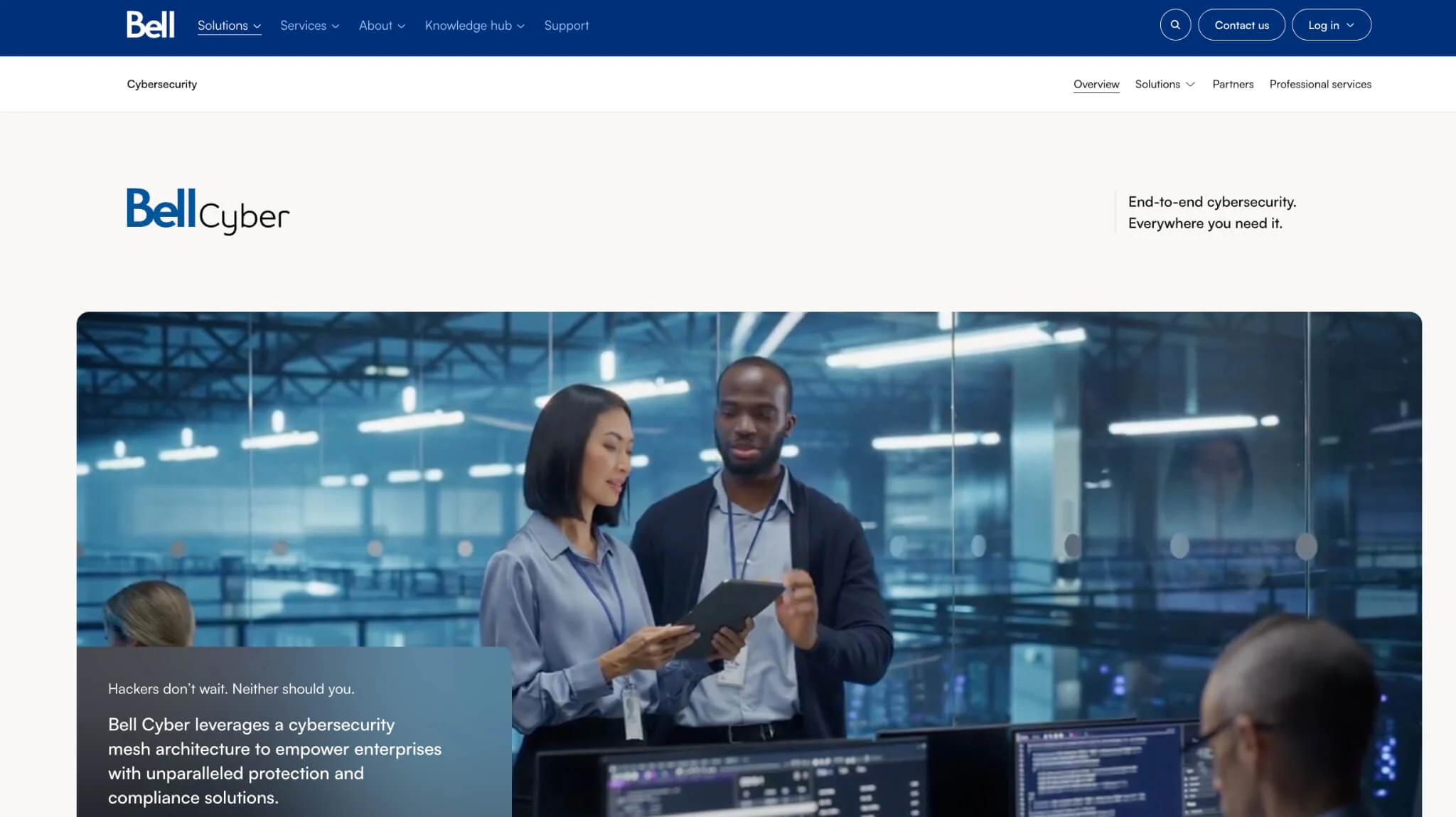
Bell Cyber is the brand under which Canada’s largest communications company now sells all of its cybersecurity services. Bell launched it on September 9, 2025, together with an autonomous security operations center that Bell says came out of more than two years of research and development. The business builds on Stratejm, the Mississauga MSSP Bell bought in July 2024, which ran a vendor-independent, SOC 2-audited security operations center.
In March 2025, Bell launched Security-as-a-Service hosted on its Canadian sovereign cloud so customer data stays in Canada. Bell Cyber also partners with Palo Alto Networks, Cisco, Microsoft, and Fortinet to design, deploy, and manage enterprise security programs.
Independent signals: Stratejm’s SOC 2 audit predates the rebrand; request the current SOC 2 Type II report covering Bell Cyber’s SOC, and confirm any Contract Security Program status through official channels.
For enterprises and public bodies that already buy connectivity and cloud from Bell, Bell Cyber offers security operations wired into the same network.
Core Services: Security-as-a-Service, autonomous SOC monitoring, threat detection and response, sovereign-cloud security hosting · Ideal for: Large organizations and public bodies that want telco-integrated security operations with Canadian data residency.
5. TELUS
Website: telus.com · Experience: 20+ years in cybersecurity services (company-stated) · SOC: all-Canadian, bilingual, 24/7
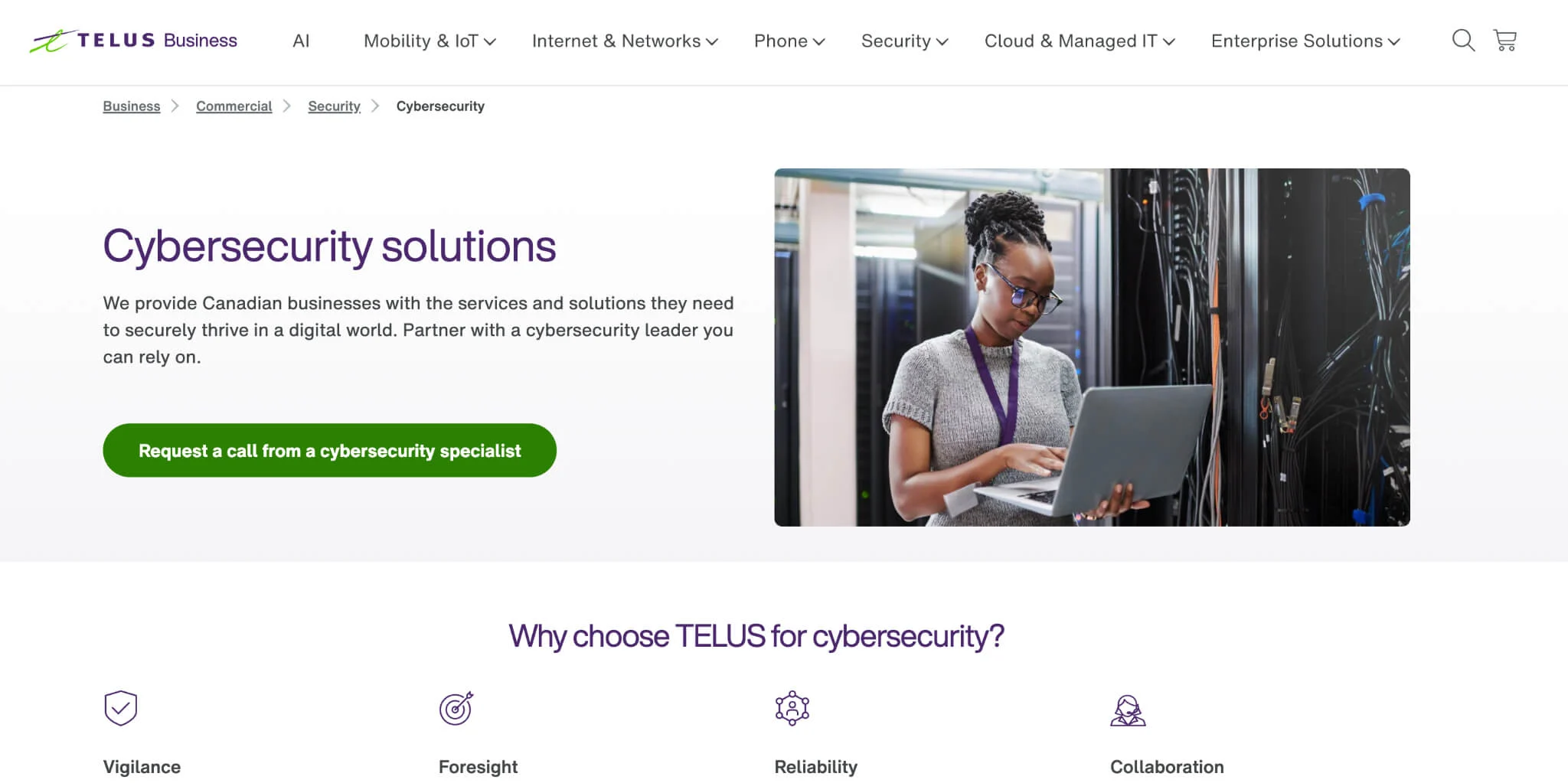
TELUS has delivered cybersecurity services to Canadian businesses for more than 20 years, with managed and co-managed options covering deployment, management, and 24/7 monitoring and response from an all-Canadian, bilingual SOC. In 2026 it introduced TELUS Managed SecOps, built on Google Security Operations, after running the Google platform internally in 2025.
The wider catalog spans managed security service edge, cloud and network security, offensive security, and security awareness, and TELUS notes that it secures one of Canada’s largest networks.
Independent signals: Rated 4.9 out of 5 on Gartner Peer Insights for managed security services, but from only three reviews as of October 2026.
For organizations that want a national carrier’s SOC run entirely in Canada, in both official languages, TELUS is the bilingual telco option.
Core Services: Managed and co-managed security, TELUS Managed SecOps (Google Security Operations), managed security service edge, cloud security, offensive security · Ideal for: Mid-size and large organizations, including those in Quebec, that need a bilingual Canadian SOC.
6. CGI
Website: cgi.com · HQ: Montreal · SOC footprint: one of nine global SOCs in Canada (per IDC, 2022)
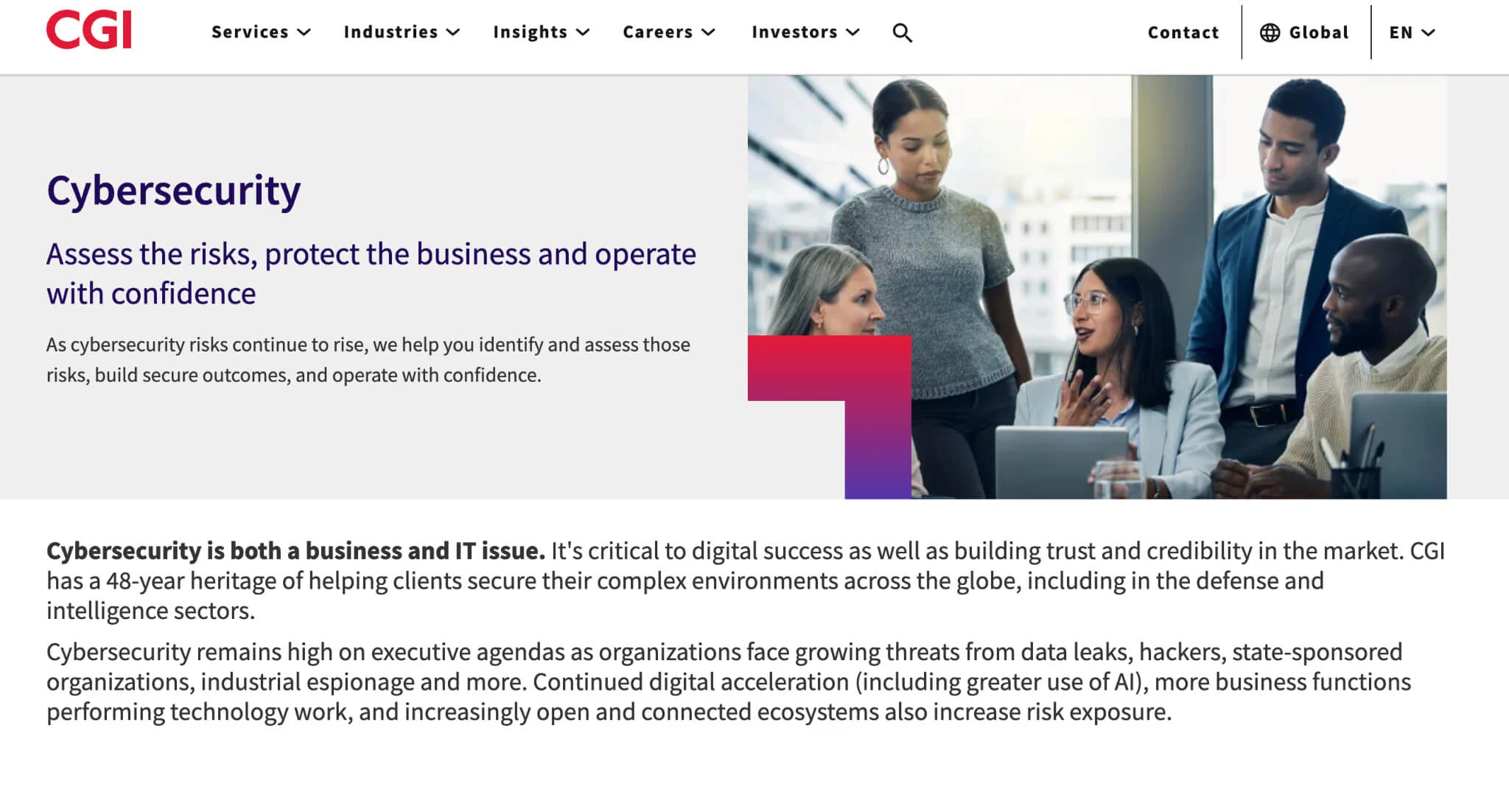
CGI, the Montreal-headquartered IT and business consulting firm, delivers managed security as part of much larger services relationships. IDC Canada has noted that CGI maintains one of the biggest security teams in the country and that one of its nine security operations centers worldwide is in Canada, and IDC positioned CGI as a Leader in its Canadian Security Services 2022 vendor assessment.
Its managed Microsoft Defender service shows the model in practice: tiered packages that correlate threat signals across endpoints, email, cloud applications, identities, and on-premises workloads, with active containment and response.
Independent signals: IDC MarketScape Canadian Security Services 2022 Leader (CA48060922). Request current SOC 2 Type II or ISO/IEC 27001 attestations for the Canadian SOC.
For large enterprises and governments that want security delivered inside an existing IT outsourcing or transformation relationship, CGI is the Canadian-headquartered integrator option.
Core Services: Managed security services, managed XDR on Microsoft Defender, security consulting, identity and compliance services · Ideal for: Large enterprises and public-sector bodies that want managed security from their existing IT services partner.
7. Deloitte Canada
Website: deloitte.com/ca · Recognition: IDC MarketScape Canadian Security Services 2022 Leader
Deloitte is the advisory-led giant of Canadian security services. When IDC named it a Leader in its Canadian Security Services 2022 assessment, which evaluated 16 providers, IDC described Deloitte’s security team as the biggest in Canada and highlighted its breadth across advising on, implementing, and operating security solutions.
The appeal for regulated enterprises is integration: the same firm can assess OSFI B-13 readiness, design the control framework, and run the monitoring, which simplifies evidence for boards and supervisors.
Independent signals: IDC MarketScape Leader (2022). Ask which delivery center will monitor the account and where data will be processed, since Deloitte runs a global network of cyber centers.
For regulated enterprises that want advisory, implementation, and managed security from one accountable firm, Deloitte Canada is the Big Four choice.
Core Services: Managed security services, MDR, cyber risk advisory, security implementation, incident response · Ideal for: Federally regulated financial institutions and large enterprises that want advisory and operations under one roof.
8. Quorum Cyber (Difenda)
Website: quorumcyber.com · Canadian base: Oakville, Ontario (Difenda) · Acquired: September 12, 2024 · Parent HQ: Edinburgh, UK
Quorum Cyber, the Edinburgh-founded Microsoft security specialist profiled in the UK edition of this guide, entered Canada by acquiring Difenda, a full-stack Microsoft Security managed services company with offices in Oakville and Goodyear, Arizona, and about 80 employees at the time of the deal. The combined business builds MDR natively on Microsoft’s security stack, so organizations already licensed for Microsoft Defender and Sentinel can run managed detection on tools they own.
Microsoft’s partner ecosystem has rewarded the focus: Quorum Cyber won Security MSSP of the Year in the 2025 Microsoft Security Excellence Awards presented by the Microsoft Intelligent Security Association (MISA).
Independent signals: MISA Security MSSP of the Year (2025); Microsoft Solutions Partner for Security designation for both Quorum Cyber and Difenda.
For Microsoft-standardized Canadian organizations, Quorum Cyber offers specialist depth with a local base.
Core Services: Microsoft-native MDR, managed SOC on Microsoft Sentinel and Defender, incident response, threat intelligence · Ideal for: Organizations standardized on Microsoft security licensing that want more value from tools they already own.
9. Calian
Website: calian.com · HQ: Ottawa · Listed: TSX (CGY) · Scale: 6,000+ people worldwide (company-stated)
Calian is an Ottawa-headquartered group whose IT and Cyber Solutions business will define, build, and run a 24/7 security operations center for a client, alongside managed MDR and XDR, firewall, endpoint, identity, email, and security awareness services. In October 2025 it began a three-year contract to implement and manage the cyber-focused SOC of the Ottawa International Airport Authority.
Its broader business is anchored in defense: Calian reported more than $200 million in new, renewed, and extended Canadian defense contracts in the second quarter of fiscal 2026, and its cyber unit actively hires military spouses.
Independent signals: Public company disclosures. Ask for SOC 2 Type II or ISO/IEC 27001 attestations for the managed SOC, and confirm Contract Security Program status through official channels.
For public bodies, airports, and defense-adjacent suppliers that want a Canadian provider fluent in government security culture, Calian is the defense-heritage pick.
Core Services: Managed SOC (build and operate), MDR and managed XDR, managed firewall, endpoint, identity, and email security, risk and compliance · Ideal for: Government, transportation, and defense-adjacent organizations, including suppliers preparing for the CPCSC.
10. Long View Systems
Website: longviewsystems.com · Founded: 1999 · HQ: Calgary · Scale: 1,000+ employees (third-party estimates), with offices in Western Canada, Toronto, and the US
Long View Systems is a Calgary-headquartered IT solutions and services company that runs cybersecurity as its Digital Defense practice, alongside managed IT, cloud, and end-user services. Its managed SIEM and SOC services are built for multi-cloud environments, and the company says its cloud security experts are trusted by national banks and international airlines.
The managed security catalog centers on a 24/7 SOC. User Shield pairs Microsoft Sentinel SIEM and XDR technology with Long View’s own SOC, XDR Shield and MDR Shield extend detection and response, and the practice adds phishing simulation, vulnerability scanning, and incident response and forensics.
Independent signals: Long View publishes unusually specific attestations for its SOC: SOC 1 Type II and SOC 2 Type II reports that explicitly cover its Security Operations Center services, ISO/IEC 27001:2022 and ISO/IEC 27017:2015 certification for its managed IT, network operations center (NOC), and SOC operations, and PCI DSS 4.0.1 certification covering the SOC. Ask for the current SOC 2 report under NDA.
For Western Canadian organizations that want managed security from an established IT services partner with a SOC-specific audit trail, Long View is the integrated option.
Core Services: 24/7 SOC and managed SIEM (User Shield on Microsoft Sentinel), XDR Shield and MDR Shield, phishing simulation and education, vulnerability scanning, incident response and forensics, cloud security · Ideal for: Mid-size and large organizations in Western Canada, including energy firms, that want security run alongside managed IT and cloud services.
How to Choose an MSSP in Canada
The 10 providers differ in scale, sector depth, and how much of their delivery happens on Canadian soil. Canada has no national accreditation register for SOC providers, so start with the evidence a buyer can check, then test fit.
| Credential | What It Proves | Where to Check |
|---|---|---|
| SOC 2 Type II report | Controls at the provider’s SOC operated effectively over a defined audit period | Request the report under NDA and check the period it covers |
| CyberSecure Canada | An audit against 13 baseline controls set by the Cyber Centre; certification lasts two years | CyberSecure Canada, now administered by the Standards Council of Canada |
| CPCSC level | Readiness for defense contracts, from a Level 1 self-assessment to a Level 3 National Defence assessment | Contract clauses and certification records (program evaluation) |
| Contract Security Program clearance | The organization is screened to handle protected or classified government information | Ask Public Services and Procurement Canada (PSPC); cleared firms may not advertise clearance details (Contract Security Manual) |
| Gartner Peer Insights ratings | Verified user reviews; review volume matters as much as the score | MDR market page |
- Verify before shortlisting: Ask for the latest SOC 2 Type II report and its audit period, the ISO/IEC 27001 certificate scope, and, for public-sector work, Contract Security Program status confirmed through PSPC. Treat peer ratings as evidence only when the review count is meaningful; 788 reviews tell a buyer far more than three.
- Plan for the CCSPA before designation: Operators in banking, telecommunications, energy, and federally regulated transportation should ask how the provider will support a cyber security program, third-party risk management, and incident reporting once their class of operator is designated.
- Map the service to your regulators: Federally regulated financial institutions need OSFI B-13 alignment and a 24-hour incident notification path, every organization needs a PIPEDA breach workflow to the OPC, organizations handling Quebec residents’ data need Law 25 processes, and defense suppliers need CPCSC evidence. Ask for the audit-ready reporting the service produces.
- Ask where the SOC is and who runs it: Confirm where analysts sit, whether Canadian data residency is contractual, whether service is available in French, and how recent acquisitions change who actually delivers the work.
- Test supplier and Dark Web coverage: The CIRO and Nova Scotia Power breaches put Social Insurance Numbers and financial details into criminal hands, so ask how the provider monitors leaked credentials, stolen data, and Dark Web activity about your brand and suppliers.
- Match the provider to your gap: Response-first MDR points to eSentire (#1) or Arctic Wolf (#2), and small businesses to Field Effect (#3); telco-integrated security to Bell Cyber (#4) or TELUS (#5); security inside a large IT or advisory relationship to CGI (#6) or Deloitte Canada (#7); a Microsoft-standardized stack to Quorum Cyber (#8); government and defense-adjacent work to Calian (#9); and security alongside managed IT and cloud in Western Canada to Long View Systems (#10).
Frequently Asked Questions
What is the difference between an MSSP, MDR, and SOC-as-a-service?
An MSSP is the umbrella term for a provider that runs security operations for clients. SOC-as-a-service supplies the monitoring center and analysts, while MDR adds threat hunting and hands-on containment. Most providers in Canada sell all three under different names, so compare the response actions written into each contract before comparing prices.
Does Bill C-8 apply to my organization?
Only if the government designates your class of operator. The Critical Cyber Systems Protection Act targets operators of vital services in finance, telecommunications, energy, and transportation under federal jurisdiction, and its obligations apply once designation orders and regulations take effect. Suppliers to those operators should still expect security questionnaires and contract clauses.
How quickly must a data breach be reported in Canada?
Under PIPEDA, organizations must report breaches that create a real risk of significant harm to the Office of the Privacy Commissioner as soon as feasible and notify affected individuals. Quebec’s Law 25 requires prompt notice of serious confidentiality incidents, and OSFI expects federally regulated financial institutions to report qualifying incidents within 24 hours.
Does security data have to stay in Canada?
Not by default. PIPEDA permits cross-border processing with safeguards and transparency, but Quebec’s Law 25 requires a privacy impact assessment before personal information leaves the province, and some federal contracts require Canadian residency. AWS, Microsoft Azure, and Google Cloud run Canadian regions, so write residency for logs and case data into the contract.
How much does an MSSP cost in Canada?
Pricing depends on the number of monitored assets, log volume, the response actions included, and the compliance reporting required. Small-business MDR is usually priced per endpoint or user, while enterprise SOC contracts are scoped individually. Request quotes from at least three providers against the same asset inventory and service levels to compare like for like.
Do I still need an MSSP if I have an in-house security team?
Often, yes. Staffing a 24/7 SOC takes more analysts than most Canadian organizations can justify, and the Cyber Centre alone handled more than 3,200 incidents at federal institutions and critical infrastructure in its latest fiscal year. A co-managed model lets the MSSP cover round-the-clock monitoring while internal staff own architecture and risk decisions.
SOCRadar provides extended threat intelligence covering threat actors targeting Canada, on Dark Web forums, Telegram channels, and data leak sites. Our Dark Web Monitoring capabilities help detect early exposure of organizational data before that exposure escalates into a breach.Request a demo or run a free Dark Web scan to understand your current exposure baseline.