
What Is Digital Forensics?
Digital forensics identifies, preserves, collects, examines, and reports digital evidence in a defensible and repeatable manner.
Investigations may involve endpoints, mobile devices, networks, cloud services, applications, memory, logs, and removable media. The objective is not simply to find artifacts, but to reconstruct events while protecting evidence integrity, scope, chain of custody, and legal or regulatory requirements.
Key Takeaways
- Digital forensics identifies, preserves, collects, examines, and reports digital evidence in a defensible and repeatable manner.
- Investigations may involve endpoints, mobile devices, networks, cloud services, applications, memory, logs, and removable media. The objective is not simply to find artifacts, but to reconstruct events while protecting evidence integrity, scope, chain of custody, and legal or regulatory requirements.
- Evidence overwritten by normal operations is a primary concern.
- Effective programs combine prevention, continuous visibility, accountable ownership, and tested response.
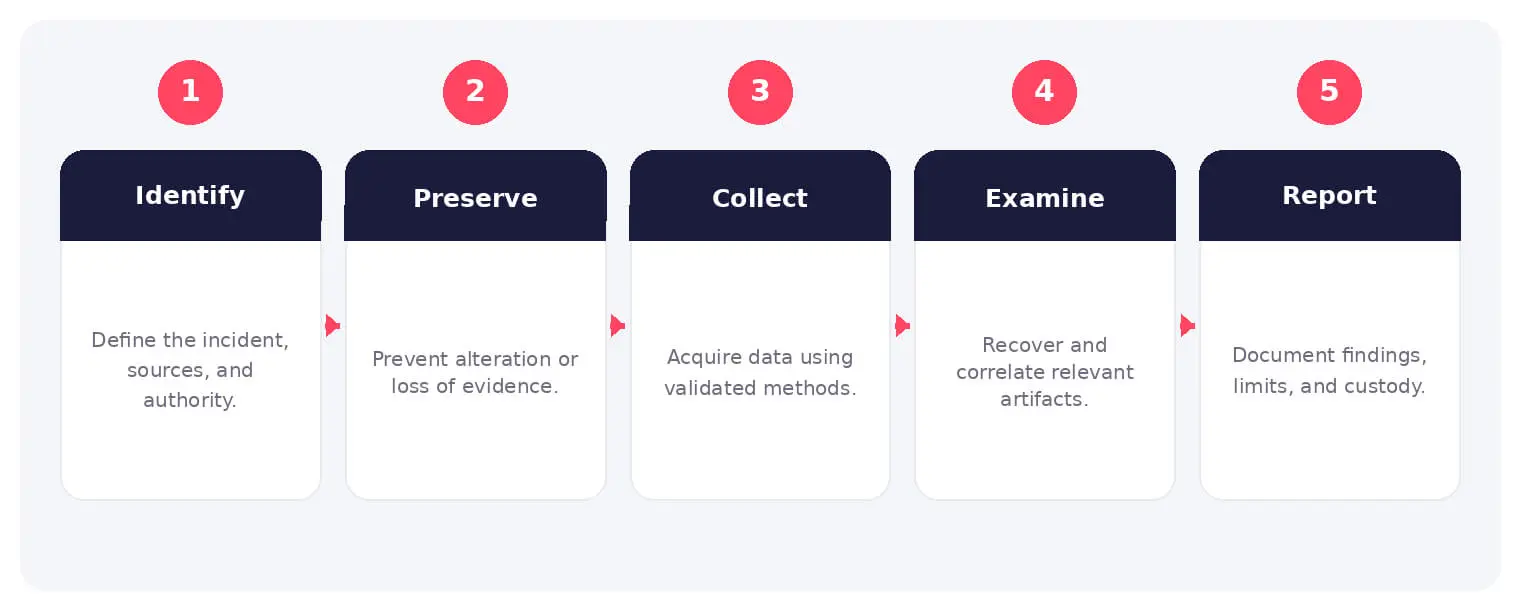
How It Works
The operating flow above turns the concept into observable steps. Exact implementations vary, but each stage needs accountable ownership, trusted inputs, documented policy, and evidence that analysts can use during investigation and review.
Investigations may involve endpoints, mobile devices, networks, cloud services, applications, memory, logs, and removable media. The objective is not simply to find artifacts, but to reconstruct events while protecting evidence integrity, scope, chain of custody, and legal or regulatory requirements.
Common Types and Capabilities
- Computer and disk forensics
- Memory and malware forensics
- Network and log forensics
- Mobile, cloud, and application forensics
Security and Business Risks
- Evidence overwritten by normal operations
- Contamination during collection
- Incomplete timelines and timezone errors
- Unsupported conclusions or broken custody
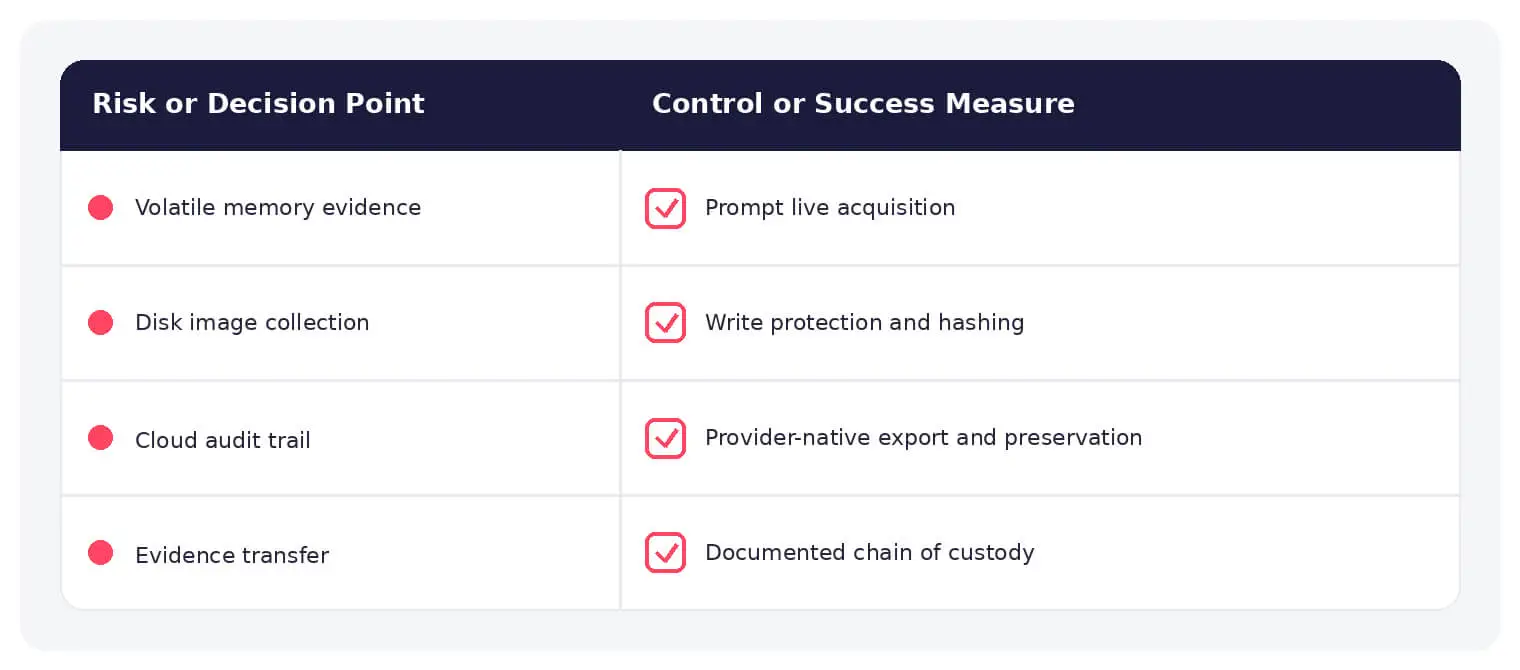
Warning Signs and Detection
Look for timestamp inconsistencies, missing logs, anti-forensic tools, cleared histories, altered audit settings, suspicious deletion, encrypted containers, volatile processes, remote sessions, cloud API activity, and gaps between endpoint, identity, and network evidence.
Best Practices
Maintain forensic readiness, synchronize time, protect and retain logs, use validated tools, collect volatile data first when appropriate, create verified copies, document every action, separate analysis from originals, and state uncertainty clearly.
How SOCRadar Can Help
SOCRadar adds external visibility, threat intelligence, exposure context, and continuous monitoring to help teams validate and prioritize risks related to digital forensics. This context complements internal AI, cloud, security operations, and governance controls.
Explore SOCRadar Cyber Threat Intelligence or request a demo to strengthen threat-informed prevention and response.
Frequently Asked Questions
What Is Digital Forensics?
Digital forensics is the practice of identifying, preserving, collecting, examining, and reporting digital evidence in a defensible and repeatable way. Investigations can span endpoints, mobile devices, networks, cloud services, memory, logs, and removable media. The goal is to reconstruct events while protecting evidence integrity, chain of custody, and any legal or regulatory requirements.
What Are the Main Types of Digital Forensics?
Core disciplines include computer and disk forensics, memory and malware forensics, network and log forensics, and mobile, cloud, and application forensics. Each discipline targets different artifacts, so complex incidents often require several of them working from the same timeline.
What Is Chain of Custody and Why Does It Matter?
Chain of custody is the documented record of who handled evidence, when, how, and why, from collection through final disposition. Gaps or unexplained changes can undermine admissibility and make conclusions easier to challenge. Every acquisition, transfer, and analysis step should be logged.
What Is the Biggest Risk to Digital Evidence?
Evidence being overwritten by normal operations is a primary concern, along with contamination during collection. Volatile data such as memory contents and live network connections disappears when a system is powered off, while ongoing activity can alter logs and timestamps. This is why preparation and careful ordering of collection steps matter so much.
How Does a Digital Forensics Investigation Work?
Most investigations move through identification, preservation, collection, examination, and reporting. Analysts typically capture volatile data first when appropriate, create verified copies of storage media, and work from those copies rather than originals. Every action is documented, and the final report links findings to evidence while stating uncertainty clearly.
What Warning Signs Point to Anti-Forensic Behavior?
Indicators include timestamp inconsistencies, missing or cleared logs, altered audit settings, suspicious deletion, encrypted containers, cleared histories, and the presence of anti-forensic tools. Gaps between endpoint, identity, and network evidence also deserve attention. No single sign proves tampering, but several together warrant deeper review.
What Should Responders Collect First at a Compromised System?
Volatile data usually comes first, including memory captures, running processes, active connections, and logged-in sessions, because it is lost at shutdown. Non-volatile data such as full disk images follows, using validated tools and write blockers where applicable. The right order depends on the incident, but the sequence should always be documented.
How Can Organizations Become Forensically Ready?
Forensic readiness means having policies, tooling, and trained staff in place before an incident occurs. Practical steps include synchronizing clocks across systems, protecting and retaining logs for an adequate period, using validated tools, and pre-defining escalation and legal hold procedures. Readiness shortens investigations and reduces the chance that critical evidence is lost.
How Does Cloud Forensics Differ From Traditional Forensics?
Investigators often cannot image cloud infrastructure the way they image a physical disk, so they rely on provider logs, snapshots, and API audit trails. Shared responsibility models, multi-tenant environments, and varying retention policies add complexity. Knowing in advance what each provider records, and for how long, is critical to scoping an investigation.
What Is the Difference Between Digital Forensics and Incident Response?
Incident response focuses on containing, eradicating, and recovering from an incident, while digital forensics focuses on reconstructing events with defensible evidence. The two overlap heavily, and forensic findings often shape response and remediation decisions. Mature programs run both in parallel rather than one after the other.
Is Digital Forensics Only Used After a Breach?
No. Digital forensics is also applied to insider threats, fraud, intellectual property theft, workplace disputes, and litigation support. The same principles of evidence integrity, custody, and repeatability apply regardless of whether a security incident occurred.
Oct 27, 2026
September 2026: FBI Breach, Clop Hijack & IDScan Leak
The major cyber attacks of September 2026 hit federal law enforcement, a rival cybercrime gang, and the companies that verify identities. ShinyHunters…

Oct 27, 2026
Australia’s Annual Cyber Threat Report 2025-26 Shows Cyber Incidents Up 20%
Australia’s cyber security authority responded to 1,524 cyber security incidents in the 2025-26 financial year, a 20% increase from the previous year…

Oct 27, 2026
PHP2Shell Weaponized After Japanese Real Estate Extortion
An exposed server ties an extortion wave on about 20 Japanese property sites to an operator who later weaponized PHP2Shell (CVE-2026-109618, CVE-2026-109619)…
Intelligence in your inbox every Thursday.
Join 30,000+ security professionals reading SOCRadar research.
Subscribe