
AI Adoption Barriers in Cybersecurity
AI adoption barriers in cybersecurity are the organizational, technical, financial, and security problems that prevent teams from turning AI capabilities into reliable operational results. The most common barriers are unclear objectives, fragmented data, difficult integrations, limited skills, weak governance, low analyst trust, and unmanaged model risk.
These barriers reinforce one another. Poor data produces unreliable output, unreliable output reduces trust, and low trust leaves the system outside daily workflows. A practical adoption program treats each barrier as an operating constraint with an owner, an action, and a measurable readiness condition.
Key Takeaways
- AI projects fail when they begin with a tool instead of a defined security decision.
- Fragmented telemetry and inconsistent context limit model accuracy and explainability.
- Governance must cover data, models, prompts, permissions, vendors, and human accountability.
- Trust grows through transparent evidence, controlled pilots, and visible handling of errors.
Strategic and Organizational Barriers
A vague mandate to use AI gives teams no defensible way to select projects or measure value. Security leaders should begin with a specific workflow, identify the current cost or failure rate, and define the outcome expected from AI. Without that discipline, pilots accumulate while few reach production.
Ownership is another frequent gap. Security, data, engineering, privacy, legal, procurement, and business teams may all influence a deployment, yet no single person is accountable for the result. A lightweight responsibility model should identify who approves the use case, data, model, integration, and production release.
Data Quality and Availability
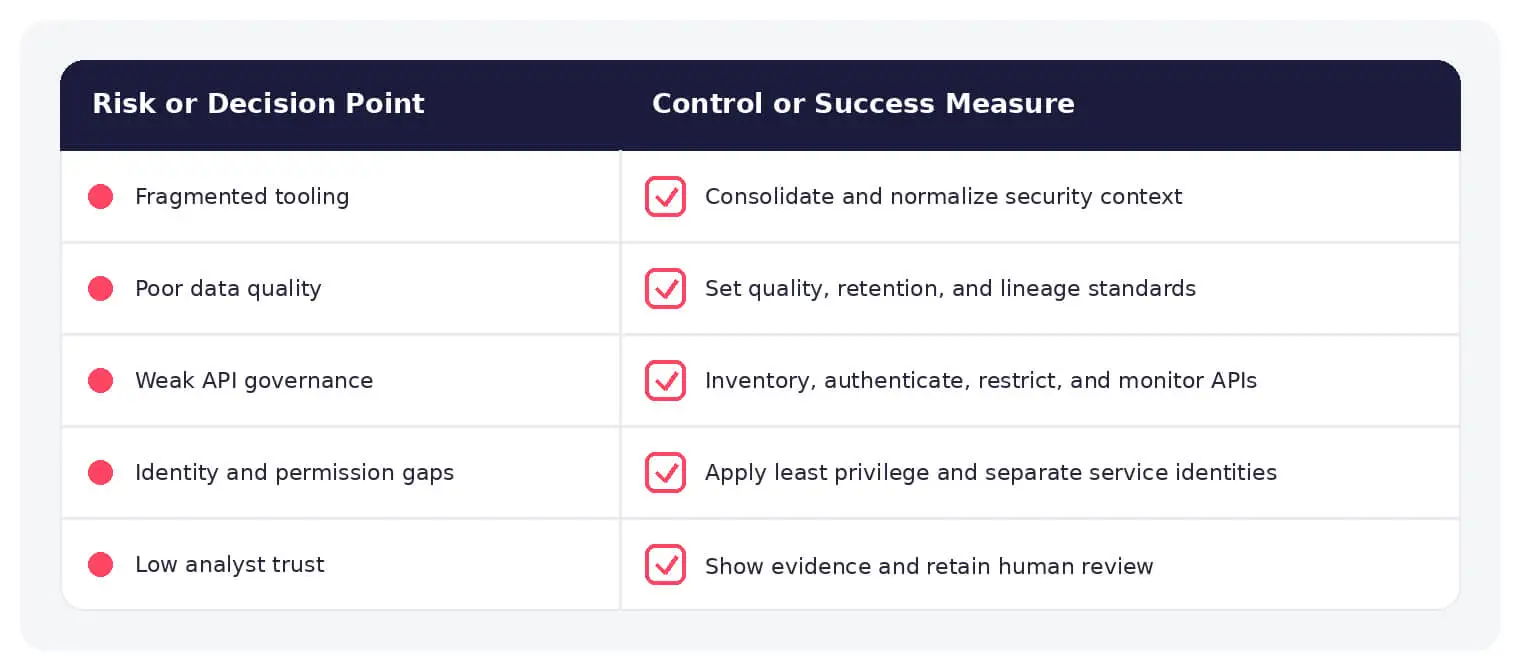
Security data is often distributed across endpoint, identity, network, cloud, email, ticketing, and threat intelligence systems. Different schemas, duplicate alerts, missing timestamps, inconsistent asset names, and short retention periods make correlation difficult. A model can amplify these weaknesses by turning incomplete context into a confident recommendation.
Teams should inventory the minimum data required for each use case, normalize identifiers, define quality checks, and document lineage. Sensitive data should be minimized before it reaches a model. Retrieval systems need permission-aware access so a user cannot obtain information through AI that they could not access directly.
Legacy Integration and Tool Fragmentation
An accurate model creates little value if its output does not reach the analyst at the right point in the workflow. Legacy systems may lack APIs, use proprietary formats, or impose rate limits. New AI tools can also create a separate console and increase context switching.
Integration planning should begin before model selection. Define where the recommendation appears, what evidence travels with it, which actions are available, and how the result is written back to the case. Open interfaces and portable data reduce lock-in and make the workflow easier to audit.
Skills, Trust, and Change Management
Security analysts do not need to become machine learning engineers, but they must understand the system’s purpose, limits, and failure modes. Data and engineering teams also need enough security context to avoid optimizing a technically impressive model for the wrong outcome.
Trust cannot be created through training alone. Analysts need to see the evidence behind a recommendation, report errors, and understand what changed after feedback. Advisory pilots, side-by-side comparisons, and clear escalation rules allow users to build calibrated trust instead of accepting or rejecting AI as a category.
Governance, Privacy, and Security Risk
Unapproved AI use can expose source code, credentials, customer data, incident details, and internal documents to external services. Models and plugins may also be vulnerable to prompt injection, data poisoning, insecure output handling, and excessive agency. Regulations and contractual obligations add requirements around transparency, retention, residency, and human oversight.
A governance program should maintain an AI inventory, approved-use policy, data classification rules, vendor assessment process, testing standard, incident procedure, and retirement plan. Controls should be proportional to impact: a drafting assistant and an autonomous containment agent should not pass through the same approval path.
Cost, Vendor Lock-In, and Uncertain Return
Licensing is only one part of the cost. Data preparation, integration, evaluation, monitoring, training, security review, and model changes can exceed the initial purchase. Usage-based pricing may also become unpredictable when prompts, retrieval, and agent loops grow.
A pilot should include a total-cost estimate and an exit condition. Teams should test whether data and prompts can move between providers, preserve evaluation datasets, and avoid proprietary dependencies where practical. The business case should count avoided rework and improved decision quality, not only hours saved.
A Readiness Plan for Overcoming Adoption Barriers
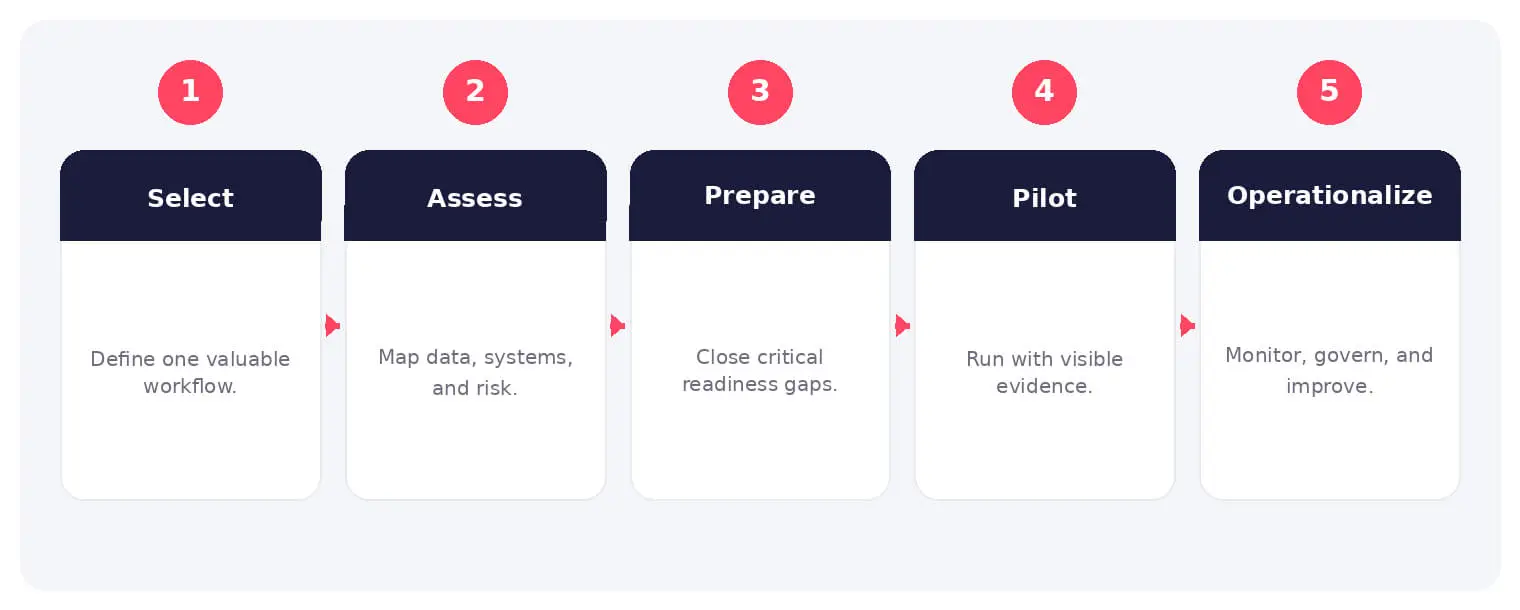
Prioritize barriers according to the selected use case. A team does not need an enterprise-wide data program before testing one workflow, but it does need reliable data for that workflow. Use a staged plan: define the decision, prepare the inputs, set governance, integrate in advisory mode, measure results, and expand only when acceptance criteria are met.
The result should be a repeatable adoption gate rather than a one-time pilot. Every new AI use case should answer the same questions about value, data, access, testing, ownership, monitoring, and rollback.
How SOCRadar Helps Close AI Readiness Gaps
SOCRadar consolidates external attack surface, threat intelligence, brand, supply chain, and Dark Web context in one platform. That verified context helps security teams reduce fragmented inputs and assess AI-generated findings against observable exposure and threat activity.
Explore SOCRadar Extended Threat Intelligence or request a demo to see how unified external intelligence can strengthen AI-assisted security workflows.
Frequently Asked Questions
What Are the Main Barriers to AI Adoption in Cybersecurity?
The most common barriers are unclear objectives, fragmented security data, difficult integration with legacy tools, limited skills, weak governance, low analyst trust, and unmanaged model risk. They reinforce one another: poor data produces unreliable output, unreliable output lowers trust, and low trust keeps the system outside daily workflows. Treating each barrier as an operating constraint with an owner and a measurable readiness condition keeps an adoption program on track.
Why Do AI Security Pilots Fail to Reach Production?
Many pilots start with a tool instead of a defined security decision, so there is no baseline to measure against and no defensible reason to scale. Ownership gaps compound the problem when security, data, engineering, legal, and procurement all influence the deployment but no single person is accountable for the result. Without an explicit approval path and acceptance criteria, pilots accumulate while few survive contact with production requirements.
How Does Fragmented Security Data Limit AI Accuracy?
Security telemetry is often spread across endpoint, identity, network, cloud, email, ticketing, and threat intelligence systems with different schemas, duplicate alerts, inconsistent asset names, and short retention periods. A model can turn this incomplete context into a confident but unreliable recommendation. Inventorying the minimum data each use case needs, normalizing identifiers, and documenting lineage reduces that risk before a model is even selected.
What Warning Signs Suggest an AI Security Program Is Struggling?
Common signals include:
- Pilots with no baseline metric or acceptance criteria
- Recommendations that arrive without evidence or uncertainty context
- Analysts who routinely override output or route around the tool
- Deployment decisions spread across teams with no named owner
- Rising context switching between new AI consoles and existing tools
Any of these suggests the program is adding work rather than reducing it.
How Should Teams Respond to Unapproved AI Use by Employees?
Unapproved tool use can expose source code, credentials, incident details, and customer data to external services, so the first step is building an AI inventory rather than issuing a blanket ban. An approved-use policy, data classification rules, and permission-aware retrieval give employees safer channels for the same work. Controls should scale with impact, since a drafting assistant and an autonomous containment agent do not warrant the same review path.
What Security Risks Apply to the AI Systems Themselves?
Models and plugins can be vulnerable to prompt injection, data poisoning, insecure output handling, and excessive agency, where a system takes actions beyond its intended scope. Retrieval layers also need permission-aware access so a user cannot obtain information through AI that they could not reach directly. A testing standard and an AI-specific incident procedure should cover these failure modes before any production release.
How Can Teams Build Analyst Trust in AI Recommendations?
Trust grows when the system cites its evidence, exposes uncertainty, and shows what changed after feedback. Advisory pilots, side-by-side comparisons against current practice, and clear escalation rules help analysts develop calibrated judgment instead of accepting or rejecting AI as a category. Human approval should remain in place before consequential actions while trust is being established.
What Hidden Costs Should an AI Security Budget Include?
Data preparation, integration, evaluation, monitoring, security review, and training can exceed the initial license price. Usage-based pricing may also become unpredictable as prompts, retrieval calls, and agent loops grow. A pilot should carry a total-cost estimate and an exit condition, and the business case should count avoided rework and improved decision quality, not only hours saved.
How Can Teams Reduce Vendor Lock-In With AI Security Tools?
Testing whether data and prompts can move between providers, preserving evaluation datasets, and avoiding proprietary dependencies where practical keep future options open. Open interfaces and portable data also make the workflow easier to audit and cheaper to re-tender. Defining exit conditions in the original pilot agreement is far easier than negotiating them after a tool becomes embedded in daily operations.
Do Teams Need an Enterprise-Wide Data Program Before Testing AI?
No. A team does not need to fix every data source before testing one workflow, but it does need reliable data for that specific use case. A staged plan works better: define the decision, prepare the inputs, set governance, integrate in advisory mode, measure results, and expand only when acceptance criteria are met. This turns a one-time pilot into a repeatable adoption gate that every new use case can pass through.

Oct 16, 2026
CVE-2026-102764: BeyondTrust Zero-Day Exploited
BeyondTrust has disclosed CVE-2026-102764, a critical Remote Support vulnerability exploited as a zero-day weeks before customers received a patch. The attack began…

Oct 15, 2026
Cisco Secure Email & PAN-OS Zero-Days Exploited
Cisco Secure Email & PAN-OS Zero-Days Exploited Cisco and Palo Alto Networks have patched two actively exploited zero-day vulnerabilities that can lead…
Oct 15, 2026
SOCRadar Splunk Integration: New MSSP and Vulnerability Apps
SOCRadar Splunk Integration: New MSSP and Vulnerability Apps Your analysts live in Splunk. Your external risk does not: SOCRadar alarms for dozens…
Intelligence in your inbox every Thursday.
Join 30,000+ security professionals reading SOCRadar research.
Subscribe