

Mar 10, 2026

Feb 19, 2026
7 Mins Read
Sep 13, 2026
Table Of Content
Related Articles

SMS Bombing

Threat Actors
Jan 08, 2026

Dark Web Monitoring
Feb 19, 2026

Ransomware
Jan 31, 2026
OSINT Framework
Apr 17, 2026

AI Adoption in Cybersecurity
AI adoption in cybersecurity is the planned use of artificial intelligence to improve security decisions, investigations, and repetitive operational work. Effective adoption connects a defined security problem to reliable data, controlled workflows, and measurable outcomes. Buying an AI feature without those foundations rarely produces sustained value.
Security teams already use machine learning for anomaly detection, malware classification, phishing analysis, alert prioritization, and threat intelligence enrichment. Generative and agentic systems extend those uses by summarizing evidence, proposing investigation steps, and coordinating tools. They also introduce risks involving data exposure, hallucinations, excessive permissions, and weak accountability.
Key Takeaways
- Start with a narrow security decision and a measurable baseline instead of a broad automation target.
- Data quality, integration, access control, and human review determine whether an AI use case is safe and useful.
- Measure operational outcomes such as investigation time, precision, analyst workload, and containment speed.
- Expand autonomy only after the system performs reliably under real operating conditions.
What AI Adoption Means for Security Teams
AI adoption changes how a security team reaches decisions. A mature program uses AI where it can reduce repetitive work or reveal patterns that are difficult to identify manually, while analysts retain authority over high-impact actions. The goal is a dependable operating capability, not the largest possible number of AI tools.
The most useful starting points are bounded and evidence-rich. Examples include grouping related alerts, enriching an indicator, summarizing a case, identifying likely phishing domains, or ranking exposed assets. Each use case has an input, an expected decision, an owner, and a clear definition of success.
Common AI Use Cases in Cybersecurity
Threat detection models can identify deviations from established behavior, while classification models sort files, URLs, and messages by risk. Natural language systems help analysts extract entities from reports, query security data, and turn investigation notes into structured case summaries.
AI can also support vulnerability prioritization by combining technical severity with exploit activity, asset exposure, business importance, and available controls. In threat intelligence, it can correlate infrastructure, campaigns, actors, and indicators across large datasets. These systems should preserve the supporting evidence so an analyst can validate the conclusion.
A Practical AI Adoption Roadmap
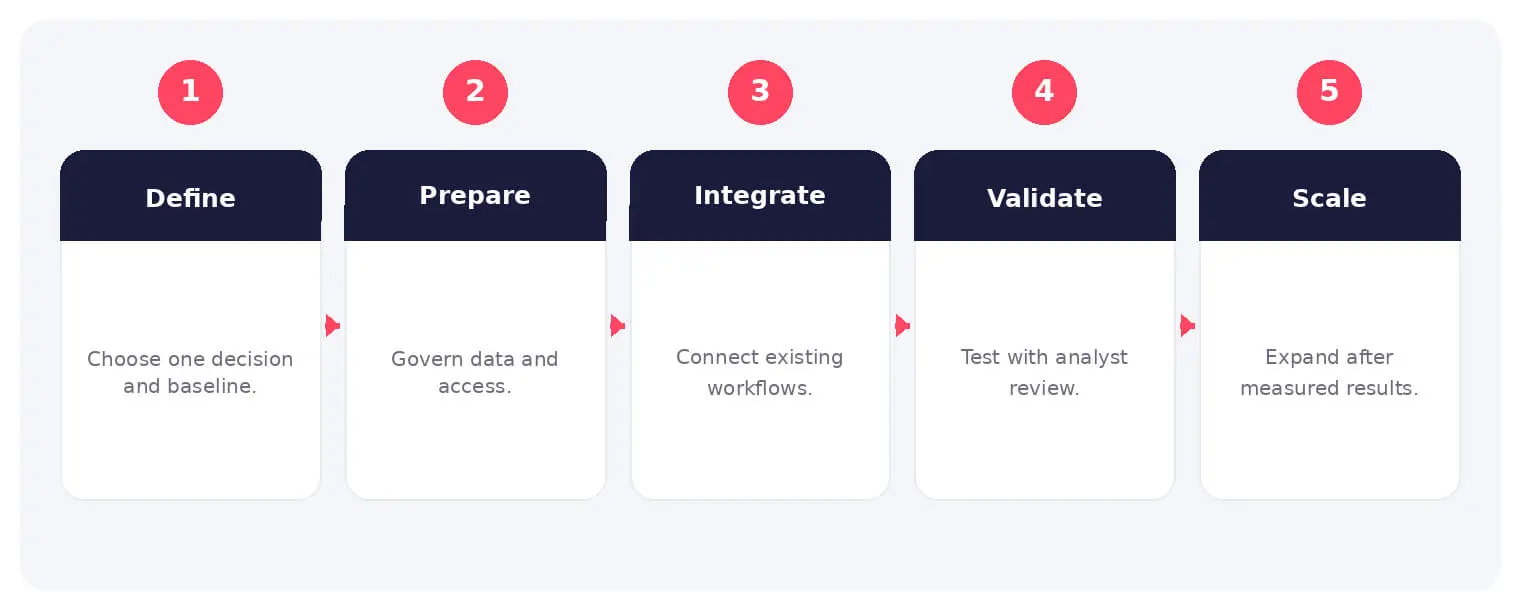
Begin by documenting the current workflow and its baseline. Record how many items enter the process, how long analysts spend on them, where errors occur, and which decisions require approval. Select one use case where the input data is available and the result can be evaluated objectively.
Prepare and govern the data before connecting a model. Define retention rules, remove unnecessary sensitive information, verify data lineage, and restrict access. Integrate the model into the tools analysts already use rather than creating an isolated interface that adds another queue.
Run the system in an advisory mode first. Compare its recommendations with analyst decisions, investigate disagreements, and test failure conditions. Production rollout should include monitoring, an escalation route, a rollback plan, and limits on actions the system may take without approval.
Governance and Security Requirements
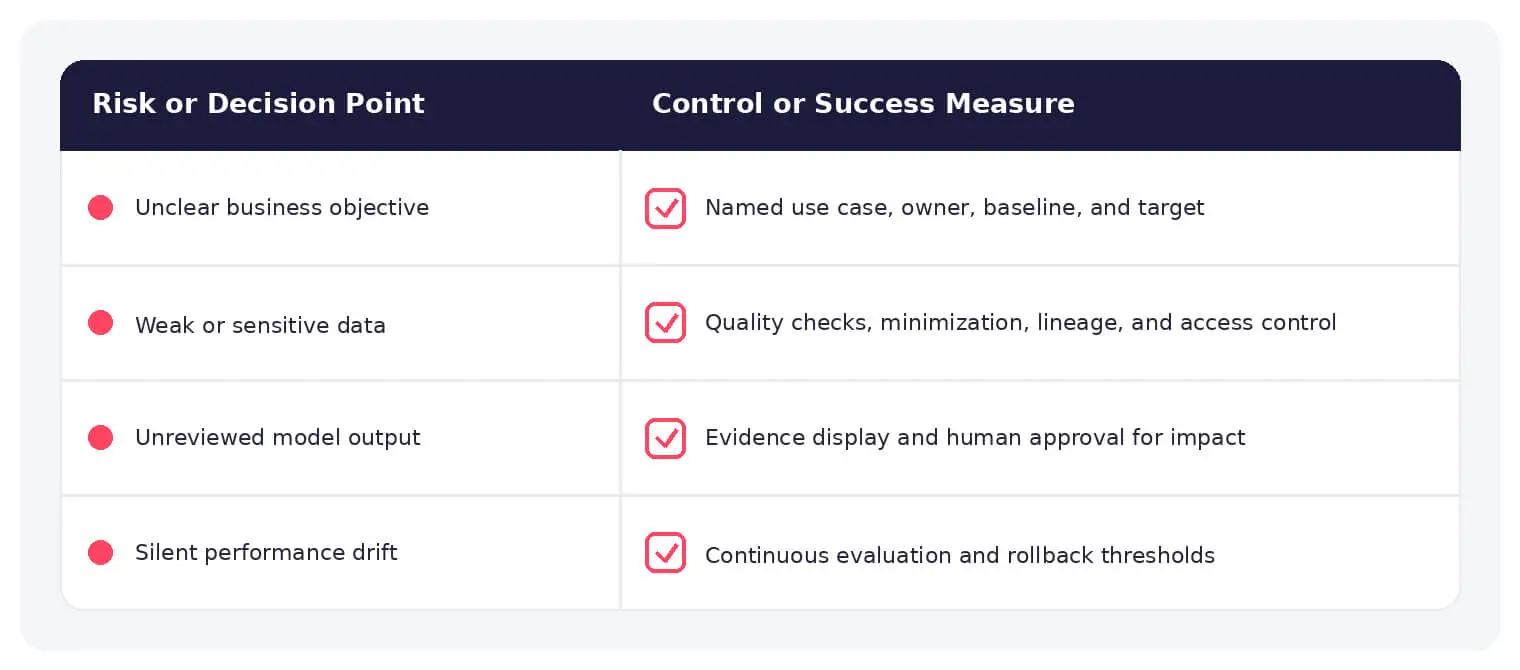
An AI system should have a named business owner, a technical owner, and a security owner. Teams need an inventory of models, data sources, prompts, integrations, permissions, and third-party dependencies. Logs should show what the system received, which sources it used, what it produced, and whether a person approved the result.
High-impact actions such as blocking an account, changing a firewall rule, or contacting a customer need explicit authorization controls. Secrets must stay outside prompts and model output, and retrieval sources should be allowlisted. Red-team testing should cover prompt injection, data leakage, hallucinations, evasion, and attempts to make the system exceed its intended authority.
How to Measure AI Adoption
Adoption metrics should reflect operational value and risk. Useful measures include precision, recall, false-positive rate, mean time to investigate, mean time to contain, analyst minutes saved, escalation quality, and the percentage of recommendations that analysts accept or reverse.
Usage alone is not evidence of success. A frequently used assistant may still create rework or encourage unsafe decisions. Review performance by use case, user group, and data source, and track failures over time. A model that cannot meet its threshold should return to advisory mode until the cause is corrected.
How SOCRadar Supports AI Adoption in Cybersecurity
SOCRadar supplies continuously updated external threat data that can ground AI-assisted security workflows. Extended Threat Intelligence combines Attack Surface Management, Cyber Threat Intelligence, Brand Protection, Supply Chain Intelligence, and Dark Web Monitoring so analysts can verify exposures, indicators, and threat context before acting.
Explore SOCRadar Extended Threat Intelligence or request a demo to see how verified external intelligence can support safer AI-assisted detection, prioritization, and investigation.
Frequently Asked Questions
What Is AI Adoption in Cybersecurity?
AI adoption is the planned use of machine learning and generative systems to improve security decisions, investigations, and repetitive operational work. It succeeds when a defined problem, reliable data, controlled workflows, and measurable outcomes are connected; buying an AI feature without those foundations rarely produces sustained value.
What Are the Main Risks of AI Adoption in Security Operations?
The primary risks are hallucinated conclusions, data exposure through prompts, excessive permissions, unclear accountability, and accuracy that degrades under real operating conditions. Red-team testing should cover prompt injection, data leakage, evasion, and attempts to push the system beyond its intended authority.
How Should a Team Choose Its First AI Use Case?
Select one bounded, evidence-rich problem such as grouping related alerts, enriching an indicator, or summarizing a case. Document the current baseline first, including input volume, analyst time, and common error points, so post-deployment performance can be compared objectively.
Why Should Data Governance Come Before Model Deployment?
Model output depends on the quality and handling of its inputs. Define retention rules, remove unnecessary sensitive information, verify data lineage, and restrict access before connecting a model. Secrets should stay outside prompts and model output, and retrieval sources should be allowlisted.
What Are Warning Signs That an AI System Is Not Ready for Autonomy?
Frequent analyst reversals of its recommendations, unexplained false positives, degraded performance on new data sources, or output that omits supporting evidence all indicate the system should stay in advisory mode. When precision or recall falls below the agreed threshold, the use case should be pulled back until the cause is corrected.
What Governance Controls Should Exist Before Production Rollout?
Name a business owner, a technical owner, and a security owner, and maintain an inventory of models, data sources, prompts, integrations, and third-party dependencies. Logging should capture what the system received, which sources it used, what it produced, and whether a person approved the result. High-impact actions such as blocking an account or changing a firewall rule need explicit authorization controls.
Should AI Run in Advisory Mode Before Acting Independently?
Advisory mode lets teams compare recommendations with analyst decisions, investigate disagreements, and test failure conditions without exposing live operations. Autonomy should expand gradually, supported by monitoring, an escalation route, a rollback plan, and limits on actions the system may take without approval.
Which Metrics Show Whether AI Adoption Is Delivering Value?
Operational measures matter more than usage counts: precision, recall, false-positive rate, mean time to investigate, mean time to contain, analyst minutes saved, and the share of recommendations accepted or reversed. Compare each figure against the predeployment baseline for the same workflow, and review performance by use case, user group, and data source.
Does AI Adoption Remove the Need for Security Analysts?
No. AI accelerates enrichment, classification, and summarization, but analysts remain responsible for validating evidence, supplying business context, handling exceptions, and approving consequential actions. The safest programs use automation to expand analyst capacity while keeping accountable human decisions in the loop.
How Is Agentic AI Different From Traditional Security Automation?
Traditional automation follows fixed rules and playbooks, while agentic systems can plan steps, coordinate tools, and adapt to intermediate results. That flexibility suits multi-stage investigations but raises the stakes for permission boundaries, logging, and human approval of high-impact actions.