What Is Data Masking?
Data masking replaces or obscures sensitive values so people and systems can use a dataset without seeing the original information.
A useful mask preserves the format and analytical properties required for an approved purpose. Masking differs from encryption because masked values may be intentionally irreversible, while encryption protects recoverable data with keys.
Key Takeaways
- Data masking replaces or obscures sensitive values so people and systems can use a dataset without seeing the original information.
- A useful mask preserves the format and analytical properties required for an approved purpose. Masking differs from encryption because masked values may be intentionally irreversible, while encryption protects recoverable data with keys.
- Reidentification through linked fields is a primary concern.
- Strong programs combine prevention, continuous visibility, ownership, and tested response.
How It Works
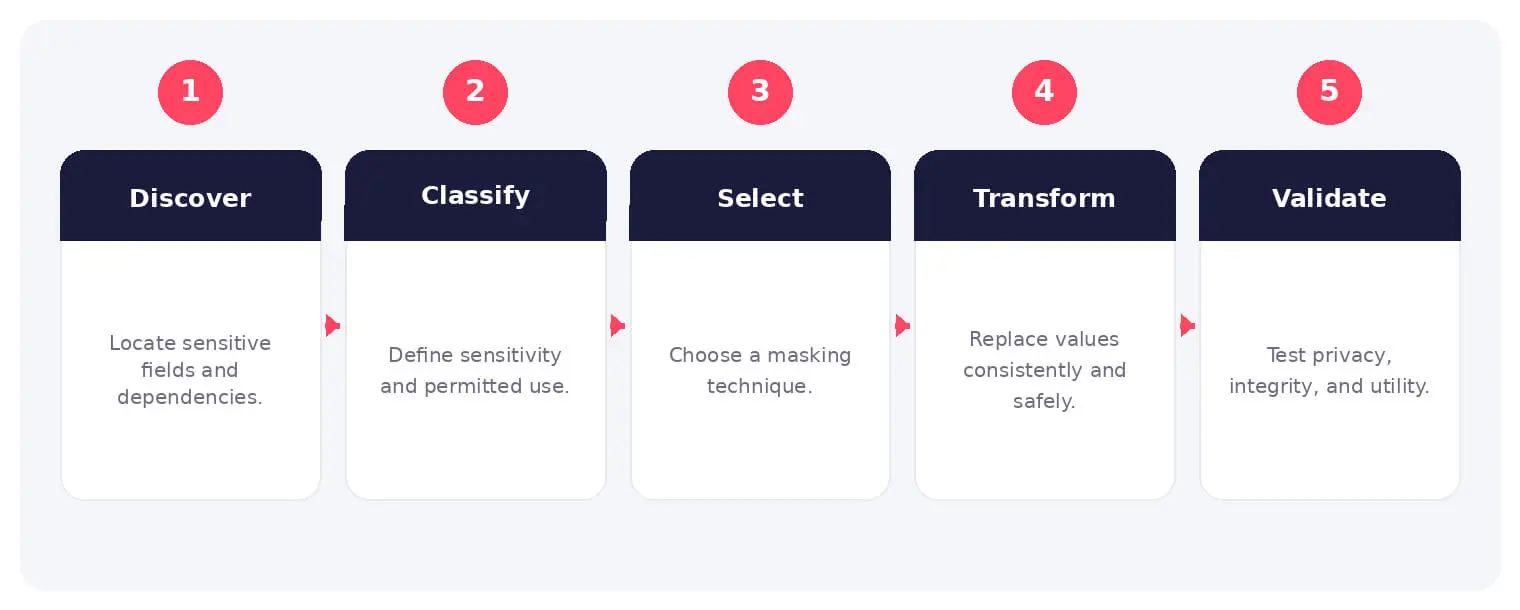
The operating flow above turns a broad security objective into observable steps. Exact implementations vary, but each stage needs an owner, trusted inputs, documented policy, and evidence that analysts can use during investigation and review.
A useful mask preserves the format and analytical properties required for an approved purpose. Masking differs from encryption because masked values may be intentionally irreversible, while encryption protects recoverable data with keys.
Common Types and Capabilities
- Static data masking
- Dynamic data masking
- Tokenization and pseudonymization
- Redaction, substitution, shuffling, and generalization
Security and Business Risks
- Reidentification through linked fields
- Production data copied into test systems
- Broken application behavior or referential integrity
- Inconsistent masking across replicas and exports
Warning Signs and Detection
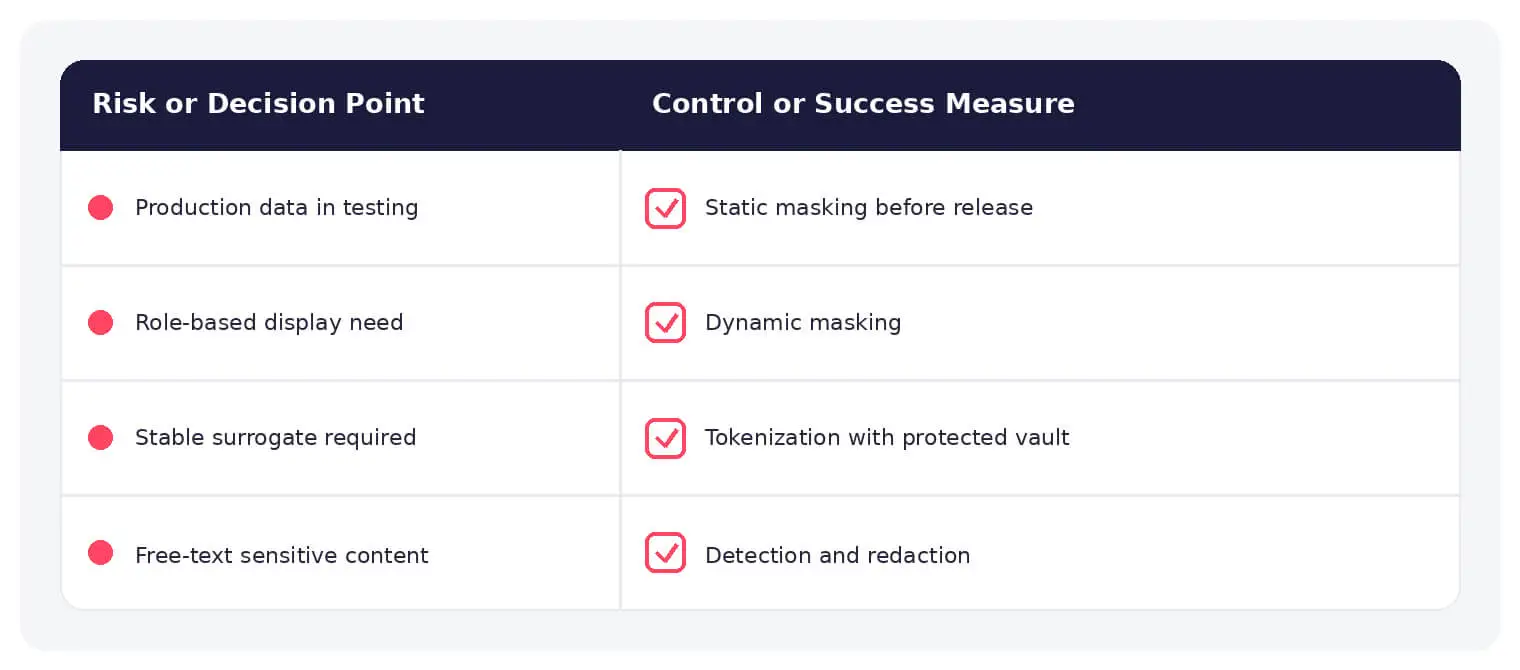
Check for realistic production values in test systems, unmasked exports, reversible transformations, shared token vault access, inconsistent results, privileged bypass, and masking-job failures.
Best Practices
Minimize copied data, use irreversible methods when possible, preserve required relationships, isolate mapping tables, restrict bypass rights, validate outputs, and include backups and replicas.
How SOCRadar Can Help
SOCRadar adds outside-in asset visibility, threat intelligence, exposure context, and continuous monitoring that help security teams validate and prioritize risks related to data masking. This context complements internal cloud, data, network, and identity controls.
Explore SOCRadar Extended Threat Intelligence or request a demo to strengthen threat-informed prevention and response.
Frequently Asked Questions
What Is Data Masking Used For?
Data masking replaces sensitive values, such as names, payment card numbers, or national identifiers, with realistic but fake equivalents so a dataset remains usable for development, testing, analytics, or training. The goal is to keep the data functional for its approved purpose while the original information stays hidden from the people and systems working with the copy.
How Does Data Masking Differ From Encryption?
Encryption protects data with keys and is designed to be reversible for authorized key holders. Masking, especially static masking, is often intentionally irreversible because the original value is discarded rather than recoverable from the masked output. Dynamic masking and tokenization sit in between, since the real value may still exist elsewhere and protection depends on the controls around it.
What Are the Main Types of Data Masking?
The most common approaches are:
- Static data masking: masking a copy before it moves to non-production environments
- Dynamic data masking: obscuring query results in real time without altering stored data
- Tokenization and pseudonymization: replacing values with tokens or surrogate identifiers
- Redaction, substitution, shuffling, and generalization: field-level techniques often combined to fit each data type
How Does Dynamic Data Masking Work in Production Environments?
Dynamic data masking intercepts queries and rewrites the results so unauthorized users see masked values while the stored data remains untouched. This is convenient for live systems, but the real values are still present, so database permissions, bypass rights, and direct export paths must be tightly controlled. If a user can copy the underlying table through a privileged account, the mask does not apply.
Why Is Reidentification Still a Risk in Masked Data?
Individually masked fields can still point back to real people when combined with other linked datasets; dates of birth, postal codes, and rare attribute values are classic examples. If a mask preserves relationships too faithfully or leaves quasi-identifiers untouched, attackers or analysts can join the data back to identities. Generalization and careful review of linked fields reduce this risk, but it should never be assumed away.
What Warning Signs Suggest Masking Controls Are Failing?
Realistic production values appearing in test or staging systems, unmasked exports shared with third parties, and inconsistent masking results across replicas are strong indicators. Masking jobs that fail silently, shared token vault access, and privileged accounts that can bypass masking rules also deserve attention because they enable reversible or incomplete masking.
What Should Teams Do When Unmasked Production Data Is Found Elsewhere?
Contain the exposure first by revoking access to the affected copy and removing or re-masking it where feasible, then review access logs to determine who viewed it and whether it was copied further. If personal data was exposed, route the incident through your data breach process, and address the root cause, such as a failed masking job or an overly broad export path.
How Can Organizations Prevent Masking Gaps Across Environments?
Copy the minimum data needed, prefer irreversible techniques where the use case allows, and isolate mapping or token vault tables from general access. Restrict bypass rights, validate masking output after each job, and extend coverage to backups, replicas, and data sent to vendors or analytics platforms, not only primary test databases.
Why Do Backups and Replicas Complicate Data Masking?
Backups, disaster recovery copies, and read replicas often retain the original unmasked values, so a fully masked production database does not guarantee masked copies everywhere. Restores from older backups can also reintroduce unmasked data into non-production systems. Masking policy should explicitly list every copy location and be reapplied after restores or cloning.
Does Data Masking Preserve Usability for Testing and Analytics?
A well-designed mask preserves format, length, referential integrity, and the analytical properties the use case requires, so applications and test suites keep behaving as expected. Masks built from identical placeholder values or ones that break foreign key relationships can corrupt application behavior and invalidate test results, which is why output validation matters.
Is Masked Data the Same as Anonymized Data?
Not necessarily. Properly applied irreversible masking can approach anonymization, but pseudonymized and tokenized data generally still counts as personal data under regulations such as GDPR because reidentification may be possible with additional information. Whether masked data is truly anonymous depends on the technique used and the realistic risk of re-linking it to individuals.

Oct 16, 2026
CVE-2026-102764: BeyondTrust Zero-Day Exploited
BeyondTrust has disclosed CVE-2026-102764, a critical Remote Support vulnerability exploited as a zero-day weeks before customers received a patch. The attack began…

Oct 15, 2026
Cisco Secure Email & PAN-OS Zero-Days Exploited
Cisco Secure Email & PAN-OS Zero-Days Exploited Cisco and Palo Alto Networks have patched two actively exploited zero-day vulnerabilities that can lead…
Oct 15, 2026
SOCRadar Splunk Integration: New MSSP and Vulnerability Apps
SOCRadar Splunk Integration: New MSSP and Vulnerability Apps Your analysts live in Splunk. Your external risk does not: SOCRadar alarms for dozens…
Intelligence in your inbox every Thursday.
Join 30,000+ security professionals reading SOCRadar research.
Subscribe