
What Is Password Hashing?
Password hashing transforms a password into a one-way value so systems can verify it without storing the original secret.
Secure password storage uses a unique random salt and a deliberately slow, memory-hard password-hashing function. General-purpose hashes such as MD5, SHA-1, or unsalted SHA-256 are too fast and enable efficient offline guessing after a database breach.
Key Takeaways
- Password hashing transforms a password into a one-way value so systems can verify it without storing the original secret.
- Secure password storage uses a unique random salt and a deliberately slow, memory-hard password-hashing function. General-purpose hashes such as MD5, SHA-1, or unsalted SHA-256 are too fast and enable efficient offline guessing after a database breach.
- Offline cracking after database theft is a primary concern.
- Effective security combines prevention, continuous visibility, ownership, and tested response.
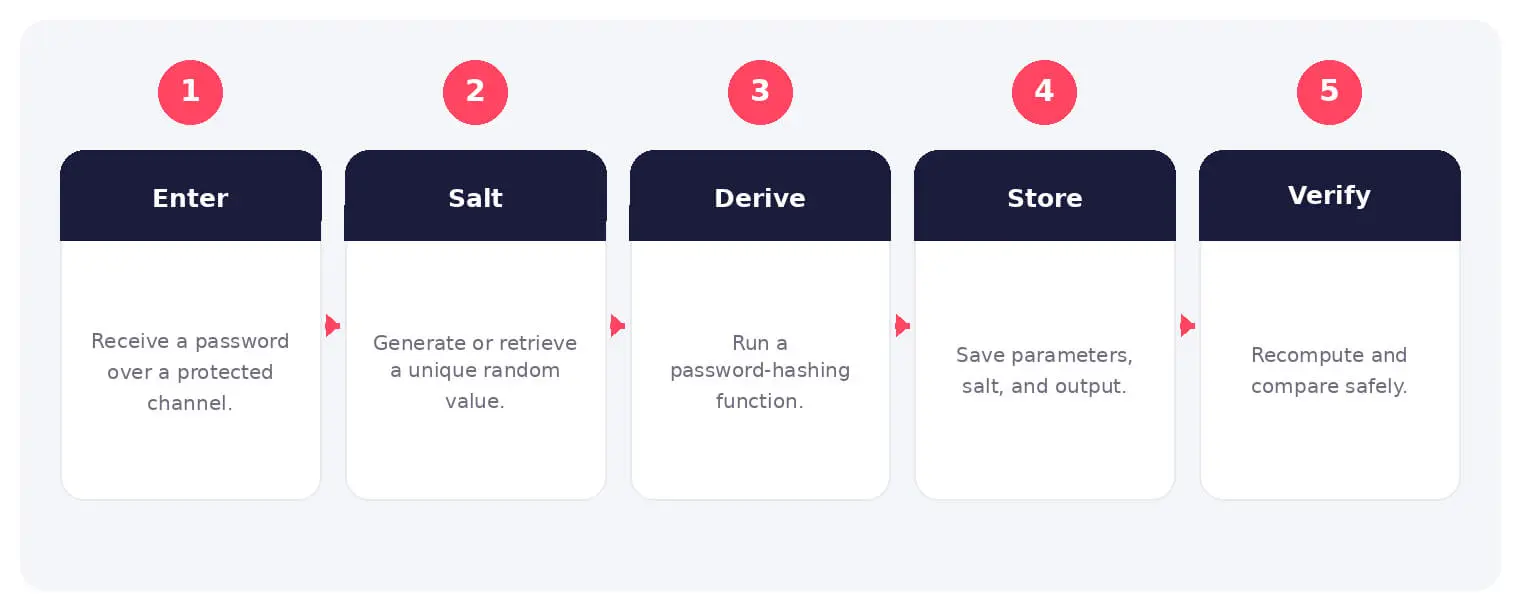
How It Works
The operating flow above turns the concept into observable steps. Exact implementations vary, but each stage needs accountable ownership, trusted inputs, documented policy, and evidence that analysts can use during investigation and review.
Secure password storage uses a unique random salt and a deliberately slow, memory-hard password-hashing function. General-purpose hashes such as MD5, SHA-1, or unsalted SHA-256 are too fast and enable efficient offline guessing after a database breach.
Common Types and Capabilities
- Argon2id password hashing
- scrypt and bcrypt
- PBKDF2 for compatible environments
- Salt, pepper, and work-factor controls
Security and Business Risks
- Offline cracking after database theft
- Weak or reused user passwords
- Unsalted and fast hash algorithms
- Poor parameter upgrades and secret handling
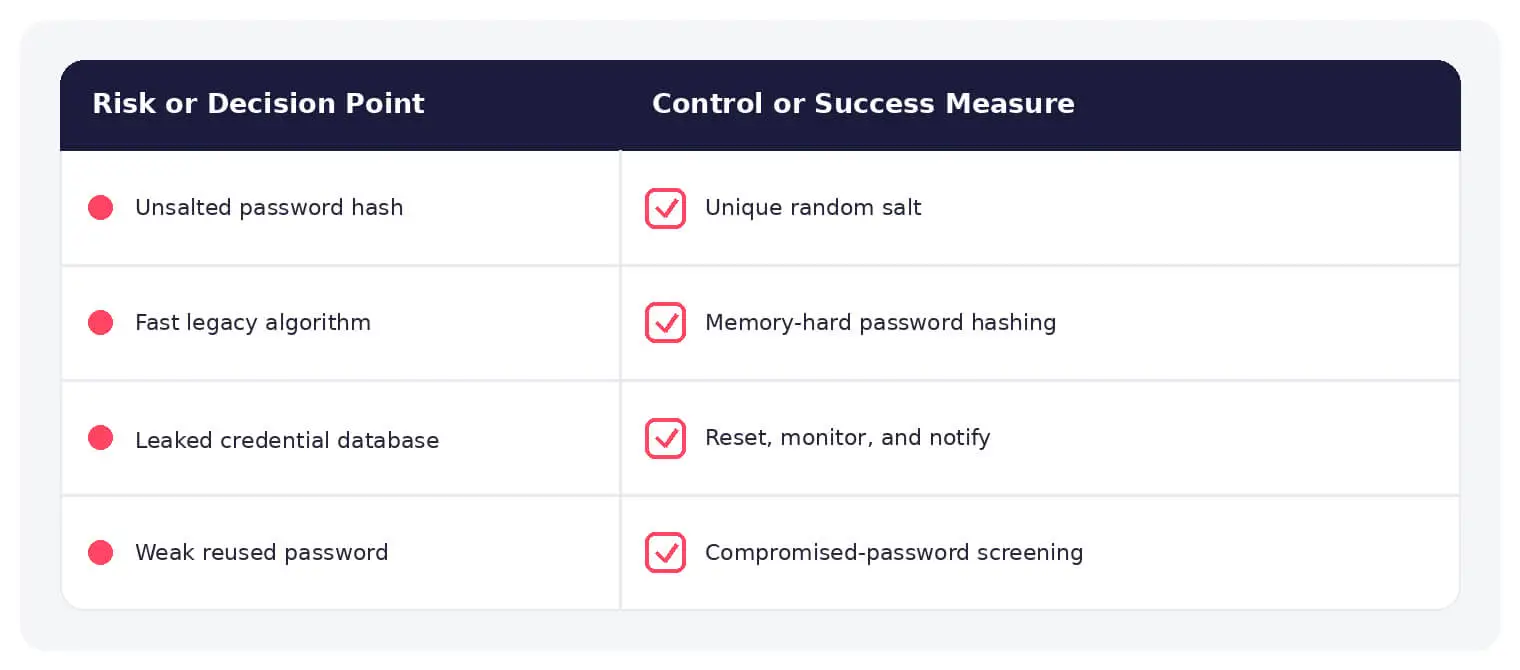
Warning Signs and Detection
Review legacy hash formats, missing or repeated salts, low work factors, plaintext or reversible password storage, unusual authentication failures, credential dumps, password-reset abuse, and databases exposed outside intended boundaries.
Best Practices
Prefer Argon2id where supported, use unique salts, tune cost parameters, protect optional peppers separately, allow long passwords, block known-compromised choices, rate-limit login, use MFA, and rehash after successful login.
How SOCRadar Can Help
SOCRadar adds external visibility, threat intelligence, exposure context, and continuous monitoring to help teams validate and prioritize risks related to password hashing. This context complements internal network, endpoint, identity, and vulnerability controls.
Explore SOCRadar Dark Web Monitoring or request a demo to strengthen threat-informed prevention and response.
Frequently Asked Questions
What Is the Difference Between Password Hashing and Encryption?
Password hashing is a one-way transformation: the original password cannot be recovered from the hash, and verification works by hashing the entered password and comparing the results. Encryption is reversible by design, so anyone holding the key can decrypt the data. Because keys can be stolen or mismanaged, passwords should be stored as salted hashes rather than encrypted values.
Why Are Fast Hashes Like MD5 and SHA-1 Considered Unsafe for Passwords?
General-purpose hashes such as MD5, SHA-1, and unsalted SHA-256 are engineered for speed, which is the opposite of what password storage needs. Modern GPUs can test billions of these hashes per second, enabling efficient offline guessing after a database breach. Slow, memory-hard functions such as Argon2id were designed specifically to make these attacks expensive.
What Does a Salt Do in Password Hashing?
A salt is a unique random value stored alongside each hash and mixed into the hashing process. It ensures that two users with the same password produce different hashes, which defeats precomputed rainbow tables and forces attackers to crack each hash individually. Salts do not need to be secret, but they must be unique per password and generated with a secure random source.
What Is a Pepper and How Does It Differ From a Salt?
A pepper is an optional secret value applied to every password and stored outside the database, for example in a key management system or hardware security module. Unlike salts, peppers are not stored next to the hashes, so a stolen database alone is not enough to begin cracking. Peppers add defense in depth, but rotating one requires rehashing every stored password, so handling and key management need careful planning.
How Do Attackers Crack Password Hashes After a Breach?
With a stolen hash database, attackers run dictionary and brute-force attacks offline using GPU clusters, wordlists, and rules derived from previous leaks. They typically start with common passwords and known credential lists, which is why weak or reused passwords fall first. Memory-hard algorithms significantly raise the hardware cost of these attempts compared with fast hashes.
Which Password Hashing Algorithms Are Recommended Today?
Argon2id is the current first choice because it is memory-hard and allows tuning of both time and memory costs. bcrypt and scrypt remain solid, widely supported alternatives, while PBKDF2 is appropriate mainly where FIPS compliance or legacy compatibility requires it. Whichever algorithm is chosen, cost parameters should be reviewed periodically as cracking hardware improves.
What Warning Signs Point to Weak Password Storage?
Indicators include legacy hash formats, missing or repeated salts, low work factors, and any plaintext or reversibly encoded password storage. Unusual authentication failure patterns, exposed databases, or credentials appearing in underground dumps can signal that hashes are already under attack. Reviewing the authentication code path and database schema is often the fastest way to confirm these issues.
What Should Teams Do After a Password Database Is Exposed?
Treat the affected credentials as compromised: require password resets, revoke active sessions where the platform supports it, and check the exposed hashes against known credential dumps. If the system used fast or unsalted hashes, migrate users to a stronger algorithm and rehash passwords with upgraded parameters as they authenticate. During the transition, rate-limit login attempts and monitor the affected accounts for credential-stuffing activity.
How Should Work Factors Be Tuned and Upgraded?
Set cost parameters so each login takes an acceptable amount of time on your production hardware, commonly in the range of a few hundred milliseconds for interactive authentication. Because cracking hardware improves over time, plan to raise the work factor at regular intervals. A practical pattern is to rehash each password with the new parameters after a successful login, then retire the legacy format once no old hashes remain.
Does Hashing Make Weak or Reused Passwords Safe?
No. Hashing keeps stored passwords from being read directly, but it does not stop attackers from guessing weak choices during offline cracking, and reused passwords put users at risk on other services as well. Combine strong hashing with minimum length requirements, screening against known-compromised passwords, rate limiting, and MFA to reduce realistic risk.
Oct 23, 2026
CVE-2026-114625: Actively Exploited VeloCloud Orchestrator Flaw Grants Superuser Access
CVE-2026-114625 is an actively exploited SQL injection flaw in VeloCloud Orchestrator that lets authenticated users gain superuser operator privileges…
Oct 22, 2026
PHP2Shell Exploit Tooling Found on Exposed Attacker Server
SOCRadar Threat Intelligence Unit (STRU) researchers found PHP2Shell exploit tooling on an attacker-controlled server whose working directory was exposed…

Oct 22, 2026
New LiteLLM Supply Chain Attack Hits PyPI and Docker
A new LiteLLM supply chain attack has turned version 1.107.0, an official release of the popular open-source LLM gateway, into a credential…
Intelligence in your inbox every Thursday.
Join 30,000+ security professionals reading SOCRadar research.
Subscribe