25 Best SOC Tools: AI-Powered & Automated Security Guide
Running a Security Operations Center (SOC) means drowning in tools, not lacking them. The harder problem is finding the right ones, deployed in the right combination, with enough integration to actually work together under pressure. This guide cuts through the noise.
Below are 25 of the best SOC tools available today, organized by function and evaluated for their performance in real-world operational conditions. The list includes enterprise platforms, open source alternatives, AI-native newcomers, and battle-tested veterans. Whether you are creating a SOC from scratch, rationalizing an overgrown stack, or looking for specific capability gaps to fill, there is something here worth your time.
The Evolution of the SOC Tool Stack
The Security Operations Center (SOC) has always been defined by its tools. Those tools are no longer judged by how many log sources they can ingest; they are judged by how autonomously they can respond. That shift is happening in production environments right now, not on a roadmap.
Traditional SIEMs were built to collect everything, correlate what they could, and surface the rest for an analyst. That worked when threat volumes were manageable. Today, a mid-sized enterprise SOC sees upwards of 100,000 alerts per day, with a fraction representing genuine threats. Human-only triage does not scale.
AI-native XDR is displacing legacy SIEMs as the analytical core. SOAR is evolving into autonomous response. Security AI Agents are handling tier-1 triage without a human in the loop. The 25 tools in this guide cover the full spectrum of that evolution.
Category 1 – The Brain: SIEM, XDR, and Data Lakes
The analytical core of the SOC has traditionally been the SIEM. That label increasingly undersells what these platforms actually do. Modern SIEM and XDR tools ingest telemetry from endpoints, networks, cloud workloads, and identity systems, correlate it with threat intelligence, and apply machine learning models to surface anomalies that signature-based rules would miss entirely. The XDR vs SIEM debate that dominated vendor discussions two years ago has largely resolved itself: the best platforms are both.
- Splunk Enterprise Security remains the dominant force in large enterprise deployments, and its acquisition by Cisco has accelerated the AI roadmap considerably. Splunk ES ships with in-SIEM AI agents that automate triage workflows and can convert natural language instructions into SOAR playbooks. For organizations with established Splunk infrastructure, it is a natural extension rather than a rip-and-replace decision.
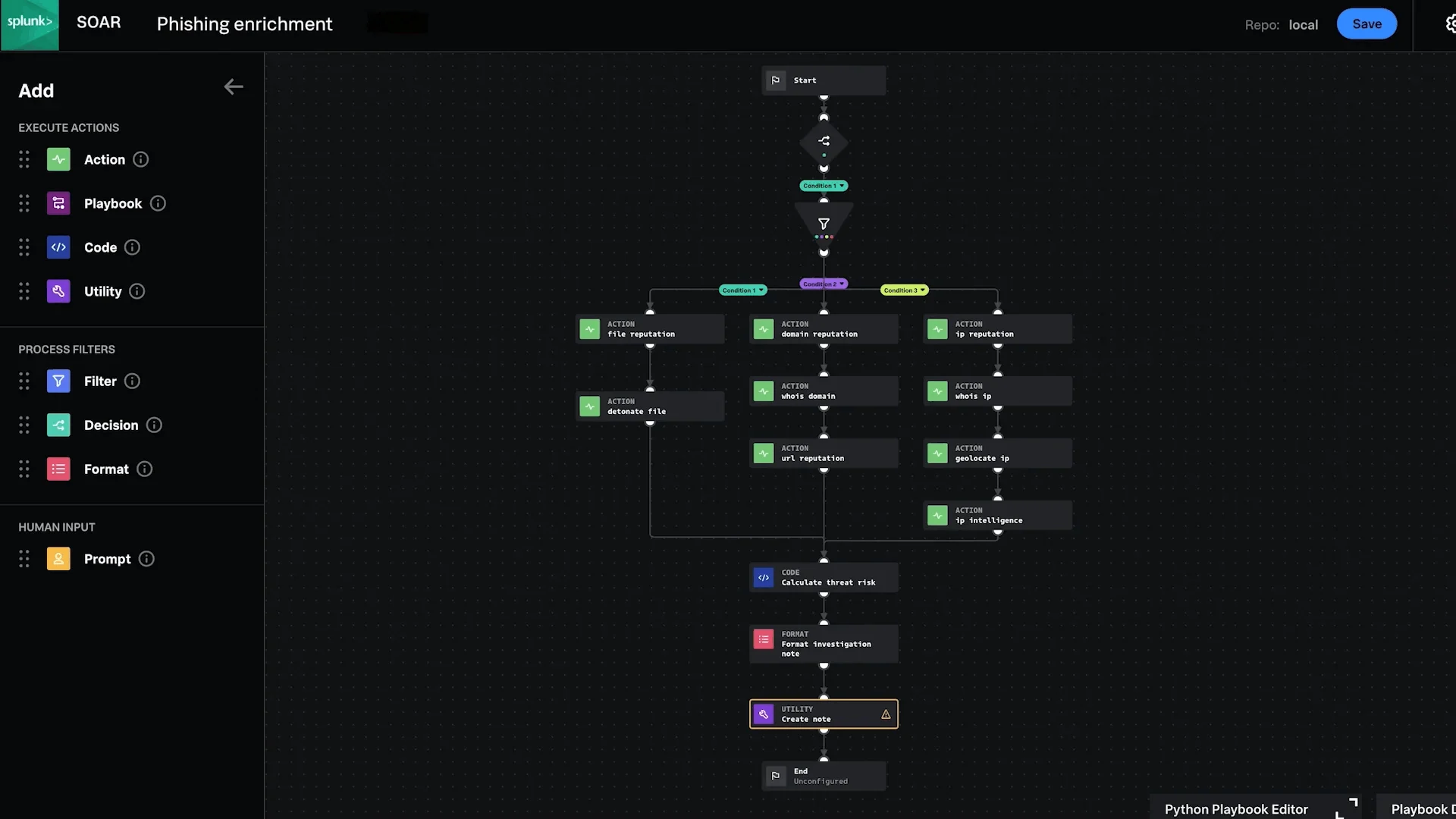
Splunk Enterprise Security, SOAR – Phishing Enrichment
- Microsoft Sentinel is the dominant cloud-native SIEM choice, particularly for organizations already running Microsoft 365 and Azure workloads. Its integration with Microsoft Defender creates a natural XDR layer that covers identity, endpoints, email, and cloud applications from a single pane. The Azure Logic Apps-based SOAR capabilities are mature enough for most incident response use cases without requiring a separate platform.
- Palo Alto Cortex XSIAM represents the most ambitious attempt to merge SIEM, XDR, SOAR, and attack surface management into a single platform. It applies over 2,600 machine learning models against ingested telemetry and now includes the AgentiX agentic layer, which was trained on over 1.2 billion real-world playbook runs. For organizations already invested in the Palo Alto ecosystem, it is the most coherent path to an autonomous SOC.
- Google Security Operations (SecOps) is built on Google infrastructure with a Unified Data Model for normalization and fast search across petabyte-scale telemetry. For teams that prioritize hunting speed and data scale over out-of-the-box automation, SecOps delivers in a way that legacy on-premises platforms simply cannot.
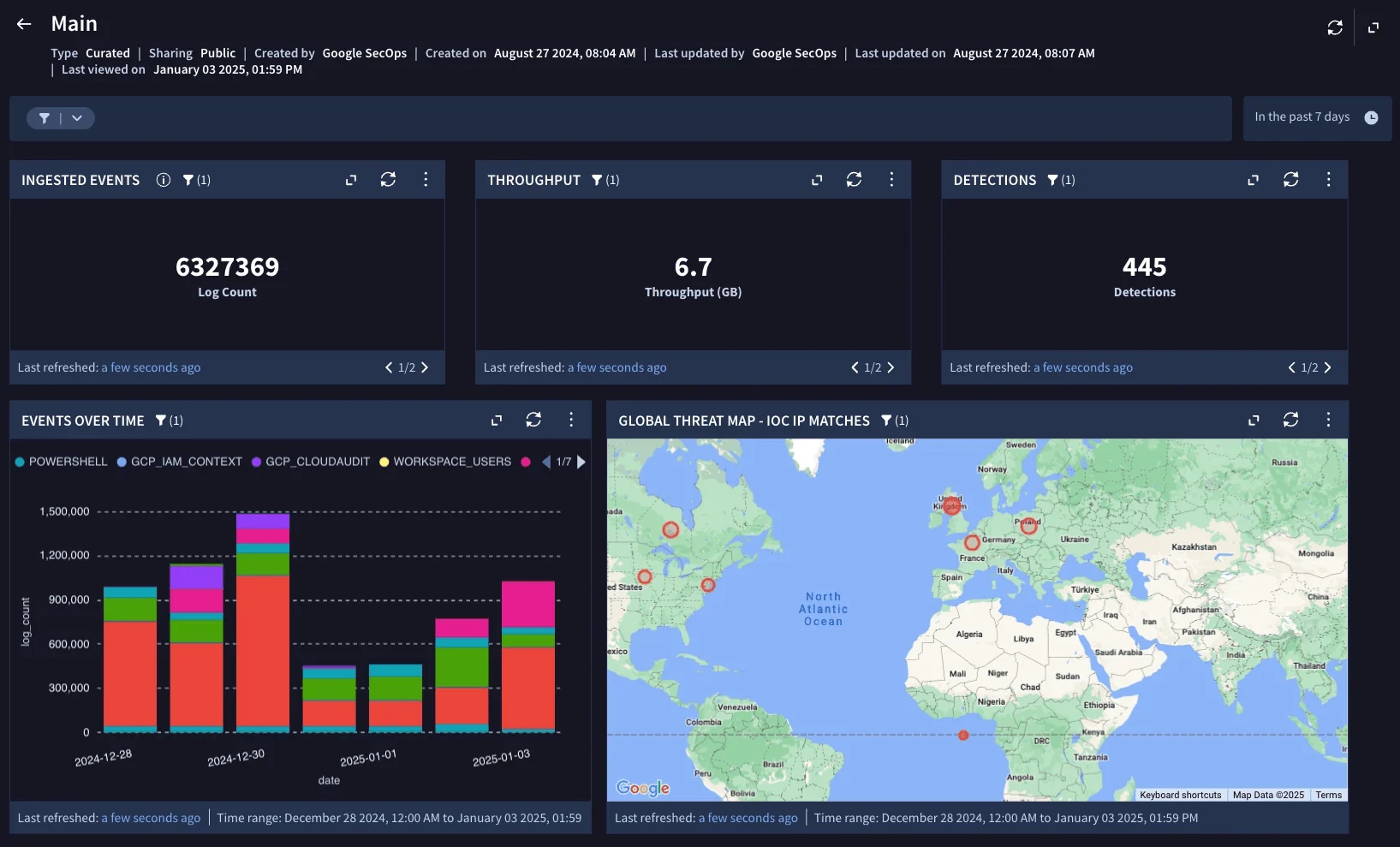
Google SecOps
- IBM QRadar SIEM remains a strong choice in regulated industries. Its Watson AI integration provides cognitive threat analysis, and the IBM X-Force threat intelligence built directly into the platform is among the most complete in the industry. For financial services and healthcare organizations with complex compliance requirements, QRadar’s long tail of compliance reporting capabilities is difficult to replicate.
Exabeam Fusion sits in a related space, applying deep UEBA behavioral analytics to build real-time baselines for users and entities, the go-to SIEM when the threat model is identity-based rather than network or endpoint.
The Security Data Lake has also emerged as a genuine architectural alternative to the traditional SIEM. Rather than paying per GB ingested into a purpose-built platform, teams are centralizing telemetry in cloud-native data stores and building detection logic on top.
- Snowflake Cybersecurity Data Platform is a leading security data lake option. Teams use it to centralize telemetry at petabyte scale without the per-GB ingestion costs that constrain SIEM deployments, then layer detection engineering and threat hunting directly on top. The trade-off is real: it requires more engineering overhead than a packaged SIEM, but for large organizations that have outgrown ingestion-based pricing, the economics shift significantly.
- Cisco Hypershield represents a different kind of architectural bet. Rather than ingesting data into a central platform, Hypershield distributes enforcement and detection directly into the network fabric (hypervisors, Kubernetes nodes, network devices) so that detection and response happen at the point of activity rather than after the fact in a SIEM. It is the most ambitious rethink of the SOC data model since XDR, and one of the more compelling entries in the AI-first security operations space.
Category 2 – The Hands: SOAR & Autonomous Response
SOAR platforms were supposed to solve alert fatigue by automating repetitive work. And they have, to a degree. But classical SOAR requires someone to write the playbooks, maintain the integrations, and handle the cases that fall outside predefined logic. That limitation is exactly where Security AI Agents are changing the equation. An autonomous SOC capability is no longer a thought experiment. It is a product feature.
The table below captures what this shift looks like in practice at the tier-1 triage level, where the volume of work is highest, and the decisions are most amenable to automation.
| Factor | Manual Tier-1 Triage | AI Agent Triage |
| Time to First Response | 15-45 minutes | 30–90 seconds |
| Alert Coverage (24/7) | Limited by shift schedules | Continuous, no gaps |
| False Positive Rate | High – analyst fatigue compounds errors | Reduced through contextual scoring |
| Escalation Quality | Varies by analyst experience | Consistent, evidence-enriched cases |
| Analyst Focus | Repetitive triage tasks | High-complexity investigations |
- Cortex XSOAR is the gold standard for enterprise SOAR. With over 1,000 integrations and a case management layer that handles the full incident lifecycle, it remains the most operationally mature option for large security teams. Its playbook development environment can feel heavyweight, but no other SOAR platform comes close to its depth of pre-built content.
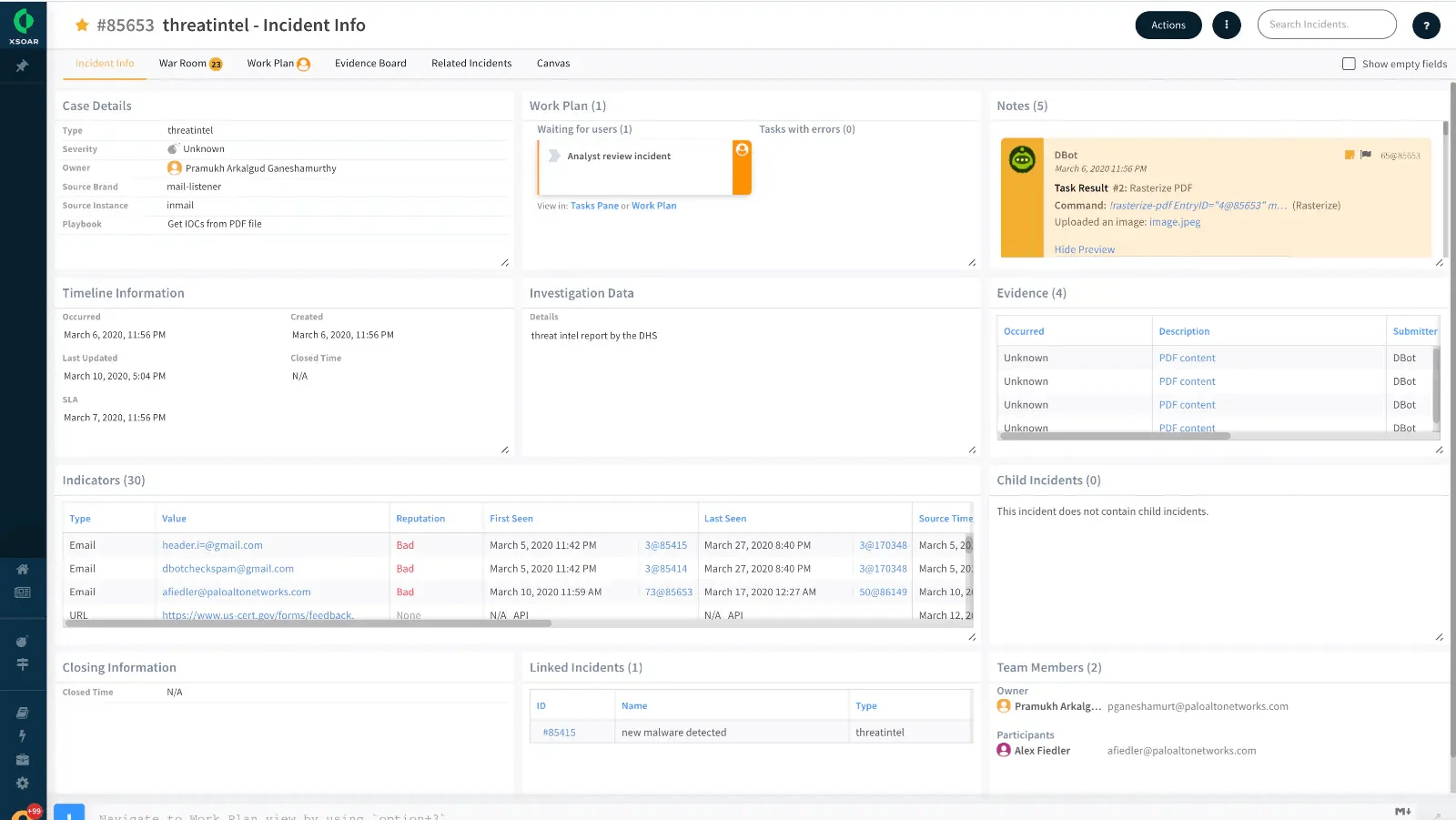
Cortex XSOAR (Palo Alto Networks)
- Splunk SOAR (formerly Phantom) is the natural companion for Splunk ES deployments. If you are already running Splunk as your primary SIEM, SOAR extends that investment by orchestrating response actions across the rest of the stack. Its AI-powered playbook authoring capability, which converts natural language descriptions into runnable playbooks, is a genuine productivity improvement.
- D3 Security Morpheus AI is purpose-built for autonomous operations. With over 800 integrations, self-healing infrastructure, and flat-rate pricing, it is a serious challenger to the established SOAR players for any team that needs orchestration without a per-event pricing model that penalizes comprehensive logging.
- Swimlane Turbine is built for SOC automation teams that need serious scale. Its platform supports execution of millions of automated actions per day, and its engineering-forward design gives large teams more control over complex, high-volume workflows than most alternatives allow.
Category 3 – The Sensors: EDR, NDR, and CNAPP
Detection quality is only as good as the visibility feeding it. The sensor layer of the modern SOC has expanded well beyond traditional endpoint agents. A complete coverage picture requires endpoint telemetry, network traffic analysis, and cloud workload visibility, with the latter increasingly delivered through Cloud-Native Application Protection Platforms that unify posture management, workload protection, and runtime detection under one roof.
- CrowdStrike Falcon remains the reference standard for EDR. Its cloud-native architecture delivers detection content updates in minutes, not days, and its threat hunting team is unmatched. The Falcon platform has expanded into XDR territory, pulling in identity data, cloud signals, and third-party telemetry. For organizations that want a single vendor to handle most of the sensor layer, Falcon is the most complete option.
- SentinelOne Singularity competes directly with CrowdStrike and wins on autonomous response. Its Purple AI layer handles investigation and threat hunting through a conversational interface, and its rollback capability for ransomware remediation remains best-in-class. For SOCs that prioritize automated response over manual investigation workflows, SentinelOne is worth a head-to-head evaluation.
- Microsoft Defender XDR offers the most cost-effective XDR option for Microsoft-centric environments. Its ability to correlate signals across email, endpoints, identity, and cloud applications in a single incident view is genuinely useful. It works best within the Microsoft stack; network detection and third-party telemetry integration require more engineering than native Microsoft coverage.
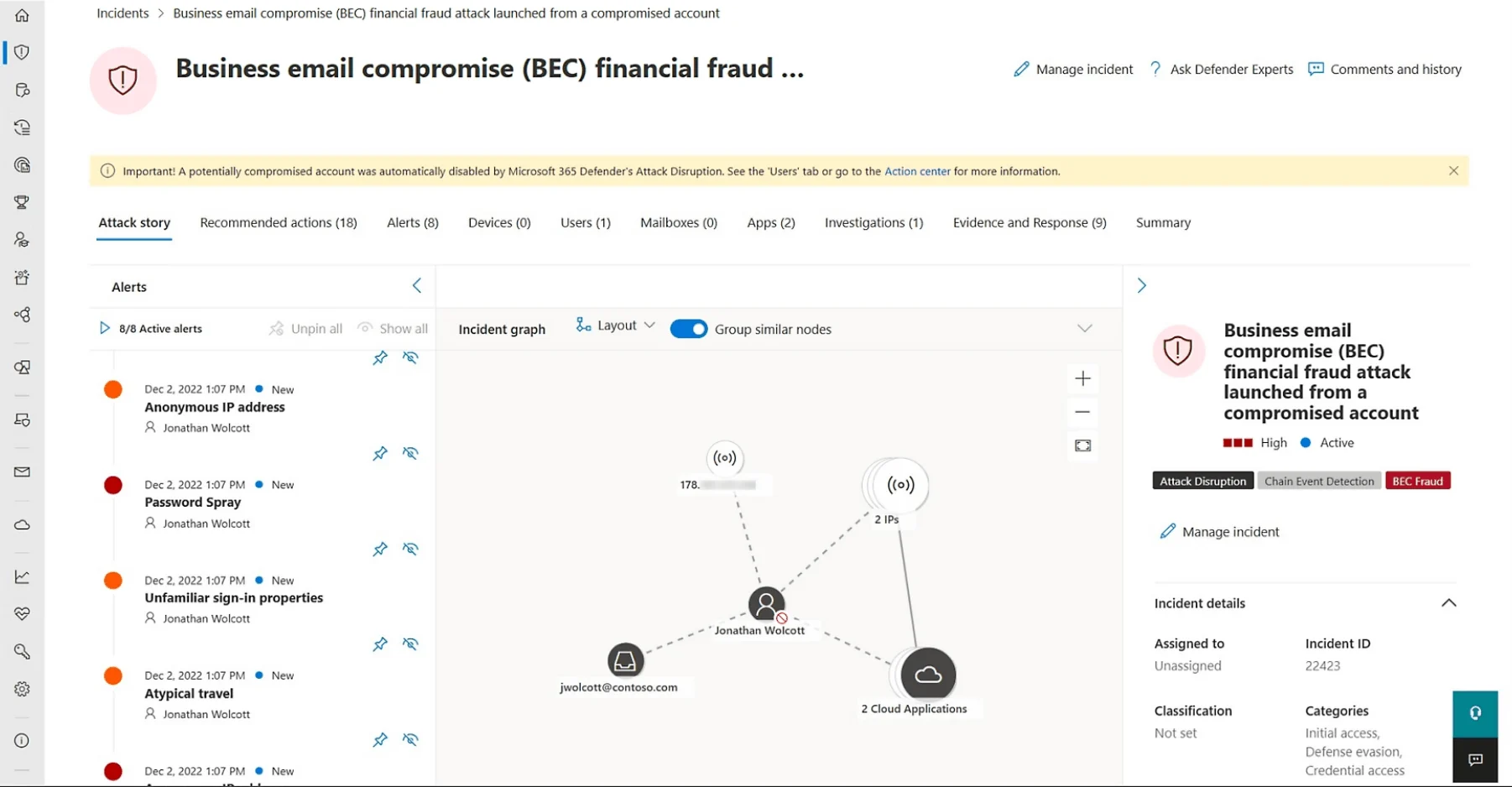
Microsoft Defender XDR
- Stellar Cyber Open XDR is built for lean teams and MSSPs who need broad coverage without tool sprawl. Its release adds agentic AI features across multiple security domains and delivers a unified data lake that ingests from network, endpoint, cloud, identity, and email simultaneously. The mid-market focus means less enterprise depth, but for organizations with 50–500 employees, it is an extremely well-rounded platform.
- Orca Security is one of the strongest CNAPP platforms in the market. Its agentless approach scans cloud workloads, storage, and identities without requiring deployed agents, using SideScanning technology to read cloud configuration and workload state directly from the cloud provider. Orca correlates vulnerabilities, misconfigurations, exposed secrets, and lateral movement paths into prioritized attack paths, giving cloud security teams a risk-ranked view rather than a raw vulnerability list. It covers AWS, Azure, GCP, and Kubernetes natively.
- Corelight was founded by the creators of Zeek and turns open-source network visibility into an enterprise-grade sensor. Its appliances generate highly structured network logs (covering DNS, HTTP, SSL, files, and connection metadata) that feed directly into SIEM platforms, data lakes, and threat hunting pipelines.
Open Source SOC Tools – The Budget-Friendly Stack
The open source SOC stack has matured to the point where engineering-capable teams can build detection and response capabilities that rival commercial platforms in depth, not just in cost savings. The honest caveat is that operational discipline, not software budget, is the real differentiator.
- SOCRadar Free SOC Tools belong in this section because that is exactly what they are: free, production-ready tools that any analyst can use without a platform license. Built on the SOCRadar big data platform with machine learning and advanced behavioral analytics, the suite covers six investigation workflows:
- IP Reputation
- Phishing Radar
- DoS Resilience
- VPN Security
- Email Threat Analyzer
- Email Security Grader
For teams running a lean or open source stack, these fill practical daily-use gaps that would otherwise require paid subscriptions. Worth bookmarking regardless of what else is in the stack.
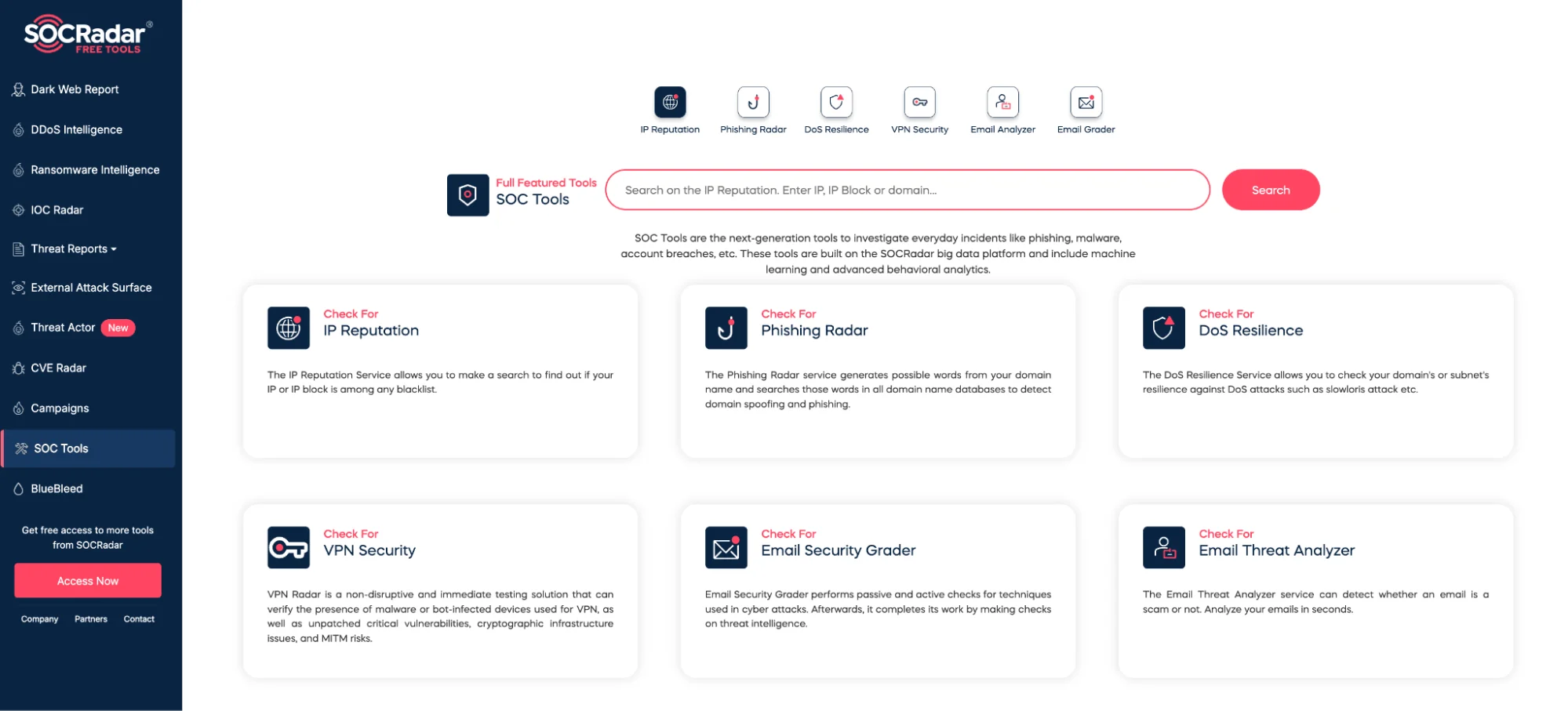
SOCRadar Free SOC Tools
- Wazuh is the anchor of the open source stack. With over 30 million downloads per year and one of the largest security communities in the world, it has moved well beyond its OSSEC roots. The current release delivers unified XDR and SIEM on a single agent architecture: log analysis, vulnerability detection against live CVE feeds, file integrity monitoring, compliance reporting for PCI DSS and ISO 27001, and active response that can isolate a host or block an IP autonomously. It runs on Windows, Linux, macOS, Kubernetes, and cloud environments. For most organizations building from open source, Wazuh is where you start.
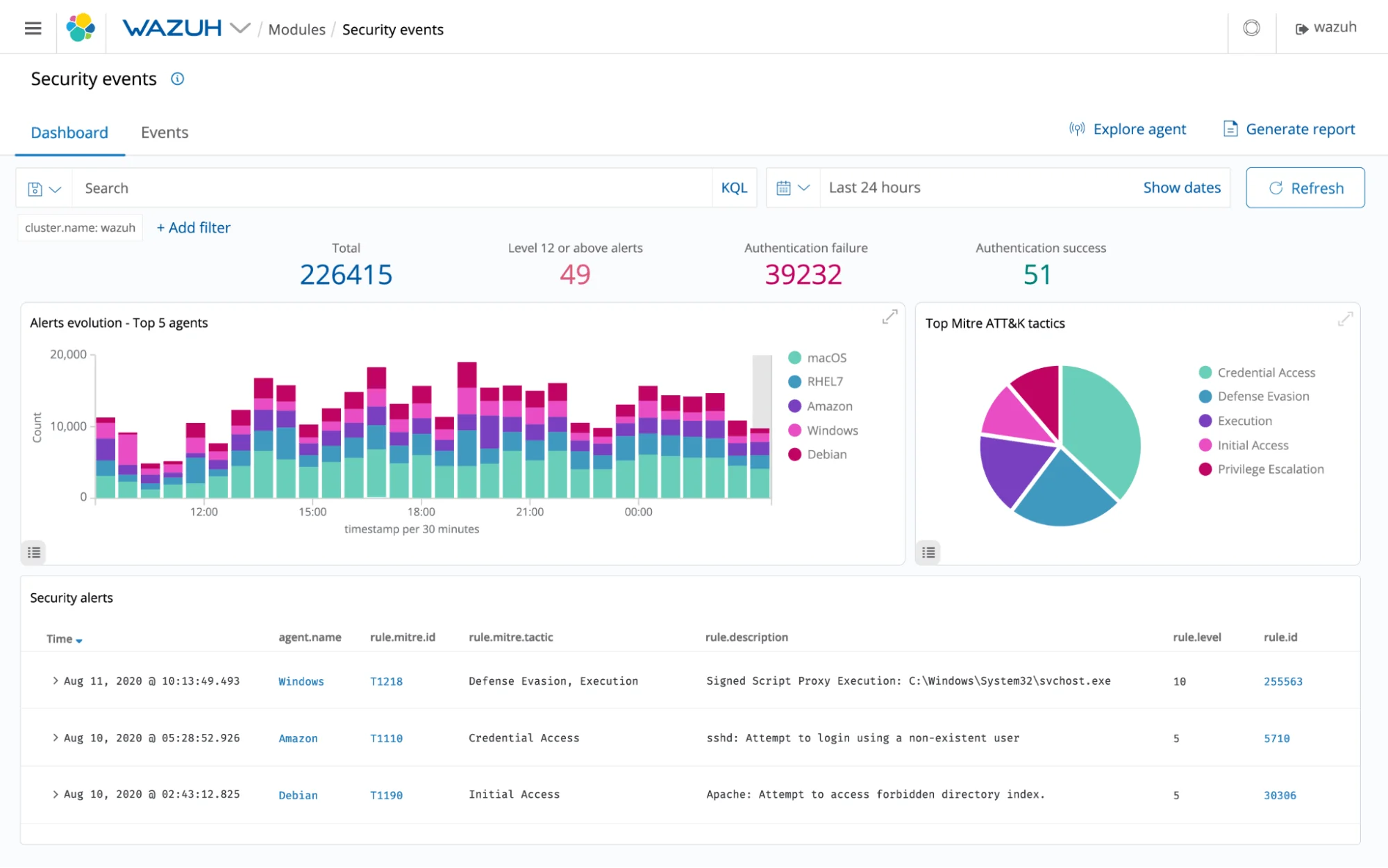
Wazuh security events dashboard
- Elastic Security is a materially different product from the ELK Stack people set up five years ago. The current release ships with a dedicated security solution layer including a detection rules engine mapped to MITRE ATT&CK, a built-in SIEM experience with timeline investigation, and cloud-native workload protection. The open-source core remains free; the managed cloud tiers and advanced ML features are paid. For teams that want Elasticsearch’s indexing power without building detection logic from scratch, Elastic Security gives you a running start.
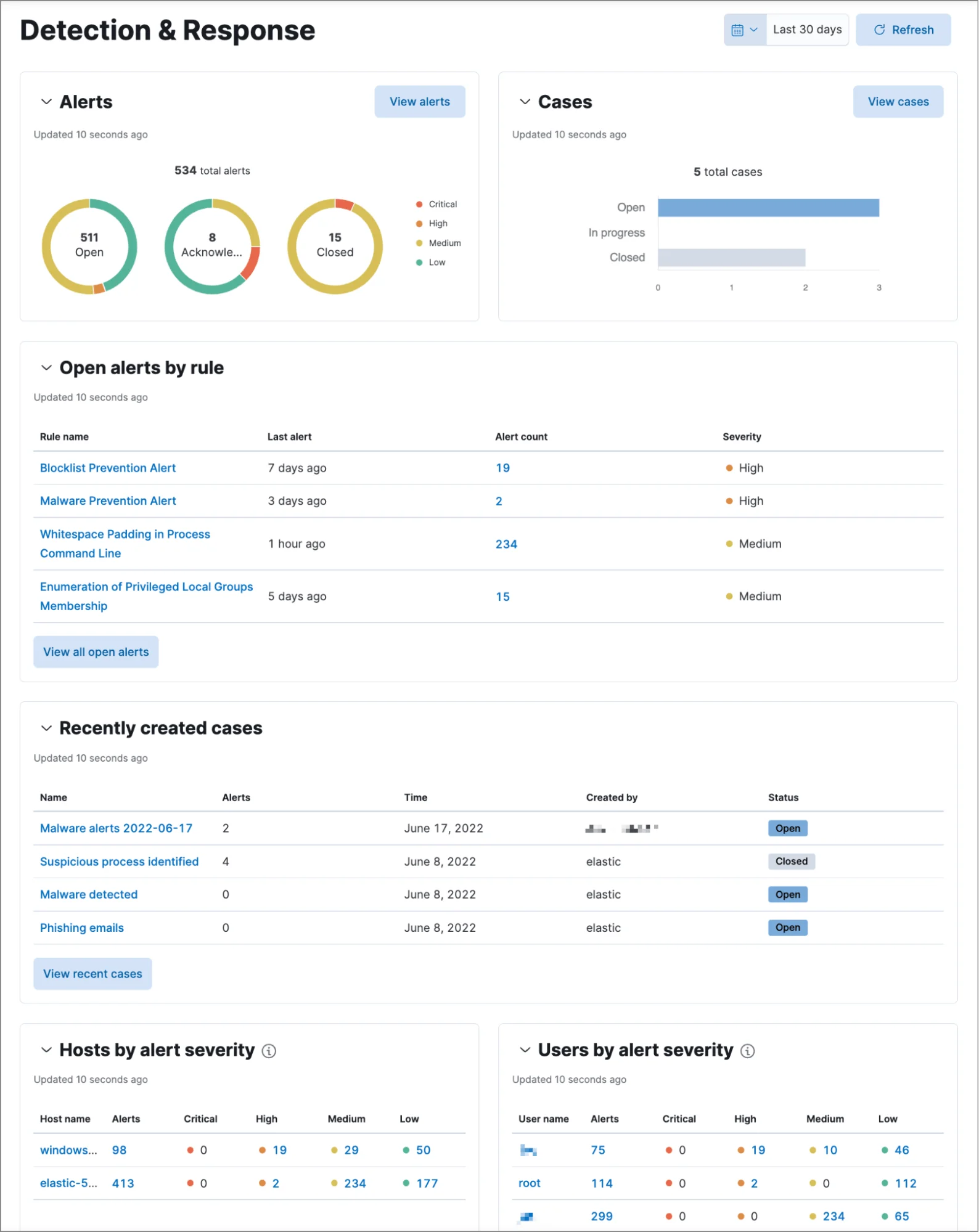
Elastic Security detection & response results
- TheHive is the case management layer that turns detection into structured response. Version 5, the current release, introduced a significantly redesigned data model and a REST API that integrates cleanly with Wazuh, Elastic, MISP, and most SOAR automation platforms. It supports multi-tenancy, which makes it viable for MSSPs, and its Cortex integration enables automated analysis of observables (IPs, domains, file hashes) at the point of triage rather than as a manual analyst step.
- Suricata and 23. Zeek together form the open source NDR layer. Suricata handles signature-based intrusion detection and prevention with multi-threading performance that scales to high-traffic environments. Zeek generates rich network metadata logs that enable behavioral threat hunting well beyond what signature matching can provide. In combination with Wazuh and TheHive, they form a practitioner-grade stack that rivals commercial alternatives in detection depth.
MISP and Shuffle round out the open source ecosystem. MISP centralizes indicators of compromise and enables automated feed ingestion, while Shuffle brings low-code SOAR orchestration through a visual editor without requiring Python. Security Onion bundles most of this into a single tested deployment for teams that want a working architecture rather than building from scratch.
Specialized Tools – Threat Intelligence & Malware Analysis
The analytical core and the sensors mean nothing if the intelligence feeding them is stale or incomplete. Threat intelligence platforms and malware analysis tools form a distinct layer in the modern SOC stack, one that determines how quickly your detections adapt to new adversary techniques.
- SOCRadar Malware Analysis is part of the SOCRadar Cyber Threat Intelligence suite and focuses on revealing the behavior and impact of malicious code rather than just flagging known signatures. It lets analysts detonate and examine suspicious files within the platform, correlating findings with SOCRadar’s broader threat intelligence database – threat actor profiles, dark web context, and IOC history – so the output is investigation-ready rather than just a sandbox report.
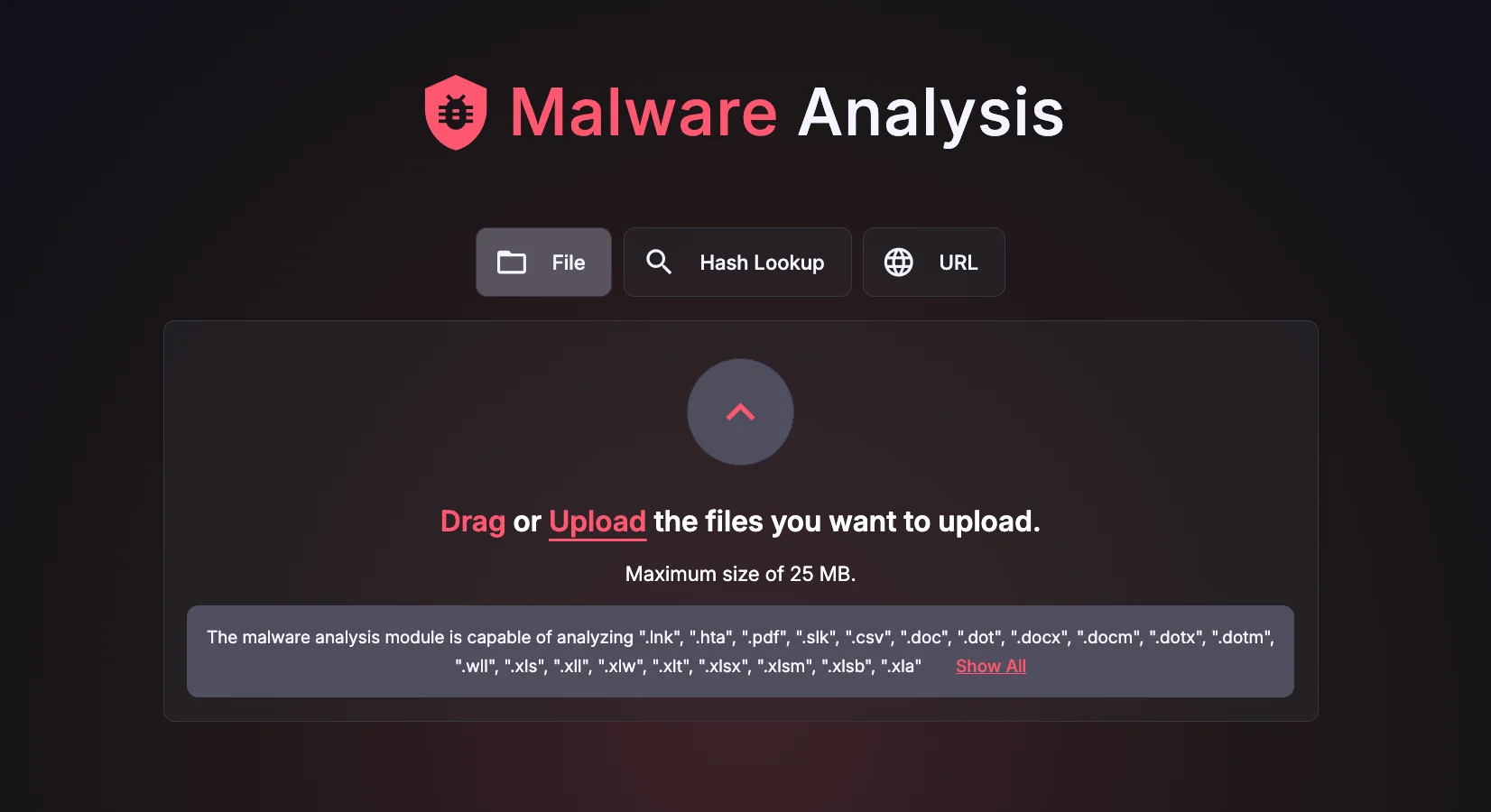
SOCRadar’s Malware Analysis
- ANY.RUN is an interactive cloud-based malware sandbox that lets analysts engage with suspicious files in real time rather than waiting for automated reports. Its process tree visualization maps file activity, registry changes, network calls, and C2 communications as they happen, with findings tagged to MITRE ATT&CK techniques. The free community tier makes it accessible for smaller teams, while the enterprise version supports API-based submission pipelines and SIEM/SOAR integration for automated triage.
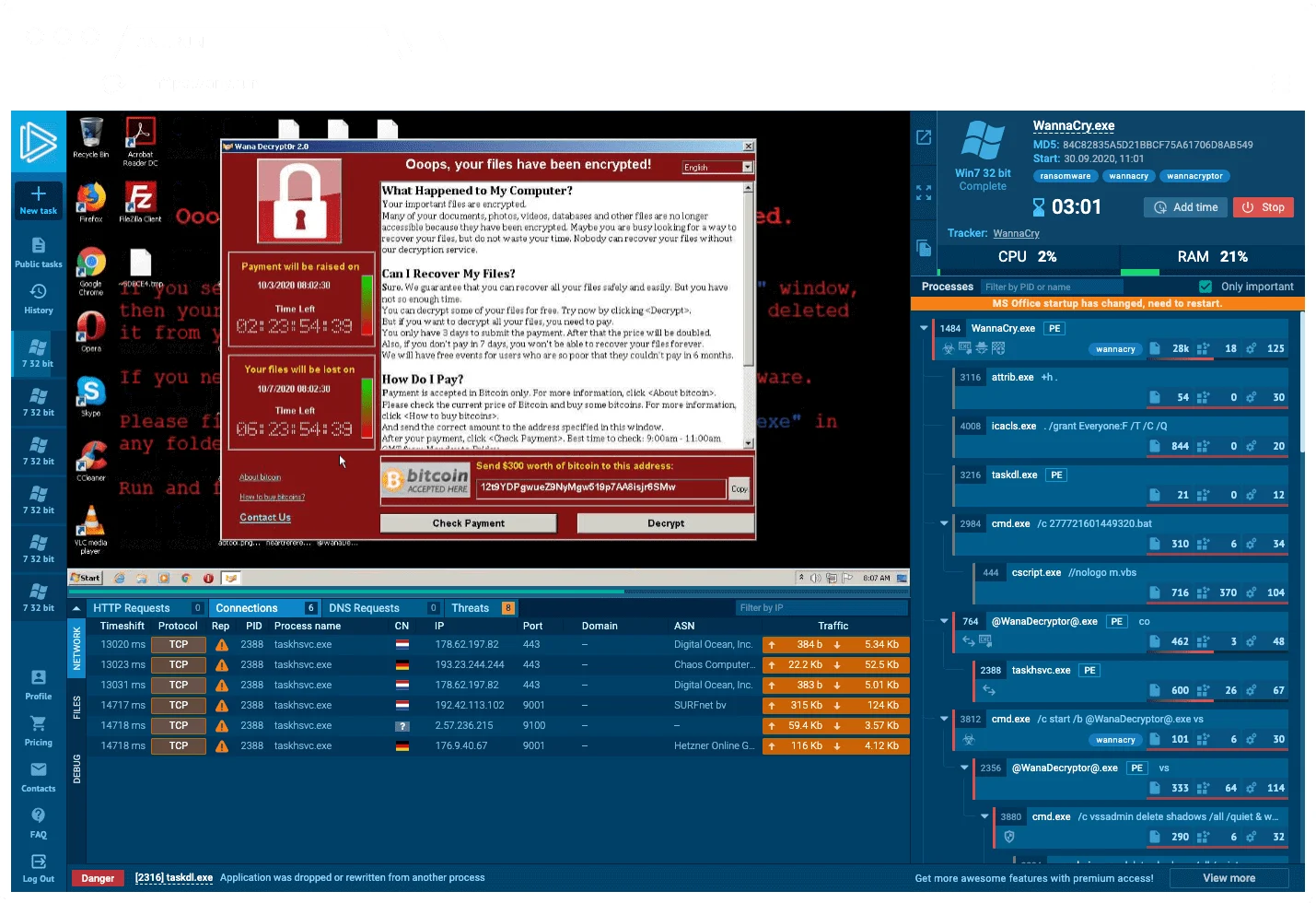
ANY.RUN with WannaCry example
Selecting the Right Stack
Twenty-five tools, six categories, a wide range of price points. The right combination is less about finding the most feature-complete platform and more about matching tool philosophy to team reality.
Three questions are worth answering before you open a vendor comparison doc. First, integration surface – does it communicate openly via API, or will it become a silo? Second, agentic readiness – the platform you select today should be architecturally capable of autonomous workflows when you need them, even if you are not ready yet. Third, time-to-value – prioritize tools that show measurable impact in weeks. Threat intelligence enrichment does not have to wait for a full platform procurement either: SOCRadar CTI Free Edition gives you actionable context on IPs, domains, and CVEs immediately, which is also a useful way to benchmark what paid intel feeds will actually add before committing.
| Profile | Prioritize First | Then Add | Watch Out For |
| Enterprise, Microsoft-heavy | Cloud-native SIEM + integrated XDR | Enterprise SOAR for orchestration | Assuming native integrations cover everything |
| Enterprise, multi-cloud | Data-lake-first SIEM or unified XDR platform | CNAPP for cloud posture + EDR for endpoints | Data ingestion costs compounding at scale |
| Mid-market, lean SOC team | Unified XDR with built-in AI triage | SOCRadar Free Tools for daily enrichment | Over-automating before processes are defined |
| Budget-constrained, strong engineering | Open source SIEM + endpoint agent | Open source case management + NDR layer; SOCRadar CTI Free Edition for threat intel | Tuning debt in first 60 days |
| MSSP / multi-tenant | Multi-tenant XDR or open source SIEM with multi-tenancy | Open source case management + threat intel feeds | Per-client customization overhead |
| Regulated industry (finance, health) | Mature enterprise SIEM with compliance reporting | Malware sandbox + automated threat intel enrichment | Compliance scope creep slowing detection work |