ShinyHunters Claims Comeback With Revoked PGP Keys After Arrests
On November 23, 2026, a statement claiming to come from ShinyHunters appeared on a new Tor leak site, announcing the extortion group’s return about two months after arrests in the Netherlands, Jordan and the United States. As proof of authenticity, the authors relied on two ShinyHunters PGP keys from 2020 that had been revoked in March.
Separately, Okta reported that a voice phishing (vishing) cluster it previously linked to ShinyHunters is now posting its victims on a new leak site branded INCEPTION.
How Did ShinyHunters Resurface?
The comeback was staged on two channels at once: a PGP-signed post titled “The Darkest Day” from the group’s Exploit forum account, and the same signed notice on its new Tor site. Naming that account, held since 2020, as the only official outlet is a credibility play. Account age carries a history that a fresh handle cannot fake, and Exploit’s paid registration sets a higher bar than the open forums where impostors have been trading on the ShinyHunters name. The logic cuts both ways, though: control of an old account, like possession of an old PGP key, proves access, not that the same people are behind it.
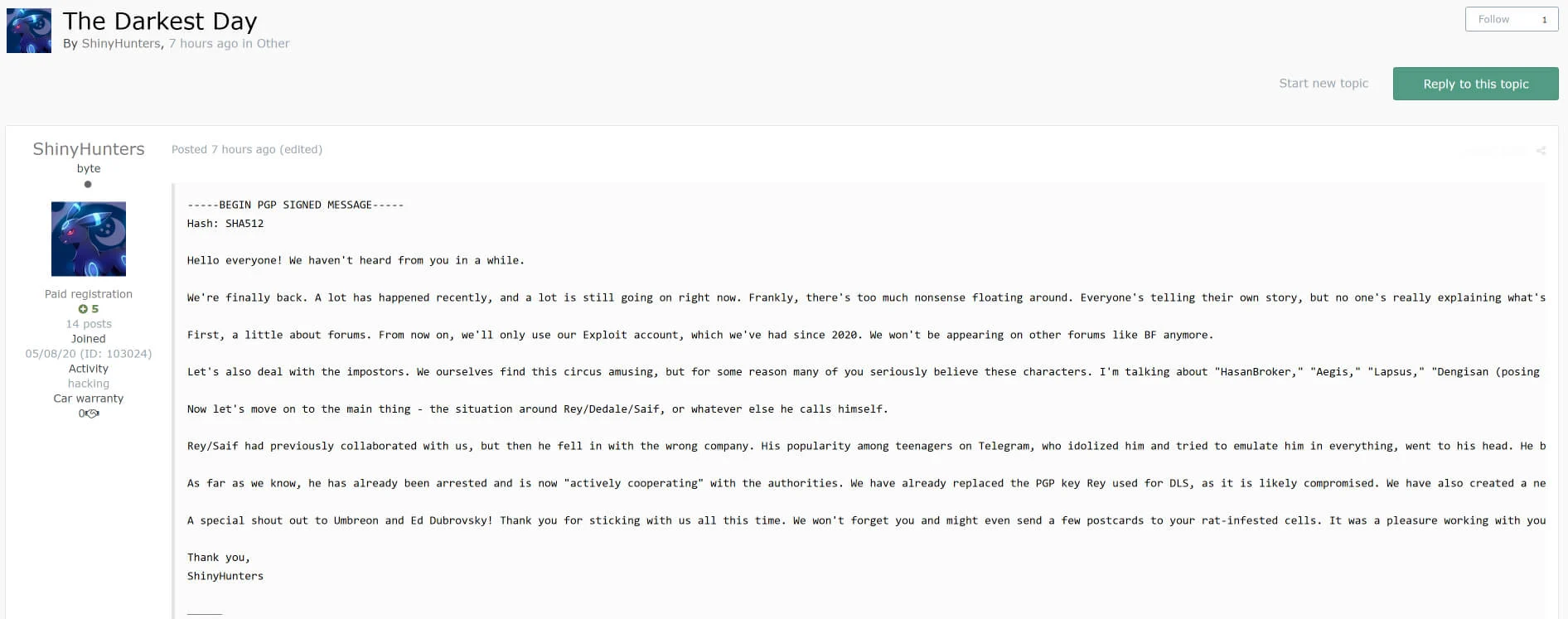
Read closely, the statement is more damage control than a comeback announcement. It disowns rival personas, casts Rey as a rogue member whose Telegram following outgrew the group, and declares his leak-site key compromised. That framing has a practical purpose. If Rey is cooperating with law enforcement, as the group claims, anything he controlled becomes suspect, and a new key plus a single sanctioned account gives the remaining operators a way to separate their output from whatever investigators or impostors publish under the brand.
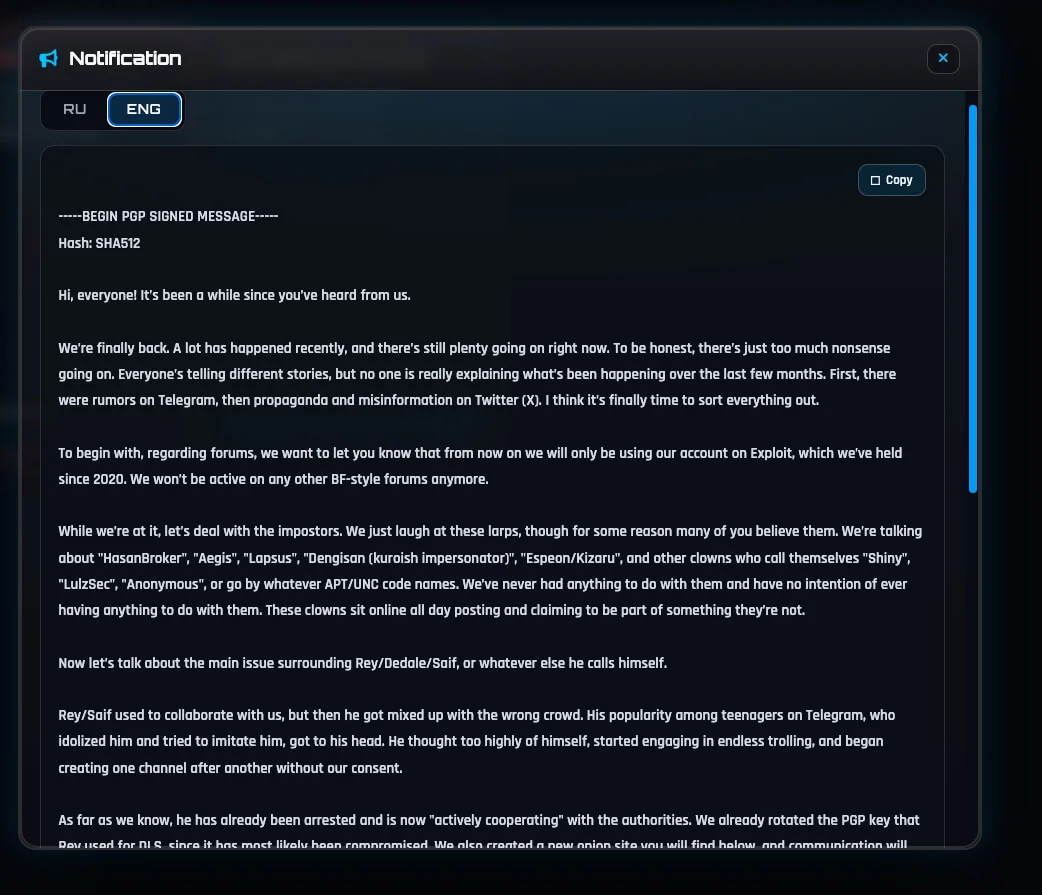
What Does ShinyHunters Say In the Statement?
Beyond the return itself, the statement makes these claims:
- Return: The group says it is back and dismisses a string of personas as impostors, including “HasanBroker,” “Aegis,” “Lapsus” and “Espeon/Kizaru,” along with anyone posting as “Shiny,” “LulzSec” or “Anonymous”
- Channels: Only two outlets are official, the new Tor site and an Exploit forum account the group says it has held since 2020; it says it will no longer post on other forums
- Former member: It says “Rey” let his popularity on Telegram go to his head and opened channels without the group’s consent, then claims he has been arrested and is “actively cooperating” with authorities
- Key rotation: It says the leak site key Rey used “has most likely been compromised” and has been replaced
- Infrastructure: It promises fresh hosting infrastructure for stolen data and says its old backup servers are retired
- Arrests: It taunts “Umbreon” and Edward Dubrovsky over their arrests
As of November 25, 2026, reporting on the statement mentions no new victims or data volumes. The cooperation claim about Rey is unverified: his detention has only been reported, and authorities have not publicly confirmed his identity or any cooperation.
Do the PGP Signatures Prove It Is the Same Group?
ShinyHunters has long used PGP signatures to authenticate its announcements, so the new statement leans on them heavily. The key history, however, complicates the picture.
| Key | Origin | Status Before November 23 | Use in the November Statement |
|---|---|---|---|
| Two historical ShinyHunters keys | Created in January and August 2020 | Revoked in March 2026 | Signed the November messages |
| Replacement key F4953411767DE71BEDCDABCB76F4E26F7A20978A | Announced in March 2026, signed with both 2020 keys | The group’s announced successor key | Not used |
| New key 27DA9D5B183247CADFC322880ABC63E30F73822E | Introduced in November 2026 | New | Vouched for by the two revoked keys |
A valid signature shows only that the signer holds the private key; it says nothing about who that signer is. Copies of the 2020 keys are rumored to have spread beyond the original crew, the statement itself admits another group key was probably compromised, and the successor key announced in March is absent from the new messages. The March rotation was meant to retire the 2020 keys for good, so bringing them back now contradicts the group’s own earlier announcement.
In short, the signatures confirm only that whoever posted the statement holds ShinyHunters’ old 2020 keys. They do not show that the people behind it are the same ones who ran the group before the arrests, so the comeback should be treated as a claim until stronger evidence appears.
Why Did ShinyHunters Go Quiet?
The group went quiet after a run of law enforcement actions that followed its claimed breach of FBI recruitment systems in September 2026.
- September 29: Dutch authorities announced the arrest of an alleged ShinyHunters leader, a 24-year-old whom media identified as Pepijn van der Stap (“Umbreon”)
- Same day: Brett Leatherman, assistant director of the FBI Cyber Division, released a video urging members to come forward, saying “reach out first while the choice is still yours”; he said the arrested suspect and co-conspirators had breached more than 140 organizations and collected at least $70 million in extortion payments
- Late September: The ShinyHunters data leak site went offline
- Early October: A member known as Rey, Dedale or Saif was reported detained in Jordan and cooperating with law enforcement
- Also in early October: Edward Dubrovsky, 54, a Canadian former executive at a ransomware negotiation firm, was arrested in Pennsylvania on charges of conspiracy to threaten the confidentiality of information to extort money and conspiracy to commit Hobbs Act extortion
Court papers in the Dubrovsky case do not name ShinyHunters, although reporting suggests a link to the attack on FBI systems, and FBI Director Kash Patel announced the arrest of “another suspected co-conspirator” without naming anyone.
What Is INCEPTION, and How Is It Tied to ShinyHunters?
Okta’s threat advisory covers a cluster it tracks as O-UNC-053. Okta has followed the cluster since March 2026 and assesses that it was previously affiliated with ShinyHunters.
The timing pattern is the core of Okta’s case. From March to September, organizations targeted by O-UNC-053 phishing domains appeared on the ShinyHunters leak site 1 to 28 days after those domains were registered. No O-UNC-053 targets appeared on any leak site from October to early November. Then, on November 16, a new site branded INCEPTION listed several organizations whose O-UNC-053 domains had been registered 6 to 19 days earlier.
Okta stops short of several conclusions. It cannot tell whether O-UNC-053 runs INCEPTION or works with another extortion operator, and it cannot verify that the leaked data is authentic. Okta also does not connect INCEPTION to the November 23 ShinyHunters statement, so the two should be treated as separate developments.
How Does O-UNC-053 Get Into Organizations?
The cluster relies on phone calls rather than malware. Callers pose as support staff, push the target toward an urgent password reset and steer them to a phishing page. The kit collects the username and password, then prompts for MFA, while the caller talks the victim into reading out one-time passcodes or approving push notifications. SaaS access obtained this way is then used for data theft and extortion.
Okta says the kit cannot defeat phishing-resistant authenticators such as FIDO2/WebAuthn passkeys and Okta FastPass. Other details from the advisory:
- Lures: Phishing themes change roughly every four to six weeks, and legal-department themes have been in use since late October 2026
- Domain patterns: legal-<target>[.]com, legaldept-<target>[.]com, <target>[.]legal and <target>-legal[.]com
- Registration timing: Domains are usually registered on the day a campaign starts or within a day of it, mostly through NICENIC, with Spaceship, Tucows and NameSilo also seen
- Hosting: Sites sit behind Cloudflare, and Cloudflare challenges have blocked deeper analysis of the current kit
- Account takeover sources: Recent logins came through AS19318 (Internet Utilities Na LLC), AS210558 (1337 Services GmbH) and AS399486 (Talon Ops LLC)
- Sectors: Technology, healthcare, biotechnology, financial services, insurance, entertainment, gaming, retail, transportation, hospitality and legal
Domain registrations peaked in August, fell sharply in September and October, a drop Okta suggests may reflect the arrests, and rebounded in November. A separate alert from other researchers analyzed more than 70 legal-themed vishing domains, with the activity running since at least October 2026.
What Should Security Teams Do Now?
Whoever controls the ShinyHunters brand today, the vishing operation behind its past leaks is still active. The measures below map to the techniques Okta describes:
- Phishing-resistant MFA: Enforce passkeys, smart cards or FastPass for sensitive applications, since one-time passcodes and push approvals are exactly what the callers collect
- Help desk verification: Make clear to staff that IT will never ask them to read out a code or approve an unexpected push, and verify password reset requests through a known callback channel
- Lookalike domains: Watch for new registrations that pair your brand with “legal” or “legaldept,” and act fast, since these domains often go live the day they are registered
- Network policy: Step up or block sign-ins from anonymizing infrastructure and rarely used networks, including the autonomous systems Okta listed, and limit sensitive apps to managed devices
- Log review: Search identity, proxy, DNS and email logs for contact with suspicious domains, and review SaaS audit logs for unusual bulk exports after a successful sign-in
- Leak site watch: Check INCEPTION and the new ShinyHunters site for your organization and key suppliers, keeping in mind that a listing is a claim until the data is verified
How Can SOCRadar Help?
When a group name can move between factions and victims can move between leak sites, defenders need to follow the activity rather than the label. SOCRadar covers the two points where this campaign reaches an organization from the outside:
- Dark Web Monitoring: Watches Dark Web platforms and alerts teams when their organization or a key supplier appears in a listing or sale
- Brand Protection: Detects newly registered lookalike domains, including patterns such as legal-<brand>[.]com, so teams can request takedowns before a vishing call sends an employee there
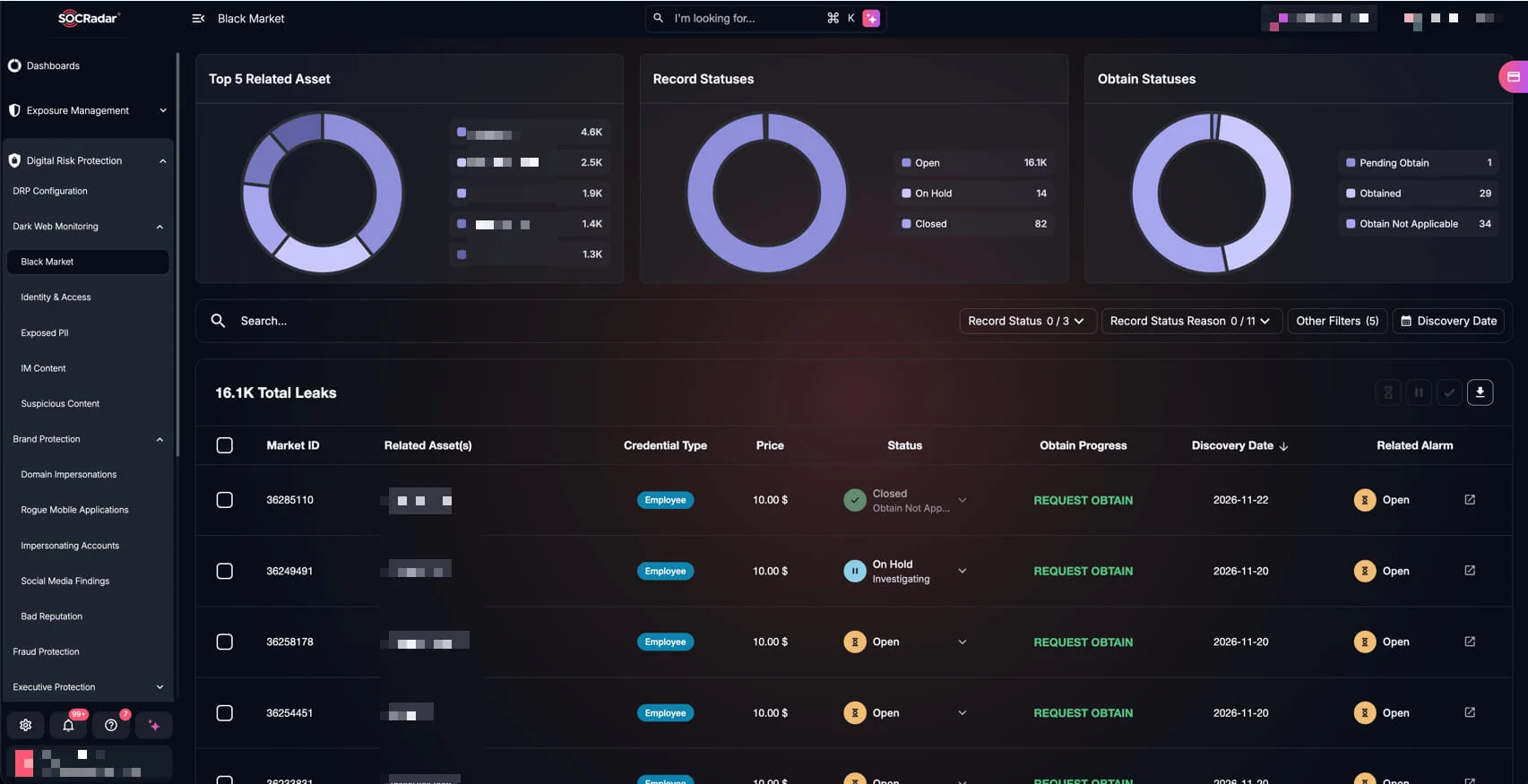
Whatever name the next leak site carries, SOCRadar keeps the focus on the activity behind it, so a listing or a lookalike domain reaches the security team before it becomes an incident.