Dark Web Profile: Rhysida Ransomware
Rhysida calls itself a “cybersecurity team,” presenting its intrusions as a service to the organizations it compromises. Its leak site offers a less charitable picture: stolen documents, price tags and auctions open to bidders. Behind the centipede logo is an operation with ties to Vice Society, operators who hide malware inside signed software installers, and an extortion business that has outlasted attempts to disrupt it.
Who Is Rhysida?
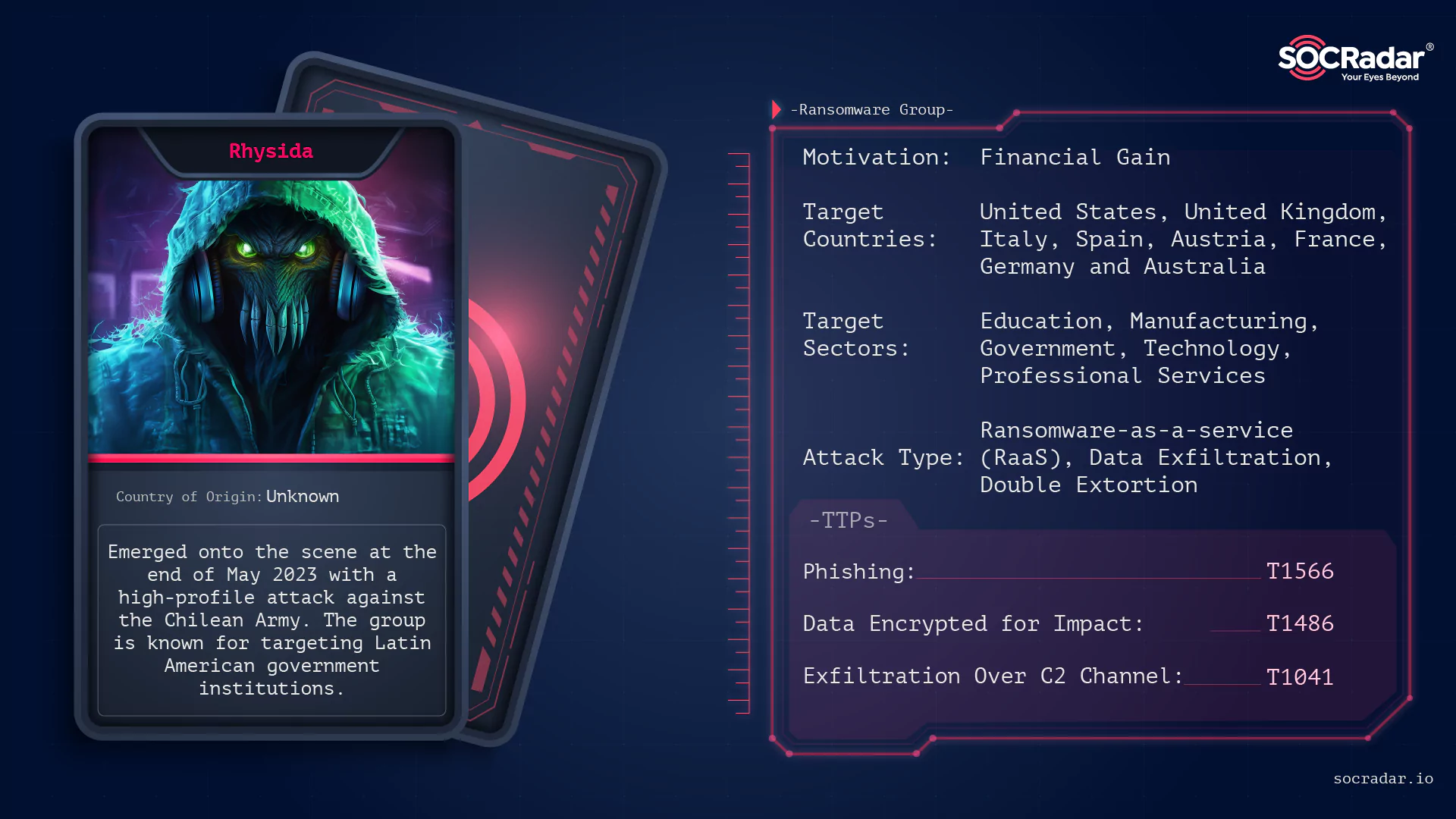
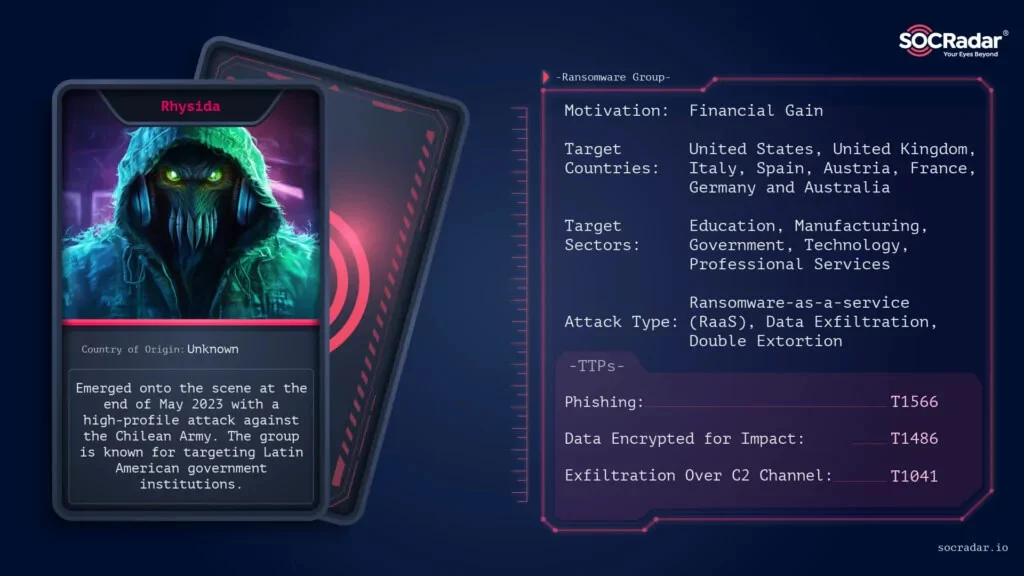
Rhysida is a financially motivated ransomware group that appeared in May 2023 and takes its name and logo from the Rhysida genus of centipedes. It calls itself a “cybersecurity team” that does victims a favor by exposing their security failures. Rhysida actors operate in a Ransomware-as-a-Service (RaaS) capacity, leasing tools and infrastructure to associates and splitting ransoms with them.
From Vice Society to Vanilla Tempest
Rhysida’s closest known relative is Vice Society, an extortion group that hit schools and hospitals in 2021 and 2022. CISA’s advisory notes similarities between Vice Society (DEV-0832) activity and the actors deploying Rhysida.
Microsoft tracks the actor behind Vice Society as Vanilla Tempest, formerly Storm-0832, and says it has been active since at least July 2022. Over that time, the actor has deployed BlackCat, Quantum Locker, Zeppelin, INC and Rhysida payloads. In October 2025, Microsoft attributed a fake Microsoft Teams installer campaign that delivered the Oyster backdoor and Rhysida ransomware to the same actor.
Reports also point to tooling overlaps between Rhysida-linked intrusions and the Interlock ransomware operation, including a shared backdoor called Supper.
Suspected Origin
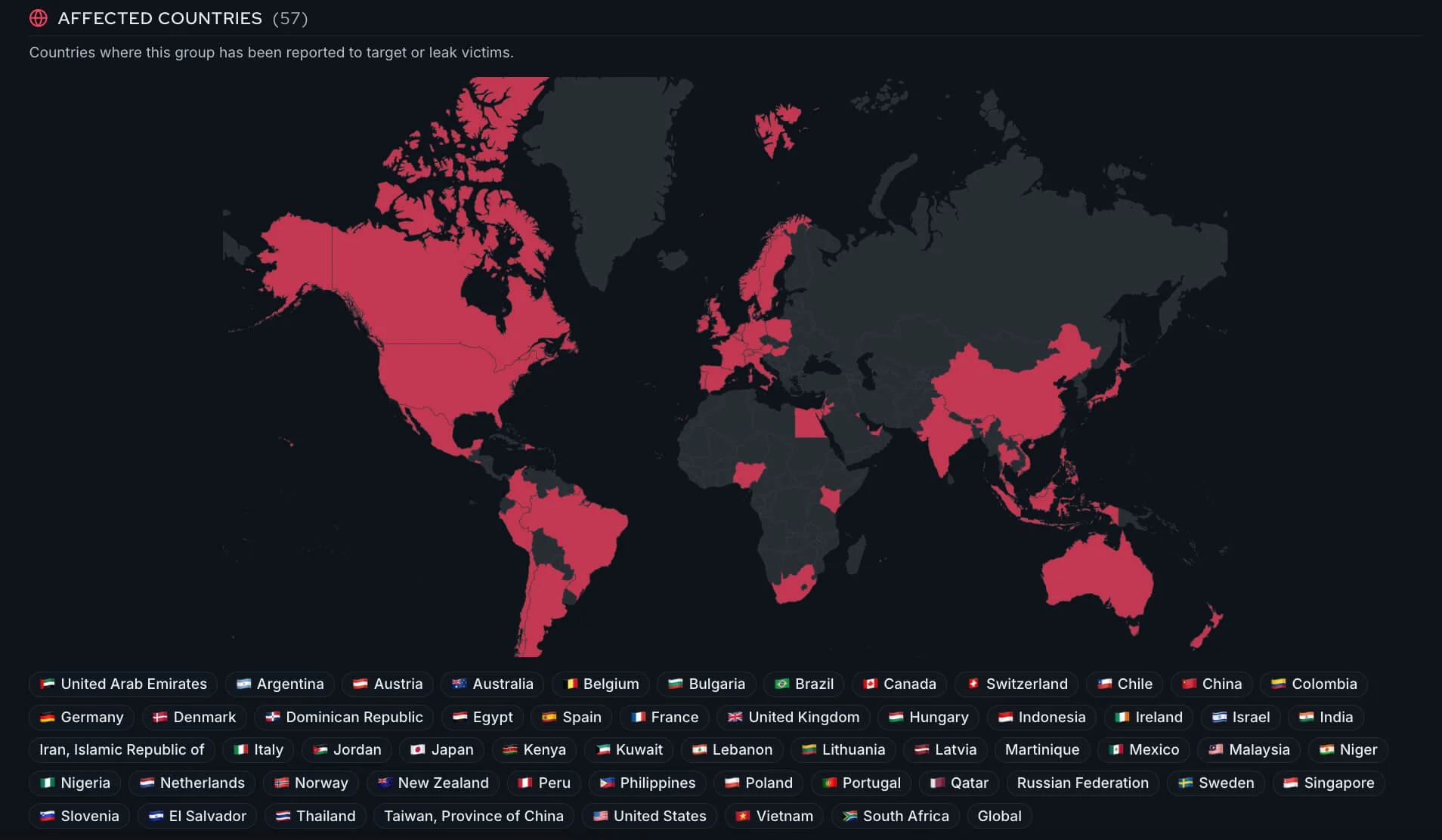
Rhysida has never said where it operates from, and no government has publicly attributed it to a country. When the group emerged in 2023, the US Department of Health and Human Services (HHS) noted that little was known about its origins, while observing that its victims sat in Western Europe, the Americas and Australia, loosely matching the pattern of groups that avoid former Soviet states.
Rhysida’s origins remain unconfirmed. Some security researchers suspect Russian-speaking operators, citing reported Russian-language traces and avoidance of targets in Russia and neighboring countries. However, these indicators do not establish that the group operates from Russia.
Inside Rhysida’s Leak Site
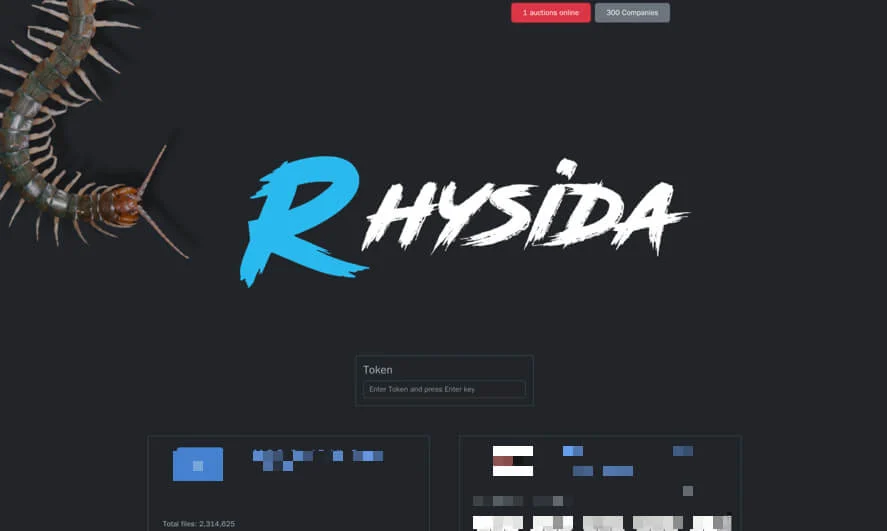
Rhysida’s data leak site (DLS) opens with its centipede logo, a token-entry field, and counters for auctions and listed companies. Open auctions feature descriptions of the targeted organizations, previews of allegedly stolen documents, Bitcoin asking prices, and countdowns. Visitors can also submit offers or comments through a form attached to the auction.
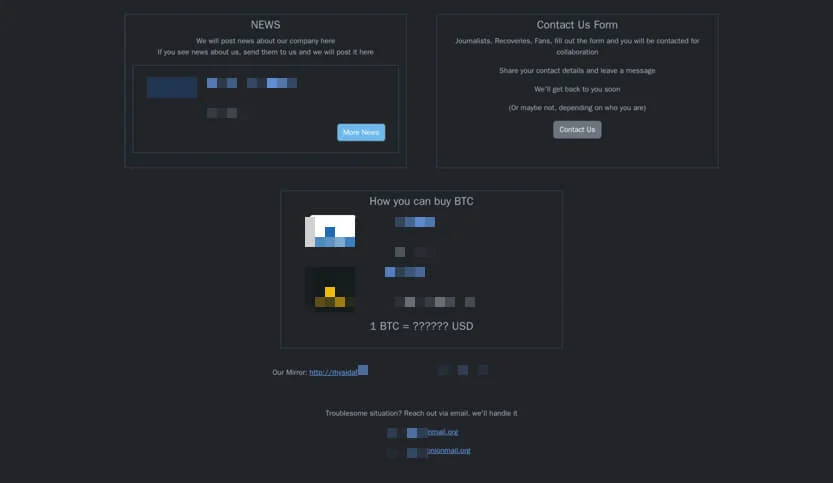
At the bottom, the site shows a news section and a separate contact form for journalists and recovery firms. There are also links to cryptocurrency exchanges, a mirror address, and contact email addresses.
Advisories, a Decryptor and Certificate Revocations
CISA, the FBI and MS-ISAC published the joint #StopRansomware advisory on Rhysida on November 15, 2023. A revision dated April 30, 2025 replaced outdated indicators with ones from investigations as recent as December 2024 and added Gootloader infections and Azure data-transfer tools to the group’s tradecraft.
In February 2024, researchers from Kookmin University and the Korea Internet & Security Agency (KISA) published a paper describing a flaw in Rhysida’s random number generator that allowed them to recreate its encryption keys. KISA used the findings to release a free recovery tool, which supports only the Windows PE version of the encryptor.
In October 2025, Microsoft revoked more than 200 code-signing certificates that Vanilla Tempest had used to sign its fake Teams installers. As of November 2026, no arrests, sanctions or infrastructure seizures targeting Rhysida have been publicly announced.
What Are Rhysida’s Targets?
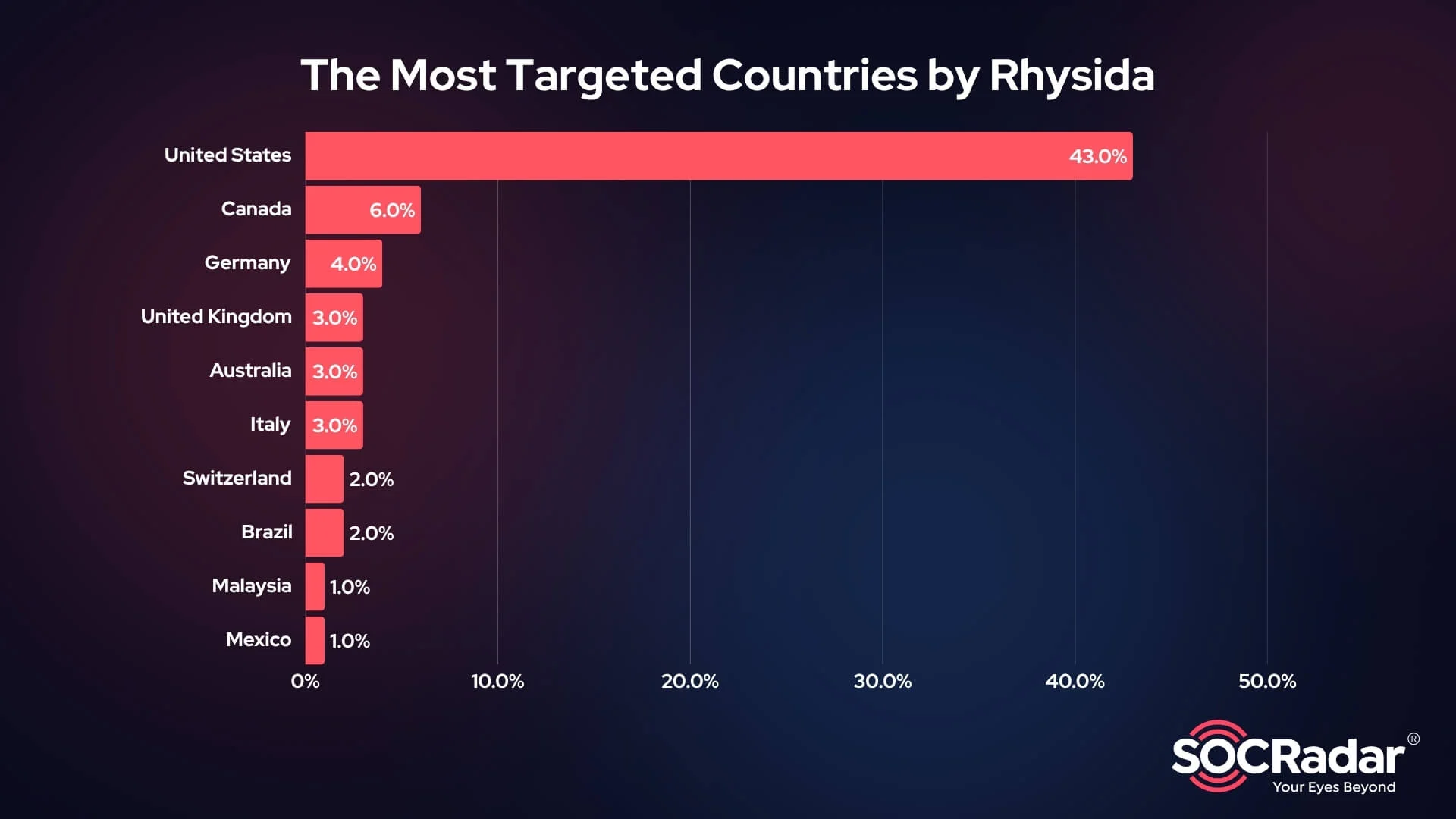
Rhysida has listed more than 300 organizations on its leak site by November 2026. Among victims with country data, the United States accounts for 43%, followed by Canada at 6% and Germany at 4%. The United Kingdom, Australia and Italy each account for 3%, reflecting a geographic reach that extends well beyond North America.
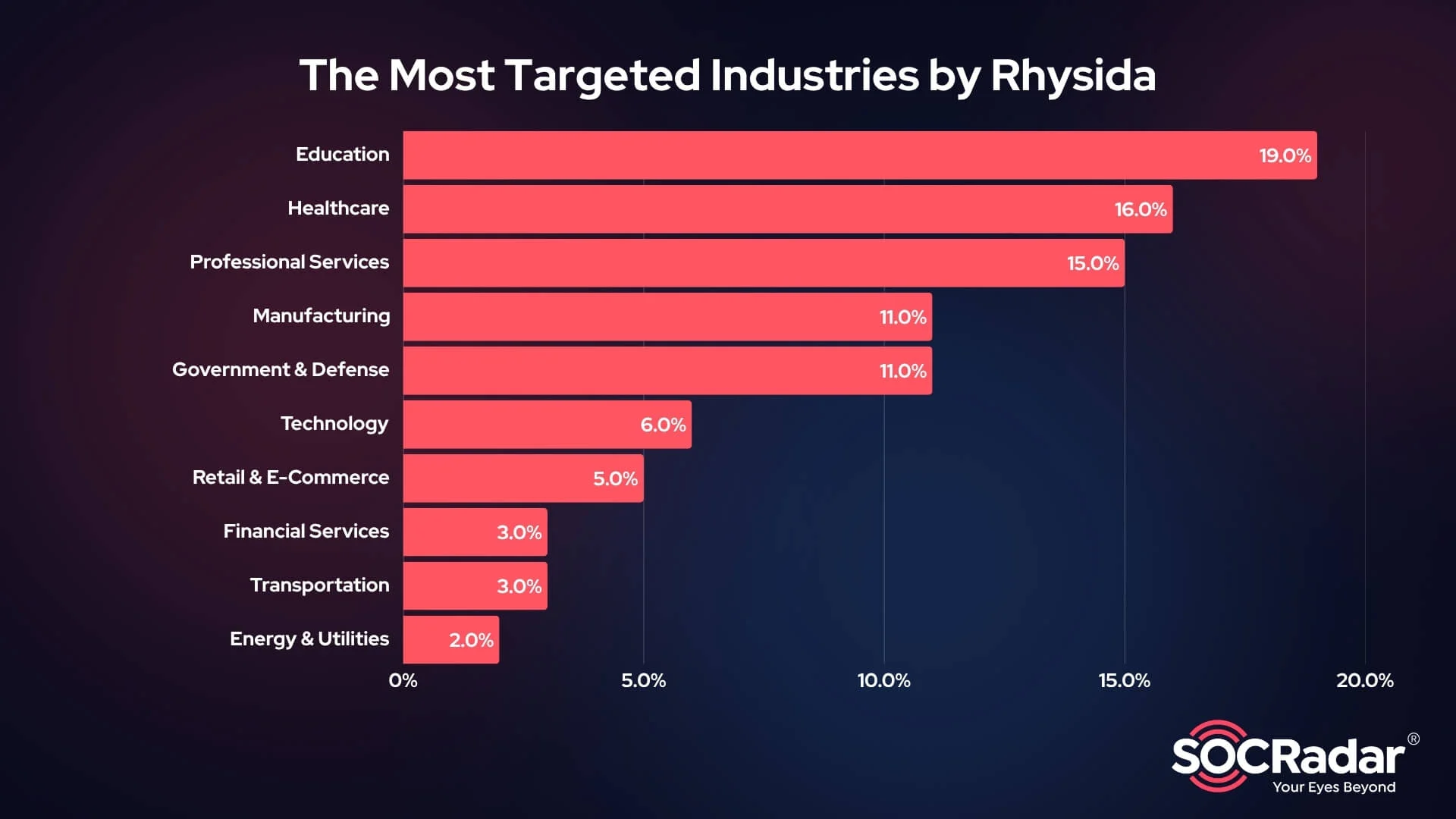
The group’s victims also span a broad mix of industries. Education leads at 19%, followed by healthcare at 16% and professional services at 15%. Manufacturing and government and defense each represent 11%, showing that Rhysida’s activity reaches both commercial organizations and public services.
What Are Rhysida’s Techniques?
Rhysida operators use stolen credentials and malicious downloads to enter networks, then gather information, steal data and deploy ransomware. The tools vary between intrusions, but legitimate Windows utilities and remote administration software feature throughout the attack chain.
Initial Access Through Valid Accounts and Malicious Downloads
Compromised accounts (T1078) provide a common entry point, particularly through VPNs without multifactor authentication. Operators also gain access through malicious downloads, including Gootloader infections. The City of Columbus traced its July 2024 intrusion to a download from a website.
CISA’s original 2023 advisory also listed phishing and exploitation of Zerologon (CVE-2020-1472). Neither appears in the April 2025 revision, though their removal does not establish that these methods are no longer used.
Malvertising and Signed Fake Installers
Since 2024, campaigns associated with Rhysida have used paid search ads (T1583.008) to direct users to fake download pages for Microsoft Teams, PuTTY and Zoom. Researchers identified seven code-signing certificates in a May-September 2024 wave and more than 40 in another beginning in June 2025.
The installers used valid digital signatures (T1553.002) to appear legitimate, including Microsoft Trusted Signing certificates valid for 72 hours. Despite carrying malware, some packed installers were detected by five or fewer antivirus engines for several days after release.
Microsoft attributed a fake Teams installer campaign to Vanilla Tempest in October 2025. Files named MSTeamsSetup.exe, hosted on look-alike domains such as teams-download[.]buzz and teams-install[.]run, delivered the Oyster backdoor. Microsoft revoked more than 200 certificates associated with the campaign, which had used Trusted Signing and certificates from SSL.com, DigiCert and GlobalSign.
Loaders, Backdoors and Crypters
OysterLoader, also known as Oyster, Broomstick and CleanUpLoader, gives attackers a foothold before ransomware deployment. Other observed tools include PortStarter, a Go backdoor that modifies firewall settings.
IBM’s June 2026 research linked Rhysida intrusions to a broader toolset: the Supper backdoor, also called SocksShell and WINDYTWIST; the Tomb crypter; the Endico downloader; and Latrodectus, also tracked as IceNova. In one September 2025 intrusion, Vanilla Tempest used trojanized installers and ClickFix lures to deliver Endico concealed with Tomb before deploying Rhysida.
Discovery, Credential Access and Lateral Movement
Once inside, operators use ipconfig, whoami, nltest and net commands to identify systems, users and administrative accounts. PowerView, Advanced IP Scanner and Advanced Port Scanner support further reconnaissance.
They use ntdsutil.exe and secretsdump to obtain Active Directory credentials (T1003.003). Suspected theft of the domain database warrants domain-wide password resets and two carefully coordinated resets of the krbtgt account.
Operators move between systems through RDP (T1021.001), SSH via PuTTY (T1021.004) and PsExec, while AnyDesk (T1219) provides another remote-access option.
Defense Evasion
Rhysida operators clear Windows event logs with wevtutil.exe (T1070.001) and modify the registry through cmd.exe (T1112). Observed activity also includes process injection (T1055.002) and self-deletion through PowerShell running in a hidden window (T1070.004, T1564.003). Software packing (T1027.002) helps conceal malicious payloads, complementing the certificate abuse described above.
Data Theft and Extortion
Operators stage files in folders such as C:\in and C:\out before transferring them out of the network. Exfiltration tools include Microsoft’s AzCopy utility and Azure Storage Explorer, allowing attackers to use legitimate cloud services for data theft.
One notable example is Rhysida’s October 2023 attack on the British Library, which disrupted its services and resulted in the theft of approximately 600 GB of data, comprising close to half a million documents. The group advertised the stolen files for auction before publishing them on the Dark Web.
Encryption and Ransom Notes
The analyzed Windows encryptor is a 64-bit PE file compiled with MinGW/GCC. Observed deployment scripts copy it as conhost.exe to C:\Windows\Temp on a list of hosts, then execute it to encrypt their files (T1486).
CISA summarizes its cryptography as RSA-4096 and ChaCha20. More detailed analysis of a Windows sample found that a ChaCha20-based random number generator produces per-file AES-256 keys for CTR-mode encryption, with RSA-4096 protecting those keys. Files larger than 1 MB are partially encrypted, targeting 1 MB in each of two to four blocks.
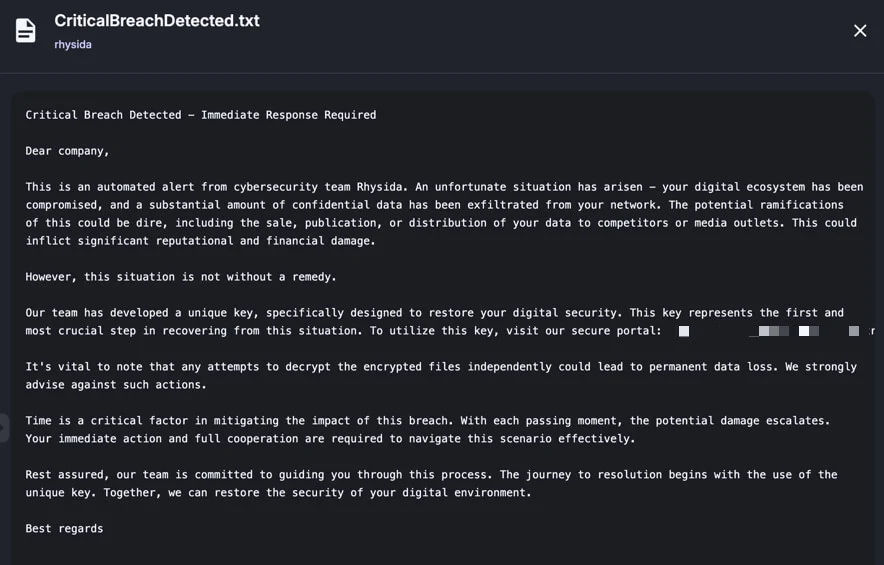
Encrypted files receive the .rhysida extension, and victims receive a ransom note named CriticalBreachDetected.txt. The encryptor also deletes volume shadow copies with vssadmin (T1490) and changes the desktop wallpaper to C:/Users/Public/bg.jpg, unless launched with the -nobg option.
KISA’s recovery tool supports only the Windows PE version covered by its research, not ESXi or PowerShell payloads. Recovery therefore depends on the specific variant involved.
What Are the Mitigation Tactics Against Rhysida?
The controls below map to the techniques Rhysida operators have used since 2023, in the order an intrusion unfolds.
Require Phishing-Resistant MFA on Every Remote Entry Point
Rhysida’s main way in is a valid account on a VPN or remote access server that accepts a password alone. Enforce phishing-resistant MFA on VPNs, RDP gateways, Terminal Services hosts and third-party remote access, and alert on successful logins from new devices or unusual locations.
Keep Software Installs Away From Search Ads
Fake Teams, PuTTY and Zoom installers reached users through paid search results. Deliver collaboration and admin tools through a managed internal software portal, block installers from running out of user download folders, and consider blocking ads through browser policy on corporate devices.
Treat a Valid Signature as One Signal Among Several
Rhysida loaders carried legitimate signatures, including Trusted Signing certificates valid for only 72 hours, and stayed under most antivirus engines for days. Use application control rules that allow only expected publishers, and flag executables signed by unfamiliar small-company signers or by recently issued certificates.
Restrict PowerShell, PsExec and Remote Access Tools
CISA recommends restricting PowerShell through Group Policy, enabling enhanced PowerShell logging and limiting RDP. Allow PsExec, AnyDesk and SSH clients only on designated admin hosts, and alert when they appear on servers or workstations that do not normally run them.
Protect Active Directory Credentials
Alert on ntdsutil.exe and secretsdump activity against domain controllers, audit administrative accounts and grant domain admin rights on a time-limited basis. If NTDS.dit may have been copied, follow CISA’s guidance: reset passwords domain-wide and reset the krbtgt account twice.
Watch for Bulk Uploads to Cloud Storage
AzCopy and Azure Storage Explorer are legitimate Microsoft tools, which makes their traffic easy to miss. Flag them on hosts that do not need them, restrict uploads to approved storage accounts, and alert on large outbound transfers at odd hours, such as the roughly 440 GB the British Library saw leave its network at 1:30 a.m.
Keep Offline, Immutable Backups
The encryptor deletes volume shadow copies, and its operators clear event logs. Keep encrypted, immutable and offline backups, alert on vssadmin shadow copy deletion and wevtutil log clearing, and test restores against a full-domain outage.
Integrate Dark Web and Threat Intelligence Monitoring
Monitor ransomware leak sites and underground forums for mentions of your organization, suppliers and exposed credentials. Use threat intelligence on Rhysida’s tools and techniques to guide threat hunting and refine detection rules. Treat victim listings and data samples as leads to investigate alongside internal logs and other evidence.
How Can SOCRadar Help?
Defending against Rhysida requires visibility into exposed remote access services, compromised credentials and the group’s extortion activity. SOCRadar helps teams connect these signals and prioritize investigation.
- Dark Web Monitoring helps identify exposed credentials, stolen data and mentions of your organization or suppliers across ransomware leak sites and underground forums. Monitoring Rhysida’s victim listings and auctions can support incident response as extortion unfolds.
- Threat Actor Intelligence brings together Rhysida’s observed tools, techniques and targeting patterns, helping analysts investigate activity associated with the group.
- Autonomous Exposure Management helps discover internet-facing VPNs and remote access services, including overlooked assets that need configuration reviews or access restrictions. This supports efforts to address the entry points Rhysida operators have used.
- Threat Intelligence Feeds supply indicators that security teams can use to enrich alerts, hunt for associated malware and update detection controls.
What Are the MITRE ATT&CK TTPs of Rhysida?
The table maps techniques from CISA’s April 2025 advisory revision and from public research on Rhysida’s 2024 to 2026 campaigns.
| Tactic | ID | Technique |
|---|---|---|
| Resource Development | T1583.008 | Acquire Infrastructure: Malvertising |
| Resource Development | T1588.003 | Obtain Capabilities: Code Signing Certificates |
| Resource Development | T1608.006 | Stage Capabilities: SEO Poisoning |
| Resource Development | T1587 | Develop Capabilities |
| Initial Access | T1078 | Valid Accounts |
| Execution | T1204.002 | User Execution: Malicious File |
| Execution | T1204.004 | User Execution: Malicious Copy and Paste |
| Execution | T1059.001 | Command and Scripting Interpreter: PowerShell |
| Execution | T1059.003 | Command and Scripting Interpreter: Windows Command Shell |
| Execution | T1059.009 | Command and Scripting Interpreter: Cloud API |
| Privilege Escalation | T1055.002 | Process Injection: Portable Executable Injection |
| Defense Evasion | T1553.002 | Subvert Trust Controls: Code Signing |
| Defense Evasion | T1036.005 | Masquerading: Match Legitimate Resource Name or Location |
| Defense Evasion | T1027.002 | Obfuscated Files or Information: Software Packing |
| Defense Evasion | T1070.001 | Indicator Removal: Clear Windows Event Logs |
| Defense Evasion | T1070.004 | Indicator Removal: File Deletion |
| Defense Evasion | T1564.003 | Hide Artifacts: Hidden Window |
| Defense Evasion | T1112 | Modify Registry |
| Credential Access | T1003.003 | OS Credential Dumping: NTDS |
| Discovery | T1016 | System Network Configuration Discovery |
| Discovery | T1018 | Remote System Discovery |
| Discovery | T1033 | System Owner/User Discovery |
| Discovery | T1046 | Network Service Discovery |
| Discovery | T1069.001 | Permission Groups Discovery: Local Groups |
| Discovery | T1069.002 | Permission Groups Discovery: Domain Groups |
| Discovery | T1087.002 | Account Discovery: Domain Account |
| Discovery | T1482 | Domain Trust Discovery |
| Lateral Movement | T1021.001 | Remote Services: Remote Desktop Protocol |
| Lateral Movement | T1021.004 | Remote Services: SSH |
| Lateral Movement | T1570 | Lateral Tool Transfer |
| Collection | T1074.001 | Data Staged: Local Data Staging |
| Command and Control | T1219 | Remote Access Tools |
| Exfiltration | T1567.002 | Exfiltration Over Web Service: Exfiltration to Cloud Storage |
| Impact | T1486 | Data Encrypted for Impact |
| Impact | T1490 | Inhibit System Recovery |
| Impact | T1491.001 | Defacement: Internal Defacement |
| Impact | T1657 | Financial Theft |
What Are the IOCs of Rhysida?
The indicators below come from CISA’s April 2025 advisory revision and from public research on the 2025 malvertising campaign. Domains, URLs and email addresses are defanged. SOCRadar’s Threat Actor Intelligence module carries the full, current indicator set for Rhysida.
| Type | Indicator | Description |
|---|---|---|
| SHA-256 | 6633fa85bb234a75927b23417313e51a4c155e12f71da3959e168851a600b010 | Rhysida encryptor, deployed as conhost.exe |
| SHA-256 | 1c4978cd5d750a2985da9b58db137fc74d28422f1e087fd77642faa7efe7b597 | S_0.bat, places 1.ps1 on victim systems |
| SHA-256 | 4e34b9442f825a16d7f6557193426ae7a18899ed46d3b896f6e4357367276183 | 1.ps1, file extension block list |
| SHA-256 | 97766464d0f2f91b82b557ac656ab82e15cae7896b1d8c98632ca53c15cf06c4 | S_1.bat, copies conhost.exe to C:\Windows\Temp on each listed host |
| SHA-256 | 918784e25bd24192ce4e999538be96898558660659e3c624a5f27857784cd7e1 | S_2.bat, runs conhost.exe to encrypt the environment |
| SHA-256 | c4d5a0c3ea69b2f3af0784df143d2b6d38e7b833def9e84ae9a54b2d25a91f5a | Gootloader sample listed by CISA |
| SHA-256 | d0397d33239229e955eb37842ad84defbe70398bfd953c1b9657967540415aa3 | main.dll listed by CISA |
| SHA-256 | 4e4a3751581252e210f6f45881d778d1f482146f92dc790504bfbcd2bdfa0129 | OysterLoader posing as Microsoft Teams, signed “Art en Code B.V.” (September 2025) |
| SHA-256 | 88e9c1f5026834ebcdaed98f56d52b5f23547ac2c03aa43c5e50e7d8e1b82b3a | Latrodectus delivered through a ClickFix lure (September 2025) |
| SHA-256 | e25db8020f7fcadaec5dd54dd7364d8eaa9efd8755fb91a357f3d29bf2d9fbad | OysterLoader signed “Alternative Power Systems Solutions LLC” |
| SHA-256 | f21483536cbd1fa4f5cb1e996adbe6a82522ca90e14975f6172794995ed9e9a2 | OysterLoader second stage signed “BRANCH INVESTMENTS HAWAII LLC” |
| SHA-256 | 32b0f69e2d046cb835060751fcda28b633cbbd964e6e54dbbc1482fff4d51b57 | OysterLoader signed “KUTTANADAN CREATIONS INC.”, cited for low antivirus detection |
| Domain | teams-download[.]buzz | Fake Microsoft Teams download site |
| Domain | teams-install[.]run | Fake Microsoft Teams download site |
| Domain | teams-download[.]top | Fake Microsoft Teams download site |
| Domain | teams-app[.]bet | Malvertising landing page impersonating Microsoft Teams |
| Domain | 776c5589[.]schedule[.]newhomessection[.]com | Domain listed by CISA |
| URL | hxxps[:]//oij89jiiuguygh[.]blob[.]core[.]windows[.]net/ | Azure Blob Storage URL listed by CISA |
| URL | hxxps[:]//e57thgdfge[.]blob[.]core[.]windows[.]net/ | Azure Blob Storage URL listed by CISA |
| rhysidaeverywhere@onionmail[.]org | Rhysida contact address | |
| rhysidaofficial@onionmail[.]org | Rhysida contact address | |
| File path | C:\in and C:\out | Data staging folders |
| File path | C:\out\PSTools.zip | Sysinternals PsTools archive staged in the out folder |
| File name | CriticalBreachDetected.pdf | Ransom note |
| File extension | .rhysida | Extension added to encrypted files |