What Is Jailbreaking? Device and AI Jailbreak Risks Explained
Jailbreaking is the act of bypassing the restrictions a manufacturer or developer places on a system so that it runs code, settings or behavior the vendor never allowed. The term started with Apple’s iOS, where users broke out of the operating system’s “jail” to install unsigned apps and modify system files. Today it covers two distinct problems for security teams: jailbroken mobile devices that weaken endpoint trust, and jailbroken AI models that ignore their safety guardrails.
Both forms share one root cause. A control that the platform owner relies on (code signing, sandboxing, or a model’s safety alignment) is removed or tricked, and everything built on top of that control becomes less trustworthy.
Key Takeaways
Jailbreaking removes vendor-imposed restrictions on a device or an AI model
Device jailbreaking disables protections such as code signing and app sandboxing, which exposes the device to malware and breaks MDM assumptions
AI jailbreaking uses crafted prompts to make a large language model (LLM) produce output its safety rules should block
Jailbreak tools and jailbreak prompts are traded on forums and the Dark Web, lowering the skill needed to misuse both
Detection relies on device attestation, MDM compliance checks, and input and output monitoring for AI systems
Jailbreaking Definition
In security terms, jailbreaking is privilege escalation against the platform owner. The user, or an attacker, gains capabilities the system was designed to withhold:
On a phone or tablet: root-level access, the ability to sideload unsigned apps, and the ability to modify the kernel or system partitions
On an AI model: the ability to extract content, instructions or actions that the model’s policies forbid
On Android, the equivalent of device jailbreaking is usually called rooting. Game consoles, smart TVs, and in-vehicle systems can be jailbroken as well.
How Does Device Jailbreaking Work?
Mobile operating systems enforce a chain of trust from the boot process up to every running app. A jailbreak exploits one or more vulnerabilities in that chain to gain kernel-level privileges, then patches out the restrictions.
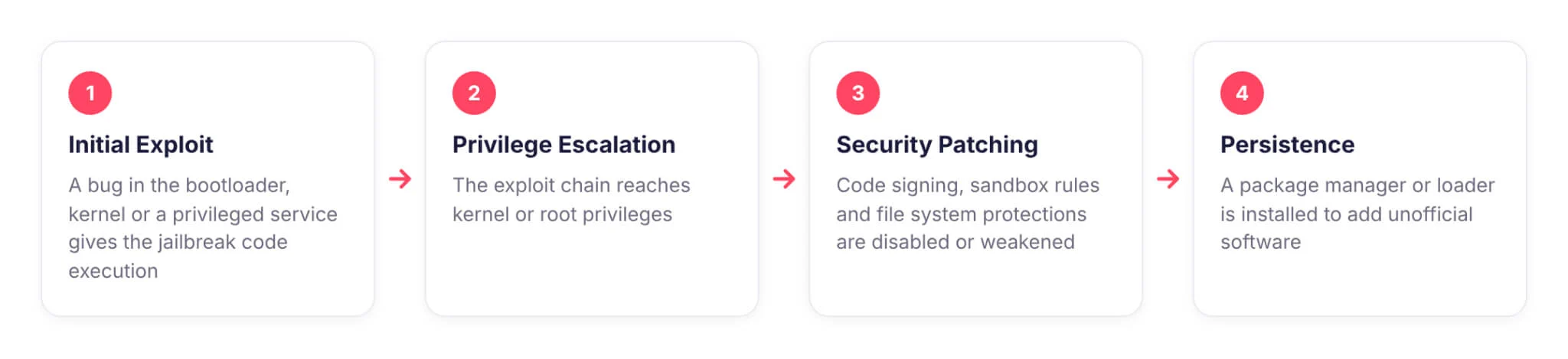
A typical device jailbreak follows these stages:
Initial exploit: a bug in the bootloader, kernel, or a privileged service gives the jailbreak code execution with elevated rights
Privilege escalation: the exploit chain reaches kernel or root privileges
Security patching: code signing enforcement, sandbox rules, and file system protections are disabled or weakened
Persistence: a package manager or loader is installed so users can add unofficial software
Typical stages of a device jailbreak, from initial exploit to persistence
Jailbreaks are usually classified by how they survive a reboot:
Jailbreak Type
Behavior After Reboot
Tethered
Device needs a computer to boot into the jailbroken state
Semi-tethered
Device boots normally but needs a computer to re-apply the jailbreak
Semi-untethered
Device boots normally and the jailbreak is re-applied with an on-device app
Untethered
Jailbreak persists across reboots with no extra steps
Some jailbreaks rely on flaws that cannot be fixed with a software update. The checkm8 BootROM exploit disclosed in 2019 targets read-only boot code in a range of older Apple chips, so affected hardware stays exploitable for its entire life.
How Does AI Jailbreaking Work?
LLMs are trained and configured to refuse certain requests. An AI jailbreak is a prompt, or a series of prompts, that pushes the model past those refusals. MITRE ATLAS tracks this as LLM Jailbreak (AML.T0054), and the OWASP Top 10 for LLM Applications groups it under prompt injection risks.
Common AI jailbreak techniques include:
Role-play and persona prompts: the model is told to act as an unrestricted character that “has no rules”
Hypothetical framing: harmful requests are wrapped in fiction, research, or “for a novel” scenarios
Multi-turn escalation: the attacker starts with harmless questions and gradually steers the conversation toward restricted output
Many-shot prompting: a long prompt packed with fabricated question-and-answer examples conditions the model to comply
Obfuscation: requests are encoded, translated, split across messages, or written with deliberate misspellings to slip past filters
Adversarial suffixes: automatically generated character strings appended to a prompt that statistically weaken refusals
Jailbreaking vs Prompt Injection
The two terms overlap but describe different goals. Jailbreaking targets the model’s safety policy, usually through direct user input. Prompt injection targets the application around the model: hidden instructions in a web page, email, or document override the developer’s system prompt and can trigger data leaks or unauthorized tool actions. Real-world attacks often combine the two. SOCRadar’s AI Prompt Security entry covers the wider set of prompt-level threats.
Security Risks of Jailbreaking
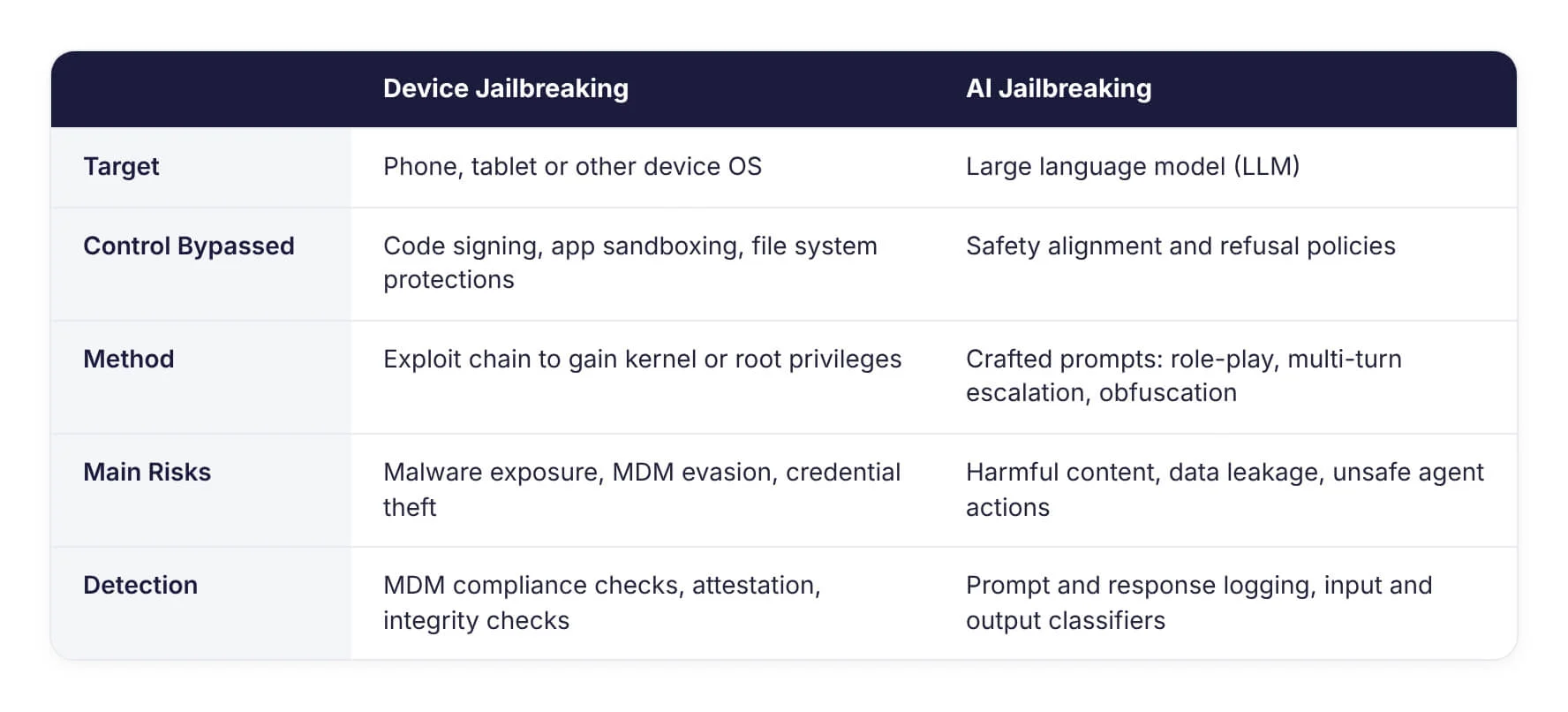
How device jailbreaking and AI jailbreaking differ in target, method, risk and detection
Risks of Jailbroken Devices
Malware exposure: apps from unofficial repositories skip app store review, and many jailbreak tweaks request deep system access
Broken sandboxing: a malicious app can read data from other apps, including corporate email, authenticator, and banking apps
Delayed patching: users often avoid updates to keep a jailbreak, which leaves known vulnerabilities open
MDM evasion: a jailbroken device can hide its state or spoof compliance checks, which undermines BYOD and zero trust policies
Credential theft: with root access, keyloggers and session-stealing tools can capture logins for enterprise services
Risks of Jailbroken AI Models
Harmful content generation: malware code, phishing lures, and fraud scripts produced on demand
Data leakage: exposure of system prompts, internal instructions, or sensitive data the model can reach
Unsafe agent actions: in AI agents connected to tools, a jailbreak can lead to unauthorized emails, file changes, or API calls
Brand and compliance damage: screenshots of a company chatbot producing abusive or false output spread quickly
Jailbreaking on the Dark Web
Threat actors treat jailbreaks as a product. Underground forums and Telegram channels share and sell working jailbreak prompts for popular AI chatbots, and some actors package them into “uncensored” AI services marketed for phishing and malware development, such as WormGPT and FraudGPT. Device jailbreak tools are also repackaged with bundled malware and spread through fake download sites that target users searching for free jailbreaks.
Monitoring these channels shows defenders which models and techniques are being abused and which fake jailbreak sites are spreading malware.
How to Detect Jailbreaking
For mobile devices:
Enforce MDM compliance policies that block jailbroken or rooted devices from corporate resources
Use platform attestation services and app-level integrity checks to verify device state
Look for indicators such as unofficial package managers, modified system paths, and unexpected root processes
Flag devices that stay on outdated OS versions for long periods
For AI systems:
Log prompts and responses, and review them for known jailbreak patterns and policy violations
Apply input and output classifiers in addition to the model’s built-in alignment
Rate-limit and flag sessions with repeated refusals followed by sudden compliance
Red team models with current jailbreak techniques before and after deployment
How to Prevent Jailbreaking Risks
Device policy: prohibit jailbroken and rooted devices in BYOD and corporate mobile policies, and enforce the rule technically
Fast patching: require current OS versions so public jailbreak exploits stop working
App hardening: add jailbreak and root detection to sensitive mobile apps such as banking and authentication apps
Least privilege for AI: limit what data and tools an AI system can reach, so a successful jailbreak has little to work with
Layered guardrails: combine system prompts, external moderation, and human approval for high-impact agent actions
Threat awareness: track newly shared jailbreak techniques and update filters and red team scenarios accordingly
How Can SOCRadar Help?
SOCRadar’s Dark Web Monitoring and Cyber Threat Intelligence track the forums, marketplaces, and Telegram channels where jailbreak prompts, malicious AI services, and trojanized jailbreak tools are shared. Digital Risk Protection identifies fake sites that impersonate your brand or apps, including lookalike download pages that push malware, so teams can act before employees or customers are affected.
Frequently Asked Questions
What Does Jailbreaking Mean?
Jailbreaking means removing the restrictions a vendor places on a device or software system. On phones, it gives root access and allows unsigned apps. On AI models, it makes the model ignore its safety rules.
Is Jailbreaking Illegal?
The legal status depends on the country and the device. In some jurisdictions, jailbreaking your own phone is permitted under specific exemptions, while using a jailbreak to pirate software or access someone else’s system is not. Jailbreaking usually violates the vendor’s terms of service and can void warranties. This is general information, not legal advice.
Is a Jailbroken Phone a Security Risk?
Yes. A jailbroken phone loses code signing enforcement and app sandboxing, often stays on outdated software, and can install apps that bypass store review. For organizations, it also weakens the reliability of MDM and device compliance checks.
What Is the Difference Between Jailbreaking and Rooting?
Both give a user elevated control over a mobile device. Jailbreaking is the term used for Apple devices, and rooting is the term used for Android devices, where the goal is to obtain superuser (root) privileges.
What Is an AI Jailbreak?
An AI jailbreak is a prompt or sequence of prompts that makes an LLM produce output its developer intended to block, such as instructions for malware or fraud. MITRE ATLAS tracks it as technique AML.T0054.
Is AI Jailbreaking the Same as Prompt Injection?
Not exactly. OWASP treats jailbreaking as a form of prompt injection, but the goals differ. Jailbreaking targets the model’s safety policy, usually through direct user input. Prompt injection hides instructions in content the model processes to hijack the surrounding application. The two are often combined in real attacks.
How Can Organizations Protect Against AI Jailbreaks?
Organizations should limit the data and tools AI systems can access, add independent input and output filters, log and review prompts, require human approval for sensitive agent actions, and red team models regularly with current jailbreak techniques.
Can a Jailbreak Be Removed?
On most devices, restoring the official firmware through the vendor’s recovery process removes the jailbreak. Hardware-level flaws such as BootROM exploits remain present in the chip, so the device can be jailbroken again.