
What Is a Malware Loader?
A malware loader is code whose primary purpose is to retrieve, unpack, inject, or execute another malicious payload. Loaders give operators a small initial foothold that can be updated with an infostealer, ransomware, remote access Trojan, or campaign-specific module after the victim is assessed.
A loader is defined by its role in the infection chain, not by one file type or technique. Some run directly from disk, while others use scripts, trusted system tools, memory injection, encrypted configuration, or staged downloads to reduce exposure and evade analysis.
Key Takeaways
- Loaders separate initial access from the final payload and let operators change malware after infection.
- Phishing, fake software, malicious ads, cracked applications, and exploited services are common delivery paths.
- Memory execution and living-off-the-land tools can reduce file-based evidence.
- Response must remove persistence and determine every payload or credential exposed by the loader.
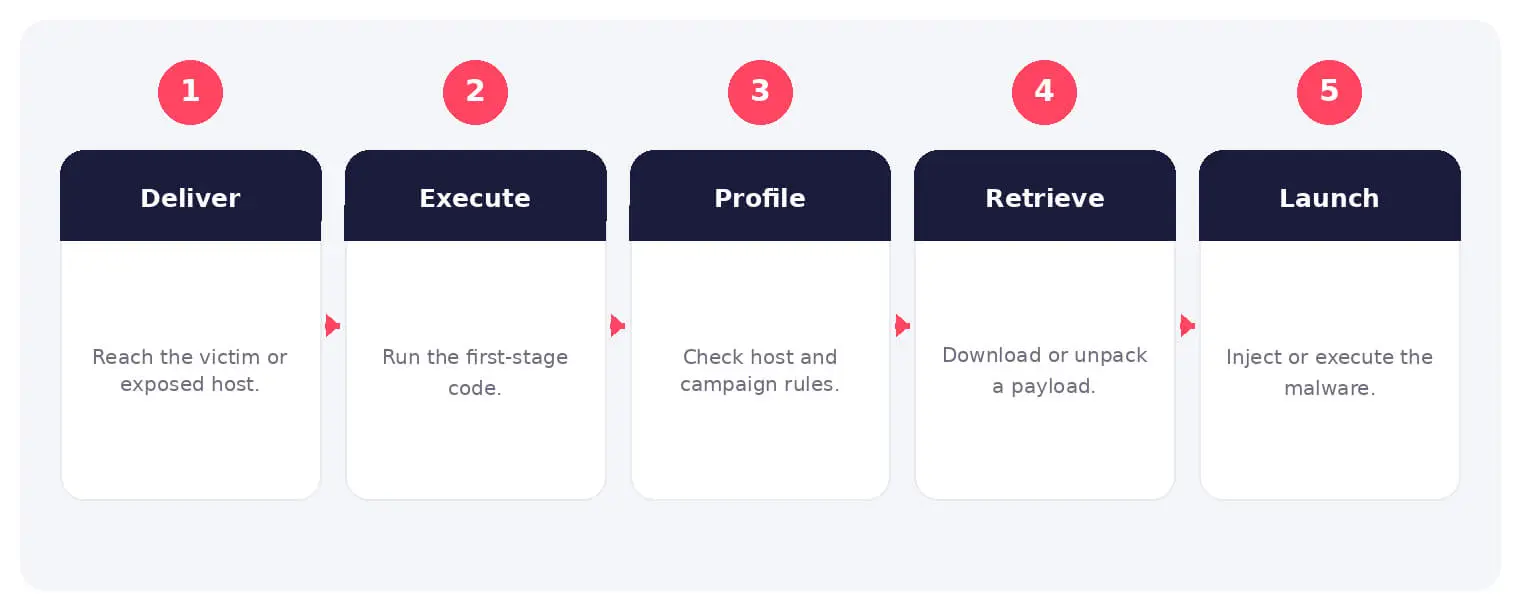
How a Malware Loader Works
The loader executes after a user opens malicious content or an attacker exploits a system. It checks the environment, establishes persistence, decrypts configuration, and contacts staging infrastructure.
The operator then selects or downloads a payload. The loader may inject it into another process, execute it through a trusted utility, or keep the code in memory. Additional stages can arrive only when the host matches campaign criteria.
Common Types and Techniques
- Single-stage downloaders and droppers
- Script-based and living-off-the-land loaders
- Memory loaders and process injection
- Modular loaders offered as a criminal service
Security and Business Risks
- Delivery of ransomware, spyware, or remote access
- Hidden persistence and repeated reinfection
- Credential, token, and browser-data theft
- Expansion from one endpoint into the wider network
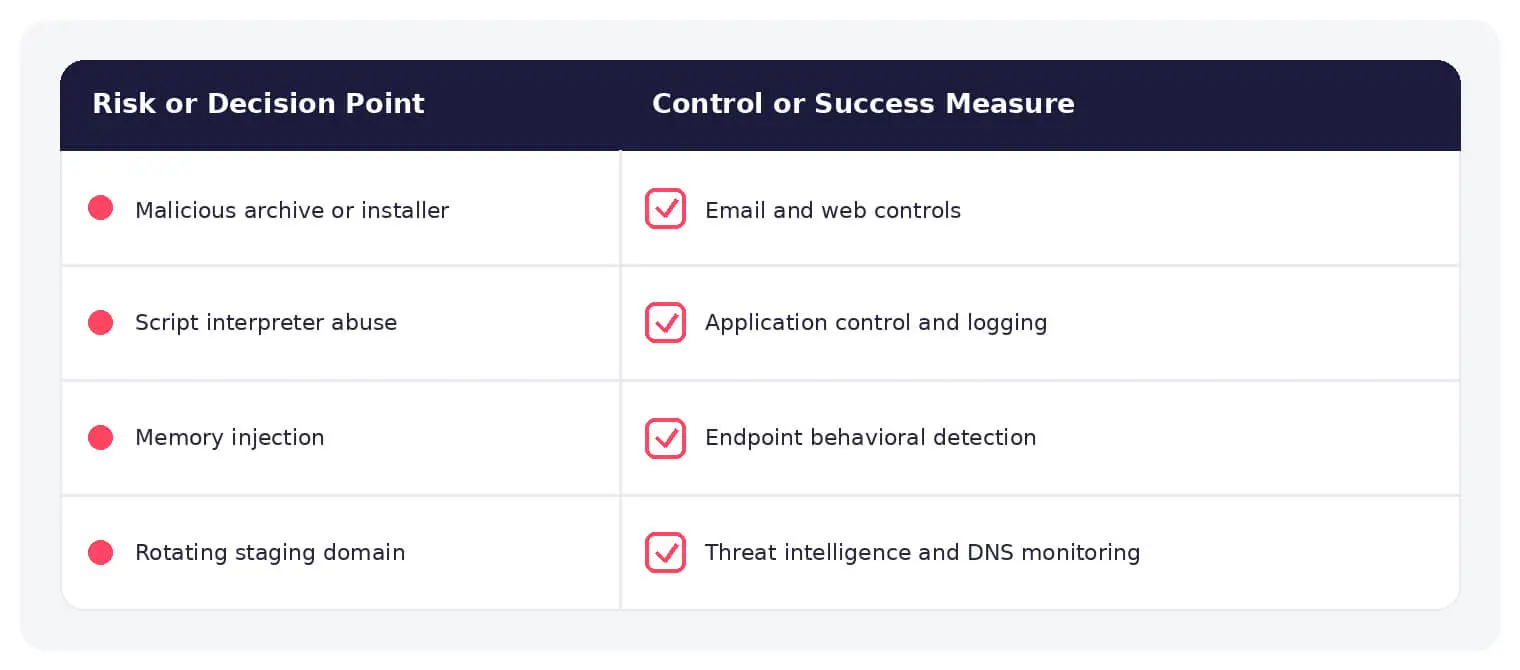
Warning Signs and Detection
Look for suspicious document or archive execution, script interpreters launching network tools, unusual parent-child processes, injection behavior, new persistence, and downloads from young or low-reputation domains. Memory and behavioral telemetry are important.
Prevention and Response
Block risky file types and untrusted software, restrict script interpreters and macros, harden email and browsers, patch exposed services, apply application control, and isolate infected systems. Scope for every secondary payload and rotate exposed credentials.
How SOCRadar Can Help
SOCRadar combines external asset visibility, threat intelligence, Dark Web monitoring, vulnerability context, and indicator enrichment to help teams identify exposure and investigate activity connected to malware loader.
Explore SOCRadar Cyber Threat Intelligence or request a demo to strengthen threat-informed prevention and investigation.
Frequently Asked Questions
What Is a Malware Loader?
A malware loader is code built to retrieve, unpack, inject, or execute a second malicious payload after establishing an initial foothold. It is defined by its role in the infection chain rather than by one file format, so a loader can be an executable, a script, a macro, or code that never touches disk. Operators use it as a reusable first stage before deploying infostealers, ransomware, or remote access Trojans.
How Is a Loader Different From a Dropper or a Downloader?
A dropper generally carries an embedded payload and writes it to the host, while a downloader retrieves the next stage from remote infrastructure. Loader describes the broader role and can cover both behaviors, along with process injection or in-memory execution. Many malware families blend these techniques within a single stage.
Why Do Attackers Deliver Malware in Multiple Stages?
Staging exposes only a small first component on the victim, which limits what analysts can collect early in an incident. It also lets operators assess the host before spending a costly payload, swap the final malware without regaining access, and distribute the campaign across separate infrastructure. Each stage can apply its own encryption and evasion, which complicates analysis.
How Do Loaders Reach Victim Machines?
Common delivery paths include phishing emails with malicious documents or archives, fake installers and updates, malicious ads, cracked software, and exploitation of vulnerable internet-facing services. Once the initial content runs or the exposed service is compromised, the loader takes over access, persistence, and payload retrieval.
How Do Memory-Based Loaders Evade File-Based Detection?
Loaders can allocate executable memory, inject shellcode into legitimate processes, or run payloads only in memory so no malicious file is written to disk. Some abuse trusted system utilities such as script interpreters to fetch and execute code, blending in with normal administrative activity. Signature-based tools see little to scan, which makes behavioral and memory telemetry important for detection.
Why Do Loaders Profile a Victim Before Delivering the Payload?
Many loaders check the environment for virtualization, security tooling, location, or signs of real user activity before pulling the next stage. This victim filtering helps operators avoid sandbox analysis and skip machines that do not match campaign criteria. Only hosts that pass the checks receive the heavier payload.
What Is Loader-as-a-Service?
Loader-as-a-Service is an underground model in which a crew rents out loading capability together with its delivery infrastructure. Affiliates supply the payload and pay per install or per campaign, while the operator handles distribution, victim filtering, and installation. This lowers the skill barrier for buyers and keeps loader campaigns and infrastructure changing quickly.
What Endpoint Signals Suggest a Loader Is Active?
Watch for script interpreters or document files spawning network tools, unusual parent-child process chains, signs of process injection, newly created persistence such as scheduled tasks or run keys, and downloads from newly registered or low-reputation domains. Because much of this activity can be fileless, telemetry that captures process behavior and memory events is more reliable than file scans alone.
What Should Responders Scope After Discovering a Loader?
Map the initial access path, the persistence the loader installed, and the staging or command infrastructure the host contacted. Then determine every payload that executed, which credentials, session tokens, or browser data may have been taken, and whether lateral movement followed. Finally, check whether the same campaign reached other endpoints in the environment.
Does Resetting Passwords Contain a Loader Infection?
Not on its own. Loader-delivered infostealers often collect browser cookies and session tokens, and a password change may not invalidate those sessions depending on the platform’s session controls. Responders should revoke active sessions and API tokens where possible, rotate the exposed secrets, and monitor for reuse of the stolen material.
Does Removing the Loader Clean an Already Infected Host?
Deleting the loader file addresses only one component of the chain. Payloads that already ran may carry their own persistence, copied data, or harvested credentials, so reinfection or continued access remains possible until each stage is addressed. Depending on the findings, teams may isolate the host, remove each persistence mechanism, or reimage the system as part of the recovery decision.
Which Controls Reduce Loader Delivery and Execution?
Blocking risky file types and untrusted software at email and web gateways, restricting macros and script interpreters, hardening browsers, applying application control, and patching exposed services all cut off common delivery and execution paths. Because loaders frequently abuse legitimate tools, monitoring script host activity and enforcing least privilege adds a further layer when a delivery slips through.

Oct 15, 2026
Cisco Secure Email & PAN-OS Zero-Days Exploited
Cisco Secure Email & PAN-OS Zero-Days Exploited Cisco and Palo Alto Networks have patched two actively exploited zero-day vulnerabilities that can lead…
Oct 15, 2026
SOCRadar Splunk Integration: New MSSP and Vulnerability Apps
SOCRadar Splunk Integration: New MSSP and Vulnerability Apps Your analysts live in Splunk. Your external risk does not: SOCRadar alarms for dozens…
Oct 14, 2026
CVE-2026-105445: Docker Hub PAT Reassignment Flaw
CVE-2026-105445: Docker Hub PAT Reassignment Flaw Docker has disclosed CVE-2026-105445 , a critical privilege assignment flaw in Docker Hub that could allow…
Intelligence in your inbox every Thursday.
Join 30,000+ security professionals reading SOCRadar research.
Subscribe