What Are the Main Types of Malware?
Malware categories describe malicious software by purpose, behavior, delivery, or propagation. A single sample can belong to several categories: for example, a Trojan may install a loader that retrieves ransomware, while also stealing credentials and joining the device to a botnet.
Classification helps teams explain behavior and choose controls, but a label should not replace technical analysis. Responders need to identify what the code executed, how it persists, what it accessed, where it communicated, and which additional payloads or identities are involved.
Key Takeaways
- Ransomware, wipers, and destructive malware is one important form or technique.
- Detection depends on correlated technical and operational context.
- Prevention should reduce both initial access and post-compromise impact.
- Response must preserve evidence and remove every reusable access path.
How the Main Types of Malware Works
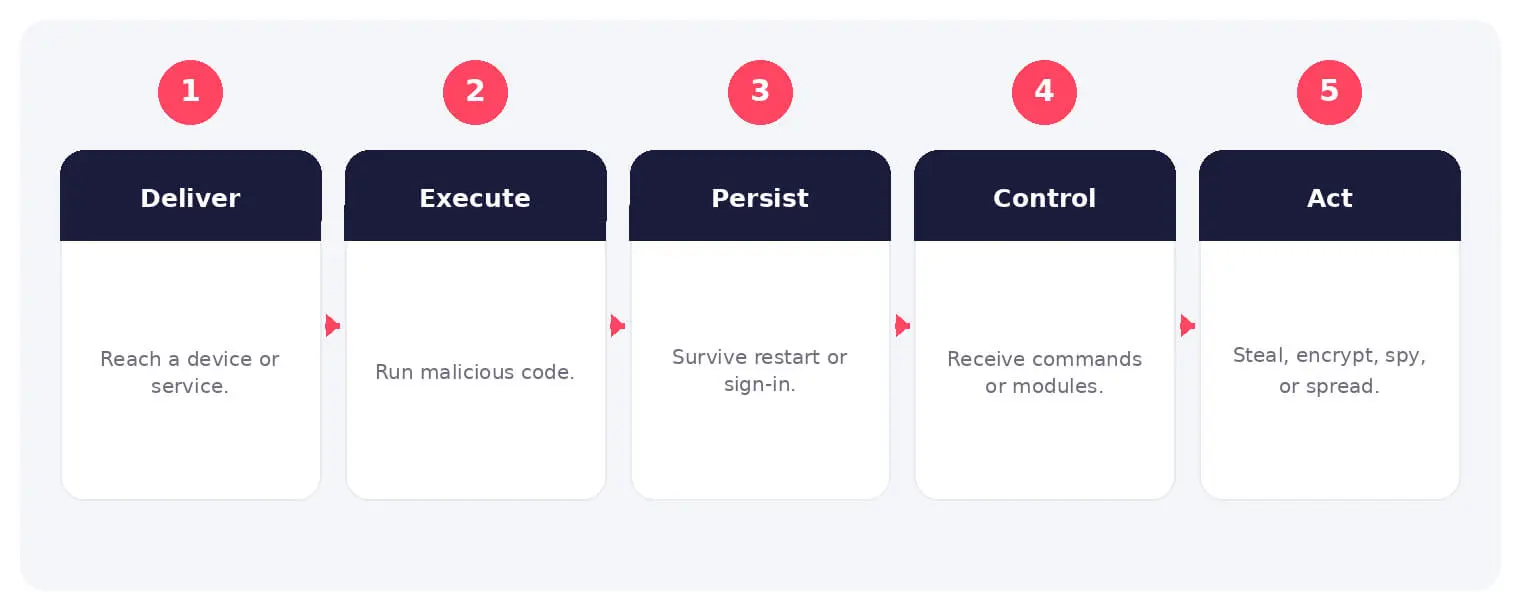
The sequence shown above is not mandatory in every case, but it provides a practical way to connect initial opportunity with the actor’s objective. Individual steps may occur in parallel, repeat, or be completed by different participants.
Classification helps teams explain behavior and choose controls, but a label should not replace technical analysis. Responders need to identify what the code executed, how it persists, what it accessed, where it communicated, and which additional payloads or identities are involved.
Common Types and Techniques
- Ransomware, wipers, and destructive malware
- Trojans, RATs, backdoors, and loaders
- Spyware, infostealers, and keyloggers
- Viruses, worms, rootkits, and botnet malware
Security and Business Risks
- Data loss, credential theft, and account takeover
- Business disruption and recovery cost
- Unauthorized surveillance and remote control
- Lateral movement, extortion, and downstream compromise
Warning Signs and Detection
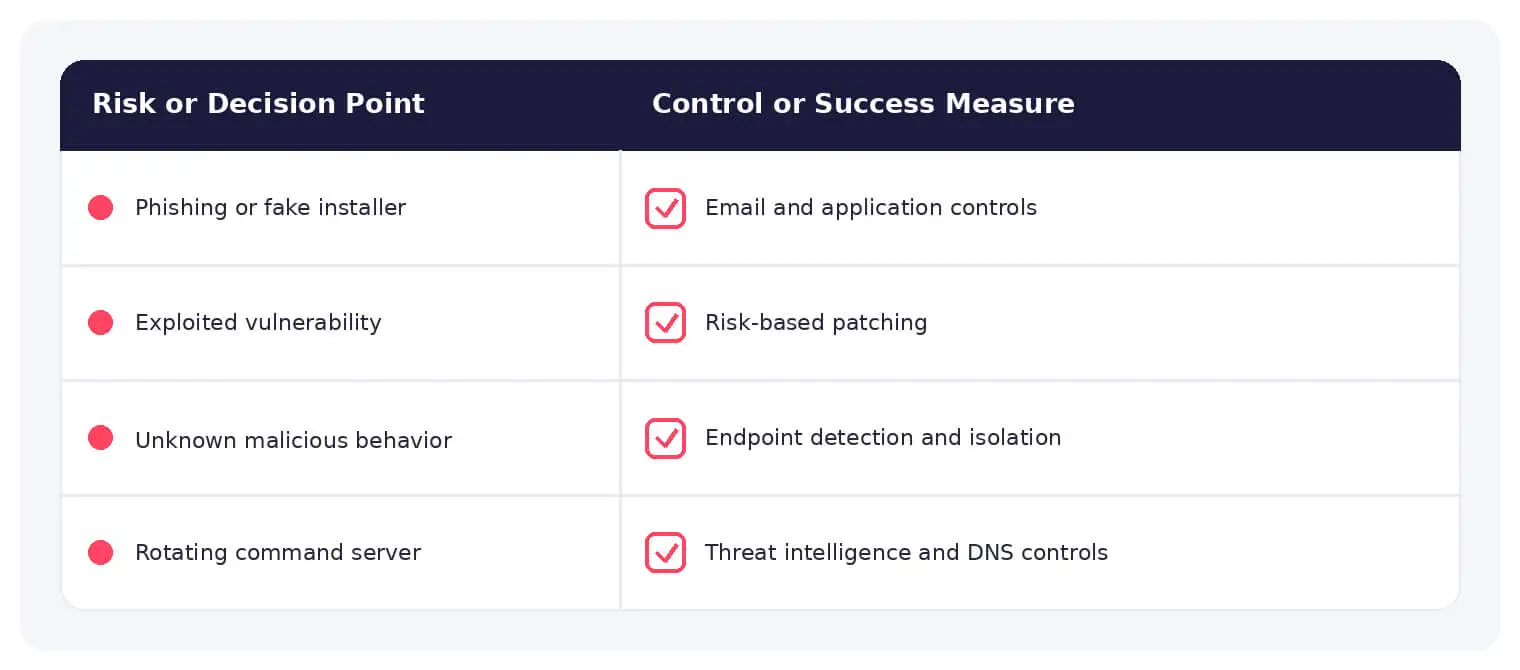
Detect suspicious process chains, persistence, credential access, security-tool tampering, unusual outbound traffic, mass file changes, and unexpected administration. Behavioral context remains useful when signatures change.
Prevention and Response
Patch systems, protect email and browsers, restrict privilege and scripts, use application control and endpoint detection, segment networks, protect backups, and investigate every affected identity and host.
How SOCRadar Can Help
SOCRadar combines external asset visibility, threat intelligence, Dark Web monitoring, vulnerability context, and indicator enrichment to help teams identify exposure and investigate activity connected to types of malware.
Explore SOCRadar Cyber Threat Intelligence or request a demo to strengthen threat-informed prevention and investigation.
Frequently Asked Questions
What Are the Main Types of Malware?
Common categories include ransomware and wipers, Trojans, RATs, backdoors, loaders, spyware, infostealers, keyloggers, viruses, worms, rootkits, and botnet malware. These labels describe purpose, behavior, delivery, or propagation rather than mutually exclusive families. A single sample can reasonably carry several labels at once.
Can a Single Malware Sample Belong to Multiple Categories?
Yes. A Trojan may install a loader that retrieves ransomware, steal credentials along the way, and join the device to a botnet. Because each category describes a different property, overlapping classifications are normal and expected.
What Is the Difference Between a Virus, a Worm, and a Trojan?
A virus attaches to files and replicates when those files execute. A worm spreads across networks without needing a host file or user action. A Trojan disguises malicious functionality as legitimate software to convince a user or system to run it.
How Is Ransomware Different From a Wiper?
Ransomware encrypts data to extort payment, while a wiper destroys data with little or no intent of restoring it. Both can halt operations, but a wiper attack removes the option of decrypting files afterward. Protected, tested backups and recovery plans matter for either scenario.
What Do Loaders and Rootkits Do in an Infection Chain?
A loader retrieves and executes additional payloads after initial access, often acting as the bridge between a Trojan delivery and the final malware. A rootkit modifies the operating system or firmware to conceal processes, files, and network activity, which makes both detection and removal harder.
How Does Malware Usually Get Onto a Device?
Common delivery paths include phishing attachments and links, malicious downloads, compromised websites, exposed remote services, and removable media. Worms and self-propagating malware can also spread internally once a single host is infected. Shrinking initial access paths reduces exposure to every category.
What Warning Signs Indicate a Possible Malware Infection?
- Suspicious process chains and administration tools used in unexpected ways
- New persistence mechanisms, security-tool tampering, or mass file changes
- Unusual outbound traffic or connections to previously unseen infrastructure
Behavioral context remains useful when signatures change or attackers deploy novel variants that scanners do not yet recognize.
What Should Responders Do After Confirming a Malware Infection?
Isolate affected hosts, preserve evidence such as memory and disk artifacts, and identify persistence mechanisms, credentials accessed, and communication destinations. Rebuilding a device may be necessary in some incidents, but scoping every affected identity and host matters as much as cleaning the first machine. Remove every reusable access path before treating the incident as contained.
Does Resetting a Password Stop an Attacker With Stolen Credentials?
Not on its own. Depending on the platform, an attacker may keep access through active session tokens until those sessions are revoked. Pair password resets with forced session invalidation and phishing-resistant MFA to reduce the chance of re-entry.
How Can Organizations Reduce Malware Risk?
Patch internet-facing and internal systems, protect email and browsers, restrict privileges and scripting, and apply application control alongside endpoint detection. Segment networks, protect and test backups, and monitor for exposed credentials. These controls reduce both initial access and post-compromise impact.
What Business Damage Can Malware Cause Beyond Downtime?
Beyond disruption and recovery cost, malware can drive data loss, credential theft, account takeover, unauthorized surveillance, lateral movement, and extortion. Some infections, such as spyware or backdoors, persist quietly and enable downstream compromise long after the initial incident appears resolved.
Oct 23, 2026
CVE-2026-114625: Actively Exploited VeloCloud Orchestrator Flaw Grants Superuser Access
CVE-2026-114625 is an actively exploited SQL injection flaw in VeloCloud Orchestrator that lets authenticated users gain superuser operator privileges…
Oct 22, 2026
PHP2Shell Exploit Tooling Found on Exposed Attacker Server
SOCRadar Threat Intelligence Unit (STRU) researchers found PHP2Shell exploit tooling on an attacker-controlled server whose working directory was exposed…
Oct 22, 2026
New LiteLLM Supply Chain Attack Hits PyPI and Docker
A new LiteLLM supply chain attack has turned version 1.107.0, an official release of the popular open-source LLM gateway, into a credential…
Intelligence in your inbox every Thursday.
Join 30,000+ security professionals reading SOCRadar research.
Subscribe