How Does Dark Web Monitoring Work? A Step-by-Step Overview
Dark web monitoring helps organizations detect stolen data, compromised credentials, and brand misuse by tracking activity across hidden forums, leak sites, and underground marketplaces. But what does this process actually involve? And how do monitoring tools find and analyze encrypted or anonymous content?
In this guide, we’ll explain how dark web monitoring works, from how data is collected to how alerts are generated and integrated into broader security systems. We’ll also explore the technologies behind the process and how accurate, real-time insights are made possible.
What Is Dark Web Monitoring?
Dark web monitoring is the process of scanning underground platforms–including Tor-based forums, encrypted messaging channels, and paste sites–to identify mentions of sensitive information related to a specific entity. This could include employee credentials, leaked documents, personally identifiable information (PII), or even threat actor discussions about a targeted attack.
By using specialized tools and crawlers, organizations can track digital risks that may not appear in traditional Open-Source Intelligence (OSINT) feeds. The goal is to detect early warning signs of data exposure and act before damage occurs.

Understanding the Dark Web: What Needs to Be Monitored
The dark web hosts a wide range of content, much of which is irrelevant to most organizations. Effective monitoring focuses on high-priority indicators, such as:
- Credential dumps containing corporate or customer email addresses
- Leaked internal files, source code, or confidential documents
- Financial data, medical records, or government-issued IDs
- Threat actor chatter targeting specific brands or sectors
- Executive doxing, impersonation attempts, or ransomware extortion posts
What makes this content difficult to detect is its volatility. Paste sites may delete data within minutes, and access to some marketplaces or forums requires vetting. That’s why monitoring relies on both broad automation and targeted collection techniques.
Key Components of a Dark Web Monitoring System
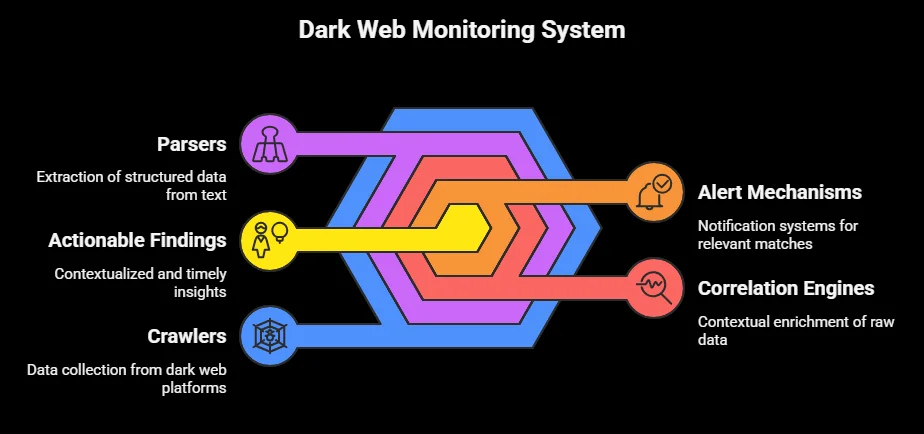
To carry out effective monitoring, platforms rely on a multi-stage system involving data collection, parsing, enrichment, and alerting. These systems typically include:
- Crawlers: Bots that navigate known and emerging dark web platforms to collect content.
- Parsers: Tools that extract structured data—such as email-password pairs or links—from messy text.
- Correlation Engines: Modules that enrich the raw data with context, such as matching it to known breaches.
- Alert Mechanisms: Systems that notify users when relevant matches are found based on predefined rules.
- Dashboards or APIs: Interfaces for analysts to explore, triage, and take action on the findings.
This layered approach ensures that findings are not only discovered but also made actionable through clear context and real-time delivery.
How Data Is Collected from Dark Web Sources
Dark web monitoring begins with crawlers navigating a mix of open and semi-private underground environments. These include .onion domains hosted on the Tor network, invite-only forums, encrypted chat platforms, and pastebin-style sites.
How do monitoring tools find hidden or encrypted dark web content?
Crawlers use knowledge of domain patterns, known threat actor hangouts, and recently indexed leaks to systematically scan relevant areas. In some cases, they leverage previously discovered links and forum hierarchies to uncover hidden pages.
Because some content is behind login walls or is time-sensitive, tools may maintain persistent sessions or use timing strategies to revisit high-risk areas more frequently.
The Role of Crawlers and Parsers in Monitoring
Crawlers are the foundation of any monitoring system. They gather raw HTML, JSON, or text content from monitored sources and deliver it to parsers for processing.
Parsers then extract relevant data, identifying structured content like usernames, passwords, cryptocurrency wallet addresses, or IPs from noisy posts. They are designed to recognize leak formats, encoded file listings, or forum-specific jargon. Parsing accuracy is critical, as it directly affects the relevance and usability of the final intelligence.
How Alerts Are Generated from Dark Web Findings
After parsing, the extracted data is run through matching engines that look for key indicators.
What triggers an alert in dark web monitoring systems?
Alerts are triggered based on defined conditions such as domain name matches, exact email addresses, or custom keywords (e.g., project names, executive names). More advanced tools may also look for patterns—such as credit card structures—or assign severity scores to prioritize alerts.
For instance, finding a list of hashed passwords might generate a lower priority alert than detecting cleartext credentials tied to admin users.
Data Enrichment and Correlation in the Monitoring Process
Enrichment helps transform raw alerts into usable cyber threat intelligence. Once a potential data leak is discovered, enrichment modules attempt to identify:
- The source of the leak (e.g., linked to a specific known breach)
- When the data was posted
- Whether it’s been seen before (deduplication)
- If it’s associated with known threat actors or ransomware groups
How accurate is the data collected from the dark web?
Accuracy varies depending on the platform’s ability to validate content. Some monitoring solutions perform real-time tests (such as password re-use checks) or correlate against public breach databases to verify findings.
However, due to the anonymous nature of the dark web, not all data can be confirmed with absolute certainty. Enrichment helps reduce false positives and flags reused or irrelevant data.
How Threat Intelligence Platforms Use Dark Web Data
Dark web insights are rarely used in isolation. Mature security platforms combine them with other data sources, like vulnerability scanners, phishing feeds, or endpoint logs to build a full picture of external risk.
For example, credential leaks from dark web sources can be correlated with suspicious login attempts. Similarly, threat actor chatter can be matched with exploit trends or vulnerability scans to identify potential targeting.
Do dark web monitoring platforms use AI or machine learning?

Yes, many platforms now incorporate AI for data classification, sentiment analysis in threat actor posts, and anomaly detection. Machine learning models can also group similar breach incidents or detect evolving tactics used by ransomware operators.
AI helps speed up triage, especially in identifying new threat actor aliases or variations of company names.
Automation vs. Manual Monitoring: What’s the Difference?
Automation provides scale, scanning thousands of sources without human intervention. But manual monitoring is still vital for context-heavy or invitation-only platforms.
Can dark web monitoring tools access private forums or invite-only sites?
Access to private forums usually requires a human analyst with established credibility or accounts. Some vendors maintain long-term access to these spaces through threat researchers or honeypots.
In these cases, analysts manually collect data or apply focused crawlers under authenticated sessions, complementing automated pipelines.
Real-World Workflow: From Detection to Response
A typical dark web monitoring workflow looks like this:
- A crawler detects a new post on a leak forum listing email addresses from a targeted organization.
- The parser extracts the emails and accompanying passwords.
- Enrichment modules associate the dump with a phishing campaign observed the previous month.
- An alert is triggered due to matches with internal employee domains.
- The incident is reviewed in a dashboard or forwarded to a SIEM/SOAR platform for automatic response.
- Remediation begins, possibly including password resets, employee notifications, and legal evaluation.
This real-time loop ensures organizations don’t just discover leaked data but act on it effectively.
Integrating Dark Web Monitoring into Your Security Operations
For monitoring to be impactful, findings must feed into your existing security infrastructure.
Can I integrate dark web monitoring with my existing security systems (SIEM, SOAR)?
Yes. Most modern platforms offer REST APIs, log-forwarding tools, or webhook integrations that allow seamless connectivity with SIEM, SOAR, and ticketing systems. This enables alerts to become actionable within your incident response pipeline.
For example, a credential leak alert can automatically trigger a SOAR playbook to disable accounts, reset passwords, and create investigation tickets—all without manual intervention.
How Often Is Dark Web Data Scanned or Refreshed?
Scanning frequency depends on the importance of the source. High-risk sites may be scanned hourly, while niche or inactive sites are checked less frequently. Ephemeral platforms like pastebins or Telegram channels require more frequent scraping due to content volatility.
Many platforms offer user-defined scan intervals or priority rules, allowing organizations to tune their visibility based on asset sensitivity and threat landscape.
Is User or Employee Data Automatically Tracked in the Process?
Yes, within defined monitoring rules. Organizations typically input employee email domains, VIP names, or asset keywords into their monitoring profile. The system then tracks these indicators continuously.
Data protection policies often ensure that personal tracking is limited to business-related accounts or roles, and compliance with privacy laws like GDPR is maintained.
How Is Collected Dark Web Data Verified Before It’s Sent to the User?
Verification methods include:
- Hash matching with known breaches
- Syntax validation (e.g., correct email formats)
- Cross-referencing with open-source datasets
- Timeframe correlation to recent incidents
While not all content can be confirmed, layered validation methods reduce false positives and improve the trustworthiness of alerts.
Discover SOCRadar’s Advanced Dark Web Monitoring
SOCRadar’s Advanced Dark Web Monitoring equips organizations with real-time intelligence from hidden parts of the internet, helping security teams detect threats before they escalate.
Key capabilities include:
- Comprehensive coverage across stealer logs, credential dumps, encrypted chat platforms, and dark marketplaces
- Real-time fraud protection through alerts on stolen credit cards, leaked credentials, and financial scams
- VIP protection tailored for executives, monitoring personal data and preventing identity misuse
- A powerful dark web search engine for deep investigations using keywords, domains, IPs, and hashes
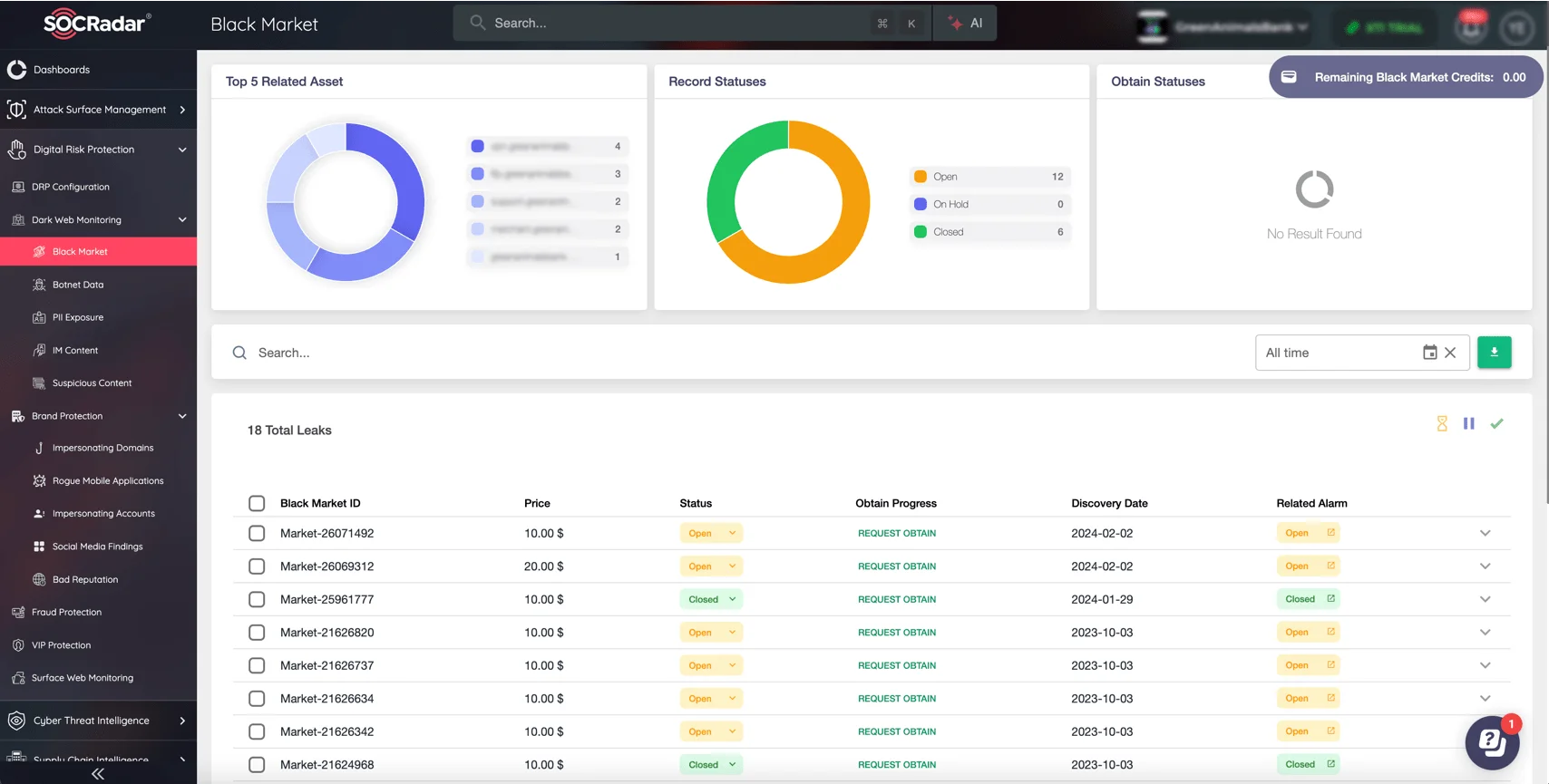
SOCRadar’s Dark Web Monitoring module
Whether you operate in finance, healthcare, education, or government, SOCRadar provides contextual, actionable insights that integrate easily into your existing security infrastructure.
Learn how to reduce your exposure, respond faster, and strengthen your digital defenses.
Explore Advanced Dark Web Monitoring to see how your organization can stay ahead of emerging underground threats.