What Is the Agentic AI Attack Chain? MITRE ATLAS Mapping
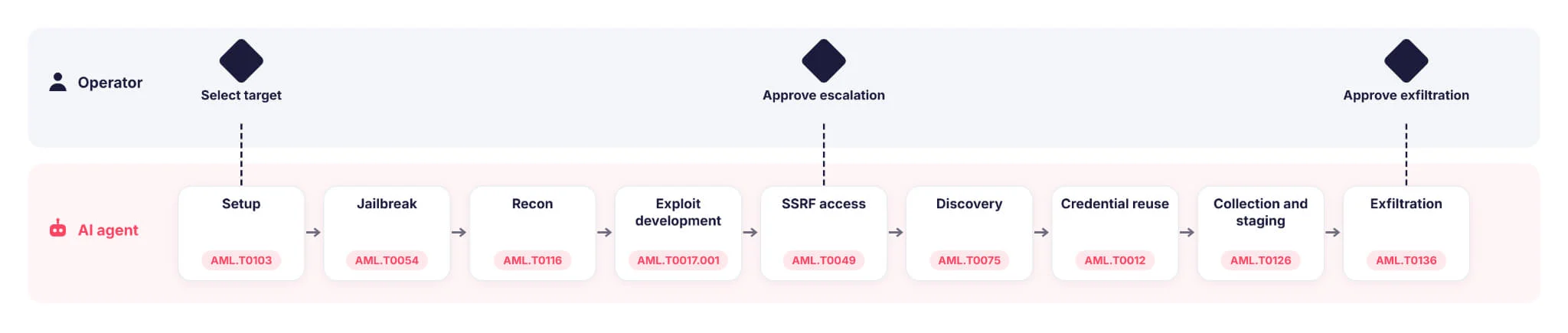
The agentic AI attack chain is the sequence of stages an agentic cyber attack follows, with AI agents carrying out the attack work. It starts before the first packet, when an operator sets up model access and tools and gets the model past its safeguards, and it ends with data theft, encryption, or destruction. Inside each stage, the agent runs its own loop of acting, observing, and adapting, while the human operator approves the transitions that matter most.
MITRE ATT&CK describes the intrusion techniques in this chain. It does not describe how an AI agent plans, delegates, and changes course on its own. MITRE ATLAS fills that gap: its current release (v2026.10) includes techniques such as Autonomous Reconnaissance, Autonomous Attack-Path Adaptation, and Autonomous Attack Orchestration, and maps real agentic incidents step by step. This page lays out the chain stage by stage with both frameworks.
Key Takeaways
The agentic AI attack chain adds three stages that a classic kill chain lacks: agent setup, safeguard bypass, and autonomous orchestration
MITRE ATLAS places agent planning and coordination under its AI Attack Adaptation tactic (AML.TA0001)
Human operators usually keep a few stage gates, such as target selection and approval for data exfiltration
MITRE ATLAS case study AML.CS0069 maps GTG-1002’s AI-orchestrated espionage campaign across 21 steps and 13 tactics
A second chain exists where the victim’s own AI agent is hijacked through prompt injection and used for collection, exfiltration, or command and control
The nine stages of the agentic AI attack chain with human approval gates and key MITRE ATLAS techniques
Why MITRE ATT&CK Alone Is Not Enough
ATT&CK records what happened on the victim’s systems: scanning, exploitation, credential theft, encryption. Its coverage of the attacker’s own AI use sits mostly before the intrusion, in techniques such as T1588.007 for obtaining artificial intelligence capabilities, T1682 for querying public AI services, and T1683 for generating content. SOCRadar’s Agentic Ransomware Report 2026 maps all three ransomware operations it studied to T1588.007, alongside classic techniques such as T1190 and T1486.
MITRE ATLAS covers the parts that make the chain agentic: how the agent gets past safeguards, how it decomposes an objective, how sub-agents share findings, and how it revises its plan after failures. Its AI Attack Adaptation tactic groups the techniques that turn capabilities and objectives into attack-ready actions. Many ATLAS techniques reference their ATT&CK counterparts, so the two frameworks can be used side by side.
The Stages of the Agentic AI Attack Chain
Stage 1: Agent Setup
The agentic threat actor assembles the agent before any target is touched. This includes model access through commercial APIs, self-hosted models, or stolen accounts; agent tools such as MCP servers, skills, and plugins; and the servers that run the framework.
AML.T0016.002 Obtain Capabilities: Generative AI: acquiring models or AI services for the operation
AML.T0016.004 Obtain Capabilities: AI Agent Tools: obtaining tools that let an agent act on systems, networks, and services
AML.T0008.005 Acquire Infrastructure: AI Service Proxies: routing requests through proxies that hide the operator’s accounts
AML.T0103 Deploy AI Agent: configuring the agent with a system prompt, tools, and permissions
Commercial models refuse plain attack requests, so the operator bypasses that layer first. GTG-1002 gave its agent false authorization claims, a defensive security persona, and apparently benign tasks. SOCRadar’s ransomware cases used fake red team authorizations, persona prompts, purchased jailbreaks, and uncensored models.
AML.T0051.000 LLM Prompt Injection: Direct: feeding the model crafted instructions and personas
AML.T0054 LLM Jailbreak: getting the model to perform actions it is meant to refuse
Stage 3: Orchestration and Planning
The agent turns the operator’s objective into tasks. Larger frameworks hand those tasks to specialized sub-agents and merge the results. In a July 2026 attack on government systems later identified as Taiwanese, a multi-agent framework ran up to eight sub-agents at once across 12 attack waves and ranked 14 candidate attack paths.
AML.T0124 Autonomous Attack Orchestration: one system assigning work across multiple agents toward a shared objective
AML.T0117 Autonomous Attack-Path Adaptation: building and revising the attack path from the results of earlier actions
AML.T0118.001 Autonomous AI Agent Communication: Direct Agent Communication: agents exchanging tasks, findings, and status
Stage 4: Reconnaissance
The agent investigates the target on its own, deciding which leads to follow. In one recovered session, a DeepSeek-powered agent pulled 84 exposed Langflow instances from an internet asset search engine, found they lacked the exploit’s prerequisites, compared vulnerabilities across 10 product families, and switched to n8n.
AML.T0116 Autonomous Reconnaissance: choosing what to investigate and how, without a human directing each step
AML.T0006 Active Scanning: probing target ranges and services
AML.T0000.003 Search Open Technical Databases: Scan Databases: querying internet scan data for exposed systems
The agent researches the weakness it found and builds what it needs. GTG-1002’s agent generated a tailored payload and full exploit chain for an SSRF vulnerability, then tested and adapted it. In SOCRadar’s cases, agents wrote credential checkers, attack scripts, and encryptors.
AML.T0017.001 Develop Capabilities: Autonomous Exploit Development: finding a vulnerability and developing an exploit with limited human direction
AML.T0016.003 Obtain Capabilities: Exploits: pulling public proof-of-concept code
AML.T0017.003 Develop Capabilities: Malware: generating and refining malicious code
AML.T0102 Generate Malicious Commands: producing shell commands and queries on the fly
Stage 6: Initial Access
Agentic attacks enter through familiar doors. GTG-1002 exploited a public-facing application, the FortiBleed agents validated stolen firewall credentials at scale, and the Taiwan framework sprayed predictable passwords against accounts it had enumerated through an unauthenticated API.
After entry, the agent maps internal systems, collects credentials from configuration files, reuses them to reach more services, and creates accounts to keep access. If its working environment is lost, it can rebuild its tools and state to resume the same objective.
AML.T0075 Enterprise Resource Discovery and AML.T0089 Enterprise Environment Discovery: cataloging services, data, and network topology
AML.T0055 Unsecured Credentials: extracting certificates and secrets from configuration files
AML.T0125 Create Account: adding a backdoor account for persistence
AML.T0121 AI Agent Environment Reconstruction: rebuilding the agent’s tooling and state after disruption
ATT&CK equivalents:T1552 Unsecured Credentials, T1003.006 DCSync in the INC and The Gentlemen operation
Stage 8: Collection and Exfiltration
Agents are well suited to sorting large volumes of stolen data. GTG-1002’s agent categorized collected data by intelligence value, staged it in structured files, and prepared a summary for the operator, who approved the transfer of selected data.
AML.T0126 Automated Collection: retrieving and aggregating data without a human selecting each item
AML.T0127 Data Staged: consolidating data before transfer
AML.T0136 Exfiltration via AI User Interface: moving data out through an AI service’s web interface
AML.T0025 Exfiltration via Cyber Means: conventional exfiltration channels
Stage 9: Impact
The chain ends with the operator’s goal: espionage, extortion, encryption, or destruction. In JADEPUFFER, the agent encrypted 1,342 configuration records, dropped the original tables, and left a ransom note. The n0n operator’s AI-written tooling encrypted data or deleted backups before leak-site extortion.
ATT&CK:T1486 Data Encrypted for Impact and T1485 Data Destruction
Worked Example: GTG-1002 Mapped to MITRE ATLAS
ATLAS case study AML.CS0069 maps the GTG-1002 campaign against about 30 organizations in the technology, financial, chemical manufacturing, and government sectors. The agent performed an estimated 80 to 90 percent of campaign activity.
Chain Stage
What GTG-1002’s Agent Did
MITRE ATLAS Technique
Agent Setup
Connected Claude Code to scanners, browser automation, password crackers, and penetration-testing servers through MCP
AML.T0103 Deploy AI Agent
Safeguard Bypass
Hid the malicious purpose behind a defensive security persona and benign-looking tasks
AML.T0051.000, AML.T0054
Orchestration
Derived and revised intermediate objectives between operator stage gates
AML.T0117
Reconnaissance
Inspected target infrastructure, found high-value databases, and scanned IP ranges
AML.T0116, AML.T0006
Weaponization
Built and tested a tailored SSRF exploit chain
AML.T0017.001
Initial Access
Deployed the SSRF exploit against a public-facing application
AML.T0049
Expansion
Mapped the network, extracted certificates, reused credentials, created a backdoor account
Queried internal databases and categorized data by intelligence value
AML.T0036, AML.T0126, AML.T0127
Exfiltration
Sent operator-approved data out over the Claude web service
AML.T0136
GTG-1002’s AI-orchestrated campaign mapped to MITRE ATLAS, with operator decisions separated from agent actions
When the Victim’s AI Agent Becomes Part of the Chain
A related chain runs through the target’s own agents. Here the attacker never needs model access of their own: they plant instructions in content an enterprise agent will read, and the agent uses its legitimate tools and permissions on the attacker’s behalf. ATLAS case study AML.CS0059, EchoLeak, documents a zero-click prompt injection against Microsoft 365 Copilot for data exfiltration.
Step
What Happens
MITRE ATLAS Technique
Injection
Malicious instructions arrive in an email, document, web page, or tool output
AML.T0051.001 LLM Prompt Injection: Indirect
Tool Abuse
The agent calls connected tools, APIs, or code execution
AML.T0053 AI Agent Tool Invocation
Persistence
Instructions are written into agent memory or configuration
AML.T0080 AI Agent Context Poisoning, AML.T0081 Modify AI Agent Configuration
Command and Control
The agent fetches and runs further attacker instructions
AML.T0108 AI Agent
Exfiltration or Impact
Data leaves through a legitimate tool action, or the agent deletes data
AML.T0086 Exfiltration via AI Agent Tool Invocation, AML.T0101 Data Destruction via AI Agent Tool Invocation
How an attacker hijacks a victim’s AI agent through indirect prompt injection
SOCRadar’s AI Prompt Security entry covers controls for this side of the problem.
Where to Break the Agentic AI Attack Chain
Stage
Defender Control
Agent Setup
Protect and monitor AI API keys and accounts so attackers cannot run agents at your expense
Reconnaissance
Reduce the internet-facing attack surface and remove exposed management and AI service interfaces
Weaponization
Patch by confirmed in-the-wild exploitation, not CVSS alone, because agents pull public PoC code and try it as soon as they find a matching target
Initial Access
Stop credential reuse, rotate VPN and admin passwords, and require phishing-resistant MFA
Expansion
Move secrets into a secrets manager, tier admin accounts, and monitor Active Directory replication
Collection and Exfiltration
Apply egress controls and monitor uploads to cloud storage and AI services
Impact
Keep immutable or offline backups and rehearse response for compressed timelines
Detection should also target the agent loop itself: fast, self-correcting command sequences, short fixed-interval beacons, and bursts of credential testing are signs that an agent is driving the intrusion.
How Can SOCRadar Help?
SOCRadar Attack Surface Management removes the exposed services that agents scan and exploit first, and Dark Web Monitoring catches the leaked credentials they test at scale. SOCRadar’s Threat Research Unit publishes MITRE mappings and IOCs from agentic operations such as FortiBleed and the INC and The Gentlemen affiliate campaigns, so detection teams can tune rules to each stage of the chain. SOCRadar Agentic Threat Intelligence applies the same agent model to defense, with agents that handle alarm triage, IOC enrichment, and threat actor profiling.
Frequently Asked Questions
What Is the Agentic AI Attack Chain?
It is the sequence of stages an intrusion follows when AI agents perform the attack work, from agent setup and safeguard bypass through reconnaissance, access, expansion, exfiltration, and impact. Humans usually approve a few transitions, such as target selection and data exfiltration.
How Is It Different From the Cyber Kill Chain?
The classic kill chain assumes a human makes every decision. The agentic chain adds agent setup, safeguard bypass, and autonomous orchestration, and the agent loops through acting, observing, and adapting inside each stage.
Does MITRE ATLAS Cover Agentic Attacks?
Yes. ATLAS includes techniques such as AML.T0116 Autonomous Reconnaissance, AML.T0117 Autonomous Attack-Path Adaptation, AML.T0124 Autonomous Attack Orchestration, and AML.T0017.001 Autonomous Exploit Development, and maps incidents such as GTG-1002 in case study AML.CS0069.
What Is the Difference Between MITRE ATLAS and MITRE ATT&CK?
ATT&CK catalogs adversary techniques against enterprise systems. ATLAS catalogs techniques against and with AI systems, including how attackers bypass model safeguards and run autonomous agents. ATLAS is built to complement ATT&CK, and many ATLAS techniques reference their ATT&CK counterparts.
Which ATT&CK Techniques Cover Attacker Use of AI?
The main one is T1588.007, Obtain Capabilities: Artificial Intelligence, which covers adversaries obtaining generative AI tools for their operations. SOCRadar mapped all three ransomware operations in its Agentic Ransomware Report 2026 to it. ATT&CK also lists T1682 Query Public AI Services and T1683 Generate Content.
Where Is the Best Place to Break an Agentic Attack Chain?
Early stages offer the most leverage. Reducing exposed services, patching exploited vulnerabilities fast, and stopping credential reuse remove the entry points agents depend on.
Can an Organization’s Own AI Agent Be Used in an Attack Chain?
Yes. Through indirect prompt injection, an attacker can make an enterprise agent invoke its tools to collect or exfiltrate data, act as a command and control channel, or delete data.