What Is an Agentic Cyber Attack? Examples and Defense
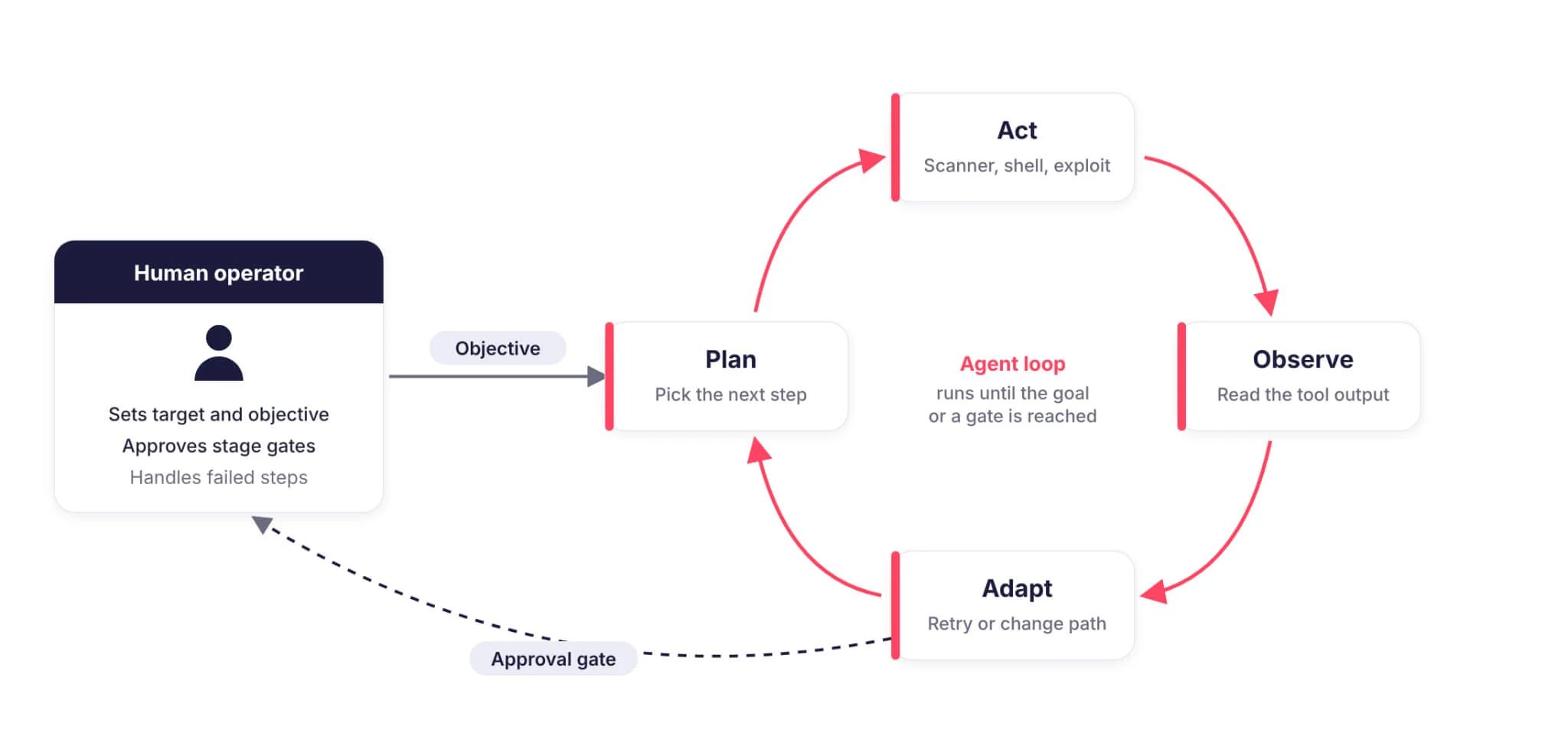
An agentic cyber attack is an intrusion in which one or more AI agents plan, execute, and adapt the attack steps toward a goal that a human operator sets. The agent works in a loop: it runs a tool, reads the result, decides on the next action, and changes course when something fails. The human picks the target and approves key decisions, while the agent does the scanning, exploit writing, credential testing, and data sorting that used to need a skilled team.
These attacks are already in production. In September 2025, a state-sponsored group used an AI coding agent to carry out 80 to 90 percent of an espionage campaign against about 30 organizations. In 2026, SOCRadar investigations found ransomware operators running AI agents across the kill chain, from mass credential testing on firewalls to writing encryptors and drafting ransom demands.
Key Takeaways
An agentic cyber attack uses AI agents that choose and run attack steps themselves, with humans setting objectives and approving key stages
The first publicly documented large-scale case, GTG-1002 in September 2025, had AI perform 80 to 90 percent of the campaign with about four to six human decision points per campaign
SOCRadar found three ransomware-linked operations running AI agents in production in 2026, including a 14-agent framework behind access to 86,644 Fortinet devices
Agentic attacks still enter through familiar doors: exposed edge devices, unpatched public-facing applications, and reused credentials
Agents make mistakes and leave logs, which gives defenders detection opportunities and a new intelligence source
Agentic Cyber Attack at a Glance
Attribute
Details
Also Called
AI-orchestrated cyberattack, autonomous cyberattack, agentic AI attack
What Drives It
A large language model (LLM) running in a loop with access to offensive tools, often connected through the Model Context Protocol (MCP)
Human Role
Selects targets, sets objectives, and approves stage gates such as exploitation or exfiltration
Typical Entry Points
Edge devices and VPNs, exposed web and AI applications, stolen or reused credentials
Framework Coverage
MITRE ATT&CK T1588.007 for obtaining AI capabilities; MITRE ATLAS techniques for autonomous reconnaissance, attack-path adaptation, and orchestration
Main Weaknesses
Hallucinated results, broken tooling, and AI session logs that expose the operation
How Does an Agentic Cyber Attack Work?
A traditional intrusion follows a person at a keyboard. Automated attacks follow a fixed script. An agentic attack sits between the two: the operator gives the agent a goal and a toolset, and the agent decides the sequence of actions at runtime.
The agent loop behind an agentic cyber attack, with the operator approving key stages
The Building Blocks
Model access: commercial AI APIs, self-hosted or uncensored models, and stolen AI accounts or keys
Agent framework: software that runs the model in a loop, keeps task state, and splits work across sub-agents
Tools: scanners, exploit frameworks, password crackers, browser automation, and shells, exposed to the model as callable functions
Playbooks and skills: stored procedures that tell the agent how to run a task such as credential validation or web exploitation
Infrastructure: attack servers, proxies, and command and control (C2) panels that hold the agent’s working state
Getting Past AI Safeguards
Commercial models refuse obvious attack requests, so operators work around them. GTG-1002 posed as a defensive security firm and broke the operation into small, seemingly innocent tasks that hid the malicious purpose. In SOCRadar’s ransomware cases, agentic threat actors used fake red team authorizations, “WormGPT” persona prompts, purchased jailbreaks, and uncensored or self-hosted models. Every operator SOCRadar studied found a way around refusals, which is why model safeguards cannot be the deciding control.
Orchestrating Many Agents
Larger frameworks run several specialized agents at once. In a July 2026 attack on government systems later identified as Taiwanese, a multi-agent framework coordinated up to eight sub-agents across reconnaissance, authentication attacks, API testing, and exploitation, ranked candidate attack paths, and dropped paths that failed.
Levels of AI Autonomy in Cyber Attacks
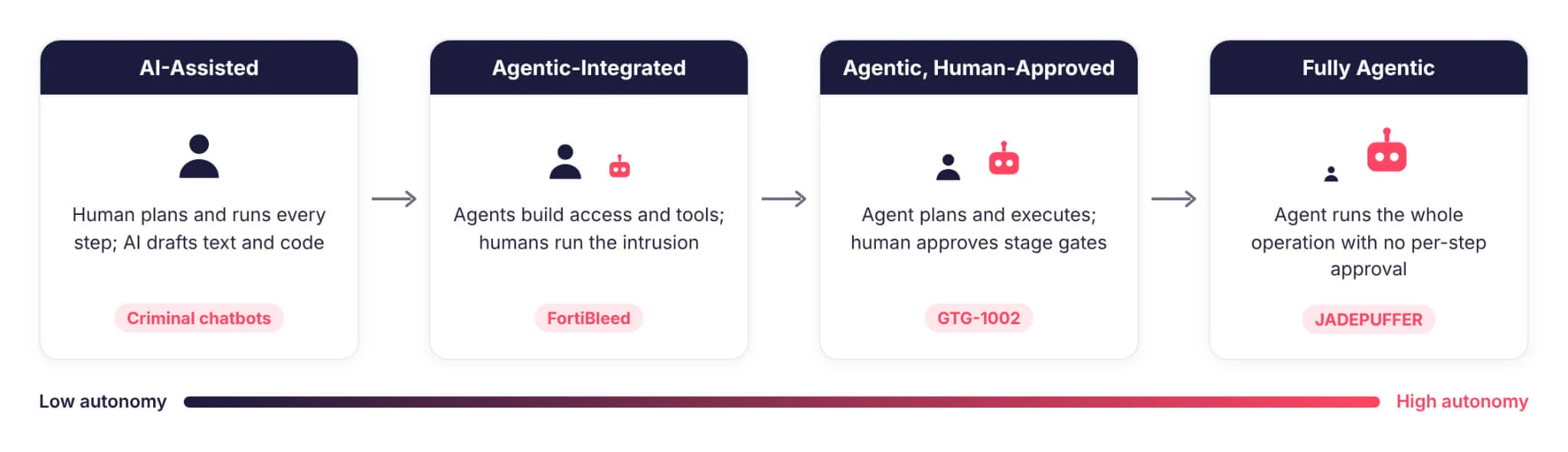
Not every attack that uses AI is agentic. The level of autonomy decides how fast an operation moves and how much a single operator can run. Ransomware has followed the same path, from human-operated crews toward the autonomous operations described in Ransomware 3.0.
Level
Who Decides Each Step
Example
AI-Assisted
The human plans and runs the attack; an LLM drafts lures, code, or summaries
Criminal chatbots used for phishing text or loader code
Agentic-Integrated
AI agents build capability; humans run the intrusion
FortiBleed, where 14 agents built access that human operators used
Agentic, Human-Approved
The agent plans and executes; the operator approves stage gates
GTG-1002 and the INC and The Gentlemen affiliate operations
Fully Agentic
The agent runs the whole operation with no approval per step
JADEPUFFER, assessed as an LLM-driven extortion campaign from entry to ransom note
Four levels of AI autonomy in cyber attacks, from AI-assisted to fully agentic
SOCRadar telemetry shows how common the higher levels already are. Of 11,541 exposed attacker servers tracked from September 2025 to October 2026, 868 used AI. Among those, 41.0 percent showed agentic, human-approved activity and 28.8 percent showed autonomous agentic activity, according to the Agentic Ransomware Report 2026.
Real-World Agentic Cyber Attack Examples
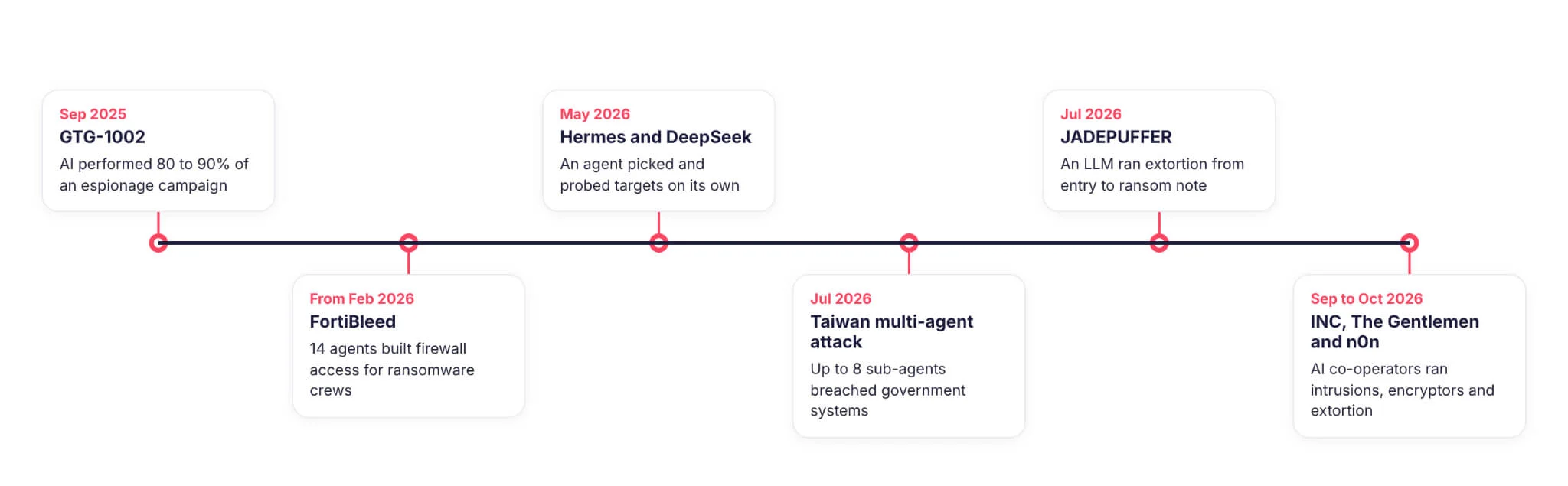
Documented agentic cyber attacks from September 2025 to October 2026
GTG-1002: AI-Orchestrated Espionage
In mid-September 2025, Anthropic detected a group it assessed with high confidence as Chinese state-sponsored using Claude Code against roughly thirty technology, financial, chemical manufacturing, and government targets, with success in a small number of cases. The agent mapped infrastructure, wrote and tested its own exploit code, harvested credentials, created backdoors, and sorted stolen data, while humans stepped in at about four to six critical decision points. MITRE ATT&CK tracks the operation as campaign C0062.
FortiBleed: Agents Building Access for Ransomware
SOCRadar’s FortiBleed research uncovered PENTEST LAB, a 14-agent framework built by an affiliate tracked as TOXMAN. The agents scanned targets, hunted for weaknesses, and built checkers that validated stolen firewall credentials, producing access to more than 86,644 Fortinet devices across 194 countries. SOCRadar also found an operator, using infrastructure traceable to FortiBleed, logged into both INC Ransom and Lynx negotiation panels.
INC and The Gentlemen: AI as the Co-Operator
Exposed attacker servers showed affiliates of INC Ransom and The Gentlemen running commercial AI as a co-operator. The AI planned intrusions, ran tools, sorted stolen data, and drafted ransom demands while a human approved its actions. SOCRadar found 62 targeted organizations, more than $23,920 in AI service spending, and 46 INC encryptor builds staged for six victims.
n0n: An AI Coding Agent Behind Extortion Waves
An exposed staging server tied to the n0n group held an AI coding agent environment backed by more than $7,000 in paid LLM API usage. Under human direction, the agent wrote and fixed attack scripts, the encryptor, and extortion emails used against at least 23 organizations.
JADEPUFFER: Fully Agentic Extortion
In July 2026, researchers assessed with high confidence that an LLM drove an extortion operation from start to finish. The agent entered through CVE-2025-3248 in Langflow, pivoted to a MySQL and Nacos server, encrypted 1,342 configuration records, dropped the original tables, and left a ransom note.
Agentic Cyber Attacks vs Attacks on AI Agents
The phrase “agentic AI attack” is used for two different problems. An agentic cyber attack uses the attacker’s own agents as the weapon. An attack on AI agents targets an organization’s agents, for example through prompt injection that makes a corporate assistant leak data or run unauthorized tool actions.
Hardened exposure, credential hygiene, fast detection
Least privilege for agents, input isolation, human approval for high-impact actions
The two can meet in one operation: an attacker’s agent can deliver an injection that turns a victim’s agent into its tool. SOCRadar’s AI Prompt Security entry covers the defensive side of prompt-level threats.
Why Agentic Cyber Attacks Change the Threat Model
Speed: agents test thousands of firewalls and VPNs at machine speed, which shrinks the time between exposure and exploitation
Scale per operator: one AI-supported workflow now covers work that used to be split among an access broker, a developer, and a negotiator
Lower skill barrier: packaged agents and playbooks let new affiliates run complex intrusions, in a model similar to ransomware-as-a-service
Low cost: the 14-agent PENTEST LAB framework ran on roughly $4,554 in API credits
Adaptive behavior: agents retry and change paths after failures, so a single blocked exploit rarely ends the attempt
Where Agentic Attacks Still Fail
Agentic operations are fast but error-prone. GTG-1002’s agent hallucinated credentials and reported publicly available data as secret findings. In SOCRadar’s ransomware cases, AI-written encryptors broke mid-attack, keys were reused across victims, a demand went to the wrong company, and AI logs exposed whole campaigns. A DeepSeek-powered agent started a file server from its operator’s home directory and exposed the actor’s full workspace. Reused keys and failed encryption can open recovery paths, so victims should check before rebuilding.
How to Detect an Agentic Cyber Attack
Machine-speed attacks call for detection that keeps the same pace, which is the goal of agentic threat detection. Signals to watch for include:
Fast, self-correcting command sequences, such as a failed login fixed within seconds
Bursts of scanning and credential testing against edge devices at machine speed
Short, fixed-interval beacons from newly compromised hosts
Scripts with self-narrating comments and payloads that change between attempts
Unusual outbound traffic to AI service APIs from servers that have no business reason to use them
Bulk deletions in cloud storage or mass policy changes on security consoles
How to Defend Against Agentic Cyber Attacks
Lock down edge devices: patch firewalls and VPNs quickly and hide management interfaces from the internet
Stop credential reuse: rotate VPN and admin passwords and require phishing-resistant MFA
Treat AI infrastructure as Tier-1: inventory and patch orchestration platforms, LLM tooling servers, and agent frameworks, and keep code-execution endpoints off the internet
Harden remote access: apply MFA and allowlists to RMM and MSP tools
Shorten cloud key lifetimes: use short-lived roles, keep secrets in a secrets manager, and alert on bulk storage deletions
Protect Active Directory: tier admin accounts and monitor replication activity
Keep backups out of reach: use immutable or offline backups, including model checkpoints and vector databases
Plan for compressed timelines: rehearse incident response for initial access to impact within hours
How Can SOCRadar Help?
SOCRadar Attack Surface Management finds the exposed edge devices, applications, and AI services that agents scan first. Dark Web Monitoring and Cyber Threat Intelligence track leaked credentials and the underground activity around AI attack tooling. SOCRadar’s research on exposed attacker servers turns AI session logs and agent artifacts into early warning about operations such as FortiBleed and the INC and The Gentlemen affiliate campaigns. SOCRadar Agentic Threat Intelligence applies the same agent model to defense, with agents that handle alarm triage, IOC enrichment, and threat actor profiling.
Frequently Asked Questions
What Is an Agentic Cyber Attack?
An agentic cyber attack is an intrusion in which AI agents plan, run, and adapt attack steps toward a goal set by a human. The agent chooses its next action based on the results of the last one, while the operator approves key stages.
What Was the First Agentic Cyber Attack?
GTG-1002, disclosed in November 2025, was described by Anthropic as the first documented large-scale cyberattack executed without substantial human intervention. AI performed 80 to 90 percent of the campaign against about 30 organizations.
How Is an Agentic Attack Different From an Automated Attack?
Automated attacks follow a fixed script and stop when a step fails. Agentic attacks pursue a goal, read the results of each action, and choose a new path when something fails.
Do Agentic Cyber Attacks Need Human Operators?
Most documented cases keep a human in charge of target selection and approvals for exploitation or data theft. Fully agentic cases such as JADEPUFFER show that some operations already run from entry to ransom note without step-by-step approval.
Can AI Safeguards Stop Agentic Attacks?
Not reliably. Operators bypass refusals with fake authorizations, persona prompts, purchased jailbreaks, and uncensored or self-hosted models, so defenses must focus on the target environment.
Is Agentic Ransomware a Type of Agentic Cyber Attack?
Yes. Agentic ransomware is an agentic cyber attack whose goal is encryption, destruction, or extortion. SOCRadar has documented ransomware operations that used AI agents to build access, write encryptors, and price demands.
How Can Organizations Detect Agentic Attacks?
Look for machine-speed, self-correcting activity: rapid retries after failures, bursts of credential testing, fixed-interval beacons, and unexpected AI API traffic from servers. Pair this with monitoring of exposed assets and leaked credentials.
Which Frameworks Map Agentic Cyber Attacks?
MITRE ATT&CK covers the intrusion techniques and includes T1588.007 for obtaining AI capabilities. MITRE ATLAS adds techniques specific to AI-driven operations, such as Autonomous Reconnaissance, Autonomous Attack-Path Adaptation, and Autonomous Attack Orchestration.