What Is an Agentic Threat Actor (ATA)? Traits and Examples
An agentic threat actor (ATA) is a threat actor whose operational capability is delivered, in whole or in part, by AI agents. The agents plan and carry out the steps of an agentic cyber attack, such as scanning, exploit development, credential testing, and data sorting, while the human behind them sets objectives and approves key decisions. The term describes a way of operating. An ATA can be a lone criminal, a ransomware affiliate, or a state-sponsored group.
The label matters because it changes what defenders should expect. An ATA moves at machine speed, can work many targets in parallel, and needs less personal skill than the operations it runs. It also leaves new kinds of evidence behind, from AI session logs to agent frameworks on exposed servers.
Key Takeaways
An agentic threat actor delegates hands-on attack work to AI agents while keeping control of targets and approvals
ATA describes a method of operation, so it can apply to cybercriminals, ransomware affiliates, and state-sponsored groups alike
Of 868 exposed attacker servers that used AI, SOCRadar classified 41.0 percent as agentic and human-approved and 28.8 percent as autonomous agentic
Known ATAs include the GTG-1002 espionage group and ransomware-linked operators tied to FortiBleed, INC, The Gentlemen, and n0n
ATAs leave AI session logs, agent frameworks, and API spending records that defenders can use for detection and attribution
Agentic Threat Actor at a Glance
Attribute
Details
Abbreviation
ATA
What It Describes
An actor that runs attack steps through AI agents instead of doing each step by hand
Who Can Be One
Individual criminals, ransomware affiliates, initial access brokers, state-sponsored groups
AI session logs, high AI API spending, stolen AI keys, self-narrating code, machine-speed retries
What Makes a Threat Actor Agentic?
Many threat actors use AI to draft a phishing email or debug a script. That alone does not make them agentic. An actor becomes agentic when an AI agent, not the person, chooses and runs the next operational step. Three traits mark the shift:
Delegated execution: the agent runs tools against targets, reads the output, and decides what to do next
Goal-based tasking: the operator assigns an objective, such as access to a target network, instead of a list of commands
Human stage gates: the operator steps in at a few points, such as approving exploitation or data theft, instead of at every action
Usage of the term varies. Some researchers reserve ATA for fully automated attackers driven by an LLM harness. SOCRadar uses it for any operator whose capability is delivered by an AI agent, which also covers human-approved operations, the largest category in SOCRadar telemetry.
Types of Agentic Threat Actors
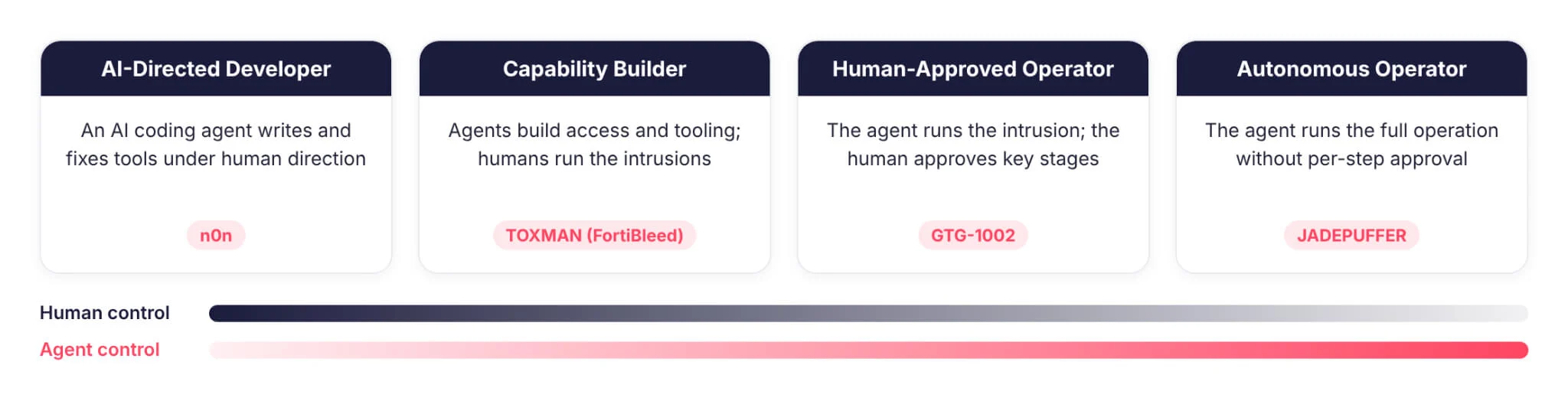
ATAs sit on a spectrum based on how much of the operation the agent controls.
Type
How the Actor Uses Agents
Documented Example
AI-Directed Developer
An AI coding agent writes and fixes tools under human direction
The n0n operator, whose agent wrote attack scripts, the encryptor, and extortion emails
Capability Builder
Agents build access and tooling; humans run the intrusions
TOXMAN, whose 14-agent PENTEST LAB built FortiBleed access for ransomware operations
Human-Approved Operator
The agent runs the intrusion; the human approves key stages
GTG-1002 and the INC and The Gentlemen affiliates
Autonomous Operator
The agent runs the full operation without per-step approval
The JADEPUFFER operator, whose agent went from initial access to ransom note
Types of agentic threat actors by how much of the operation the agent controls
How Agentic Threat Actors Operate
Getting Access to AI
ATAs need model access that will not refuse offensive work. SOCRadar’s investigations found operators using commercial AI APIs behind fake red team authorizations and persona prompts, purchased jailbreaks, and uncensored or self-hosted models. Stolen access is another route: 97 attacker servers in SOCRadar telemetry held stolen AI keys. MITRE ATLAS also documents adversaries using AI service proxies and pools of AI accounts to spread requests and avoid provider enforcement.
Building the Agent Stack
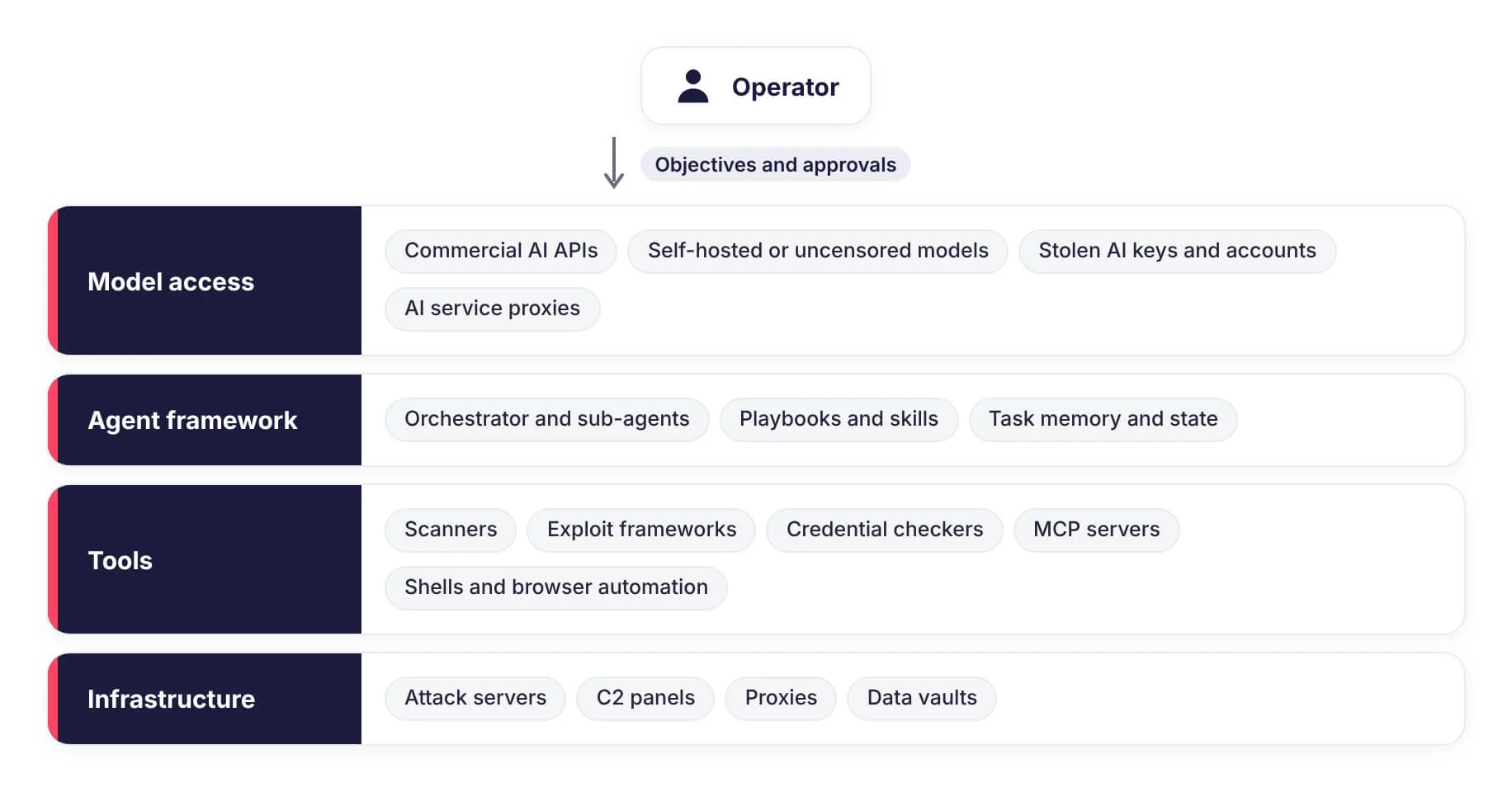
Most ATAs assemble a stack from four layers: a model, an agent framework, tools, and infrastructure. In SOCRadar’s cases, the INC and The Gentlemen affiliates ran an autonomous red-team framework called Phantom with 18 skill modules, and the FortiBleed affiliate coordinated 14 Docker-based agents through a model routing service. A separate actor tracked in ATLAS paired the Hermes agent framework with DeepSeek, controlled it over Telegram, and connected an MCP server for internet-wide asset search and scan generation.
The four layers of a typical agentic threat actor toolkit
Running Operations
Once the stack is in place, the operator assigns objectives and the agents work. GTG-1002’s agent mapped target infrastructure, wrote and tested exploit code, harvested credentials, and categorized stolen data, while humans stepped in at four to six critical decision points per campaign. The INC and The Gentlemen affiliates’ AI planned each intrusion, ran tools, sorted stolen data, and drafted ransom demands while a human approved its actions.
Agentic Threat Actors in the Wild
SOCRadar tracked 11,541 exposed attacker servers between September 2025 and October 2026. Of those, 868 used AI, and the level of AI involvement on those servers broke down as follows, according to the Agentic Ransomware Report 2026:
Level of AI Involvement
Share of 868 AI-Using Servers
AI-assisted
25.0%
AI-scripted
5.2%
Agentic, human-approved
41.0%
Autonomous agentic
28.8%
Level of AI involvement across 868 AI-using attacker servers in SOCRadar telemetry
781 of the AI-using servers ran agent tooling. SOCRadar observed an association between victim data on attacker servers and AI use, but the data does not show that AI caused more compromises.
Notable Agentic Threat Actors
GTG-1002: a group Anthropic assessed with high confidence as Chinese state-sponsored, which used an AI coding agent against about 30 organizations in September 2025
TOXMAN: the FortiBleed affiliate whose agents built access to more than 86,644 Fortinet devices for ransomware use
INC and The Gentlemen affiliates: operators whose exposed servers showed 62 targeted organizations and more than $23,920 in AI spending
n0n operator: an extortion actor whose AI coding agent environment ran on more than $7,000 in paid LLM API usage
JADEPUFFER operator: the actor behind an extortion campaign that researchers assessed was driven end to end by an LLM
Agentic Threat Actors vs Traditional Threat Actors
Aspect
Traditional Threat Actor
Agentic Threat Actor
Who executes
Human operators at the keyboard
AI agents, with humans approving key stages
Speed
Limited by operator time
Machine speed, with automatic retries after failures
Parallel targets
A few at a time per operator
Many at once per operator
Skill needed
Deep hands-on expertise
Less, when agents and playbooks are packaged for affiliates
Cost driver
People and tooling
AI API spending, accounts, and infrastructure
Evidence left
Tools, logs, and infrastructure
The same, plus AI session logs, prompts, and agent artifacts
Weaknesses of Agentic Threat Actors
ATAs inherit the flaws of the models they run. GTG-1002’s agent hallucinated credentials and overstated findings. In SOCRadar’s ransomware cases, AI-written encryptors broke mid-attack, keys were reused across victims, and a demand went to the wrong company. Operational security is also weak: several actors exposed their entire workspaces through open directories and misconfigured servers, which is how several of the cases above came to light. Until ATAs learn to scrub them, AI artifacts remain a valuable intelligence source.
How to Detect and Track Agentic Threat Actors
Tracking ATAs works best when infrastructure hunting is paired with agentic threat detection that keeps pace with machine-speed activity:
Hunt for attacker infrastructure: look for exposed servers running agent frameworks, AI session databases, and playbook repositories
Watch for machine-speed behavior: rapid, self-correcting command sequences, mass credential validation, and fixed-interval beacons
Monitor AI key exposure: leaked or stolen AI API keys feed ATA operations and run up costs for the owner
Map activity to frameworks: use MITRE ATT&CK and MITRE ATLAS together to map each stage of the attack chain
Close the usual entry points: ATAs still rely on edge devices, exposed applications, and reused credentials
How Can SOCRadar Help?
SOCRadar Cyber Threat Intelligence tracks ransomware affiliates and access brokers that adopt AI agents, and SOCRadar’s Threat Research Unit analyzes exposed attacker servers to document their frameworks, targets, and tooling. Attack Surface Management shows which of your edge devices and applications an ATA would scan first, and Dark Web Monitoring alerts on leaked credentials that agents can test at scale. SOCRadar Agentic Threat Intelligence applies the same agent model to defense, with agents that handle alarm triage, IOC enrichment, and threat actor profiling.
Frequently Asked Questions
What Is an Agentic Threat Actor?
An agentic threat actor (ATA) is a threat actor that runs attack steps through AI agents. The agents plan and execute tasks such as scanning, exploitation, and data sorting, while the human sets objectives and approves key decisions.
What Does ATA Stand For in Cybersecurity?
In this context, ATA stands for agentic threat actor. It describes an attacker whose capability is delivered by AI agents.
Is an Agentic Threat Actor the Same as Malicious AI?
No. An ATA is still a person or group with a motive. The AI agent is the means they use to carry out the operation.
Are Agentic Threat Actors Fully Autonomous?
Most are not. In SOCRadar telemetry, agentic human-approved activity was the largest category, and documented operations such as GTG-1002 kept humans in charge of a few critical decisions per campaign.
Which Groups Are Agentic Threat Actors?
Documented examples include GTG-1002, the FortiBleed affiliate TOXMAN, affiliates of INC Ransom and The Gentlemen, the n0n operator, and the actor behind JADEPUFFER.
How Do Agentic Threat Actors Bypass AI Safeguards?
They use fake security-testing authorizations, persona prompts, task splitting that hides the malicious goal, purchased jailbreaks, and uncensored or self-hosted models.
How Can Organizations Defend Against Agentic Threat Actors?
Reduce exposed attack surface, patch edge devices quickly, stop credential reuse with phishing-resistant MFA, and tune detection for machine-speed, self-correcting activity. Keep immutable backups and rehearse response for compressed timelines.