What Is Quantum Key Distribution (QKD)? How It Works, Benefits and Limits
Quantum key distribution (QKD) is a method of sharing a secret encryption key between two parties by encoding it in quantum states, usually individual photons. Its security relies on physics instead of mathematical difficulty: measuring a quantum state disturbs it, so an eavesdropper trying to intercept the key introduces errors that the legitimate parties can detect.
QKD is often described as “unhackable” encryption. That claim needs context. QKD only distributes keys. It still depends on classical authentication, and real-world equipment has been attacked through implementation flaws.
Key Takeaways
QKD shares symmetric keys over a quantum channel and detects eavesdropping through measurable error rates
BB84, introduced in 1984, is the best-known QKD protocol
QKD does not encrypt data itself; the shared key is used with a symmetric cipher such as AES
Practical limits include distance, dedicated hardware, trusted relay nodes, and the need for separate authentication
Many government security agencies currently recommend post-quantum cryptography over QKD for most use cases
Quantum Key Distribution Definition
QKD is a key exchange technique, not a full encryption system. Two parties, traditionally called Alice and Bob, use two channels:
Quantum channel: carries photons encoded with key information, usually over optical fiber or free-space links such as satellites
Classical channel: an authenticated public channel used to compare measurement settings, estimate errors, and finalize the key
QKD uses a quantum channel for key material and an authenticated classical channel to finalize the key
The output is a shared random key known only to Alice and Bob. That key then protects data with conventional symmetric encryption, or with a one-time pad when the key rate allows it.
How Does Quantum Key Distribution Work?
QKD security rests on two principles of quantum mechanics:
Measurement disturbance: observing a quantum state in the wrong basis changes it in a way that can be detected
No-cloning theorem: an unknown quantum state cannot be copied perfectly, so an attacker cannot keep a perfect copy of each photon while forwarding the original
The BB84 Protocol Step by Step
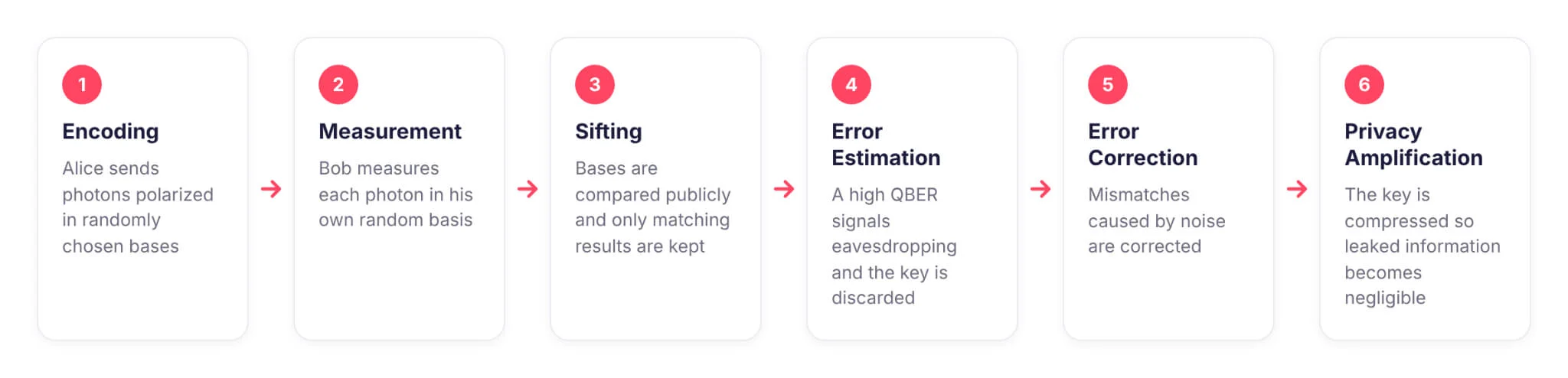
Proposed by Charles Bennett and Gilles Brassard in 1984, BB84 works as follows:
Encoding: Alice sends photons, each polarized in one of two randomly chosen bases (for example, rectilinear or diagonal) to represent a 0 or a 1
Measurement: Bob measures each photon in a randomly chosen basis of his own
Sifting: over the classical channel, Alice and Bob reveal which bases they used, not the bit values, and keep only the results where the bases matched
Error estimation: they compare a sample of the remaining bits to calculate the quantum bit error rate (QBER); a rate above a set threshold signals possible eavesdropping, and the key is discarded
Error correction: remaining mismatches caused by noise are corrected
Privacy amplification: the key is compressed so any partial information an attacker might hold becomes negligible
The six stages of the BB84 quantum key distribution protocol
Other QKD Protocols
E91: proposed by Artur Ekert in 1991, it uses entangled photon pairs and tests of quantum correlations to detect interference
Continuous-variable QKD (CV-QKD): encodes information in properties of light such as amplitude and phase, which can work with more standard telecom components
Measurement-device-independent QKD (MDI-QKD): removes detector-side vulnerabilities by letting an untrusted middle node perform the measurements
QKD vs Post-Quantum Cryptography
Organizations preparing for quantum attacks usually compare QKD with post-quantum cryptography (PQC).
Aspect
Quantum Key Distribution
Post-Quantum Cryptography
Security basis
Laws of physics
Hard mathematical problems
Hardware
Dedicated optical equipment
Runs on existing hardware and software
Scope
Key exchange only
Key exchange and digital signatures
Authentication
Requires a separate method
Signatures provide authentication
Distance
Limited without relays
No distance limit
Deployment
Point-to-point links
Internet-scale protocols such as TLS
Standards
Emerging
NIST FIPS 203, 204, and 205 published in 2024
The two approaches are not mutually exclusive. Some operators layer QKD on top of PQC on high-value links.
Limitations and Security Risks of QKD
Authentication gap: QKD cannot verify who is on the other end; without classical authentication, it is open to man-in-the-middle attacks
Distance limits: photons are lost in fiber, so practical point-to-point links are typically limited to metropolitan or regional distances
Trusted nodes: long-distance networks rely on relay nodes where the key exists in readable form, so each node becomes a high-value target
Implementation attacks: researchers have demonstrated attacks on real QKD equipment, such as detector blinding and photon-number-splitting, that exploit hardware imperfections instead of the protocol
Denial of service: because any disturbance aborts key generation, an attacker can disrupt the link by interfering with the channel
Cost and integration: specialized hardware, dedicated fiber, and limited interoperability raise deployment costs
Because of these issues, agencies including the U.S. NSA do not currently recommend QKD for protecting national security systems and point to post-quantum cryptography as the preferred path.
Real-World Use Cases
Financial networks: securing links between data centers and trading sites within a metropolitan area
Government and defense: experimental and dedicated backbone networks for sensitive communications
Critical infrastructure: protecting control links in energy and telecom networks
Satellite QKD: in 2016, China launched the Micius satellite, which demonstrated key distribution between ground stations over very long distances
Best Practices for Evaluating QKD
Treat QKD as one layer in a defense-in-depth design, not a replacement for PQC
Confirm how the system authenticates the classical channel, and prefer quantum-resistant authentication
Assess the physical security of every trusted relay node
Ask vendors for independent security evaluations that cover side-channel and implementation attacks
Plan for availability, since channel disruption stops key generation
How Can SOCRadar Help?
SOCRadar Cyber Threat Intelligence tracks threat actor interest in encrypted data, cryptographic weaknesses, and attacks on critical communication infrastructure. Attack Surface Management maps exposed services and certificates, giving teams the visibility they need to plan a quantum-safe migration that combines PQC, and QKD where it is justified.
Frequently Asked Questions
What Is Quantum Key Distribution in Simple Terms?
QKD is a way to share a secret key using single particles of light. If someone tries to intercept the key, the measurement changes the particles and the two parties see the interference.
Is QKD the Same as Quantum Encryption?
Not exactly. QKD only distributes the key. The data itself is encrypted with a classical symmetric cipher, such as AES, or a one-time pad, using the key QKD produced.
Is Quantum Key Distribution Unhackable?
The protocol is secure in theory, but real systems can be attacked. Hardware flaws, missing authentication, and trusted relay nodes have all been identified as weak points.
What Is the BB84 Protocol?
BB84 is the first QKD protocol, introduced by Charles Bennett and Gilles Brassard in 1984. It encodes bits in photon polarization using two randomly chosen bases and detects eavesdropping by measuring the error rate.
How Far Can QKD Work?
Fiber-based QKD is practical over metropolitan and regional distances. Longer networks need trusted relay nodes or satellite links.
Is QKD Better Than Post-Quantum Cryptography?
They solve different problems. PQC runs on existing systems, covers signatures, and scales to the internet. QKD offers physics-based key exchange but needs special hardware and separate authentication. Many security agencies currently prefer PQC.
Does QKD Protect Against Quantum Computers?
The key exchange itself is designed to resist quantum computers. Overall security still depends on the authentication method and the symmetric cipher used with the key.
Who Uses Quantum Key Distribution Today?
Early adopters include financial institutions, telecom operators, government networks, and research projects that run dedicated fiber or satellite QKD links.