What Is a Quantum Attack? Risks to Encryption and How to Prepare
A quantum attack is an attack that uses a quantum computer to break cryptographic protections that are considered secure against classical computers. The main concern is public-key cryptography. RSA, Diffie-Hellman, and elliptic curve algorithms protect most of today’s internet traffic, digital signatures, and software updates, and a large enough quantum computer could break all of them.
No publicly known quantum computer can do this yet. The threat is still active today, because encrypted data stolen now can be stored and decrypted later, and because replacing cryptography across an organization takes years.
Key Takeaways
A quantum attack uses quantum algorithms to break or weaken encryption and digital signatures
Shor’s algorithm threatens RSA, Diffie-Hellman, and elliptic curve cryptography, while Grover’s algorithm only weakens symmetric encryption
“Harvest now, decrypt later” makes long-lived sensitive data a target today
NIST published its first post-quantum cryptography standards (FIPS 203, 204, and 205) in August 2024
Organizations should inventory their cryptography and plan migration to quantum-resistant algorithms now
Quantum Attack Definition
A quantum attack exploits the computing model of quantum machines, where qubits can represent combinations of states and interfere with each other, to solve specific mathematical problems far faster than classical computers. A machine capable of breaking real-world cryptography is often called a cryptographically relevant quantum computer (CRQC).
The term also covers attacks against quantum systems themselves, such as attacks on the hardware used for quantum key distribution. In most security discussions, however, a quantum attack refers to breaking classical cryptography with a quantum computer.
How Do Quantum Attacks Work?
Shor’s Algorithm
Published in 1994, Shor’s algorithm efficiently solves integer factorization and discrete logarithm problems. These are the hard problems that RSA, Diffie-Hellman, DSA, and elliptic curve cryptography depend on. A CRQC running Shor’s algorithm could recover private keys from public keys, which would allow attackers to:
Decrypt recorded TLS and VPN sessions that used vulnerable key exchange
Forge digital signatures on software updates, certificates, and documents
Impersonate servers and users in authentication protocols
Grover’s Algorithm
Grover’s algorithm, published in 1996, speeds up brute-force search quadratically. Against symmetric encryption and hash functions, it roughly halves the effective security level. AES-256 remains strong under this model, which is why the usual guidance for symmetric cryptography is to use longer keys instead of replacing algorithms.
Algorithms at Risk
Algorithm Type
Examples
Quantum Threat
Recommended Response
Public-key encryption and key exchange
RSA, Diffie-Hellman, ECDH
Broken by Shor’s algorithm
Migrate to ML-KEM or hybrid key exchange
Digital signatures
RSA signatures, DSA, ECDSA, EdDSA
Broken by Shor’s algorithm
Migrate to ML-DSA or SLH-DSA
Symmetric encryption
AES-128, AES-256
Weakened by Grover’s algorithm
Prefer AES-256
Hash functions
SHA-256, SHA-384, SHA-3
Weakened by Grover’s algorithm
Use larger output sizes where needed
Harvest Now, Decrypt Later
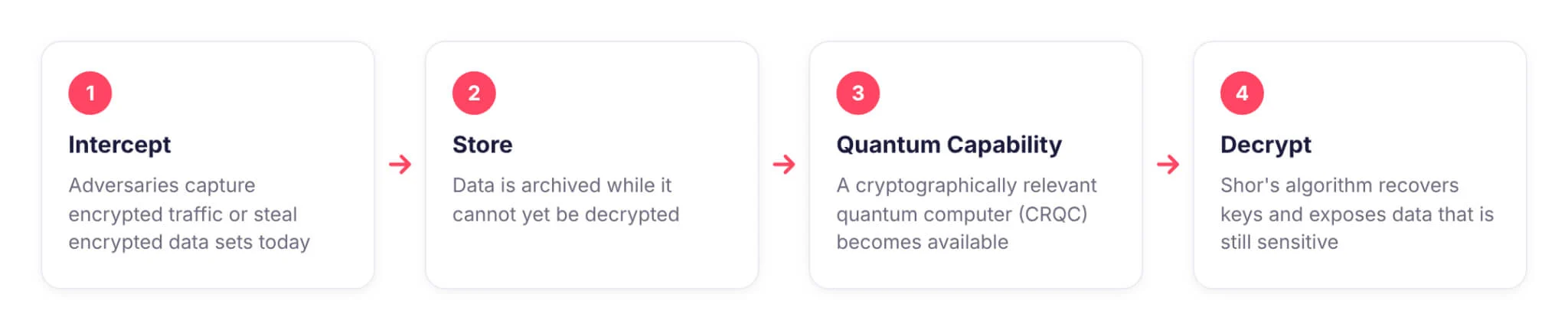
The most immediate quantum risk does not need a quantum computer today. In a “harvest now, decrypt later” approach, adversaries intercept and store encrypted traffic or steal encrypted data sets, then wait until quantum capability exists to decrypt them.
How harvest now, decrypt later exposes data that is encrypted today
This matters for any data that must stay confidential for many years:
Government and defense communications
Health records and genetic data
Intellectual property and trade secrets
Financial records and long-term contracts
Identity data and credentials that are never rotated
If the confidentiality period of your data is longer than the time it will take you to migrate, plus the time until a CRQC exists, that data is already exposed in practice.
Other Quantum-Related Attack Surfaces
Signature forgery: long-lived root certificates and firmware signing keys are high-value targets because a forged signature can enable trusted malware distribution
Attacks on quantum hardware: implementations of quantum key distribution have been attacked through side channels such as detector blinding, which exploit the physical equipment instead of the underlying physics
Migration flaws: rushed or incorrect post-quantum implementations can introduce classic vulnerabilities, such as side-channel leaks or downgrade paths to legacy algorithms
Post-Quantum Cryptography Standards
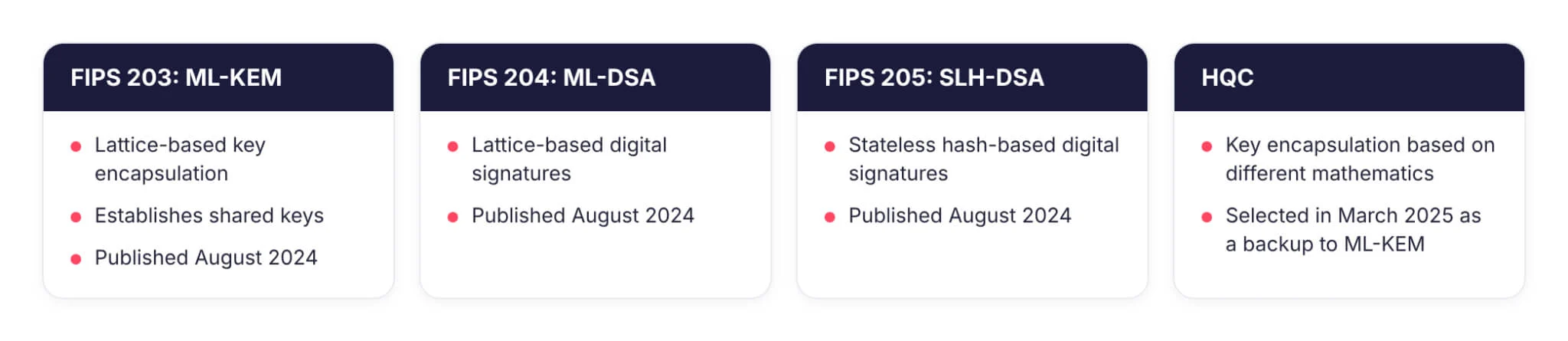
Post-quantum cryptography (PQC) uses mathematical problems believed to be hard for both classical and quantum computers, and it runs on existing hardware. In August 2024, NIST released its first three PQC standards:
FIPS 203 (ML-KEM): a lattice-based key encapsulation mechanism for establishing shared keys
FIPS 204 (ML-DSA): a lattice-based digital signature algorithm
FIPS 205 (SLH-DSA): a stateless hash-based digital signature algorithm
In March 2025, NIST selected HQC as an additional key encapsulation algorithm based on different mathematics, to serve as a backup to ML-KEM. NIST IR 8547, finalized in October 2026, sets the transition path: quantum-vulnerable public-key algorithms such as RSA and elliptic curve cryptography are deprecated after 2030 and disallowed after 2035.
NIST post-quantum cryptography standards and the HQC backup algorithm
How to Prepare for Quantum Attacks
Build a cryptographic inventory: identify where public-key cryptography is used across applications, protocols, certificates, hardware, and third-party products
Classify data by shelf life: prioritize systems that protect data with long confidentiality requirements
Adopt crypto-agility: design systems so algorithms can be replaced through configuration instead of code rewrites
Use hybrid key exchange: combine classical and post-quantum algorithms during the transition so security holds if either one fails
Engage vendors: ask suppliers for post-quantum roadmaps and include PQC requirements in procurement
Upgrade symmetric strength: standardize on AES-256 and strong hash functions
Test and monitor: validate performance, interoperability, and implementation security before full rollout
How Can SOCRadar Help?
SOCRadar Attack Surface Management maps internet-facing assets and their certificates, which supports the discovery step of a cryptographic inventory, including weak or outdated configurations. Cyber Threat Intelligence and Dark Web Monitoring track stolen databases and encrypted data sets offered by threat actors, which are exactly the assets at risk in harvest now, decrypt later scenarios.
Frequently Asked Questions
What Is a Quantum Attack?
A quantum attack uses a quantum computer to break cryptography that is secure against classical computers, mainly public-key algorithms such as RSA and elliptic curve cryptography.
Can Quantum Computers Break Encryption Today?
No publicly known quantum computer can break RSA or elliptic curve cryptography at real-world key sizes today. The risk comes from future capability and from data being collected now for later decryption.
What Is Harvest Now, Decrypt Later?
It is a strategy where attackers collect encrypted data today and store it until quantum computers can decrypt it. Data that must stay secret for many years is most at risk.
Is AES Safe From Quantum Attacks?
AES is considered resistant. Grover’s algorithm reduces its effective strength, but AES-256 still provides a high security margin, so it is the recommended choice.
What Is Post-Quantum Cryptography?
Post-quantum cryptography is a family of algorithms designed to resist both classical and quantum attacks while running on current computers. NIST standardized ML-KEM, ML-DSA, and SLH-DSA in 2024.
What Is the Difference Between Post-Quantum Cryptography and Quantum Cryptography?
Post-quantum cryptography uses new mathematical algorithms on classical hardware. Quantum cryptography, such as quantum key distribution, uses quantum physics and specialized hardware to exchange keys.
When Should Organizations Start Preparing for Quantum Threats?
Now. NIST deprecates quantum-vulnerable public-key algorithms after 2030 and disallows them after 2035, and large migrations take years, so inventory and planning should already be underway.
Which Systems Should Migrate to Quantum-Safe Cryptography First?
Systems that protect long-lived sensitive data, external key exchange such as TLS and VPNs, and long-lived signing keys for firmware, software, and certificate authorities should be prioritized.