

Mar 10, 2026

May 15, 2026
5 Mins Read
Sep 25, 2026
Table Of Content
Related Articles

SMS Bombing
Threat Actors
Jan 08, 2026
Dark Web Monitoring
Feb 19, 2026

Ransomware
Jan 31, 2026
OSINT Framework
Apr 17, 2026

What Is SOAR in Cybersecurity?
Security Orchestration, Automation, and Response (SOAR) combines integrations, case management, and playbooks to coordinate security investigation and response.
SOAR is most effective when it automates stable, understood processes and preserves analyst judgment for ambiguity and high-impact decisions. Poor data, fragile integrations, and uncontrolled automation can accelerate mistakes as easily as correct actions.
Key Takeaways
- Security Orchestration, Automation, and Response (SOAR) combines integrations, case management, and playbooks to coordinate security investigation and response.
- SOAR is most effective when it automates stable, understood processes and preserves analyst judgment for ambiguity and high-impact decisions. Poor data, fragile integrations, and uncontrolled automation can accelerate mistakes as easily as correct actions.
- Automation based on false positives is a primary concern.
- Effective programs combine prevention, continuous visibility, accountable ownership, and tested response.
How It Works
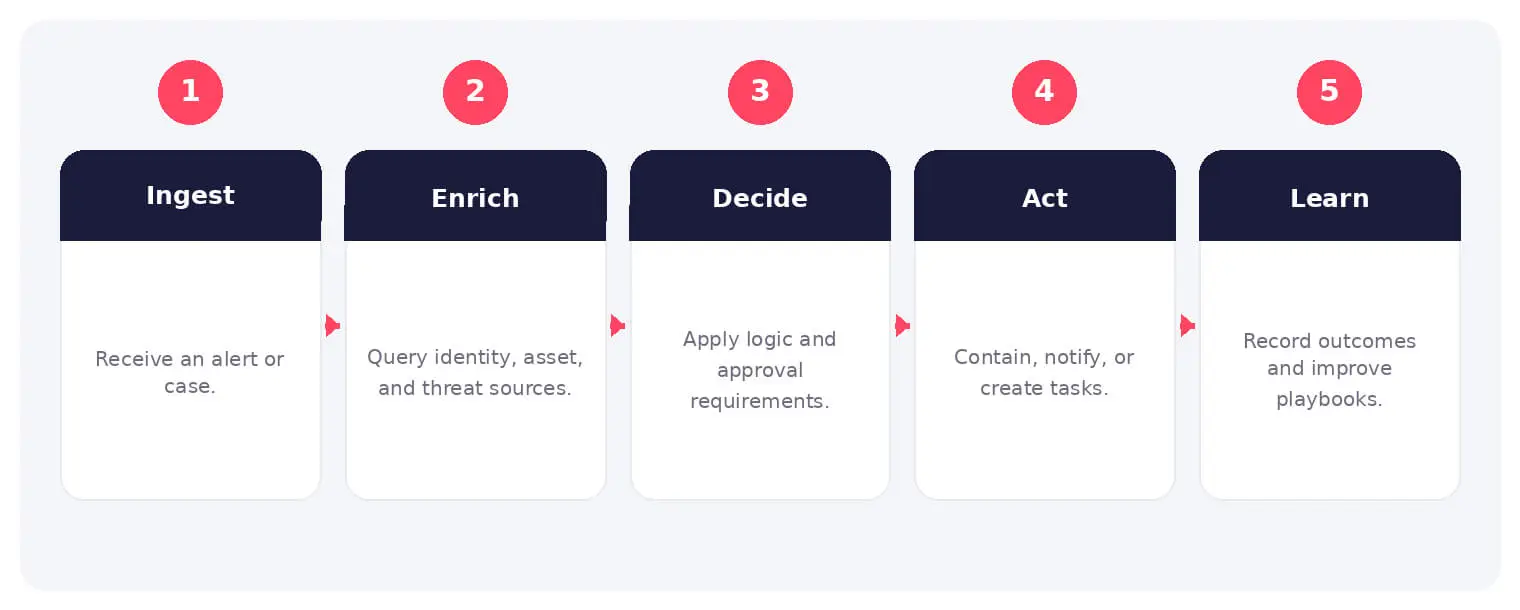
The operating flow above turns the concept into observable steps. Exact implementations vary, but each stage needs accountable ownership, trusted inputs, documented policy, and evidence that analysts can use during investigation and review.
SOAR is most effective when it automates stable, understood processes and preserves analyst judgment for ambiguity and high-impact decisions. Poor data, fragile integrations, and uncontrolled automation can accelerate mistakes as easily as correct actions.
Common Types and Capabilities
- Security orchestration and integrations
- Automated enrichment and triage
- Incident case management
- Response playbooks and approvals
Security and Business Risks
- Automation based on false positives
- Broken connectors and partial action
- Overprivileged service accounts
- Opaque workflows and weak rollback
Warning Signs and Detection
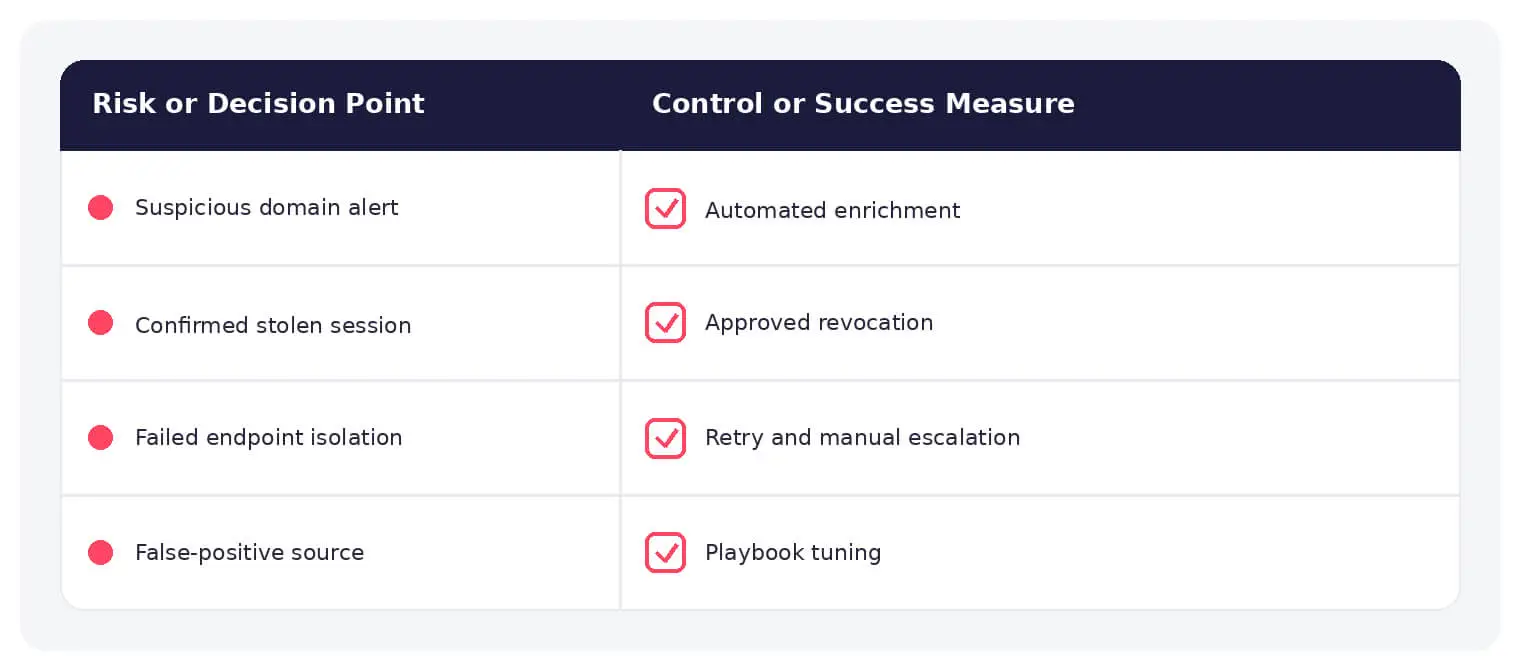
Monitor connector failures, API errors, queued actions, repeated retries, playbook drift, unexpected containment, approval bypass, service-account changes, missing case evidence, analyst overrides, and differences between reported and actual control state.
Best Practices
Start with high-volume low-risk tasks, define owners, use least-privilege integrations, require approvals for disruptive action, preserve evidence, make workflows idempotent, test failure paths, monitor connectors, version playbooks, and measure time saved and error rate.
How SOCRadar Can Help
SOCRadar adds external visibility, threat intelligence, exposure context, and continuous monitoring to help teams validate and prioritize risks related to SOAR. This context complements internal security operations, identity, response, and governance controls.
Request a demo to strengthen threat-informed prevention and response.
Frequently Asked Questions
What Does SOAR Stand For in Cybersecurity?
SOAR stands for Security Orchestration, Automation, and Response. It combines tool integrations, incident case management, and response playbooks to coordinate security investigation and response. The goal is to reduce manual work on repetitive tasks while keeping analysts in charge of ambiguous, high-impact decisions.
How Is SOAR Different from a SIEM?
A SIEM collects and correlates log data to support detection and alerting, while SOAR coordinates actions across tools, manages cases, and executes response steps. Many teams pair the two: the SIEM surfaces alerts, and the SOAR platform enriches, triages, and acts on them. SOAR can operate without a SIEM, but the combination is common in mature security operations.
What Is a SOAR Playbook?
A playbook is a documented, repeatable workflow that defines how the platform handles a specific scenario, such as phishing reports or suspicious logins. It typically chains together enrichment queries, case updates, notifications, and containment actions. Disruptive steps should include approval gates so analysts remain in control of consequential actions.
Which Tasks Should Teams Automate First?
Start with high-volume, low-risk tasks that follow a stable, well-understood process, such as indicator enrichment, alert deduplication, or ticket routing. Workflows that change frequently or require ambiguous judgment are poor first candidates. Automating an unclear process tends to scale mistakes rather than save time.
What Are the Main Risks of SOAR Automation?
The most significant risk is automated action based on false positives, which can lock out legitimate users or isolate healthy systems. Other risks include broken or partial integrations, overprivileged service accounts, and opaque workflows that are hard to roll back. Poor data quality can accelerate wrong actions as easily as correct ones.
What Warning Signs Suggest a SOAR Problem?
Watch for connector failures, API errors, queued actions, repeated retries, and playbook drift from the approved version. Unexpected containment, approval bypass, service-account changes, and missing case evidence also indicate trouble. Any difference between reported and actual control state warrants immediate investigation.
How Can Teams Keep Automated Actions from Backfiring?
Require analyst approval for disruptive steps such as host isolation or account disablement, and run integrations under least-privilege service accounts. Make workflows idempotent so a retried action does not compound damage, and test failure paths before production use. Version playbooks and preserve evidence so every action can be reviewed and reversed if needed.
What Metrics Show Whether SOAR Is Working?
Measure time saved per workflow and the error rate of automated actions, rather than counting automated steps alone. Analyst overrides, actions driven by false positives, and case backlog trends reveal whether automation helps or creates new work. Regular reviews against these metrics keep the program aligned with operational reality.
Does SOAR Replace Security Analysts?
No. SOAR performs best when it removes repetitive enrichment and triage work while preserving analyst judgment for complex or high-impact incidents. Analysts still own playbook design, approval decisions, and incident review. Treating automation as a full replacement usually leads to uncontrolled workflows and blind spots.
Is SOAR the Same as XDR or EDR?
No. EDR focuses on endpoint detection and response, XDR extends detection across multiple telemetry sources, and SOAR orchestrates workflows and actions across separate tools, including EDR and XDR platforms. A SOAR platform can trigger actions in an EDR tool, but it does not replace the detection capabilities those tools provide.