What Are YARA Rules?
YARA rules describe textual, binary, and structural patterns that help identify and classify malware, suspicious files, memory artifacts, and related threat families.
A rule commonly contains metadata, string definitions, and a condition that determines a match. Effective rules balance precision and coverage, use stable distinguishing features, and are tested against both malicious samples and representative benign files.
Key Takeaways
- YARA rules describe textual, binary, and structural patterns that help identify and classify malware, suspicious files, memory artifacts, and related threat families.
- A rule commonly contains metadata, string definitions, and a condition that determines a match. Effective rules balance precision and coverage, use stable distinguishing features, and are tested against both malicious samples and representative benign files.
- Broad rules that generate false positives is a primary concern.
- Effective programs combine clear scope, evidence, accountable ownership, and continuous review.
How It Works
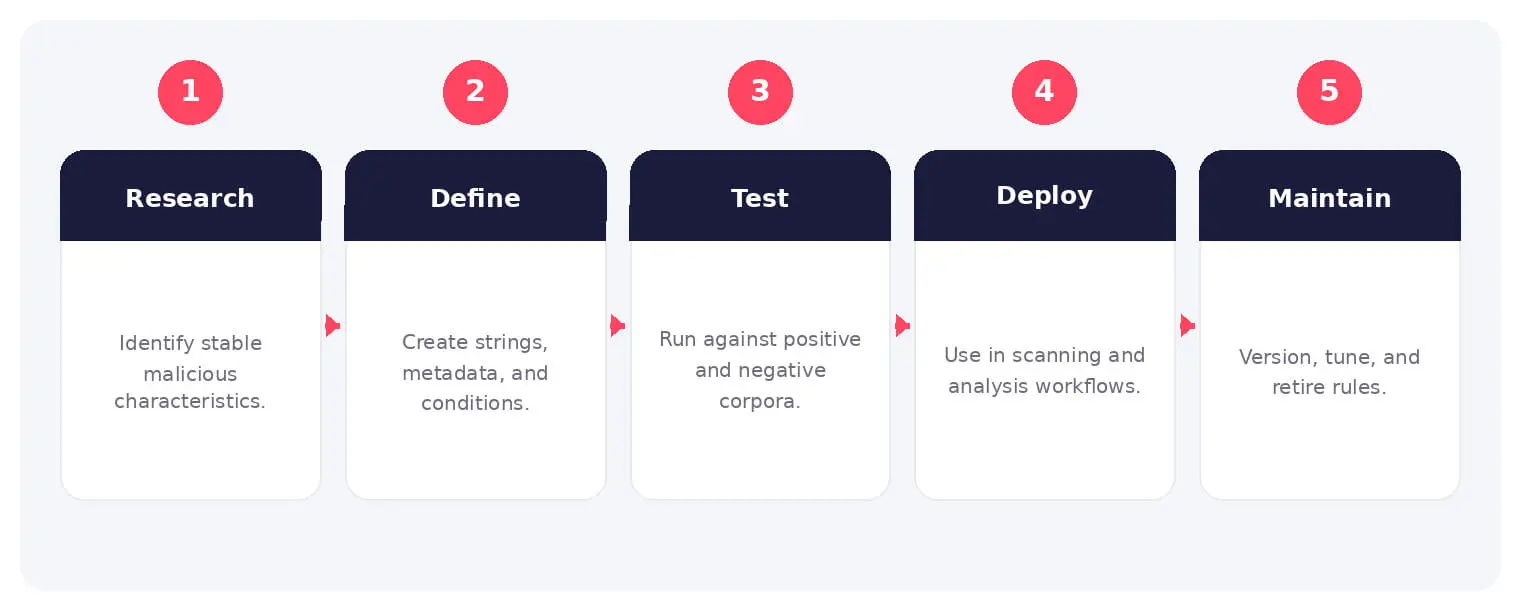
The operating flow above turns the concept into observable steps. Exact implementations vary, but each stage needs accountable ownership, trusted inputs, documented policy, and evidence that practitioners can use during review and decision-making.
A rule commonly contains metadata, string definitions, and a condition that determines a match. Effective rules balance precision and coverage, use stable distinguishing features, and are tested against both malicious samples and representative benign files.
Common Types and Capabilities
- Text, hexadecimal, and regular-expression strings
- File-format and module-aware rules
- Malware-family and campaign rules
- Memory and incident-response hunting rules
Security and Business Risks
- Broad rules that generate false positives
- Fragile rules tied to one sample
- Performance problems from costly patterns
- Sensitive intelligence exposed through rule content
Warning Signs and Detection
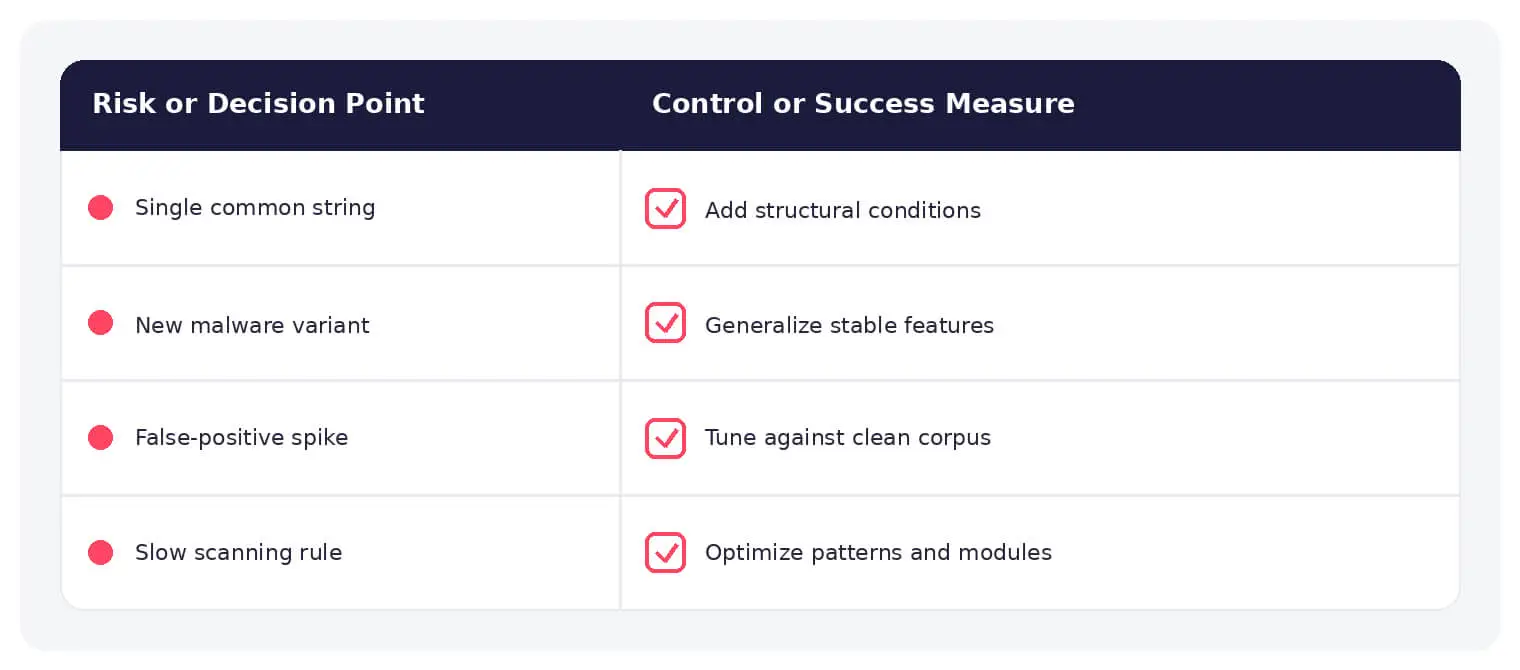
Monitor sudden match-volume changes, new benign matches, missed variants, expensive scans, rules without owners, outdated family names, copied rules without provenance, conditions dominated by common strings, and rule updates that were not tested against a clean corpus.
Best Practices
Use distinctive stable features, combine multiple conditions, add metadata and references, avoid secrets, test positive and negative samples, measure performance, use namespaces and version control, peer review changes, document confidence, and retire obsolete rules.
How SOCRadar Can Help
SOCRadar adds external visibility, threat intelligence, exposure context, and continuous monitoring to help teams validate and prioritize risks related to YARA rules. This context complements internal engineering, governance, vulnerability, and security operations controls.
Explore SOCRadar Cyber Threat Intelligence or request a demo to strengthen threat-informed prevention and response.
Frequently Asked Questions
What Are YARA Rules Used For?
YARA rules let analysts describe the textual, binary, and structural patterns that distinguish a malware family, a suspicious file, or a memory artifact. Teams apply them for classification, retroactive hunting across sample collections, incident response triage, and automated scanning of file stores and endpoints.
What Are the Main Components of a YARA Rule?
A typical rule has three parts:
- Metadata records context such as author, date, family name, and references.
- Strings define the text, hexadecimal, or regular-expression patterns to look for.
- Condition states the logical combination that must be true for a match.
Documenting these sections makes rules easier to review, maintain, and share.
What Types of Patterns Can YARA Match?
YARA matches plain text strings, hexadecimal byte sequences, and regular expressions, with modifiers for case-insensitivity, wide-character encoding, and other variations. Module-aware rules can also inspect file structures such as PE headers or computed hashes, enabling detections tied to format traits rather than raw content alone.
Why Do Overly Broad YARA Rules Generate False Positives?
Rules anchored to short or common strings, such as generic packer markers or widely reused API names, can fire on large volumes of legitimate software. High false-positive rates consume triage time and erode trust in the ruleset, which is why distinctive, stable features should carry the weight of each condition.
How Should a New YARA Rule Be Tested Before Deployment?
Validate the rule against known malicious samples it is meant to catch, then run it against a representative corpus of benign files to surface false positives. Performance testing matters as well, because expensive constructs such as unanchored regular expressions can noticeably slow large-scale scans.
What Makes a YARA Rule Reliable Across Malware Variants?
Reliable rules combine several distinctive indicators, such as unique byte sequences, family-specific strings, or structural traits, instead of depending on a single value. Features that persist across variants reduce breakage, whereas rules tied to one sample tend to fail as soon as the malware is recompiled or obfuscated.
Can YARA Scan Running Process Memory?
Yes. YARA can scan live process memory and memory dumps, which makes it valuable during incident response for locating injected code, unpacked payloads, or attacker tooling that never touches disk. Memory scanning usually requires careful performance tuning because the address space being searched can be large.
What Warning Signs Indicate a YARA Ruleset Needs Review?
Watch for sudden changes in match volume, new matches on benign files, missed variants of known families, and scans that grow progressively slower. Organizational signals count as well: rules without a named owner, outdated family names, copied rules with unclear provenance, and updates that were never tested against a clean corpus.
How Should Teams Manage YARA Rules at Scale?
Treat rules as code: store them in version control, organize them with namespaces, require peer review before changes ship, and record confidence levels and references in metadata. Retire obsolete rules on a schedule and retest the ruleset against both malicious and clean corpora after significant updates.
Can Sharing YARA Rules Expose Sensitive Intelligence?
Yes. A shared rule can reveal that a team is tracking a specific actor, campaign, or sample, which may compromise an ongoing investigation or a collection source. Rules should not contain confidential file paths, internal hostnames, or undisclosed indicators, and their content should be reviewed before any external release.
Is YARA a Replacement for Antivirus Software?
No. YARA is a pattern-matching and classification tool, not a full endpoint protection platform with prevention, behavioral detection, and automated response. It complements antivirus and EDR tooling by giving analysts a flexible way to describe specific threats and hunt for them across files, memory, and sample repositories.
Oct 27, 2026
September 2026: FBI Breach, Clop Hijack & IDScan Leak
The major cyber attacks of September 2026 hit federal law enforcement, a rival cybercrime gang, and the companies that verify identities. ShinyHunters…

Oct 27, 2026
Australia’s Annual Cyber Threat Report 2025-26 Shows Cyber Incidents Up 20%
Australia’s cyber security authority responded to 1,524 cyber security incidents in the 2025-26 financial year, a 20% increase from the previous year…

Oct 27, 2026
PHP2Shell Weaponized After Japanese Real Estate Extortion
An exposed server ties an extortion wave on about 20 Japanese property sites to an operator who later weaponized PHP2Shell (CVE-2026-109618, CVE-2026-109619)…
Intelligence in your inbox every Thursday.
Join 30,000+ security professionals reading SOCRadar research.
Subscribe