What Is the Deep Web?
The deep web is internet content that standard search engines do not index. It includes email inboxes, online banking, cloud storage, subscription databases, corporate portals, medical records, private social content, dynamically generated pages, and resources available only through direct queries or authentication.
Most of the deep web is ordinary and legitimate. It is broader than the dark web, which is a smaller subset hosted on overlay networks and accessed through special software. Unindexed does not mean anonymous, criminal, or unreachable to authorized users.
Key Takeaways
- Authenticated accounts and customer portals is a central category or use case.
- Reliable assessment depends on source, timing, ownership, and operational context.
- Detection should connect external findings with identity, device, network, and business signals.
- Response should protect affected people and remove every reusable access path.
How the Deep Web Works
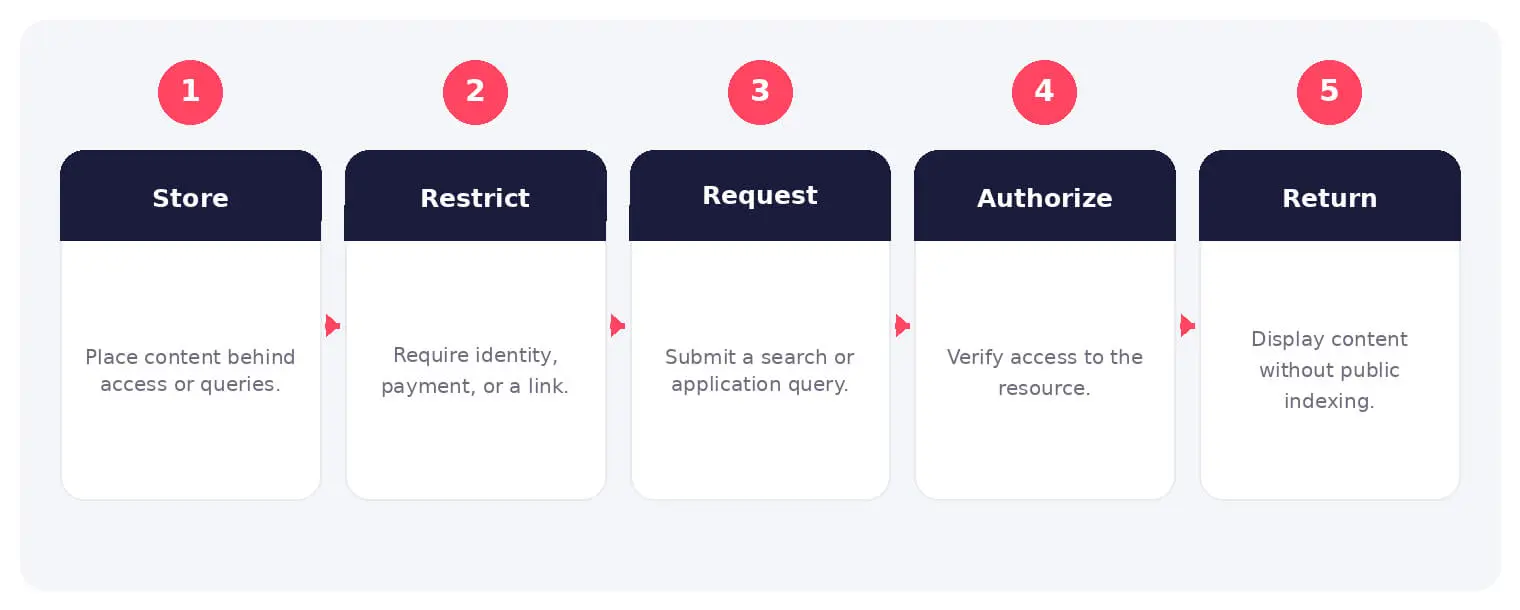
The sequence shown above provides a practical operating model. Individual steps may overlap, repeat, or involve different services and participants, so analysts should validate each stage against available evidence.
Most of the deep web is ordinary and legitimate. It is broader than the dark web, which is a smaller subset hosted on overlay networks and accessed through special software. Unindexed does not mean anonymous, criminal, or unreachable to authorized users.
Common Types and Use Cases
- Authenticated accounts and customer portals
- Private cloud storage and enterprise applications
- Academic, legal, and subscription databases
- Dynamic pages and unlinked resources
Security, Privacy, and Business Risks
- Exposure through weak authentication or misconfiguration
- Sensitive data indexed accidentally
- Stolen credentials used against private portals
- Shadow assets and forgotten applications
Warning Signs and Validation
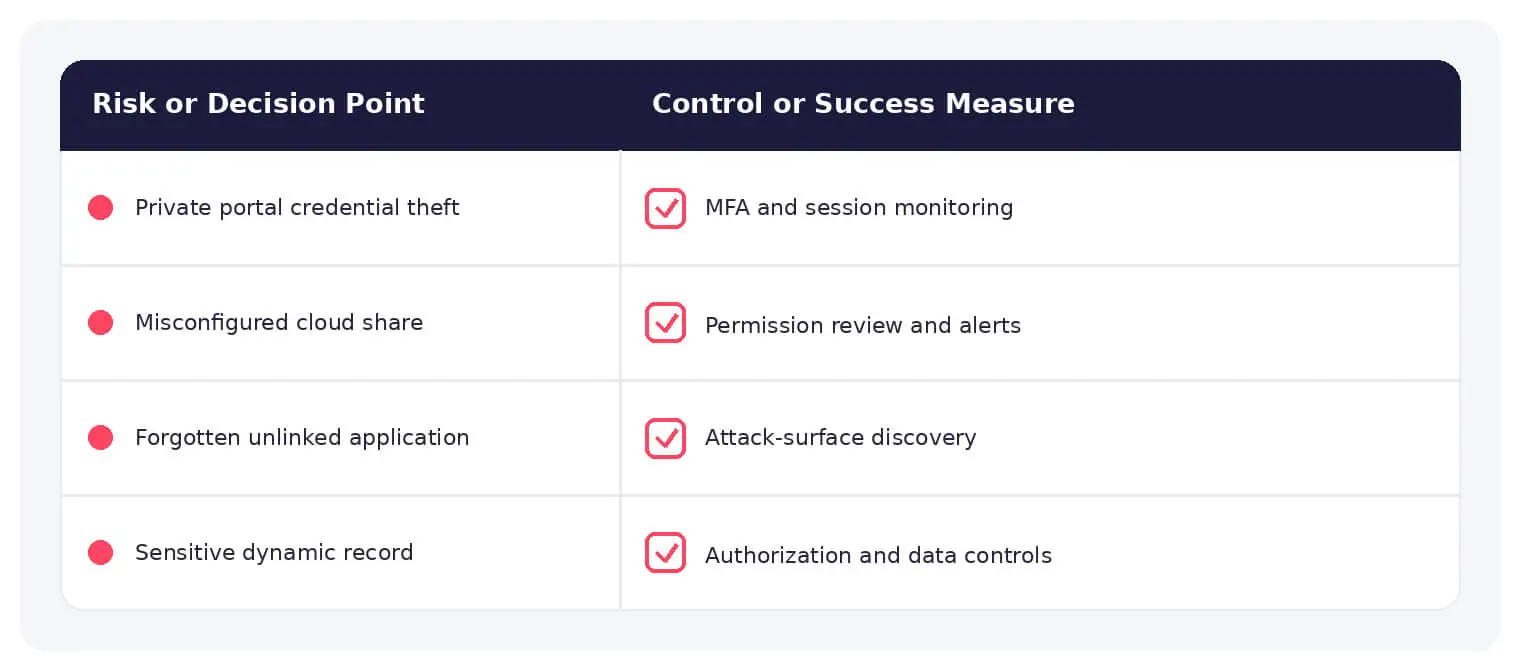
Inventory private applications and data stores, monitor authentication and sharing, detect public exposure, review cloud permissions, and find forgotten subdomains or portals that are not linked from the main website.
Prevention and Response
Use strong authentication, least privilege, secure sharing, data classification, attack-surface discovery, logging, and regular access reviews. Ensure robots directives are not treated as access control.
How SOCRadar Can Help
SOCRadar combines external intelligence, Dark Web visibility, brand monitoring, attack-surface discovery, and contextual enrichment to help teams identify exposure and investigate activity connected to deep web.
Explore SOCRadar Attack Surface Management or request a demo to strengthen external threat detection and response.
Frequently Asked Questions
What Counts as Deep Web Content?
Any page or resource that standard search engines do not index. Common examples include email inboxes, online banking, subscription databases, corporate portals, medical records, and pages that render only after a form submission or login. Dynamically generated pages and resources with no inbound links also count, so deep web content is not limited to password-protected sites.
Why Don’t Search Engines Index Deep Web Pages?
Crawlers discover content mainly by following links and fetching pages without restriction. Pages that require authentication, sit behind search forms or paywalls, exist only as responses to queries, or are disallowed by robots directives do not enter the index. Absence from an index says nothing about how well the content is protected.
Is robots.txt a Security Control for Deep Web Content?
No. robots.txt is a voluntary directive that cooperative crawlers are expected to follow, and the file is publicly readable, so it can reveal directory names to anyone who looks. It performs no authentication and blocks nothing; access is actually governed by authentication, authorization, and network controls.
How Do Attackers Reach Deep Web Systems?
Search engine invisibility does not stop direct access. Attackers usually get in with stolen or reused credentials, phishing, misconfigured sharing settings, exposed APIs, or URLs harvested from leaks, subdomain enumeration, and indexed documents. Weak authentication and forgotten assets are frequent entry points, which is why inventory and access reviews matter.
What Warning Signs Suggest Deep Web Exposure?
Useful indicators include corporate credentials appearing in stealer logs or leak dumps, logins to private portals from unfamiliar devices or locations, private pages turning up in public search results, and sharing links that work without authentication. Publicly reachable subdomains, staging portals, or admin panels that were never meant to be linked are also strong red flags.
How Can Teams Find Forgotten Deep Web Assets?
Start with an inventory of private applications, cloud storage, and data stores, then compare it against externally observable assets such as subdomains, open ports, and TLS certificates. Review cloud sharing permissions, look for unlinked portals and test environments, and check whether private pages have been indexed by search engines. Periodic access reviews surface applications and accounts that no longer have a clear owner.
What Should You Do After Deep Web Credentials Are Stolen?
Reset the exposed credentials, but remember that password changes do not always terminate active sessions, so revoke sessions and API tokens where the platform supports it. Enforce phishing-resistant MFA on the portal and review authentication logs to identify access that already occurred. Rotate any secrets the account could reach, and if data was downloaded or shared, treat it as exposed and notify affected parties as required.
Which Security Controls Protect Deep Web Resources?
Use strong, phishing-resistant authentication and least-privilege access, apply data classification so sensitive stores carry stricter controls, and set sharing defaults that avoid unauthenticated links. Maintain logging on private portals, run attack-surface discovery to find shadow assets, and schedule regular access reviews to remove stale accounts. Never rely on robots directives, obscurity, or an unlisted URL in place of real access controls.
What Business Impact Can Deep Web Exposures Have?
Exposed deep web resources put customer records, financial data, internal documents, and regulated information at risk of breach and compliance violations. Stolen credentials can enable account takeover, fraud, and follow-on attacks against partners, while forgotten applications quietly expand the audit surface. Incident costs typically include investigation, notification, legal exposure, and reputational harm.
Is the Deep Web Illegal?
No. Most deep web content is ordinary and legitimate, such as email inboxes, banking portals, subscription databases, and corporate applications. Whether content or activity is legal depends on what it is, not on whether search engines index it; the dark web hosts some illicit markets, but the deep web as a whole is simply the unindexed portion of the internet.
How Is the Deep Web Different From the Dark Web?
The deep web is everything search engines do not index, while the dark web is a much smaller subset hosted on overlay networks such as Tor that requires special software to access. Dark web sites are deliberately hidden, whereas deep web content is usually private because it sits behind authentication, forms, or a lack of links. Content being unindexed does not make it anonymous or suspicious by itself.

Oct 27, 2026
September 2026: FBI Breach, Clop Hijack & IDScan Leak
The major cyber attacks of September 2026 hit federal law enforcement, a rival cybercrime gang, and the companies that verify identities. ShinyHunters…

Oct 27, 2026
Australia’s Annual Cyber Threat Report 2025-26 Shows Cyber Incidents Up 20%
Australia’s cyber security authority responded to 1,524 cyber security incidents in the 2025-26 financial year, a 20% increase from the previous year…

Oct 27, 2026
PHP2Shell Weaponized After Japanese Real Estate Extortion
An exposed server ties an extortion wave on about 20 Japanese property sites to an operator who later weaponized PHP2Shell (CVE-2026-109618, CVE-2026-109619)…
Intelligence in your inbox every Thursday.
Join 30,000+ security professionals reading SOCRadar research.
Subscribe