What Is a Proxy Firewall or Application Gateway?
A proxy firewall, also called an application-level gateway, terminates a client connection and creates a separate connection to the destination while enforcing application-aware policy.
Because the client and server do not communicate directly, the proxy can validate protocol behavior, authenticate users, filter content, hide internal addressing, and log transactions. This inspection adds control but can introduce latency, compatibility issues, and concentration risk.
Key Takeaways
- A proxy firewall, also called an application-level gateway, terminates a client connection and creates a separate connection to the destination while enforcing application-aware policy.
- Because the client and server do not communicate directly, the proxy can validate protocol behavior, authenticate users, filter content, hide internal addressing, and log transactions. This inspection adds control but can introduce latency, compatibility issues, and concentration risk.
- Application-layer attacks and malicious content is a primary concern.
- Effective security combines prevention, continuous visibility, ownership, and tested response.
How It Works
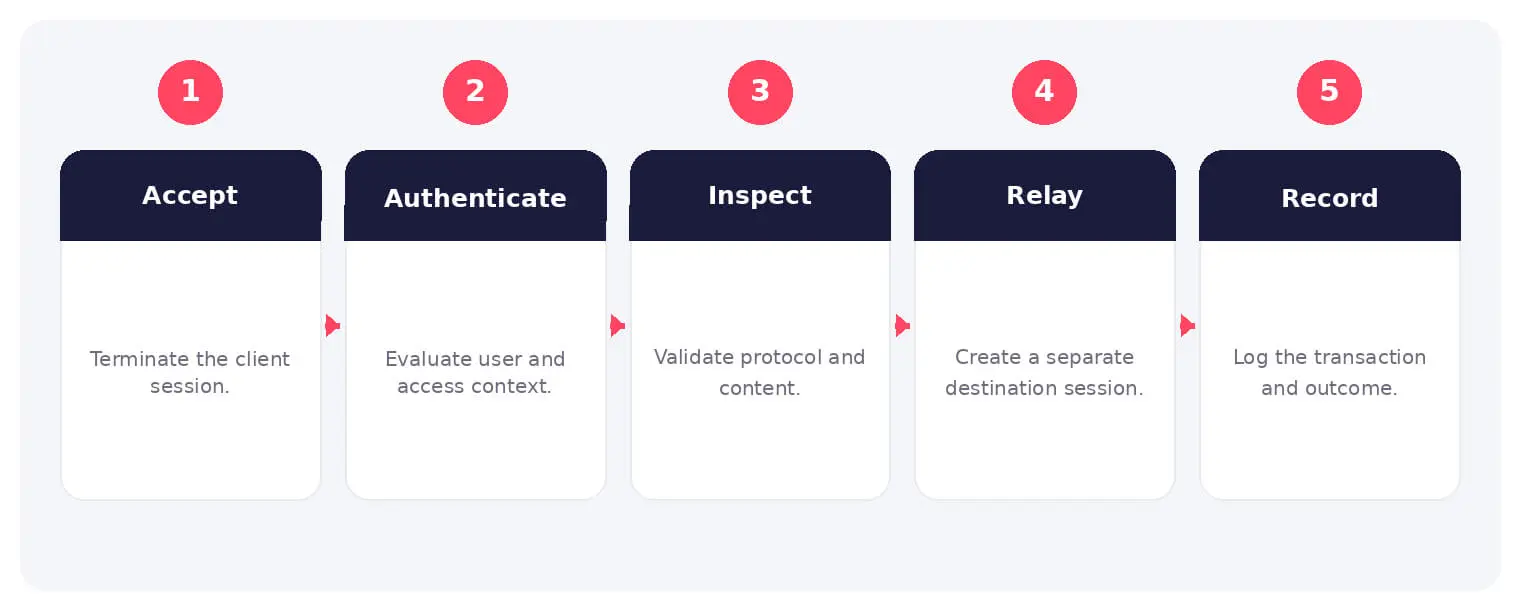
The operating flow above turns the concept into observable steps. Exact implementations vary, but each stage needs accountable ownership, trusted inputs, documented policy, and evidence that analysts can use during investigation and review.
Because the client and server do not communicate directly, the proxy can validate protocol behavior, authenticate users, filter content, hide internal addressing, and log transactions. This inspection adds control but can introduce latency, compatibility issues, and concentration risk.
Common Types and Capabilities
- Forward proxy firewalls
- Reverse proxy and application gateways
- Circuit-level gateways
- Protocol-specific email and web proxies
Security and Business Risks
- Application-layer attacks and malicious content
- Proxy bypass or unsupported protocols
- Credential and certificate exposure
- Availability and performance bottlenecks
Warning Signs and Detection
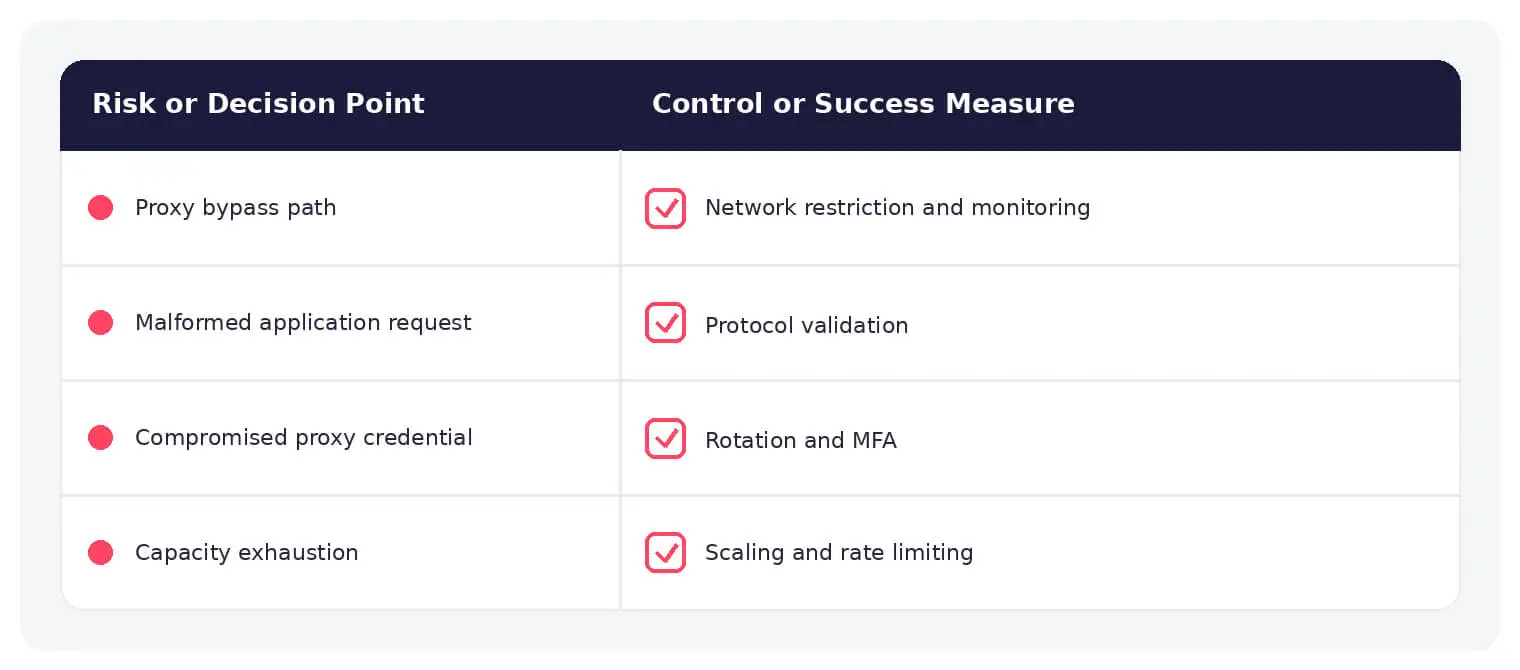
Monitor direct connections that bypass the proxy, protocol violations, unusual methods, authentication anomalies, certificate errors, large uploads, malware detections, configuration changes, backend exposure, and resource saturation.
Best Practices
Force approved traffic paths, restrict direct access, harden and patch the proxy, protect keys, validate protocols, use strong authentication, filter egress, scale redundantly, preserve logs, and test application compatibility.
How SOCRadar Can Help
SOCRadar adds external visibility, threat intelligence, exposure context, and continuous monitoring to help teams validate and prioritize risks related to proxy firewall. This context complements internal network, endpoint, identity, and vulnerability controls.
Explore SOCRadar Attack Surface Management or request a demo to strengthen threat-informed prevention and response.
Frequently Asked Questions
What Is a Proxy Firewall?
A proxy firewall, also known as an application-level gateway, sits between clients and servers and brokers every connection at the application layer. It terminates the client’s connection, opens a separate connection to the destination, and enforces protocol-aware policy on the traffic passing between them.
How Is a Proxy Firewall Different from a Packet-Filtering Firewall?
Packet-filtering firewalls evaluate header details such as IP addresses and ports without examining payload content. A proxy firewall understands the application protocol itself, so it can validate commands, authenticate users, filter content, and log complete transactions rather than only connection metadata.
Why Does a Proxy Firewall Terminate the Client Connection?
Terminating the connection means the client and server never communicate directly. This breaks the end-to-end path, allowing the proxy to inspect payloads, validate protocol behavior, mask internal addressing, and stop malformed or malicious requests before they reach the destination.
What Is the Difference Between a Forward Proxy and a Reverse Proxy?
A forward proxy handles outbound traffic from internal clients to external services, enforcing egress policy and filtering returned content. A reverse proxy sits in front of internal servers, accepting inbound requests, distributing load, and shielding backend systems from direct internet exposure.
How Does an Application-Level Gateway Compare to a Circuit-Level Gateway?
A circuit-level gateway relays connections without deeply parsing the application protocol, similar to a SOCKS proxy. An application-level gateway interprets the actual protocol, such as HTTP or FTP, so it can detect malformed requests, unauthorized methods, and content hidden inside legitimate-looking traffic.
What Performance Trade-Offs Come with Proxy Firewalls?
Full application inspection adds latency, consumes more processing resources, and can become a bottleneck for high-volume traffic. Some applications and protocols also function poorly through proxies, so teams should test compatibility and deploy redundant capacity before requiring all traffic to traverse the proxy.
What Warning Signs Suggest Proxy Firewall Problems?
Watch for direct connections bypassing the proxy, protocol violations, unusual request methods, authentication anomalies, certificate errors, and unexpected large uploads. Configuration changes without change records, exposed backends, and sustained resource saturation on the proxy also warrant investigation.
How Should Teams Respond to Traffic Bypassing the Proxy?
Identify the source, destination, and business justification for the bypassed traffic first. Then block direct egress at the network boundary, update access rules so approved flows traverse the proxy, and determine whether the bypass was an unintended misconfiguration or a deliberate evasion attempt.
Which Best Practices Keep a Proxy Firewall Secure?
Force approved traffic paths and restrict direct outbound access, patch and harden the proxy platform, protect certificates and keys, and enforce strong authentication. Preserve logs for investigations, filter egress destinations, and periodically verify that business applications still operate correctly through the proxy.
Can a Proxy Firewall Stop All Application-Layer Attacks?
No. It meaningfully reduces risk by validating protocol behavior and filtering malicious content, but evasion techniques, encrypted traffic it cannot inspect, and vulnerabilities in the proxy itself can still allow threats through. Pair it with endpoint, identity, and monitoring controls rather than relying on it alone.
Does a Proxy Firewall Hide Internal IP Addresses?
For proxied connections, the destination sees the proxy’s address instead of internal client addressing, which reduces the value of external network mapping. Other channels, such as email headers or misconfigured services, can still reveal internal details if they are not separately controlled.
Oct 27, 2026
Australia’s Annual Cyber Threat Report 2025-26 Shows Cyber Incidents Up 20%
Australia’s cyber security authority responded to 1,524 cyber security incidents in the 2025-26 financial year, a 20% increase from the previous year…

Oct 27, 2026
PHP2Shell Weaponized After Japanese Real Estate Extortion
An exposed server ties an extortion wave on about 20 Japanese property sites to an operator who later weaponized PHP2Shell (CVE-2026-109618, CVE-2026-109619)…

Oct 27, 2026
Wasmtime Sandbox Escape Flaws Patched in Cranelift
Two critical Wasmtime sandbox escape flaws, CVE-2026-115889 and CVE-2026-115893, let a crafted WebAssembly (Wasm) module push the Cranelift compiler into generating unsafe…
Intelligence in your inbox every Thursday.
Join 30,000+ security professionals reading SOCRadar research.
Subscribe