What Is a Cloud Network Firewall?
A cloud network firewall controls network traffic between cloud resources, networks, users, and external destinations according to defined security policy.
Implementations include provider-managed firewall services, virtual appliances, distributed controls, security groups, and web application firewalls. These tools operate at different layers and are not interchangeable.
Key Takeaways
- Provider-managed network firewalls is a central category or capability.
- Reliable assessment requires identity, timing, source, and operational context.
- Detection should correlate external, identity, device, network, and cloud evidence.
- Response should preserve evidence and remove every reusable access path.
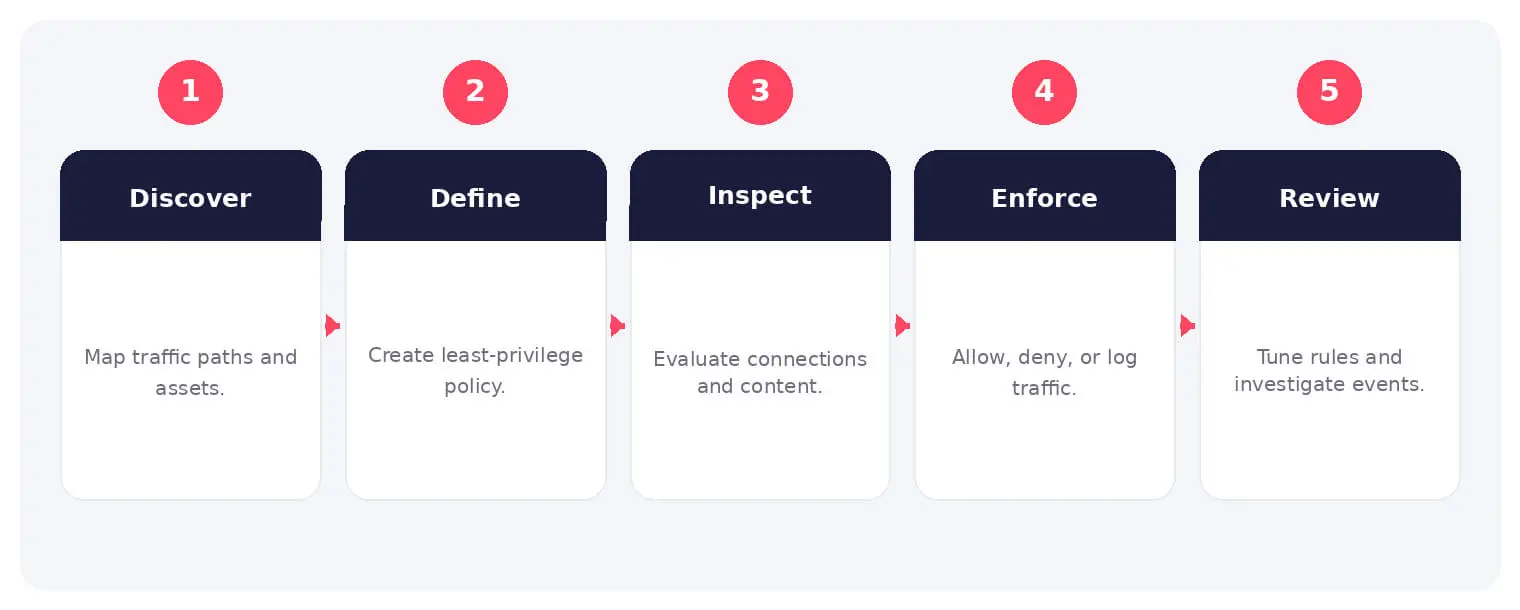
How a Cloud Network Firewall Works
The sequence above provides a practical operating model. Individual stages may overlap, repeat, or involve different people and services, so analysts should validate each step against the available evidence.
Implementations include provider-managed firewall services, virtual appliances, distributed controls, security groups, and web application firewalls. These tools operate at different layers and are not interchangeable.
Common Types and Techniques
- Provider-managed network firewalls
- Virtual firewall appliances
- Security groups and distributed controls
- Web application and DNS firewalls
Security and Business Risks
- Overly permissive ingress or egress
- Rule sprawl and shadowed policy
- Uninspected encrypted or east-west traffic
- Availability impact from incorrect changes
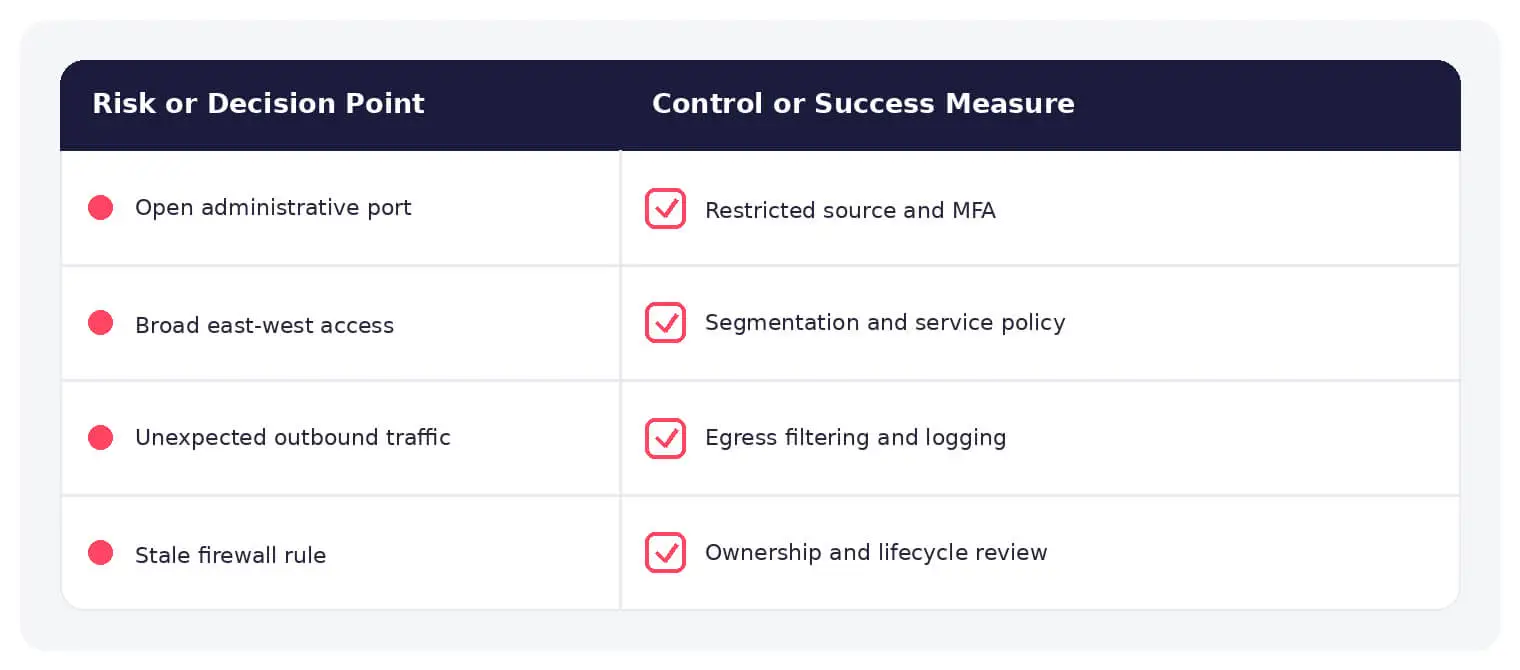
Warning Signs and Detection
Review public routes, broad source ranges, unused and duplicate rules, unexpected egress, denied traffic, policy changes, asymmetric paths, and assets outside inspection.
Prevention and Response
Use default-deny where practical, segment environments, restrict administration, manage policy as code, log decisions, inspect egress, test changes, and review rules and ownership regularly.
How SOCRadar Can Help
SOCRadar combines external visibility, threat intelligence, Dark Web monitoring, brand protection, vulnerability context, and indicator enrichment to help teams investigate exposure connected to cloud network firewall.
Explore SOCRadar Attack Surface Management or request a demo to strengthen threat-informed prevention and response.
Frequently Asked Questions
What Is a Cloud Network Firewall?
A cloud network firewall controls traffic between cloud resources, networks, users, and external destinations based on defined security policy. It can be delivered as a provider-managed service, a virtual appliance, or distributed controls such as security groups. These implementations operate at different layers and are not interchangeable.
How Is a Cloud Network Firewall Different From a Traditional Data Center Firewall?
Traditional firewalls typically inspect traffic at fixed physical choke points, while cloud firewalls are software-defined and applied closer to workloads or delivered as managed services. Cloud environments often lack a single perimeter, so policies are scoped per VPC, subnet, or instance. Rapid infrastructure change also makes automation and policy-as-code far more practical than manual appliance management.
How Does a Cloud Network Firewall Handle Encrypted and East-West Traffic?
Stateful rules can still filter encrypted traffic by source, destination, port, and direction, but they cannot inspect packet contents without decryption. East-west traffic between resources may not cross traditional perimeter inspection points unless distributed controls or internal inspection points are in place. Many teams combine flow logs, segmentation, and identity-based controls to cover these gaps.
Are Security Groups the Same as a Cloud Network Firewall?
Security groups are a distributed, instance-level form of filtering and count as one implementation of cloud firewall capability. Centralized provider-managed firewalls and virtual appliances instead inspect traffic at defined network points and can enforce broader policies. Because the layers differ, they usually complement each other rather than replace one another.
What Are the Biggest Risks of Misconfigured Cloud Firewall Rules?
Overly permissive ingress or egress rules, such as broad source ranges on sensitive ports, can expose services intended to stay private. Rule sprawl, duplicates, and shadowed entries make policies difficult to audit, so a restrictive rule may be silently overridden by a broader one. Uninspected encrypted and east-west traffic can also let attackers move laterally without generating alerts.
What Warning Signs Suggest a Cloud Firewall Problem?
Review public routes to sensitive subnets, broad source ranges, unused or duplicate rules, and unexpected egress flows. Repeated denied traffic, unexplained policy changes, asymmetric paths, and assets sitting outside inspection paths all indicate potential coverage gaps or active misuse.
How Should Teams Respond to a Suspicious Firewall Rule Change?
Preserve evidence first, including change logs, configuration history, and the identity and timing context of the change. Revert the rule through your normal change process rather than ad hoc edits, then review traffic during the exposure window for signs of abuse. If unauthorized access is suspected, remove every reusable access path, including open rules, keys, and active sessions.
What Best Practices Reduce Cloud Firewall Risk?
Apply default-deny where practical, segment environments, and restrict firewall administration to a small set of monitored identities. Manage policy as code so changes are reviewed, tested, and logged, and inspect egress traffic to detect unusual data movement. Schedule regular reviews of rules, ownership, and coverage so stale entries do not accumulate.
What Business Impact Can Cloud Firewall Misconfiguration Cause?
Misconfiguration can both expose sensitive resources and block legitimate traffic, turning a security control into an outage source. Compliance findings, emergency reviews, and investigation costs add to the operational burden. Testing changes before deployment and logging every decision helps limit both security and availability risk.
Can a Cloud Network Firewall Replace a Web Application Firewall?
No, because they operate at different layers and address different threats. A network firewall filters traffic by addresses, ports, protocols, and routing policy, while a web application firewall inspects HTTP requests for application-level attacks such as injection or malicious payloads. Mature cloud environments typically run both, since neither control covers the other’s blind spots.
Oct 27, 2026
Australia’s Annual Cyber Threat Report 2025-26 Shows Cyber Incidents Up 20%
Australia’s cyber security authority responded to 1,524 cyber security incidents in the 2025-26 financial year, a 20% increase from the previous year…

Oct 27, 2026
PHP2Shell Weaponized After Japanese Real Estate Extortion
An exposed server ties an extortion wave on about 20 Japanese property sites to an operator who later weaponized PHP2Shell (CVE-2026-109618, CVE-2026-109619)…
Oct 27, 2026
Wasmtime Sandbox Escape Flaws Patched in Cranelift
Two critical Wasmtime sandbox escape flaws, CVE-2026-115889 and CVE-2026-115893, let a crafted WebAssembly (Wasm) module push the Cranelift compiler into generating unsafe…
Intelligence in your inbox every Thursday.
Join 30,000+ security professionals reading SOCRadar research.
Subscribe